The Senior Developer’s Flawless Zero-Test Strategy
Why is this Testing meme funny?
Level 1: The Pencil Without an Eraser
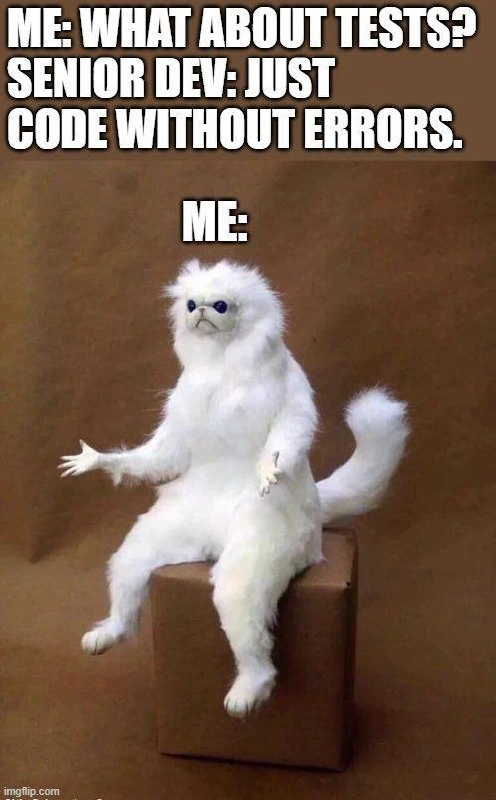
It is like asking, “Should we check our homework?” and being told, “Just write every answer correctly the first time.” That advice would be wonderful if people never misunderstood questions or made slips. The strange fluffy cat looks baffled because checking the work is exactly how ordinary people discover that “just be perfect” did not work.
Level 2: Tests Remember the Rules
A unit test is a small program that runs part of the application with a known input and checks the result. For example:
def test_free_shipping_starts_at_fifty():
assert shipping_cost(order_total=50) == 0
That test records a boundary rule. Months later, someone can reorganize the shipping code and run the test again. If the rule accidentally changes, the failure appears immediately instead of waiting for a customer complaint.
A regression is a feature that used to work but breaks after a change. This is why even careful developers need tests: software is edited repeatedly, often by people who did not write the original code. Memory and code review do not scale as reliably as an automated check that runs on every proposed change.
Tests still need judgment. Testing only the happy path misses empty inputs, failures, permissions, and boundary values. Mocking every dependency can produce a suite that passes while the real services disagree. The goal is not to prove the developer can write test files; it is to build useful confidence that important behavior survives change.
The fluffy figure's open-handed confusion captures the junior developer's impossible assignment. Asking for tests is asking, “How will we know this still works later?” The answer JUST CODE WITHOUT ERRORS means, “We will know because I have decided it is true.” Computers remain stubbornly outside that management structure.
Level 3: Correctness by Executive Order
The entire engineering strategy is visible in two lines:
ME: WHAT ABOUT TESTS?SENIOR DEV: JUST CODE WITHOUT ERRORS.
Below them, the second ME: points to a bewildered white cat-like creature sitting on a brown cube, tiny human arms spread as if asking which computer-science course covered “simply never be wrong.” The reaction works because the senior has not answered the question. They have replaced a risk-control mechanism with the outcome that mechanism is supposed to support.
Software is correct only relative to requirements, inputs, dependencies, timing, and environment. A function can contain no obvious typo and still implement the wrong business rule. It can work for today's data and overflow tomorrow, behave correctly alone and race under concurrency, or pass manual inspection before an upstream API changes. “Code without errors” assumes the developer knows every relevant condition in advance and will preserve all of them through every future edit. That is not seniority; it is an undocumented production dependency on clairvoyance.
Automated tests provide several things the implementation cannot provide by assertion:
- Executable specifications show expected behavior with concrete examples or properties.
- Regression protection reruns old expectations after code changes.
- Fast feedback catches mistakes before deployment or manual review.
- Design pressure exposes code that is too tightly coupled to exercise in isolation.
- Shared knowledge preserves assumptions after the original author leaves.
- Failure localization narrows which behavior changed and where to investigate.
Tests do not prove that software has no errors. A suite checks selected behaviors through selected oracles, and the tests can themselves be incomplete, flaky, or wrong. Passing means “no covered expectation failed under this run,” not “mathematics has certified the product.” But the alternative in the meme is worse: no repeatable evidence at all, followed by production serving as an extremely realistic test environment with unusually impatient test engineers.
A mature strategy layers different techniques rather than demanding a ceremonial number of unit tests. Fast unit tests exercise focused logic and edge cases. Integration tests verify boundaries such as databases, queues, files, and external services. Contract tests check that independently deployed components agree on message shapes and behavior. A small set of end-to-end tests protects critical user journeys. Static types, linters, code review, fuzzing, property-based tests, canary releases, and monitoring cover risks that example-based tests miss.
The right mix follows the failure model. A pure parser may benefit from property-based and fuzz testing. A payment workflow needs integration behavior, idempotency checks, and carefully isolated external-service tests. A bug that escaped should usually gain a regression test that fails for the old behavior. Writing hundreds of mock-heavy tests around getters merely gives the dashboard a comforting number; quality theater is still theater, even when CI performs it automatically.
The senior-versus-junior framing adds an organizational failure. The person asking WHAT ABOUT TESTS? is raising a reasonable maintainability concern. Dismissing it with authority teaches less-experienced developers that questioning the delivery plan is unwelcome. The team then loses both test coverage and psychological safety, a two-for-one discount rarely advertised in engineering handbooks. Good senior developers explain the trade-off: what risks are covered, what is intentionally deferred, and how the decision will be revisited.
There are narrow cases where extensive automated testing may not pay: a disposable experiment, a one-off migration guarded by reconciliation, or trivial generated glue already exercised elsewhere. Even then, “no test” is a scoped decision with compensating checks, not a universal philosophy. Formal verification can establish much stronger properties for suitable systems, but it requires explicit specifications and proofs—considerably more rigor than the senior's four-word spell.
The accompanying post message, Me: you're fired, supplies the missing performance review. It is hyperbolic, but it restores the accountability the dialogue lacks: if someone's quality plan is “never make mistakes,” eventually reality will submit a failing case.
Description
Large white Impact-style text on a brown background reads, "ME: WHAT ABOUT TESTS? SENIOR DEV: JUST CODE WITHOUT ERRORS." Farther down, another "ME:" label hangs over a bewildered white fluffy cat-like figure sitting upright on a brown cube with tiny human arms spread in disbelief; an "imgflip.com" watermark appears at bottom left. The absurd visual reaction captures the gap between a reasonable request for automated tests and the senior developer's impossible instruction to achieve correctness by fiat. Technically, the meme mocks overconfidence and the bad practice of treating defect-free implementation as a substitute for regression protection, executable specifications, and feedback from a test suite.
Comments
1Comment deleted
The code has no errors because production hasn’t finished running the test suite yet.