When Every Subagent Gets the Premium Model
Why is this AI ML meme funny?
Level 1: The Expensive Helpers
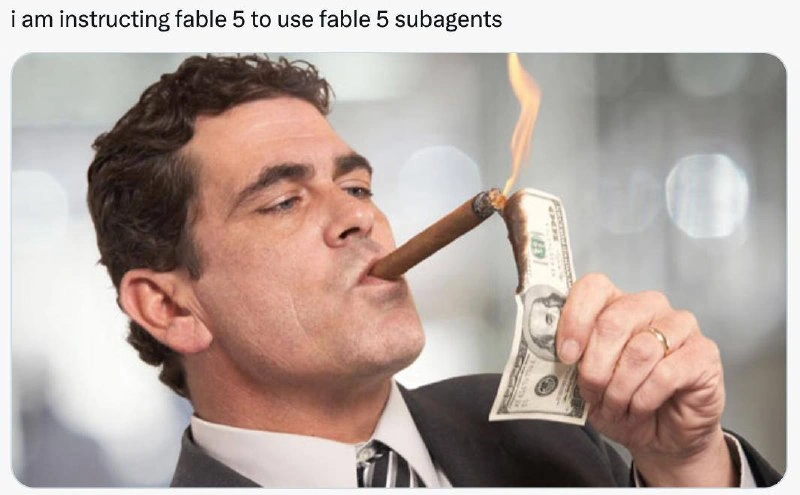
Imagine hiring the most expensive expert in town to plan a party, then telling that expert to hire several equally expensive experts to inflate balloons, count napkins, and check the guest list. Everything might get done quickly and beautifully, but the picture of a man setting money on fire shows how the bill feels. The joke is that having the fanciest helper recruit only fancy helpers is impressive, convenient, and spectacularly costly.
Level 2: Many Minds, Many Tokens
An LLM produces and reads chunks of text called tokens. Providers meter those tokens or count them against usage limits because every model call consumes computing resources. A subagent is a separate AI worker given a smaller assignment, such as searching a codebase, writing tests, or reviewing a patch. The main agent acts as the orchestrator: it divides the job, waits for results, and combines them.
Suppose one coding task becomes four assignments. Each worker may need the same project rules and problem description before doing its own work. Even when all four run at once, there are still four sets of inputs and outputs to process. The wall clock may show a speedup while the account shows increased consumption. That is the productivity trade-off satirized by the burning money.
The visual does not merely show someone spending cash; it shows cash used as a disposable ignition tool. Likewise, the caption does not merely use Fable 5 once; it insists that the premium lead delegate to more instances of itself. Cheaper workers could handle simpler jobs, while the strongest model reviews uncertain decisions. Choosing the premium option everywhere is the AI equivalent of sending a limousine to deliver each sticky note.
Level 3: Premium Fan-Out
i am instructing fable 5 to use fable 5 subagents
The caption describes agent orchestration with the economic restraint of the man below it: he is calmly lighting a cigar with a burning hundred-dollar bill. The parent Fable 5 session is already the premium decision-maker; explicitly assigning that same model to every delegated worker turns a hierarchy into a fleet of premium inference jobs. It may be excellent engineering for a genuinely difficult investigation. For routine searching, formatting, or boilerplate, it is also a magnificent way to make the billing dashboard develop a personality.
A subagent is not merely another paragraph inside the parent’s answer. It usually receives its own context, instructions, tools, and model invocation, performs a bounded task, then returns a result for synthesis. If the parent fans work out to several workers, the workflow pays repeatedly for some combination of task instructions, relevant repository context, generated reasoning, tool results, and the final summaries that flow back into the parent. Parallelism can reduce elapsed time, but it does not make those tokens disappear; duplicated context and coordination can increase total work.
The important nuance is that expensive orchestration is not automatically wasteful. Independent workers can explore unrelated areas concurrently, challenge one another’s findings, or keep bulky logs out of the lead agent’s context. The anti-pattern is uniform model allocation: treating every task as if it requires the strongest available reasoning. A cost-aware design routes difficult planning and ambiguous judgment to the frontier model while using a faster, cheaper model for mechanical searches or well-specified edits. Model choice is part of resource management, just like choosing a large cloud instance only when the workload needs it.
The meme was posted on July 7, 2026, alongside the message “It was great while it lasted.” That date directly completes the gag: July 7 was the announced final day when Fable 5 usage was temporarily included within portions of eligible subscription limits before access shifted to usage credits. Burning the banknote therefore depicts both high per-worker consumption and one last flamboyant use of an expiring allowance. The instruction is less “optimize my workflow” and more make quota vanish --parallel.
The human incentive is familiar. A visible swarm feels productive, premium models feel safer, and a fast result is easier to celebrate than avoided spend. Yet orchestration adds failure modes: agents can duplicate research, return incompatible assumptions, edit overlapping areas, or produce summaries whose verification costs another round of premium calls. The mature question is not “How many agents can we spawn?” but “Which independent tasks justify a fresh context and which model is sufficient for each?”
Description
A white caption above a rounded-corner reaction image reads, in lowercase, "i am instructing fable 5 to use fable 5 subagents." Below it, a smug businessman in a dark suit lights a large cigar with a burning U.S. hundred-dollar bill, visually equating the workflow with conspicuous destruction of money. Fable 5 is framed as both the lead agent and the model behind its delegated workers, so parallel or nested subagents multiply frontier-model token consumption instead of reserving the expensive model for orchestration. The meme satirizes agentic overkill: the task may finish faster, but quota depletion and the API bill scale with every spawned worker.
Comments
1Comment deleted
Congratulations, you reinvented the fork bomb with a per-token billing model.