Skip to content
DevMeme
2146 of 7435
Debugging Progress: A New Error Is an Absolute Win
Debugging Troubleshooting Post #2395, on Nov 30, 2020 in TG

Debugging Progress: A New Error Is an Absolute Win

Why is this Debugging Troubleshooting meme funny?

Level 1: Small Victories

Imagine you’re on a treasure hunt where solving one clue leads you to the next clue. You crack the first riddle after a lot of effort – yay! 🏆 Instead of finding the treasure immediately, you find another clue. Do you get upset? Not really, because a new clue means you’re closer to the treasure than you were before. In fact, you’re happy to see a different clue, since it proves you solved the last one correctly.

That’s exactly what’s going on in this meme. The programmer’s “treasure” is a fully working program. Each error message is like a riddle or obstacle on the way. When they see a brand-new error message pop up after fixing the previous one, they’re excited – it means they’ve moved forward. It might sound funny to cheer for a problem, but to a coder it feels like finding that next clue. It’s a small victory on the path to the big prize, and every little win counts!

Level 2: Fix One, Find One

Let’s break down what’s happening in this meme from a practical coding perspective. When you compile code, you’re running it through a compiler – a special program that checks your program and translates it into something the computer can run. If the compiler finds a mistake (like a missing symbol, wrong syntax, or type mismatch), it throws a compiler error. This error message is the compiler’s way of saying “I don’t know how to translate this part of your code.” Importantly, many compilers stop at the first serious error they encounter, because after something goes fundamentally wrong, the rest of the code might not make sense to analyze. This means you often have to debug errors one by one: fix the first error, compile again, then see the next error (if there is one). The meme’s joke hinges on that exact process – the second compile produced a different error, implying the first error was fixed. A new error is actually good news: it’s evidence you solved the previous issue and moved forward in the build process.

For a junior developer, the normal reaction to any error is frustration. You might think, “Ugh, an error – I failed.” But experienced devs learn to view the debugging process more optimistically as a step-by-step challenge. Each error message is like the compiler giving you a to-do item. You tackle them one at a time. In fact, a common troubleshooting workflow goes something like this:

  1. Write or change code. (For example, you might accidentally forget a semicolon or mis-name a variable.)
  2. Compile the code. The compiler runs and hits a problem in your code.
  3. Receive an error message. This message pinpoints a mistake (e.g., “syntax error: expected ;”).
  4. Fix the reported issue. You edit the code to correct that specific mistake (add the missing semicolon).
  5. Compile again. The compiler continues from where it left off. If the first error is gone, it might find another error later in the code.
  6. Get a new error message. Now it flags the next problem (say, an undefined variable). Back to step 4 – fix that too.
  7. Repeat until no errors remain. Eventually, the code compiles successfully with zero errors, and you can run your program. 🎉

Each cycle of this compile–debug loop brings you a little closer to a working program. The meme highlights step 6 in this loop: that moment when you do get a new error message. It means you’ve cleared the previous hurdle. It’s the programmer’s equivalent of seeing a checkpoint in a video game after defeating a mini-boss.

To make this concrete, consider a small C program with two mistakes: a missing semicolon and an undefined variable. The first time you compile, the compiler will complain about the missing semicolon and stop there:

// buggy_code.c (before fixes)
#include <stdio.h>
int main() {
    int x = 10          // Oops, missing semicolon here
    return y;           // 'y' is used but not declared anywhere
}

If we try to compile this, we’ll see the first error message about the semicolon:

$ gcc buggy_code.c
buggy_code.c:5:17: error: expected ‘;’ before ‘return’

The compiler caught the missing ; at the end of the int x = 10 line. It didn’t even get to warn us about y yet, because the missing semicolon threw it off. Now we go and fix that first mistake:

// buggy_code.c (after fixing semicolon)
#include <stdio.h>
int main() {
    int x = 10;         // Fixed the missing semicolon
    return y;           // Still using 'y' which is not declared
}

Compile again, and voila – the original error is gone, but a new error appears:

$ gcc buggy_code.c
buggy_code.c:6:12: error: ‘y’ undeclared (first use in this function)

Now the compiler complains that y is undeclared. This is a different error message than before; it only showed up because we fixed the semicolon and the compiler was able to move on. Getting this new error is actually great news! It confirms we solved the first problem. If we now declare y (or change the code to use x instead), we can compile yet again, and if no other issues are lurking, the program will finally compile successfully. Each new error was a sign of progress in this incremental compilation process.

So why would a developer be happy about an error, anyway? It’s all about context. When you’re stuck seeing the same error for hours, you feel like you’re banging your head against a wall. But when that error disappears and a new one pops up, it’s like the wall cracked open slightly – a light of hope! 😅 You’re no longer stuck in the same spot. This is where the meme’s punchline comes in. The big guy in the image proudly saying “I see this as an absolute win” is exactly how a programmer feels on seeing a new error after endless tries. It’s a tongue-in-cheek way of saying, “It may just be another problem, but at least it’s a new problem!”

This attitude also ties into a bit of developer slang: Heisenbug. A Heisenbug is a bug that seems to change its behavior when you try to debug it. The term comes from the Heisenberg Uncertainty Principle in physics (observing something can change it). For example, you might have a program that crashes whenever you run it normally, but the moment you run it in debug mode or add a printf to see what’s going on, the bug disappears or changes. It’s spooky! In our compilation scenario, the error message “changed” after recompiling (because we fixed one issue). It’s not a true unpredictable Heisenbug – we know why the error changed – but developers joke about it in a similar vein: the act of recompiling gave a new outcome. The meme plays on that feeling of chasing an almost elusive bug: it’s as if the bugs are playing hide-and-seek, and each fix “moves” the problem somewhere else until cornered. To a newcomer, it might seem crazy to high-five over an error, but to a programmer, it means you’re one step closer to victory. Debugging is often a slog of trial-and-error, and this meme nails the idea that even a small win (like clearing one error) is worth celebrating during that journey.

Level 3: Heisenbug Observed

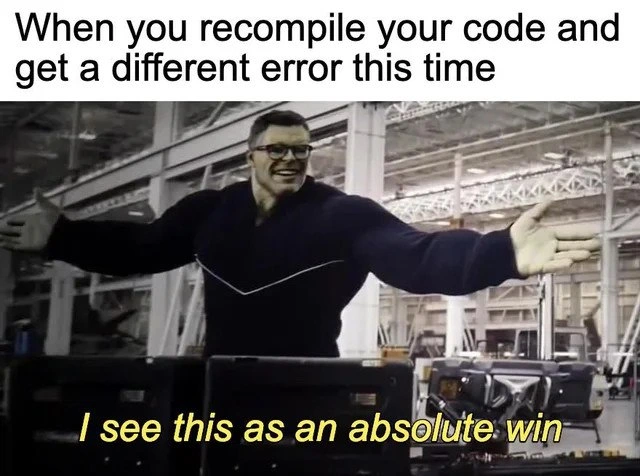
At first glance, celebrating a compiler error sounds completely backward. But seasoned developers know that this situation – recompiling code and getting a different error message – signals real progress. The meme’s top caption sets the scene: "When you recompile your code and get a different error this time." To an experienced engineer, this evokes the weary yet triumphant feeling of finally moving past a stubborn issue. The image of the muscle-bound hero with arms outstretched (a nod to a famous scene where the character proclaims "I see this as an absolute win") perfectly captures the absurd victory dance. Why is it so relatable? Because in real-world coding, fixing one error often unearths the next. It’s like peeling layers off an onion of bugs – your eyes might tear up, but each layer removed means you’re closer to the core.

This humor taps into a common debugging pattern in compiled languages (C, C++, Java, etc.): you compile your code, the compiler halts at the first error it encounters, you fix that error, compile again, and repeat. Each new compile is a spin of the compiler roulette wheel, and a new error means you actually got past the previous one. In a big legacy codebase or a gnarly merge, you might genuinely cheer, “Hooray, a different error!” because it confirms yesterday’s blocker is gone. It’s a shared industry anti-pattern turned coping mechanism: we’ve all wasted hours on an obstinate bug or a single missing semicolon. When finally that original error vanishes, the next error in line feels like a reward. As dark as it sounds, it beats being stuck on the same problem forever.

This meme also whispers about Heisenbugs – those ghostly bugs that seem to change or disappear when you try to debug them. Normally, compiler errors aren’t supposed to behave non-deterministically: if you haven’t changed the code, the error should remain the same every time. But anyone who’s dealt with race conditions in a build system or flaky includes knows the spooky reality: occasionally, an error does seem to morph or vanish on a re-run, as if observing it altered the outcome. (Cue the Heisenberg Uncertainty Principle reference – hence Heisenbug.) More often though, what’s happening is you did change something (or fixed one thing) and now the next failure surfaces. The meme exaggerates this feeling – it’s as if by simply recompiling, you got a brand-new outcome. Seasoned devs chuckle because it’s a wink at countless late-night debugging sessions where troubleshooting is a game of whack-a-mole. Each compile is an experiment: Did that change fix it? If the error message changes, that’s data – a new clue! Fixing nasty bugs is often an exercise in methodically clearing roadblocks, so a novel error is tangible evidence of movement. Better a mysterious new segfault than the same old crash you’ve been staring at; at least you’ve crossed one item off the list.

The humor works on another level of shared developer pain: it highlights how debugging frustration can warp your standards for success. In any other context, getting an error is bad news. But in programming, we learn to celebrate incremental victories. That bold yellow subtitle “I see this as an absolute win” is pure irony and optimism blended perfectly. It’s a quote lifted from pop culture (when a Marvel genius proclaims success after a half-successful experiment) – and in our world, it’s the rallying cry of the beleaguered programmer. The code still isn’t running, things are still broken, but hey, it’s broken in a new way today! High-five! 🥳 That mindset keeps us going at 3 AM when the build is still failing. We joke that each new error message is an achievement unlocked, a step closer to the final boss of “it compiles and runs.” In the casino of compilers, you keep pulling the lever (hitting make or gcc), and a new error feels like hitting a small jackpot – not the grand prize yet, but enough to keep hope alive. This inside joke resonates widely because it’s born from collective experience: the pain of debugging turned into a dark little victory. Every senior dev has learned that sometimes, to stay sane, you have to treat a minor improvement as “an absolute win.”

Description

This meme uses the 'I see this as an absolute win' format, featuring a smiling Professor Hulk from the movie Avengers: Endgame, with his arms outstretched in a welcoming gesture. The top text reads, 'When you recompile your code and get a different error this time'. The bottom of the image has the yellow-text caption, 'I see this as an absolute win'. The meme perfectly captures the paradoxical sense of achievement developers feel during a difficult debugging session. Getting a new and different error, instead of the same recurring one, is a sign of progress. It indicates that the recent code changes have altered the program's execution path, bringing the developer one step closer to the root cause. For experienced engineers, this isn't just a joke; it's a genuine reflection of the incremental, often frustrating, nature of troubleshooting complex systems
Comments

7
Anonymous ★ Top Pick A new compiler error is just the program's way of saying, 'Congratulations, you've unlocked the next layer of the dependency hell onion.'
  1. Anonymous ★ Top Pick

    A new compiler error is just the program's way of saying, 'Congratulations, you've unlocked the next layer of the dependency hell onion.'

  2. Anonymous

    Watching the build evolve from a 200-line template instantiation backtrace to a single linker error is basically C++’s version of character development

  3. Anonymous

    After 20 years in this industry, I've learned that debugging is just binary search through an infinite space of possible failures, and a new error message means you've successfully eliminated at least one branch of the search tree

  4. Anonymous

    Ah yes, the classic 'error evolution' - when your compiler decides to keep you on your toes by serving up a fresh compilation failure. It's the software equivalent of playing whack-a-mole with undefined behavior, except each mole is a different template instantiation error. Senior devs know this feeling intimately: you've fixed the segfault, now enjoy your use-after-free. Resolved the race condition? Here's a deadlock. The real skill isn't avoiding errors - it's recognizing when your new error means you're actually making progress through the dependency hell, one linker complaint at a time. At least it's not the same error with a different line number

  5. Anonymous

    Incremental compilation: where Heisenbugs mutate at build time, turning 'undefined reference' into 'segfault' - pure progress

  6. Anonymous

    Different error after rebuild? Perfect - failure moved one node down the dependency DAG. Executives call that “velocity.”

  7. Anonymous

    Different error after rebuild is just gradient descent on the diagnostic loss function - converging toward the inevitable linker error

Use J and K for navigation