The Hero We Need to End Pedantic Arguments
Why is this Meetings meme funny?
Level 1: Playground Peacekeeper
Imagine a group of kids playing a game, and then two of them start arguing about a tiny rule. They argue so much that the game has to stop for everyone else. Then a teacher comes over and says, “You two can talk about this later. Let’s keep playing now.” Suddenly, the argument stops, and everyone can have fun again. In this story, the teacher’s quick words act like a magic shield that protects the playtime for all the kids. The other children feel happy and relieved, just like everyone else in the meeting cheers in the meme when the knight uses the special phrase “Let’s take this offline” to block the argument. One little phrase can save the day by stopping an unimportant fight so the group can focus on what really matters.
Level 2: Shielding the Meeting
Now let’s break down the joke in practical terms. “Let’s take this offline” is a piece of common meeting lingo in corporate culture. It doesn’t mean turning off your internet; it means “let’s discuss this later, outside of this meeting.” When a discussion in a meeting becomes too detailed, off-topic, or contentious, a project manager or tech lead might use this phrase to put the debate on pause. It’s a polite way to shield the meeting from a lengthy side conversation. Instead of everyone in the room getting dragged into a two-person debate, those two can resolve the issue afterward (in an offline discussion via email, Slack, or a smaller meeting). This keeps the main meeting on track so the team can cover all the important agenda items.
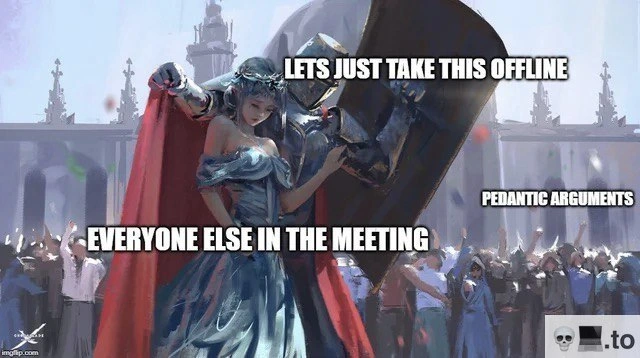
In the meme’s image, the knight with the huge shield is like that meeting facilitator. The text on the shield, “LETS JUST TAKE THIS OFFLINE,” shows the exact phrase being used as a literal shield. The incoming danger labeled “PEDANTIC ARGUMENTS” represents those nit-picky discussions that can derail a meeting. Pedantic arguments are when someone gets overly concerned with small details or insists on minor technicalities — for example, obsessively arguing about a minor syntax style in the code or a tiny design detail while everyone else wants to move on. These arguments are often not very productive, and they can cause a communication breakdown in the group because the conversation gets stuck on one narrow point. That’s why the rest of the people in the meeting — shown as “EVERYONE ELSE IN THE MEETING” in the meme — are depicted cheering in the background. They’re relieved and happy that the leader (the knight) has stepped in to block the distracting argument, allowing the meeting to proceed.
For a junior engineer or someone new to meeting culture, it might be the first time hearing this odd phrase “take it offline.” You quickly learn it’s basically code for “let’s stop talking about this now and circle back later.” It’s one of those workplace tricks to handle collaboration challenges. The phrase helps maintain good meeting etiquette: it respects everyone’s time by preventing a deep dive into details that only matter to a couple of people. By “parking” the issue for later, the speaker avoids embarrassing the person raising the point, while still preventing the whole group from going down a rabbit hole. In short, saying “Let’s take this offline” during a meeting is like saying, “This topic is important to you, but it’s sidetracking the team. We’ll address it afterwards, so we can keep the current discussion productive for everyone.” The meme humorously makes this concept clear by showing that phrase as a heroic shield protecting the rest of the team from the onslaught of endless arguments over trivial details.
Level 3: Paladin of Productivity
At the highest level of technical insight, we see this meme dramatizing a common meeting anti-pattern through an epic fantasy metaphor. The armored knight holding the shield labeled “LET’S JUST TAKE THIS OFFLINE” represents a battle-hardened meeting facilitator or team lead deploying a sacred corporate incantation to defend against pedantic arguments. In real engineering teams, pedantic arguments often arise when discussions spiral into overly detailed or trivial points — a phenomenon known colloquially as bike-shedding (after Parkinson’s Law of Triviality). For instance, in a system architecture review, two senior engineers might waste 15 minutes debating the intricacies of indentation style or naming conventions while the rest of the team silently groans. The phrase “Let’s take this offline” is the shield of focus that slams down to cut off the endless debate. It’s a polite corporate shorthand for “this tangent is derailing our agenda, so we’ll discuss it later (probably never)” – essentially a form of meeting thread isolation.
This meme resonates strongly in corporate meeting culture (think sprint reviews or architecture syncs) where time is precious. The knight is portrayed protecting an elegantly dressed figure (perhaps symbolizing the project’s dignity or the meeting’s agenda) and everyone else in the meeting stands behind, cheering. In reality, everyone else in the meeting feels relief akin to that cheering crowd when someone finally intervenes to steer the conversation back on track. The humor here leverages exaggeration: a mundane project-manager phrase is elevated to legendary status, as if it’s a holy artifact shielding the kingdom of Productivityland from the dragon of communication breakdown. Seasoned engineers chuckle because they’ve seen how a simple phrase can miraculously slay monstrous collaboration challenges that threaten to consume meeting time.
From an organizational perspective, the use of “take it offline” highlights an important practice: timeboxing discussions. Effective teams often set strict time limits for topics. When a discussion exceeds its scope or dives too deep into implementation minutiae, the facilitator wields this phrase to enforce the boundary. It’s both a communication gap remedy and a political tool – it avoids directly calling someone out as being pedantic in front of peers, yet halts the unproductive back-and-forth. The meme’s knight imagery perfectly captures how heroic this feels to the rest of the participants. After all, in the battlefield of cross-functional meetings, being able to block tangential debates is as valuable as a shield in actual combat.
In more technical terms, one can think of “Let’s take this offline” as an interrupt handler in the operating system of corporate dialogue. When triggered, it preempts the current process (argument) and schedules it for later, allowing the main thread of the meeting to continue running smoothly. It’s akin to handling an exception: the facilitator catches the PedanticArgumentException and defers it to a separate log or “parking lot.” Many of us have even developed a reflex for this. Pseudocode for a meeting might look like:
if discussion.topic.is_trivial() and meeting.time_overrun():
facilitator.say("Let's take this offline") # Deploy shield to deflect the tangent
meeting.continue_topic("Main Agenda")
Veteran developers have sat through countless hours of workplace chaos and know that without such interventions, a one-hour meeting can easily turn into a two-hour saga of nitpicking. This shared pain is exactly why the meme’s punchline hits home. It satirizes the communication gaps we all endure in meetings and the subtle art of facilitation required to survive it. The phrase may be a corporate cliché, but as every battle-weary tech lead knows, “Let’s take this offline” can be the last line of defense between a productive discussion and a meeting completely lost to the forces of pedantry.
Description
The image is a meme based on a piece of fantasy artwork. The artwork depicts a knight in full, shining armor, holding a large shield to protect a gentle-looking princess in a blue dress. In the background, a large crowd of people is gathered. Text has been overlaid on the image to create a workplace scenario. The knight and the princess together are labeled 'EVERYONE ELSE IN THE MEETING'. The large shield the knight is holding is labeled 'LETS JUST TAKE THIS OFFLINE'. The crowd in the background, from which the knight is shielding the princess, is labeled 'PEDANTIC ARGUMENTS'. The meme humorously illustrates a common and frustrating experience in technical or corporate meetings. It's about when a discussion gets derailed by two or more participants engaging in a niche, overly detailed, or trivial argument, while everyone else is forced to listen. The hero of the meeting is the person who steps in with the classic phrase 'Let's just take this offline,' effectively saving the team's collective time and sanity, much like the knight saving the princess
Comments
9Comment deleted
That shield is the enterprise equivalent of '/dev/null'. It's where pointless arguments are piped to so the main thread can continue execution
“Let’s take this offline” - the meeting’s circuit-breaker pattern: trip after three consecutive “well, technically…” 500s, route the traffic to /dev/null, and save the rest of the cluster from cascading failure
"Let's take this offline" - the corporate equivalent of git stash for a 45-minute argument about whether the API should return null or undefined, while the rest of the team's mental health degrades faster than a JavaScript framework's backwards compatibility
The classic 'let's take this offline' moment - when two engineers discover they have fundamentally different opinions about microservices architecture 15 minutes into a standup, and the rest of the team realizes they're about to witness a 45-minute debate about eventual consistency while their coffee gets cold. Meanwhile, the PM is frantically calculating how much this meeting costs per minute in engineering salaries
“Let’s take this offline” is the circuit breaker for meetings - trips on bikeshedding, averts a cascading failure, and shunts the pedantry into a dead-letter Slack channel
'Let’s take this offline': the dev's escape from pedantic recursion, stashing debates to avoid meeting stack overflow
“Let’s take this offline” is the human circuit breaker that reroutes O(n^2) bikeshedding to /dev/null without touching the roadmap
what is 💀💻.to Comment deleted
just a watermark Comment deleted