Skip to content
DevMeme
3238 of 7435
When a Programmer Baby Needs Motivation
Juniors Post #3560, on Aug 19, 2021 in TG

When a Programmer Baby Needs Motivation

Why is this Juniors meme funny?

Level 1: When Grown-ups Act Like Robots

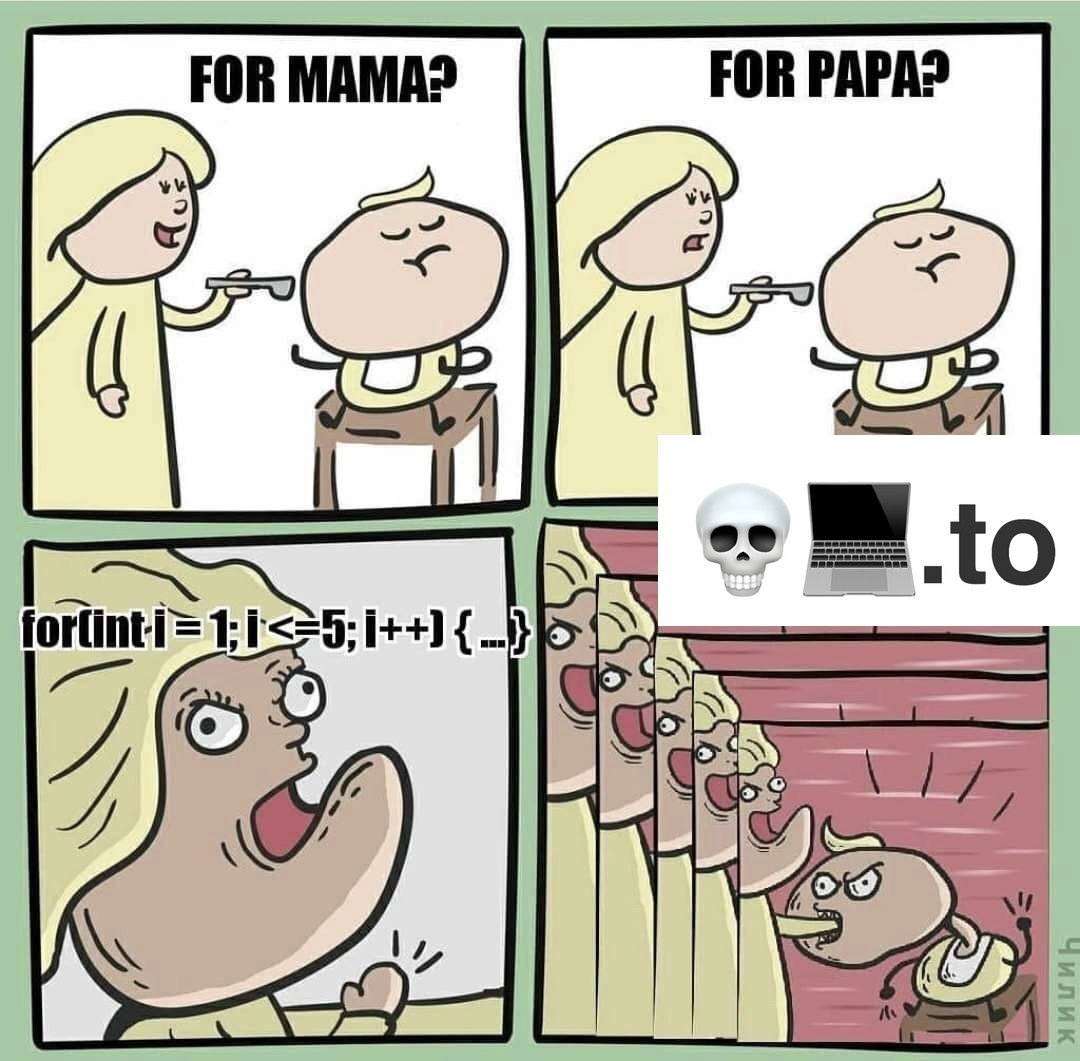
At its heart, this meme is funny because it shows a parent doing something silly and exaggerated to feed a baby. Imagine your mom or dad trying to get you to eat some yucky food. First they say, “Come on, do it for Mama?” and you refuse. Then, “Please, for Papa?” – you still won’t eat. Now the parent gets a crazy look and suddenly starts repeating the same spoon trick five times in a row, really fast! It’s like your parent turned into a wind-up toy or a robot, moving mechanically: spoon forward, baby turns away, spoon forward again, baby turns away... over and over. The final scene shows the parent lunging with the spoon again and again, which looks absurd, almost like a cartoon in fast-motion.

We laugh because seeing a grown-up act in such a ridiculous, robotic way is unexpected. The mom (or dad) is so desperate to feed the baby that she behaves like a looping machine: doing the exact same goofy motion repeatedly. To a child, it’s like when a short animation keeps playing the same clip again and again – it becomes goofy and funny. The baby in the meme is making an angry face, which adds to the humor: the more the parent repeats the spoon game, the more the baby is like “No! Stop!” (imagine a baby thinking “Mom has gone crazy!”). It’s a playful take on a real situation – sometimes parents will try anything, even very silly routines, to get a child to eat. Here it’s turned up to eleven, showing the parent’s super-speed feeding attempt five times. It’s basically saying: if being nice didn’t work, maybe try, try, try, try, try again! The over-the-top repetition makes it clear it’s a joke. It’s funny in a simple way because everyone understands that doing the same silly thing again and again, especially with a frantic look on your face, just looks comically ridiculous – even a baby would think so!

Level 2: Spoon-Fed Loops

Let’s break down the geeky joke here. In programming, a for loop is a basic control flow statement that tells the computer to repeat a block of code a certain number of times or while a condition is true. The syntax shown in the comic, for(int i = 1; i <= 5; i++) { ... }, is typical of languages like C, C++, and Java. It has three parts inside the parentheses, separated by semicolons:

  • Initialization: int i = 1 sets up a counter variable i starting at 1. This represents the first attempt (the first spoonful offer).
  • Condition: i <= 5 is a check that must be true for the loop to continue running. This means “keep looping as long as i is less than or equal to 5.” So when i becomes 6, the loop will stop. In plain terms, it limits the parent to 5 tries.
  • Increment: i++ means “add 1 to i each time the loop has run one iteration.” After each feeding attempt, i goes up by one (1, then 2, 3, 4, 5...). This ensures the loop progresses and will eventually end when i exceeds 5. i++ is a language quirk (the increment operator) that is very common in C/C++ dialects – it’s a compact way to say i = i + 1.

The { ... } braces would contain the code to execute each time. In our parenting scenario, the loop’s body is essentially “offer a spoonful to the baby.” If we wrote it in pseudocode, it might look like:

for(int i = 1; i <= 5; i++) {
    attemptToFeedBaby();  // try feeding the baby this iteration
}

This loop will execute attemptToFeedBaby() five times in a row. In the comic, panel 4 visualizes that by showing the parent lunging forward with the spoon five successive times (you can see the ghosted images of the parent – one for each loop iteration). It’s as if the parent became a loop-driven robot, performing the same action repeatedly in quick succession.

Now, why is this funny? The humor relies on knowing what a for loop is and noticing the pun. In everyday parenting, saying “One bite for Mama? One for Papa?” is a common tactic to get a baby to eat – you’re basically persuading the baby by making it a game (“this bite is for mommy, this one for daddy”). But here those words “for Mama” and “for Papa” secretly hint at the programming keyword for. A developer immediately sees “for” and thinks of code. By the third panel, the comic makes it explicit: the parent actually thinks in code and decides to use a loop to solve the problem. The joke clicks for anyone who has written code, especially in C/C++, because they recognize that loop syntax instantly. It’s DeveloperHumor 101: treating a life situation as if it were a piece of software that we can debug or control with code. The parent couldn’t get the result they wanted with two polite attempts, so they wrote a quick “program” in their head to brute-force the baby into eating by repetition.

This also illustrates a basic CS fundamental concept in a silly way. Loops are taught early in programming because so many tasks involve repetition. For example, if you want to print a message 5 times or iterate over a list of 5 items, a for loop is your friend. Here the “list” is essentially five spoonful attempts. The parent chooses 5 as an upper limit – a reasonable guess that maybe by the 5th try the baby will give in (or at least that’s as many tries as the parent can tolerate!). In real coding, setting a fixed number of iterations might remind a junior developer of retry mechanisms or just a fixed repetition, but in plain terms it’s just “do this action 5 times.” The control flow aspect means the normal one-by-one flow of actions is altered: instead of moving on after one attempt, the program (parent) loops back and tries again, up to 5 times, before proceeding.

It’s also highlighting a language quirk in a fun way: In English, “for” is just part of a phrase (“for Mama” meaning “on behalf of Mama”), but in C++ for is a reserved word that initiates a loop. The meme combines these meanings. The child doesn’t respond to “for Mama?” or “for Papa?”, so the parent’s next “for” is not for a person at all but for a loop! This kind of pun – where a normal word overlaps with a programming term – is a staple of coding humor. And the comic makes it super visual, so even if you’re a newcomer who just learned about loops, you can connect the dots: The parent literally implemented a loop in real life. It’s a playful way to reinforce what a for loop does: repeat an action a set number of times. After all, if something fails once, a programmer might say “let’s try doing it in a loop and see if it eventually succeeds.” Just hopefully, in real life, we check if the baby opened their mouth instead of blindly doing it five times!

Level 3: Brute Force Feeding

In this meme, code logic invades the chaos of parenting. A frustrated parent tries the classic coaxing techniques – “for Mama?” and “for Papa?” – to convince a stubborn baby to eat. When those gentle attempts fail (the baby’s mouth stays firmly shut, like a program returning an error), the parent’s brain switches into developer mode. The third panel literally overlays a C-style for loop on the parent’s crazed face: for(int i = 1; i <= 5; i++) { ... }. This is a tongue-in-cheek reference to a brute-force algorithm – if one or two tries won’t work, systematically try five times in rapid succession! It's a play on the idea that when all else fails, you loop until something gives. The final panel shows the parent executing that loop: a blur of spoon-feeding attempts (i = 1 through 5) lunging at the baby.

For seasoned developers, the humor cuts deep into control-flow statements and our tendency to see code patterns in everyday life. The parent has effectively written a tiny feeding algorithm: an initialization (i = 1), a loop condition (i <= 5 to limit the insanity), and an increment (i++ after each attempt). By picturing the parent’s actions as a for loop, the comic highlights how programmers often think – encountering a stubborn problem (baby won’t eat) and responding with a structured solution (repeat attempts in a loop). It’s funny because it dramatizes that extreme logical approach in a silly, human scenario. The baby’s furious reaction in panel 4 is every system overloaded by too many requests, while the parent’s desperate persistence is every programmer saying, “Alright, let’s run it again… just one more time.”

There’s an extra wink here for C and C++ veterans: the loop syntax is classic C++ style, complete with a typed index and semicolons. This isn’t a Python for i in range(5) or a fancy functional map; it’s old-school, low-level looping – the kind we learned in CS101. The inclusion of i++ (the post-increment operator) is itself a little language quirk that screams “C-family language.” If you’ve spent years with C/C++ (or Java, C# etc.), seeing for(int i=1; i<=5; i++) instantly feels familiar – it’s the universal incantation for “do something five times.” The meme leverages that familiarity. It’s illuminating the absurdity of applying a strictly logical CS fundamental (the counted loop) to a messy real-world problem (a kid who won’t eat their peas). Seasoned devs chuckle because we often joke about “if only I could loop my way out of this” in real life. Here, that’s exactly what happens – parenthood turned into a program.

This mix of domains is what makes the meme pure CodingHumor: only in a developer’s world would the solution to a picky eater be to literally write a loop. It parodies how programmers sometimes (half-jokingly) approach human problems with code logic. The phrase “for Mama? for Papa?” was a setup, and the punchline is “for-loop.” It’s a wordplay that only works because “for” has double meaning here – in normal parenting it’s an entreaty (“this bite is for someone you love”), but in code, for is a looping construct. The parent exhausted the sentimental approach and fell back to a deterministic loop: feed the baby 5 times, no more, no less, no matter what. It’s humorously over-engineered and relatable to any dev who has ever joked about programming their way out of a non-technical problem. And just like a piece of code running wild, the result is chaotic: spoon flying, baby recoiling, and a comic exaggeration of an algorithmic parenting fail that leaves us laughing.

Description

A four-panel comic strip meme depicting a mother trying to feed her reluctant baby. In the first panel, she offers food 'FOR MAMA?', but the baby refuses. In the second, she tries 'FOR PAPA?', with the same result. In the third panel, the mother, with a crazed expression, says 'for(int i = 1; i <= 5; i++) { ... }', which is a C-style for loop. The final panel shows the baby eagerly eating while the mother is replicated five times, visually representing the loop's execution. A watermark with a skull emoji, a laptop emoji, and the text '.to' is visible in the fourth panel. The humor comes from personifying the baby as a developer who only responds to programming logic, making the abstract concept of a for-loop a literal and motivating force


Comments

13
Anonymous ★ Top Pick That baby will grow up to be a senior engineer who still gets excited about a simple, elegant loop, and still refuses to do anything unless the logic is explicitly spelled out in the requirements
  1. Anonymous ★ Top Pick

    That baby will grow up to be a senior engineer who still gets excited about a simple, elegant loop, and still refuses to do anything unless the logic is explicitly spelled out in the requirements

  2. Anonymous

    When the “FOR MAMA?” abstraction leaks, you drop to a C-style for(i=1;i<=5;i++) spoon++, praying the transaction is idempotent and the rollback isn’t projectile

  3. Anonymous

    After 15 years of debugging production issues, you realize the real infinite loop isn't in your code - it's explaining to stakeholders why fixing that 'simple' loop requires refactoring half the legacy codebase because someone in 2008 thought global state was a good idea

  4. Anonymous

    The real horror isn't the C-style for loop - it's realizing you've been writing `for(int i = 1; i <= 5; i++)` for 15 years when you could've just written `5.times`. It's like discovering your entire career has been manually managing memory in a garbage-collected language. Ruby developers look at traditional for loops the way architects look at goto statements: technically functional, but why would you inflict that on yourself when elegant abstractions exist? The skull emoji isn't for the code - it's for the thousands of hours spent typing semicolons and increment operators when `.each`, `.times`, and `.map` were waiting patiently in the wings

  5. Anonymous

    Parenting refactor: swapped 'for mama/papa' with for(i=1;i<=5;i++); the kid accepts the API because it has a deterministic termination condition - use while(true) and you're on call all night

  6. Anonymous

    Copy-paste mama and papa threats? Amateur hour. Seasoned architects loop it DRY - until prod scales to i<Infinity

  7. Anonymous

    Feeding is a side-effectful API; that for(i=1;i<=5;i++) retry without backoff or idempotency keys turned a 400 into a screaming 500

  8. @Josiyahse 4y

    Lol

  9. @pe_che 4y

    Looks better with python's "for i in range"

  10. @adhdnigga 4y

    Best way is to use fork(); for each bit

  11. @adhdnigga 4y

    int food = 0xf00d; puts("For mama? for papa?"); fork(); feed(&food); Now i am funny

  12. @kirich_yo 4y

    What is 💀💻.to

    1. @affirvega 4y

      Watermark ig

Use J and K for navigation