Skip to content
DevMeme
3237 of 7435
Agile Standup vs. Stand-up Comedy Misunderstanding
Agile Post #3559, on Aug 19, 2021 in TG

Agile Standup vs. Stand-up Comedy Misunderstanding

Why is this Agile meme funny?

Level 1: Funny Word Mix-up

Imagine you hear your friend say, “Every morning, my team does a stand-up.” You might picture them on a stage with a microphone, telling jokes like a comedian at a stand-up comedy show. That sounds pretty fun, right? 😀 But in reality, what your friend means is something quite different and not really funny at all. A “daily stand-up” is just a quick little meeting where each person says what they’re working on. The word “stand-up” here comes from the idea that everyone stands up for the meeting so it stays short. It has nothing to do with comedy.

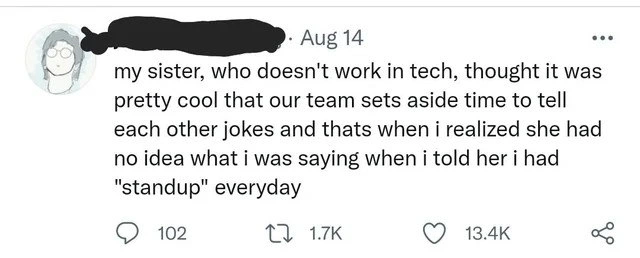
This mix-up is exactly what happened in the meme: the person’s sister misunderstood the word. She thought the team set aside time each day to tell jokes to each other. She was like, “Wow, your job is so cool and silly!” But actually, the friend had meant a normal, maybe even boring, team meeting. It’s funny because one simple word — “standup” — has two meanings depending on who hears it. In one world (everyday life) it means a comedy show, and in another world (tech workplaces) it means a daily meeting. The sister didn’t know the tech meaning, so she imagined the wrong thing. Oops!

Think of it like this: If your teacher said, “We’re going to have a little jam session in class tomorrow,” you might think you’ll be making music or spreading jelly on toast! But if the teacher actually meant “jam session” as in a brainstorming talk, you’d be confused. That’s a funny misunderstanding — just like thinking a stand-up meeting is a stand-up comedy time. The core of the joke is that words can be tricky when they have special meanings in certain groups. It made everyone laugh because the sister’s idea of a daily work routine with jokes was so far from reality. In the end, it’s a harmless, cute misunderstanding: the tech sibling realized, “Ohhh, she has no idea what I really meant!” and probably had a good chuckle explaining it.

So, why is it funny? Because the sister’s interpretation was both reasonable and totally wrong at the same time. It’s reasonable since “stand-up” usually means funny business, but it’s totally wrong in the tech context. This kind of mix-up can happen with lots of words, and it makes us smile. It reminds us that sometimes we need to explain our special work language to our families. And maybe it also makes us wish, just a tiny bit, that our daily team meetings were as fun as a comedy hour!

Level 2: Stand-up Meeting 101

So, what exactly is a daily stand-up in software teams, and why did this confusion happen? Let’s break it down in simple terms. In Agile software development (particularly using a framework called Scrum), a daily stand-up is a short team meeting held every workday, usually in the morning. The idea is literally that everyone stands up during the meeting – not because we’re about to do jumping jacks or tell jokes, but because standing helps keep the meeting quick and to-the-point. Typically, it lasts around 15 minutes. Each team member answers a few quick questions about the project: for example, “What did I work on yesterday? What am I working on today? Is anything blocking my progress?” This helps the whole team know what’s going on and if anyone needs help. It’s one of the key Agile ceremonies meant to improve team communication and coordination.

Now, why do we call it “stand-up”? The term comes from the practice of holding the meeting while standing. Imagine a small circle of developers and a Scrum Master (the person who leads the meeting) all literally on their feet, often huddled near their desks or on a video call. Because no one wants to be stuck standing forever, it encourages everyone to keep their update concise – usually under a minute per person. This way, the meeting doesn’t drag on. It’s not a time for long discussions or problem-solving (those happen separately if needed). It’s more like a quick round-robin check-in to make sure everyone is on the same page. If I’m a junior dev, on my first job, the first time I heard “we have stand-up at 10am” I might have been a bit confused – stand up for what? – until someone explained, “Oh, it’s just a quick meeting where we share what we’re working on.” Lightbulb moment! 💡

The funny mix-up in the meme happened because the word “standup” outside of tech usually refers to stand-up comedy – as in, a comedian standing on stage telling jokes. The developer’s sister isn’t in tech, so when she heard “our team has standup every day,” she understandably imagined something like a daily comedy session at the office. She even thought it was “pretty cool” – who wouldn’t, right? It sounds like the company values having a laugh together every day. This is a classic example of tech jargon misunderstanding. The term we techies use so casually has a totally different meaning in everyday language.

Let’s clarify some of these terms to see why someone outside tech might get confused:

  • Agile: This is a style of working in software development. Being Agile means the team works in small pieces, delivers software frequently, and can adjust plans quickly. (Everyday meaning of "agile" is just “quick and flexible,” so non-tech folks might just think you mean you’re working quickly.)
  • Scrum: A popular Agile framework (kind of like a recipe for how to do Agile). Scrum has specific roles (like Scrum Master and Product Owner) and meetings (called ceremonies). The name “Scrum” is borrowed from rugby, where a scrum is a tight huddle formation. (To someone not in tech, “scrum” might sound like gibberish or something sports-related.)
  • Daily Stand-up (Stand-up Meeting): A daily Scrum ceremony where the team quickly stands together to share updates. It’s also called a daily huddle or daily Scrum. Everyone typically shares: what they did yesterday, what they plan today, and any blockers (problems). It’s not about telling jokes or literally performing – it’s just called "stand-up" because of the standing part. (To an outsider, “stand-up” almost always means a stand-up comedy act. So you can see why the sister made that error!)
  • Sprint: In Scrum, a sprint is a short, fixed-length period (often 1 or 2 weeks) during which a team builds and delivers some piece of the project. It’s like a mini-project with a deadline. (In normal use, a “sprint” is running really fast – like a 100m sprint. So if you say “our sprint ends Friday,” a non-tech friend might jokingly ask if you’ve been training for a race! 🏃)
  • Scrum Master: This is a role on the team – kind of like a coach or facilitator who makes sure the Scrum process is followed and helps remove obstacles for the team. They’re not anyone’s “master” in a boss way; they serve the team. (To someone outside, “Scrum master” might sound like a strange title – maybe a kung-fu level or some mystical position.)
  • Tech Jargon: This just means specialized words or slang used in a certain field (technology in our case) that others might not know. Every field has jargon. In tech, we have loads of it (server, cloud, repo, sprint, bug, deploy, etc.). It helps us communicate quickly with each other, but can confuse people who aren’t familiar with it.

For a new developer or someone learning about Agile, it might be surprising how many everyday words have specific meanings in this context. When I first heard about all these Agile terms, I remember thinking some of them sounded oddly playful. Stand-up? Sprint? It’s almost as if the workplace was trying to be a gym 😅. Once you learn them, though, they become second nature. You start scheduling “standups” without batting an eye, and you’d never think of stand-up comedy.

The meme is poking fun at what happens when our meeting humor and jargon collide with people outside our tech bubble. If you’re new to this, don’t worry – even your family might give you funny looks at first. “Daily stand-up” is just one example. Imagine telling your non-tech friend, “I can’t hang out yet, our sprint hasn’t finished,” and they reply, “Wait, you started running?!” This kind of misunderstanding is common and honestly pretty amusing once you realize what’s happening.

The key takeaway for juniors (and all of us) is: be mindful of jargon when talking to others. If someone looks confused when you mention a deployment or a kernel panic, it might just be the first time they’ve heard those words. It helps to explain: “Oh, a stand-up is just a quick meeting my team does each morning.” In fact, many of us have developed a habit of simplifying our language when talking to family: instead of “stand-up,” we say “morning team check-in.” Instead of “Sprint review,” maybe “we’re showing our work to the client.” It bridges that communication gap.

So, in simple terms: This meme is funny because the author’s sister badly misunderstood a piece of tech lingo. The sister thought her brother/sister’s team literally sets aside time to entertain each other with jokes every day (which would be a rather unique office routine!). But really, “having stand-up” means having a daily team meeting. It’s an innocent mistake that highlights how Agile humor and jargon can confuse even the smartest non-tech folks. And hey, if you’re a new developer, now you know the difference too! No, we developers aren’t secretly comedians – we’re just doing our daily meetings, promise.

Level 3: Not That Kind of Stand-up

In the world of Agile development, a "daily stand-up" has nothing to do with comedy clubs or open mic nights – but to outsiders it sure sounds like it. This meme highlights a classic case of tech jargon vs. everyday language. The tweet describes a scenario where the author tells their non-tech sister, “I have standup every day,” and the sister, not knowing Agile terminology, assumes the team is sharing jokes every morning. Why wouldn’t she? In normal English, stand-up almost always means stand-up comedy. To seasoned developers, though, a daily stand-up meeting (sometimes just called “daily Scrum”) is a short team status meeting held each day, often with everyone literally standing up to keep it brief. The humor here comes from that miscommunication: a term that has a very specific meaning in an Agile software team sounds like something completely different (and more fun!) to the rest of the world.

This misunderstanding is painfully relatable for anyone in tech. We use an entire dictionary of specialized Agile jargon and assume it’s universally understood. It’s easy to forget how strange our conversations sound to family or friends outside the developer bubble. In Scrum (a popular Agile framework), teams have several ritualized meetings (politely called ceremonies). Along with daily stand-ups, we talk about sprints, backlog grooming, retrospectives, and Scrum masters. To us, these words have well-defined, work-related meanings. But to a non-tech sibling or friend, it can almost feel like we’re speaking in tongues or code words. Many experienced developers have amusing war stories of trying to explain to relatives what they do all day, only to be met with puzzled looks. This tweet’s popularity (over 13k likes!) shows that a lot of developers have been in that same boat, laughing at how our serious work lingo can sound like a running joke to outsiders.

Let’s unravel the layers of this joke from a senior developer’s perspective. First, Agile teams aim for strong communication and quick course-corrections. The daily stand-up meeting is one of the core Agile ceremonies designed to keep everyone in sync. It’s usually a 10-15 minute meetup each morning where each team member quickly answers three questions: What did I accomplish yesterday? What am I working on today? Am I blocked on anything? By standing up, the team stays physically uncomfortable enough to encourage brevity – nobody wants to launch into a long-winded monologue while everyone’s on their feet. So “stand-up” literally means everyone stands up in a circle to chat briefly. There’s no stage, no spotlight, and definitely no canned laughter (unless your team is really easily amused). If there’s any humor, it’s incidental – maybe a teammate slips in a light-hearted comment about the absurd bug they wrestled with, or the Scrum Master opens with a cheesy dad joke to liven the mood. But trust me, a daily stand-up is not intended as a comedy hour; it’s about as routine as a morning huddle in sports or a quick status check-in.

Now, the comedic gold of the meme is that the sister thought the tech team literally schedules daily joke-telling time. From her perspective, how cool (and odd) is that? It’s as if this company values humor so much that every day the team gathers around like, “Alright folks, time for our daily laughs, who’s got a joke today?” 😄 In reality, of course, the only thing being shared in stand-up are progress updates or blockers on tasks. The contrast between expectation and reality is what makes it funny. It’s a classic case of miscommunication where a familiar word has a totally different meaning in a specialized context. Everyone in tech can chuckle because we’ve experienced how our work language doesn’t always translate well at home. There’s also an ironic subtext: sometimes stand-ups do feel a bit performative, like when team members try to put a positive spin on things or use buzzwords to sound on top of it – a senior dev might jokingly say that occasionally stand-up is the only time some developers “perform on stage.” But generally, we wish our stand-ups were as entertaining as an actual stand-up comedy set (imagine if status reports came with punchlines).

The meme also hints at a broader communication gap. Tech folks often assume others understand terms that are second-nature to us. When we talk about scrums, sprints, or deploys, our families might be envisioning rugby scrimmages, running marathons, or military operations. It’s a reminder that context is everything. What’s obvious jargon to us is gibberish or something else entirely to others. In fact, Agile vocabulary is full of everyday words given new meaning:

Tech Term Meaning in Agile What Outsiders Think
Daily stand-up Morning team status meeting (stand & talk briefly) A stand-up comedy session (telling jokes)
Sprint 1-2 week development cycle for a chunk of work A short running race or exercise
Scrum An Agile framework with specific roles & ceremonies (from rugby metaphor) A rugby scrum (players huddled and pushing)
Scrum Master Team facilitator/coach in Scrum Some kind of martial arts master or game leader (it sounds like a title)
Backlog Grooming Organizing/prioritizing tasks (user stories) in the backlog Pet grooming? (The term grooming throws people off)
Retrospective Meeting to reflect on the last sprint (what went well, what to improve) An old-fashioned art exhibit or memory session (retro = old style)

For a senior developer, this table is both funny and a little cringey – we see how absurd our tech lingo can sound. Developer humor often comes from this exact realization: we live in a bubble where saying “I’ll finish the sprint after stand-up” makes perfect sense, but step outside that bubble and it’s almost comedic gibberish. The tweet’s author experienced that firsthand. It reminds veteran devs of the importance (and difficulty) of communicating with non-tech folks. We might chuckle, but it’s also a gentle nudge: next time you mention an Agile ceremony to your family, maybe clarify what kind of “standup” you really mean! After all, you don’t want your relatives thinking your Scrum team is performing improv comedy at work (even if some planning meetings do feel like a clown show 😜).

On a more serious note, the meme underscores why good communication matters. Agile practices like stand-ups are meant to increase transparency and team alignment. But when communicating outside the team, using the same jargon without explanation can have the opposite effect – creating confusion. Many senior folks have learned to translate tech-speak when talking to leadership or other departments: e.g., instead of "blocker" we might say "issue stopping progress," instead of "sprint" we say "two-week development phase." It’s almost like being bilingual – one language for fellow developers, another for everyone else. The sister’s innocent misunderstanding is a perfect illustration of how easily things get lost in translation. And it’s funny because in this case, the misunderstanding was harmless and silly. (It’s much better than a misunderstanding where, say, someone deletes the wrong database because they misheard instructions – now that’s an Agile horror story no one wants to relive!).

In summary, this meme resonates on multiple levels with experienced devs: Agile humor, the perennial “it’s not what it sounds like” problem with tech jargon, and the everyday comedy of trying to explain our weird work life to non-tech family. It’s a light-hearted reminder that what we consider a normal daily ritual can sound downright bizarre – or hilariously cool – to someone outside our industry. Communication is hard, folks, but at least we got a great laugh out of it this time. If only our daily stand-up meetings were actually as entertaining as what my sister imagined! 🤷‍♂️

Description

A screenshot of a tweet from a user with a cartoon avatar. The tweet text reads: 'my sister, who doesn't work in tech, thought it was pretty cool that our team sets aside time to tell each other jokes and thats when i realized she had no idea what i was saying when i told her i had "standup" everyday'. The tweet has 102 replies, 1.7K retweets, and 13.4K likes. This meme highlights the communication gap between tech professionals and those outside the industry. The humor stems from the double meaning of 'standup': in agile software development, it's a brief daily team meeting, but to the uninitiated, it sounds like a stand-up comedy routine. It's a relatable scenario for any developer who has tried to explain their job's specific jargon to family or friends
Comments

9
Anonymous ★ Top Pick Our daily standup is a lot like stand-up comedy: it's painfully early, the delivery is awkward, and the main goal is to finish as quickly as possible without anyone crying
  1. Anonymous ★ Top Pick

    Our daily standup is a lot like stand-up comedy: it's painfully early, the delivery is awkward, and the main goal is to finish as quickly as possible without anyone crying

  2. Anonymous

    Our “daily stand-up” is just corporate open-mic: 30-second sets on yesterday’s heroic refactor, today’s wildly optimistic roadmap, and the crowd-pleaser “no blockers,” all while the 2008 monolith heckles from prod

  3. Anonymous

    After 15 years of explaining to stakeholders why our 'standup' doesn't scale to 50 people and shouldn't last 45 minutes, I'm starting to think my sister's interpretation would actually be more productive - at least comedy has a clear definition of bombing

  4. Anonymous

    The real comedy is explaining to your family that 'standup' is where everyone stands around awkwardly for 15 minutes discussing blockers, not where you workshop your tight five about microservices. Though honestly, after hearing 'no blockers, just working on tickets' for the 847th consecutive day, maybe we should pivot to actual stand-up - at least then someone might laugh

  5. Anonymous

    If daily standup were actual stand‑up, the recurring bit would be “Any blockers?” and the heckler would be Jira asking for another status update

  6. Anonymous

    Agile standup isn’t comedy; it’s a 15-minute status improv where everyone says “blocked by upstream,” Jira provides the laugh track, and leadership calls it velocity

  7. Anonymous

    Standups: civilians imagine mic drops; we deliver blocker bingo - same awkward silence

  8. @ivan_kostrubin 4y

    )))

  9. @Bodziek 4y

    I once had to listen my coworker's stories about assembling ikea furniture with his wife during daily standups :(

Use J and K for navigation