Skip to content
DevMeme
4746 of 7435
Rust Will Replace C++? Doctor Diagnoses Programming Language Hype Disorder
Languages Post #5201, on May 15, 2023 in TG

Rust Will Replace C++? Doctor Diagnoses Programming Language Hype Disorder

Why is this Languages meme funny?

Level 1: New Toy vs Old Toys

Imagine you have a bunch of favorite toys that you’ve played with for a long time. Now suppose you get a brand new, super cool toy for your birthday. You’re really excited and you say, “This new toy is so awesome, I’m only going to play with it from now on. In fact, it’s so great it’s going to replace all my other toys – I might as well throw all the old ones out!” Hearing that, your parents or friends would probably chuckle and shake their heads, because they know you’re really excited, but they also know you’ll probably still play with your old toys sometimes. After all, you’ve had those old toys for years and they still do the job when you want to have fun, right?

This meme is just like that, but with computer languages. The “new toy” here is a programming language called Rust, and the “old toys” are languages called C and C++ that have been around forever and are used everywhere. The joke is saying someone believes Rust will be so amazing that nobody will use C or C++ anymore – which is a really wild, exaggerated claim. Other software developers hear that and find it silly, kind of how adults smile at the idea of one new toy making all other toys obsolete. It’s funny because it’s an over-the-top way to show how some people get overexcited about new things. In reality, just like we keep old toys we still like, the world will keep using those old programming languages for a long time, even if a cool new one comes along. The meme basically compares that overexcited person to someone saying something so goofy, you’d jokingly ask if there’s a “history of craziness” in their family. It’s a playful way to say, “Calm down, the new thing is cool, but let’s not go off the deep end!”

Level 2: Rust vs C++ 101

Let’s break down the joke in plain terms. Rust and C++ are two programming languages, and there’s been a lot of buzz about them. C++ is an older language (born in the 1980s, as an extension of the C language from the 70s) that has been hugely popular for building software where performance is key – think of video game engines, operating systems like Windows or parts of Linux, web browsers, even parts of your smartphone’s software. It’s powerful and fast, but it’s also kind of infamous for being tricky to get right. In C++, the programmer has to manage memory manually (like keeping track of when to allocate and free memory). If they mess up, the program can crash or have security bugs. You might have heard of things like segfaults (segmentation faults) or buffer overruns – those are the kind of nasty errors you get when C/C++ code mismanages memory. There’s a lot of code written in C and C++ over the past few decades; we call that legacy code when it’s old but still in use. Your operating system, databases, a ton of big established software – under the hood there’s a good chance it’s running on C/C++ code that’s been around for years.

Now, Rust is a newer language (first released around 2015 after some years in development at Mozilla). It was created specifically to address some of the pain points of C++. The big selling point of Rust is memory safety without giving up speed. Rust has this concept of an ownership system and the borrow checker (that’s the Rust compiler’s secret sauce) which makes sure you don’t make common mistakes like using memory after it’s freed, or messing up data when multiple parts of a program try to change it at once. Essentially, if your Rust program compiles successfully, it’s guaranteed to be free of many kinds of memory errors that would compile just fine in C++ but then blow up at runtime. For example, in C++ you can do something like:

int* p = nullptr;
std::cout << *p;  // This compiles, but dereferencing nullptr will crash the program (segfault)

In Rust, there isn’t even a concept of a plain “null” pointer you can dereference. You’d use an Option type to represent “maybe there’s a value, maybe not,” and the Rust compiler forces you to check that option before you use it. If you try to do something unsafe in Rust without marking it explicitly, the code just won’t compile. It’s like the language has guard rails: you have to really intend to go off-road (by using an unsafe block) to do the dangerous stuff, whereas C++ lets you roam free and you hope you don’t step on a landmine.

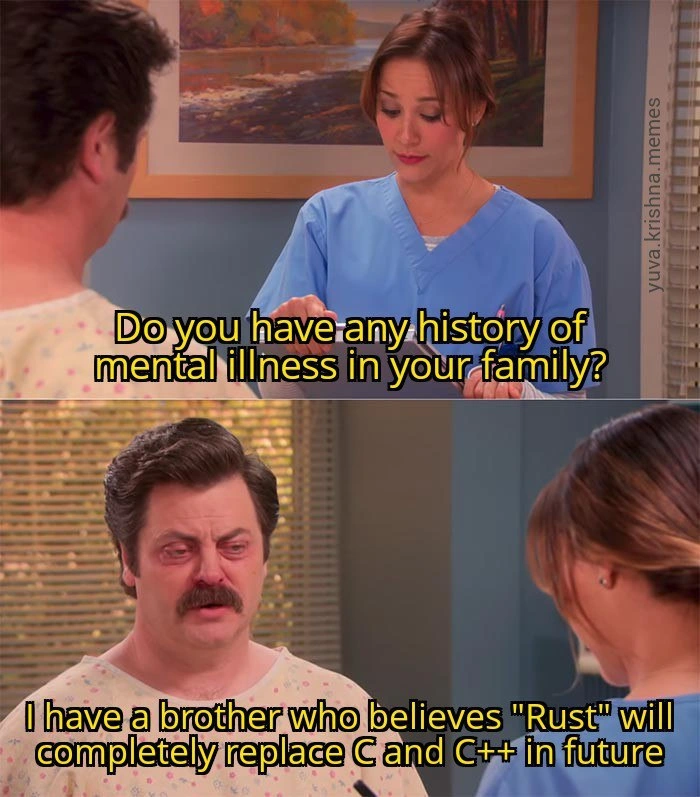
Because of these guarantees, a lot of developers are excited about Rust. It’s frequently discussed in blogs, on Reddit, at conferences – people say things like “Rust lets you have the performance of C++ with the safety of a higher-level language.” This excitement can turn into hype: that’s when people start thinking Rust is not just good, but almost magical – that it will solve all problems and therefore should replace older tools entirely. This meme is referencing that hype. The question posed in the meme is, “Do you have any history of mental illness in your family?” The answer given is, “I have a brother who believes Rust will completely replace C and C++ in the future.” It’s an absurd answer to a serious question, which is why it’s funny. It’s using exaggeration to make a point: believing that Rust will totally take over and old languages like C and C++ will just disappear is treated as a kind of crazy idea.

Why is it a crazy idea (in reality)? Because of language adoption and the nature of the software industry. New languages rarely fully replace older ones, especially not quickly. Language wars (people arguing over which language is better) are common, but the result is usually that each language finds its place rather than one language to rule them all. C++ and C have been around a long time; even though many people complain about their pitfalls, those languages are deeply entrenched. Tons of existing software and libraries are written in them – that’s the legacy_code_reality_check: you can’t just throw away decades of work and say “we’re all using Rust now.” For one thing, there aren’t enough developers or hours in the day to rewrite everything. For another, C and C++ still have their own advantages for certain use cases, and many experts who know them inside out.

So what tends to happen in reality is a more gradual language evolution. Rust might be adopted for new projects or to replace parts of systems where its safety guarantees are a big win. In fact, we see that happening: some projects that would have used C++ are starting to use Rust. But C++ (and C) aren’t going extinct; they’re still evolving too (the C++ standard is updated regularly, adding features to make life easier and safer for programmers). It’s more likely that in the future, Rust and C++ will coexist, each being used where they make sense, rather than Rust wholesale eliminating C++.

The humor here is classic DeveloperHumor: if you’re a programmer, you’ve probably seen online discussions or heard colleagues make bold claims like “X language will kill Y language!” It’s a running joke because it almost never pans out that way, at least not as completely as the most ardent fans predict. This meme uses a sitcom_two_panel_meme format (a scene from a TV show – in this case, Parks and Recreation – with captions). In the first panel, the nurse’s question is the setup, and in the second panel, the patient’s answer is the punchline. It’s formatted like a dialogue joke: setup, then zinger. The medical_question_setup_punchline makes it extra snarky by implying that believing the “Rust will replace C++ entirely” hype is akin to having a screw loose. Of course, it’s not actually insulting anyone’s mental health seriously – it’s hyperbole. The target is the language_replacement_myth itself and the over-the-top enthusiasm some people have. If you’re new to this joke, just know it’s poking fun at how developers sometimes treat their favorite programming language like a religion. Programming_language_evangelism is the term – when someone is so in love with a language that they preach it everywhere and think it’s the answer to everything. This meme says, “I have a family member who’s gone that far down the Rust hype train.” And that’s why other programmers find it funny – it’s a gentle roast of our tendency to get a little cultish about new tech.

Level 3: Delusions of Grandeur++

For the battle-hardened developer, this meme’s punchline triggers a knowing smirk (or an eye-roll). It nails a recurring industry comedy: the starry-eyed programming_language_evangelism that crops up whenever a shiny new language arrives. Here we have Rust, the young prodigy with a crusade to end undefined behavior, going up against the grizzled veterans C and C++ which have been running the world’s software for decades. The joke paints the Rust uber-fan as so far gone that a medical professional might consider their belief a symptom of insanity. Why? Because seasoned devs have seen this movie before.

Take a stroll down memory lane: In the 90s, Java was hyped to eliminate C++ (“no more pointers, write once run anywhere!”); in the 2000s, C# was the chosen one (at least in Redmond’s eyes) to dethrone C++ for application development; around the 2010s, Go was touted as the C replacement for the cloud era; heck, even JavaScript zealots at one point claimed everything would be written in JS. Each time, the new language found its niche, sure, but legacy code reality checks soon kicked in. Huge existing codebases didn’t magically evaporate, and C++ kept chugging along, evolving and absorbing ideas from its “killers” (lambdas, concurrency features, smart pointers – C++ grew new teeth). Language wars are never won overnight; they end in truces and long co-existence. Today’s Rust vs C++ hype is just the latest chapter. Rust aficionados (half-jokingly dubbed the “Rust Evangelism Strike Force” in online humor) proclaim that Rust’s fearless concurrency and memory safety will make C/C++ obsolete. To an experienced engineer who’s slogged through million-line C++ codebases, that claim sounds about as grounded as saying we’ll all be coding in Latin next year. They’ve lived through enough IndustryTrends_Hype cycles to know the difference between genuine long-term shifts and temporary fanfare.

Why is the idea of Rust completely replacing C/C++ so absurd? First, legacy code is king. There are literally billions of lines of C and C++ out there in production – operating systems, database engines, game engines, embedded device firmware, you name it. Companies aren’t going to bulldoze a working, tested codebase just because Rust came to town. Rewriting everything from scratch is risky and expensive; it’s the software equivalent of ripping out a city’s infrastructure just to lay a new kind of pipe. Sure, Rust promises fewer memory leaks and data races, but try telling your boss you need to freeze feature development for two years to port the entire codebase – it’s career suicide (and they might check your sanity!). This is the legacy_code_reality_check: even if a new language is objectively better in some ways, the world runs on existing systems that won’t disappear. We still have mission-critical COBOL running on mainframes precisely because “if it ain’t broke (enough), don’t fix it.” C and C++ may be broke in places (hello, segfaults and buffer overruns), but thousands of engineers have applied patches, workarounds, and expertise to keep that machinery largely functional.

Secondly, C++ isn’t standing still. The language has been updated with modern features (C++11/14/17/20 and beyond) to reduce its pain points – things like std::unique_ptr and std::shared_ptr to manage memory, or thread sanitizers to catch races. It’s not as if C++ devs are happily running around with wild pointers and memory corruption by design; they’ve built tons of tooling and best practices to mitigate those issues. Rust just bakes the solution into the language itself. That’s awesome, but it also means Rust can feel like a strict schoolmaster – you can’t even compile until you appease the borrow checker. A lot of veteran C++ programmers, while acknowledging Rust’s power, chuckle because they know adopting Rust at scale means retraining teams, retooling build systems, and rethinking decades of code architecture. It’s not a drop-in improvement; it’s a paradigm shift that not everyone is ready or willing to make for existing projects. LanguageAdoption in large organizations is slow and conservative, often for good reason.

The meme brilliantly exaggerates this gap between hype and reality using the format of a medical drama setup and punchline. The nurse asks a serious question about mental illness history – a setup straight from a hospital scene – and the patient responds completely straight-faced with what in our world is an outrageous tech claim. Visually, it’s a scene from a sitcom (recognizable as a Parks and Recreation bit by the looks of the actors), repurposed for developer humor. The patient (played by Nick Offerman, sporting a legendary mustache and a deadpan grimace) delivers the line as if it’s a grave concern. The medical_question_setup_punchline structure underscores how crazy that belief sounds: it’s portrayed as a diagnosis! We’re essentially laughing at the language_replacement_myth – the bogus idea that one language to rule them all is just around the corner. Developers share a collective smirk here because we’ve all encountered “that one guy” on Reddit or at the office who won’t shut up about Rust’s supremacy, predicting C++’s imminent death like an end-times preacher. This meme says, “Yeah, my poor brother caught the Rust evangelism bug so bad, we might need professional help for him.” It’s poking fun at programming_language_evangelism taken to zealot level.

On a deeper level, there’s also genuine camaraderie in the humor. DeveloperHumor often revolves around hyperbole that contains a grain of truth. Rust is a fantastic system language, and it very well might replace C/C++ in some new projects or critical components (even the Linux kernel is cautiously allowing Rust for new modules). But the key word is “some”, not “all”. Believing in total, inevitable replacement betrays a misunderstanding of how technology adoption works. It ignores the polyglot reality of software engineering – different tools for different jobs, old and new coexisting. The meme’s dark sarcasm (equating excessive tech optimism with insanity) resonates with senior devs who have been burned by chasing the Next Big Thing before. It’s a gentle form of gatekeeping humor: “Kid, we’ve all been hyped about a cool new language, but you’ll learn that claiming complete victory is a one-way ticket to Disillusionment Ville.” In other words, welcome to the club, but check your “Rust will conquer the world” flyers at the door. This mix of eye-rolling skepticism and shared experience is exactly why the meme lands so well among engineers. It’s a laugh not just at the brother’s expense, but at the part of us all that wants to believe in easy revolutions.

Level 4: Hype Cycle Hallucinations

At the theoretical scale of tech evolution, expecting Rust to completely supplant C and C++ is a textbook example of hype-driven delusion. The tech industry loves its Gartner Hype Cycle – every promising new language is heralded as the next global standard, soaring up a peak of inflated expectations. In theory, Rust’s strong guarantees around memory safety and concurrency give it a formal advantage over C++: its compiler’s borrow checker enforces an ownership model akin to an implicit proof that your code is free of data races and use-after-free bugs. This stems from deep computer science concepts – Rust’s type system incorporates ideas from affine types and linear logic, ensuring each value is owned in one place at a time. It’s essentially doing a form of static verification that many academic papers only dreamed of, catching whole classes of errors at compile time that in C/C++ only blow up at 3 AM in production. From a purely technical perspective, Rust represents a new programming language evolution that advances the state of the art in safety without a garbage collector, something even theorists find impressive.

However, these theoretical merits slam into the harsh reality of decades of legacy. Rewriting an entire universe of C/C++ code in Rust is not a solved algorithm – it’s more like an NP-hard problem made of budgets, politics, and human factors. In formal terms, the state space of existing C/C++ systems is immense, and translating them bug-for-bug into Rust would be as complex as re-proving every program correct from scratch. There’s no magical compiler pass that can ingest million-line C++ codebases and emit safe Rust – Turing completeness means both languages can compute the same things, but it says nothing about ease of translation or adoption. Moreover, even Rust acknowledges not everything can be absolutely safe: it has unsafe blocks for cases that escape the guarantees, effectively little wormholes back to C-like freedom (and risk). This is like a built-in reminder that some low-level tasks inherently can’t be fully proven safe by a compiler; you sometimes have to step outside the guarded sandbox. In short, fundamental constraints in computing (like undecidability in program analysis and the cost of large-scale refactoring) act like gravity, keeping those hype-fueled dreams from escaping orbit. Historically, language replacement myths have always hit these limits. Enthusiasts often hallucinate a future where the new hotness erases the old – yet here we are, with COBOL from the 1960s still handling bank transactions and FORTRAN simulating rocket physics. Rust is brilliant, but the idea it will totally replace C/C++ is more of a geek fever dream than an inevitable theorem. The meme winks at this truth: treating such absolute certainty as a comical psychosis born from indulging in too much conference Kool-Aid.

Description

Two - panel sitcom screenshot meme. Panel 1: a nurse in blue scrubs faces a patient off-screen and asks in yellow caption text, “Do you have any history of mental illness in your family?”. Panel 2: the camera shows the patient in a hospital gown replying with another yellow caption, “I have a brother who believes "Rust" will completely replace C and C++ in future.” Faces are blurred, room decor is neutral hospital colors, and the creator watermark “yuva.krishna.memes” appears on the right. The joke equates over-optimistic claims about the Rust programming language supplanting decades-entrenched C/C++ code to a medical concern, poking fun at language wars, adoption hype, and the reality of legacy ecosystems

Comments

28
Anonymous ★ Top Pick Rust will replace C++ the same quarter management signs off on rewriting the 3-million-line C++98 engine that settles a trillion dollars a day - right after “migrate the mainframe to Kubernetes” on the roadmap
  1. Anonymous ★ Top Pick

    Rust will replace C++ the same quarter management signs off on rewriting the 3-million-line C++98 engine that settles a trillion dollars a day - right after “migrate the mainframe to Kubernetes” on the roadmap

  2. Anonymous

    After 20 years of watching language evangelists promise to replace C, we've learned the only thing that truly replaces C is... more C, just with different undefined behavior and a new committee arguing about whether nullptr should have been null_ptr

  3. Anonymous

    The real family history here is decades of C programmers insisting 'if it ain't broke, don't rewrite it in a memory-safe language' while simultaneously debugging their 47th segfault this week. Meanwhile, the Rust evangelists are out there like missionaries, armed with borrow checker testimonials and zero-cost abstraction pamphlets, convinced they can save everyone from undefined behavior - one reluctant systems programmer at a time. The truth? Both languages will outlive us all, because legacy codebases are the true immortals of software engineering

  4. Anonymous

    Rust is fantastic, but replacing C/C++ means convincing every kernel ABI, vendor SDK, and real-time firmware to cross the FFI without a single unsafe block - great aspiration, terrible migration plan

  5. Anonymous

    Rust will replace C/C++ the day vendors stop shipping SDKs as a zip of .h files and a mystery .so; until then we’re just wrapping unsafe extern 'C'

  6. Anonymous

    Rust replacing C/C++? Adorable - until the pager wakes you at 3AM because unsafe escaped anyway

  7. @LonelyGayTiger 3y

    If it wasnt for personal preference I think it would.

    1. @ZgGPuo8dZef58K6hxxGVj3Z2 3y

      We still use old stuff. I believe before everything switches to rust there will be 2 more replacements that will try replacing rust.

    2. @viktorrozenko 3y

      Not quite. I met some guys doing really low level stuff and they explained to me why rust will never replace c++. At really low level, sometimes you need to break conventions and safety to get those additional 2ms out of it. He cited me an example where he had an arena allocation and he knew that the thing he needs is located 2 bytes to the left of this other pointer. So he just *(ptr-2) which is unsafe but faster than saving that pointer somewhere. On that same note, Rust performs a boundary check when you acces a vec item by index - that's additional clock cycles and they add up at his level. So he uses C++ because it lets him to whatever he has to do, pretty much.

      1. @LonelyGayTiger 3y

        You can have unsafe Rust code, additionally, as is the case with security features in C++, I'm sure you can disable the boundary check on a vec, or just write a vec implementation yourself.

        1. @viktorrozenko 3y

          Sure, but at that point 90% of your code is going to have to be marked as unsafe. In which case, why did you even use Rust in the first place?

          1. @LonelyGayTiger 3y

            You wouldn't mark all of your code as unsafe. Only the specific sections where you use unsafe operations. I do occasionally write C++ code for embedded hardware where performance and memory usage is critical, and while yes, there is a fair amount of unsafe code, the vast majority of it isnt. I dont think that rust is going to replace C++, but for the most part I think in many cases it could, or should.

            1. @viktorrozenko 3y

              I'm a backend guy myself and in most cases Go or Rust do the job for me. I don't remember ever having to go down to C level. Just passing on the things they told me. Maybe he's wrong, maybe he's right - a second perspective doesn't hurt :)

              1. @LonelyGayTiger 3y

                I'm not saying that he's wrong, I just think he's missing the bigger picture. The nice thing about rust, is that if you need part of the code to be written and compiled as ANSI C, you can have that. And have it operate seamlessly with the rest of your program. Safe or not.

              2. @Araalith 3y

                Backend tasks are usually associated with languages like PHP, Python, and JS. Enterprises tend to prefer C# and Java. For heavy calculations, F77, Java, and Python are often used, largely due to their extensive set of libraries. Rust is an extremely niche language, similar to Scala, Ruby, and Go. In my humble opinion, the only reason to use Rust is to delve into C-level programming, in order to achieve the speed of C while maintaining the safety that is typically provided only by high-level languages. But you don't "go down to C level". So, why do you use Rust?

                1. @RiedleroD 3y

                  because it's a modern language with modern features, a really nice LSP and a REALLY nice dependency manager

                  1. @Araalith 3y

                    So, is it just enthusiasm about a new language, not related to any real tasks?

                    1. @RiedleroD 3y

                      modern language → more good features, less legacy not hype-related

                      1. @Araalith 3y

                        Also, there are more bugs, a lack of libraries, poor documentation, and changes without backward compatibility. In most cases, it's potentially a dead language with nearly zero chances of finding a job in it in 5 years. I don't mind. Just curious.

                        1. @RiedleroD 3y

                          poor documentation? lmao you never used rust, did you?

                          1. @Araalith 3y

                            I checked the documentation. It's just a mix of code with occasional comments without common style. To be honest, it's worse than CPAN, which I usually refer to as a dump of garbage.

                2. @kandiesky 3y

                  Choosing a programming language is always a game of pros and cons. And Rust has some pros over the more established frameworks. For example, it's fast, reliable and well documented. It's hard to make bad code in Rust, and you get full support from the LSP and the compiler, while not having the same complexity as C or C++, for about the same speed. Also, you can work with async code without giving yourself headaches most of the time, and that's a big plus Besides that, you can see a lot of articles both praising and criticizing Rust, it's not hard to find them. So you can have a better opnion about how it works and why it's so well loved.

                  1. @Araalith 3y

                    In many backend scenarios, the performance bottlenecks are often I/O-bound, such as database access or external API calls, rather than CPU-bound. That's why Python, PHP, and JS/TS are so popular, despite their poor performance and resource usage from certain perspectives. I'd prefer mainstream languages over niche ones, but that's because I like to see tangible results and financial gain. Pioneering hasn't been my kind of fun for at least the last 25 years of my work experience. Nonetheless, I appreciate enthusiasm because occasionally it yields good tools for everyone.

                    1. @kandiesky 3y

                      I agree these are the commom bottlenecks. Yet, many have migrated entire backends to Rust or Go, not because of niche or hype, but because they're more efficient at that. Go has a bit of a problem with GC, yet it's more reliable than Javascript for a server, for example. And by the way, Rust isn't niche anymore, not even close to that. It's used by big and small techs. You can see that by going to crates.io; there's a big ecosystem with lots and lots of packages and weekly downloads. Even some Javascript CLI tools are being re/written in Rust Also, it's not new. Rust is more than 10 years old, with it's 1.0 released back in 2015.

                3. @viktorrozenko 3y

                  So at the last company I worked for, our codebase was mainly Go microservices running on k8s. And they did their job just fine. There were a couple of microservices tho, where we either wanted to be 100% sure that it stays online no matter what and does things fast(er). Another time we used Rust was for its type system. We had to parse something and Enums were very helpful. Generally the decision to use Rust was due to the fact that we were familiar with it and knew its pros and cons. Also, as a sidenote, Go isn't that "niche" anymore. It's grown A LOT.

  8. @viktorrozenko 3y

    They do write some components that are mission critical in Rust to ensure memory safety and all that. But they can't afford the cost everywhere

  9. @spiritualattunement 3y

    Rust is not a suitable replacement for C, as the two languages have different goals and trade-offs. While C prioritizes performance and control over the hardware, Rust prioritizes safety and memory management. Therefore, Rust should not be seen as a C replacement, but rather as a complementary language that can enhance C code with additional safety measures.

    1. @RiedleroD 3y

      exactly. Rust isn't replacing C for the same reason C++ isn't replacing C

Use J and K for navigation