npm Login Returns Raw Sadness
Why is this PackageManagement meme funny?
Level 1: The Locked Tool Shed
It is like needing one screwdriver from a shared tool shed, but when you go to unlock the door, the sign just says "not available." You cannot fix your own project because the place that holds the tools is having a bad day. The joke is funny because the error is tiny, but the helpless feeling behind it is huge.
Level 2: Packages Need A Store
npm is the common package manager and registry used by many JavaScript projects. A package is reusable code someone publishes so other projects can install it. Developers use npm to download libraries, publish their own modules, and manage project dependencies.
The screenshot is funny because the user tried to open the login page, but got a technical error instead of a normal page. Service Unavailable means the service could not handle the request at that moment. It is especially frustrating on a package site because developers depend on it to build and ship software.
This connects to package management, dependency management, and downtime. A small error page can represent a much bigger problem: if a central tool is unavailable, many projects can be slowed down even if their own code is fine. That is why the post message, "Sad npm noises," fits so well. The sound is not dramatic screaming. It is the tired noise of a developer realizing the problem is outside their repo.
Level 3: Registry Dependency Panic
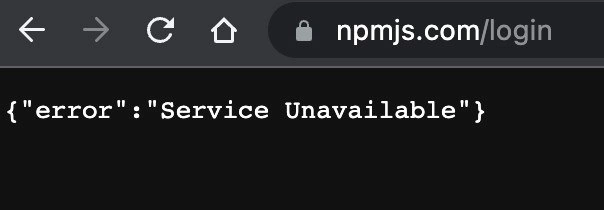
The screenshot shows a browser at npmjs.com/login, but instead of a login UI it displays only:
{"error":"Service Unavailable"}
That raw JSON is the whole joke. A polished web service is supposed to greet users with forms, buttons, session handling, and maybe a little corporate cheerfulness. Here, the abstraction falls away and the developer gets the machine's blunt confession: the service is not available. No spinner, no friendly status page, no reassuring "please try again soon." Just a tiny object of sadness.
For JavaScript developers, npm is not merely a website. It is package discovery, dependency installation, version publishing, authentication, automation tokens, security advisories, and a large part of the open-source supply chain. So seeing the login route fail hits a specific nerve. If the registry or account layer is unhealthy, every downstream workflow starts to feel fragile: npm publish, CI installs, release automation, package ownership, and incident response can all depend on infrastructure most teams do not control.
The humor comes from the mismatch between how casual package management feels on a normal day and how foundational it becomes the moment it breaks. Developers routinely pull hundreds or thousands of transitive dependencies as if the registry were just background oxygen. Then one login endpoint returns Service Unavailable, and suddenly the whole ecosystem looks like a group project balanced on a remote JSON vending machine.
There is also an error-design joke here. A browser page showing raw JSON means some layer did respond, just not the layer users expected. It may be an API response leaking through a web route, a backend dependency failing upstream, or a frontend route that never got a chance to render. The exact cause is not visible, but the developer reaction is universal: if the package registry is sad, everyone gets to become an infrastructure engineer for a while.
Description
A mobile browser is open to `npmjs.com/login`, shown in the address bar with a lock icon. Instead of a login page, the black page displays a raw JSON response: `{"error":"Service Unavailable"}`. The meme captures the particular anxiety of JavaScript package infrastructure failing at the exact layer developers rely on for publishing, dependency access, and account workflows.
Comments
6Comment deleted
When npm returns JSON instead of a login page, the dependency graph briefly becomes an existential graph.
is it rn? cs ive got problems with it Comment deleted
yep, see the problem too Comment deleted
Cool! Now guys will switch to real programming Comment deleted
res.write(JSON.stringify(message)) Comment deleted
blah blah dot plah parenth. blah smt blah parrenth. closes Comment deleted