Any Sophomore Can Monad This
Why is this FunctionalProgramming meme funny?
Level 1: The Impossible Recipe
This is like asking someone how to make a sandwich and getting an answer about molecular chemistry, ancient philosophy, and seven kinds of folding, followed by "any kid could do it." The funny part is the gap between the expert's confidence and the listener's total confusion.
Level 2: Fancy Function Words
Functional programming is a style of programming that treats functions as central building blocks and often avoids changing data in place. Languages and communities around Haskell, ML, Scala, Lisp, and related systems tend to use mathematical vocabulary because many of the ideas come from formal logic and category theory.
CPS, or continuation-passing style, means a function is given another function that represents the next step. Monads are a structured way to sequence computations that carry extra behavior, like failure, state, input/output, or parsing. Monad transformers help combine those behaviors. Recursion schemes are reusable patterns for walking through recursive data, like trees or syntax expressions.
The meme is funny because the speaker acts as if all of that is beginner material. A sophomore might be very smart and still reasonably ask, "Can we start with what problem this solves?" That question is not ignorance; it is engineering hygiene. Fancy abstractions should earn their place by making code clearer, safer, or easier to change.
Level 3: Jargon As Gate
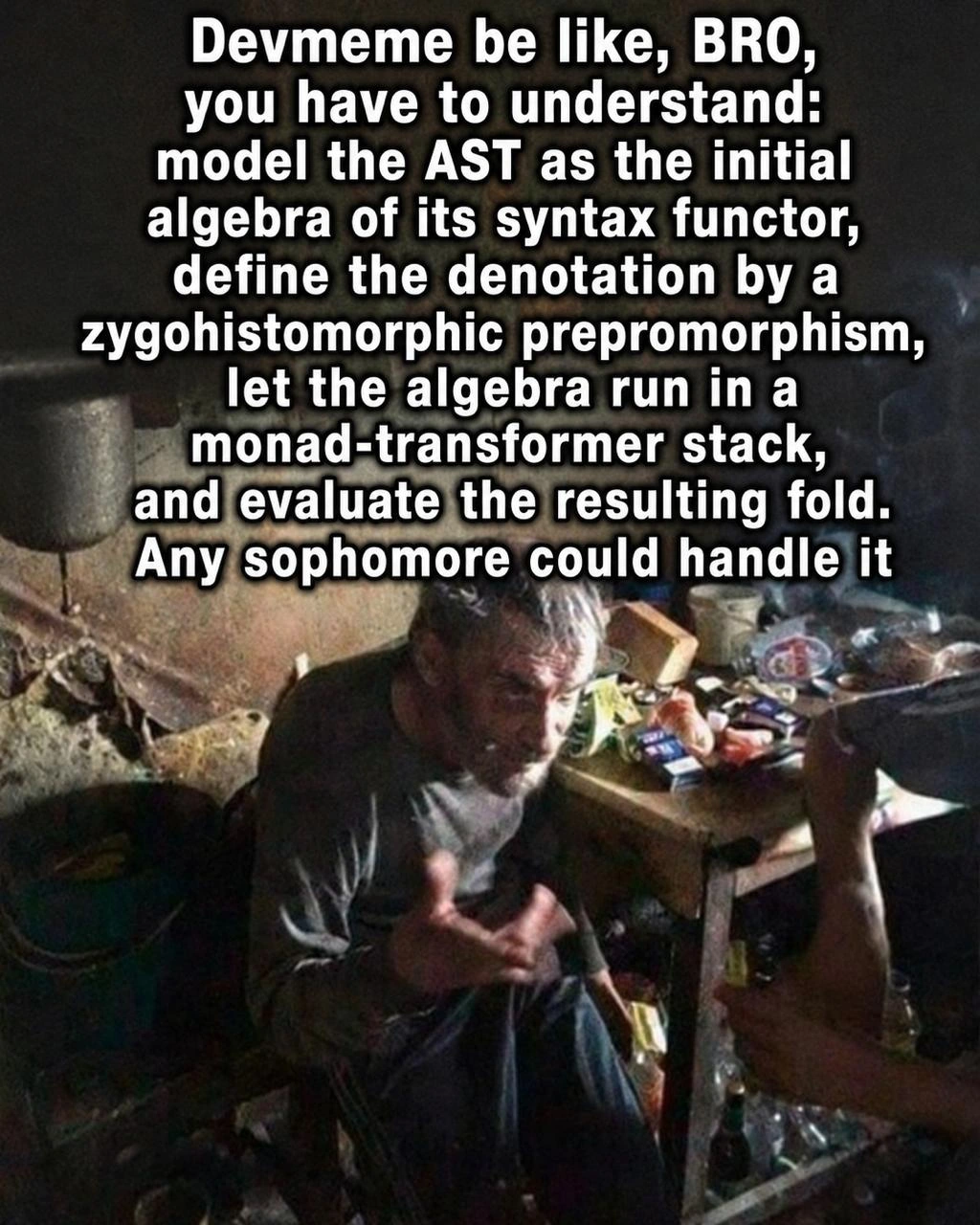
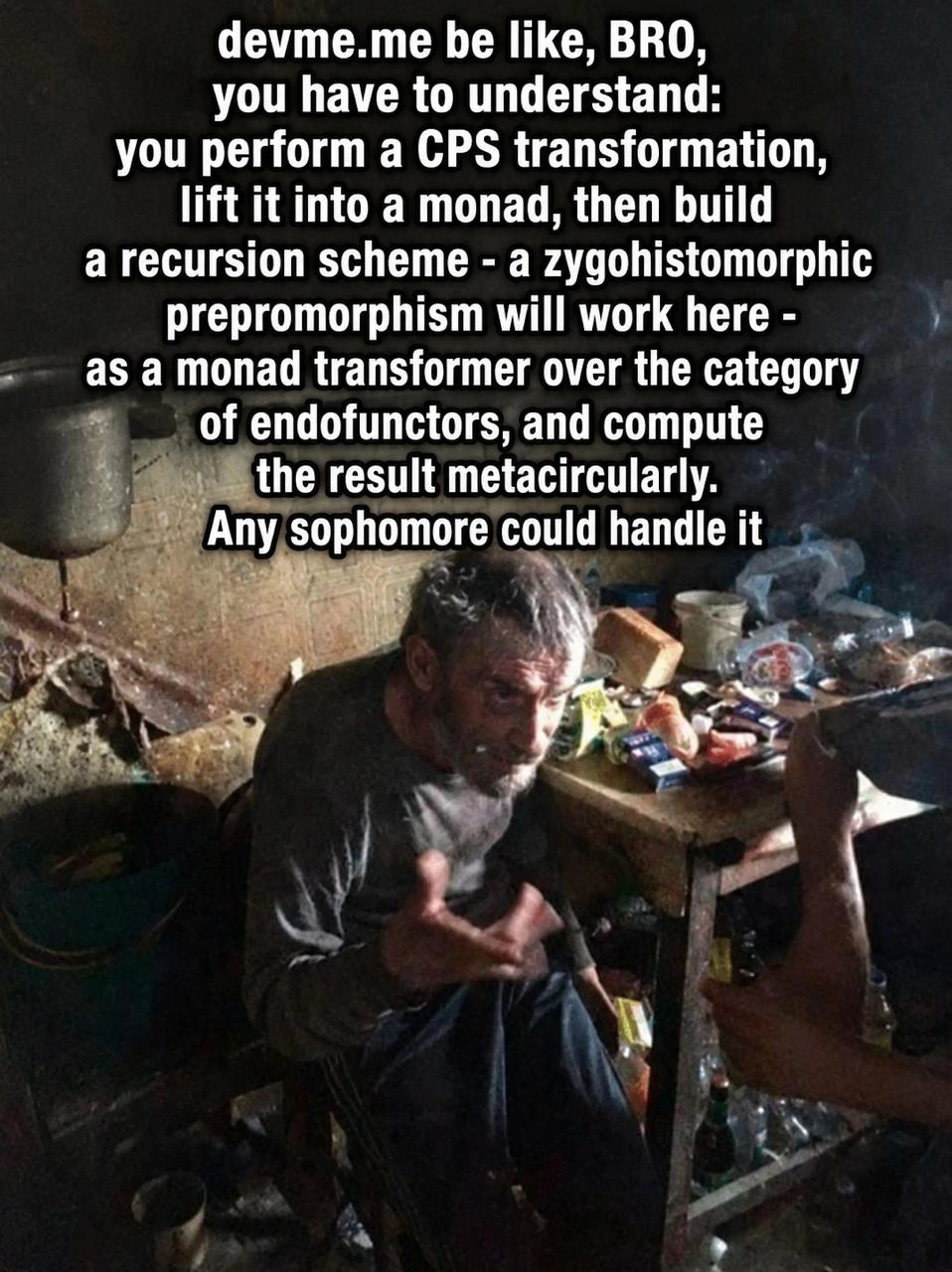
The photo's dim, cluttered room and intense gesturing matter. The person looks like he is delivering a life-or-death lecture into a phone, while the caption presents a maximalist CS explanation as casual advice. That contrast is the meme: highly abstract FunctionalProgramming language being delivered with street-corner urgency.
The final line, "Any sophomore could handle it", is the real punchline. It mocks a familiar failure mode in technical communities: experts forget what it felt like not to know the vocabulary. Once a developer has internalized LambdaCalculus, TypeSystems, monads, recursion schemes, and metaprogramming, the concepts compress into shorthand. To everyone else, the shorthand sounds like a prank generated by a thesaurus with tenure.
This is not just anti-intellectualism. The best versions of these ideas are powerful. CPS helps explain control flow, async callbacks, exceptions, coroutines, and compiler transformations. Monads give structure to effectful computation. Recursion schemes can remove repetitive traversal code and clarify program shape. Type systems can make illegal states unrepresentable. These abstractions are not fake. The joke is about the social move where real depth becomes performative opacity.
That is why the post message calling it "real memes like its 2020 again" fits: this is classic developer in-joke material, dense enough to reward insiders and absurd enough to amuse everyone else. It satirizes ComputerScienceEducation and GatekeepingInTech at the same time. A useful explanation lowers the ladder. This caption sets the ladder on fire, names the flames categorically, and asks why the juniors are still on the ground.
Level 4: Endofunctor Soup
The visible text is a deliberately overloaded functional-programming incantation:
devme.me be like, BRO, you have to understand: you perform a CPS transformation, lift it into a monad, then build a recursion scheme - a zygohistomorphic prepromorphism will work here - as a monad transformer over the category of endofunctors, and compute the result metacircularly. Any sophomore could handle it
Every ingredient in that sentence is real enough to hurt. A CPS transformation rewrites a program so functions do not return values directly; instead, they receive "what to do next" as an explicit continuation. In direct style, the call stack hides the future of the computation. In continuation-passing style, the future is passed around as data.
-- Direct style: compute, then return
square x = x * x
-- CPS style: compute, then call the continuation
squareCps x k = k (x * x)
A monad then packages a computation with sequencing rules. In practical Haskell terms, it gives you a way to chain computations such as optional values, errors, state, IO, or parsers without manually wiring every effect through every function. In category-theory language, the famous phrase is that a monad is a monoid in the category of endofunctors. That is correct, compact, and almost useless as a first explanation unless the listener already knows what all three nouns mean. Naturally, this is why someone will say it during onboarding.
Recursion schemes abstract patterns of recursion over data structures. A catamorphism generalizes folding. A histomorphism can let a fold see previously computed results. A zygomorphism pairs a main fold with an auxiliary fold. A prepromorphism preprocesses structure as it recurses. A zygohistomorphic prepromorphism is the kind of term that sounds like a compiler error from a monastery, but it points at a genuine tradition: naming reusable recursion patterns instead of writing bespoke recursive functions every time.
Then the meme stacks in a monad transformer, which is a way to combine monadic effects, such as StateT over Either over IO. Finally, it says to compute the result metacircularly, meaning through an evaluator or interpreter written in the same or closely related language as the thing it evaluates. The technical comedy is that each concept can be justified in isolation, but the sentence chains them with the emotional pacing of a person explaining how to make toast using a particle accelerator.
Description
A meme image shows a dim, cluttered room with a disheveled man gesturing intensely while someone holds a phone toward him, as if he is delivering an unhinged technical lecture. Large white Impact-style text reads: "devme.me be like, BRO, you have to understand: you perform a CPS transformation, lift it into a monad, then build a recursion scheme - a zygohistomorphic prepromorphism will work here - as a monad transformer over the category of endofunctors, and compute the result metacircularly. Any sophomore could handle it". The joke is a caricature of extremely theory-heavy functional programming explanations that treat continuation-passing style, monads, recursion schemes, category-theory language, and metacircular evaluation as casual beginner material. It works as insider humor for developers who have encountered brilliant but wildly inaccessible explanations of abstractions that may or may not help the code in front of them.

Comments
3Comment deleted
The implementation is left as an exercise to the reader, along with understanding the sentence that described it.
Category theory, my beloved Comment deleted
Yippee 🔥 Comment deleted