Product owner overpromises new features while developers watch in horrified silence
Why is this Agile meme funny?
Level 1: My Dad Will Do It
Imagine your friend excitedly tells the whole class that you will finish a big project for them by tomorrow – without even asking you first. 😨 You’d turn to your friend with a look just like the woman in the meme: wide-eyed, worried, and a bit angry, thinking “How on earth am I going to do that?!” This meme is funny because we’ve all been in a spot where someone promises we’ll do something impossible. It’s like a kid saying “Don’t worry, my dad will build a treehouse for us this weekend!” while the dad (who hasn’t agreed at all) stands there in shock. In the picture, the guy at the desk basically says, “Sure, we can get all this work done in no time!” and the people who actually have to do the work are silently freaking out. We laugh because we feel the surprise and panic of those developers – it’s the same as being volunteered for a huge task out of the blue. In simple terms: someone else promised, and now you’re stuck figuring out how to make it happen. The humor comes from that very human “Oh NO, what did you just get me into?!” feeling, which the meme captures perfectly.
Level 2: Scrum Reality Check
Let’s break this situation down in simpler terms and explain the roles and concepts, especially if you’re newer to Agile development:
Agile and Scrum Basics: Agile is a way of managing software work that emphasizes flexibility, frequent releases, and working closely with customer needs. Scrum is one popular Agile framework, with specific roles and ceremonies. In Scrum, teams work in short cycles (usually 1-2 weeks) called sprints. The idea is you plan what features or fixes you can complete in a sprint, do the work, then review and adjust for the next sprint. It’s all about realistic pacing and responding to change without going crazy.
Product Owner (PO): The man at the desk in the meme represents the Product Owner. In Scrum, this is the person who owns the product vision and priorities. They act as a liaison between the stakeholders/clients (like customers, or the business side) and the development team. The PO’s main job is to decide what the team should build next to maximize value. They manage the product backlog, which is basically a to-do list of features, enhancements, and bug fixes, prioritized by importance. Importantly, a good PO should also manage expectations – they need to understand how much work the team can do in a sprint (the team’s capacity or velocity) and not promise more than what’s possible.
In the meme, the PO character is doing exactly what they shouldn’t: promising a client a bunch of new stuff “within days” without checking if it’s feasible. It’s like if a restaurant waiter promised a customer a complex off-menu cake in 5 minutes without asking the chef. The Product Owner here likely wants to keep the client happy in the moment, but they’re ignoring the reality of development work.
Developers (Dev Team): The older woman in the meme stands for the developers – i.e., the engineers, programmers, QA testers, etc., who actually build and deliver the product. In Scrum, the dev team is cross-functional and collectively responsible for completing the sprint’s work. They know how long things take from experience. When the PO promises “new features within days,” the devs are horrified because they will have to do the work, and they understand it’s not a magic trick.
In real life, developers get anxious or frustrated when commitments are made on their behalf that don’t match reality. They might be thinking about all the coding, testing, and debugging steps required for those “new features”. Hearing a promise of “just a few days” for something that could take weeks naturally causes DeveloperFrustration (as tagged!). They’re silent in the meme because, well, often devs aren’t in a position to publicly contradict a bold promise, especially if a big client or upper manager is on the call. But their faces say it all: “We’re in trouble.”
Clients/Stakeholders: The meme text mentions a “client.” That’s the person or entity the features are being promised to – basically the stakeholder who wants the new functionality. Clients could be an external customer, or an internal user, or your company’s higher-ups. They usually care about when they’ll get a feature and what it will do, but they might not know what’s realistic technically. They rely on the Product Owner (or managers) to tell them the truth about timelines. Here the client is being told “within days,” so naturally they’ll expect very fast delivery. If that expectation isn’t reset, anything slower will seem like a failure. Managing these StakeholderExpectations is crucial; otherwise, you get unhappy clients or overworked teams (or both).
Sprint Capacity & Planning: In a proper Scrum process, the team and Product Owner plan each sprint together. They discuss which tasks or user stories to pull from the backlog into the sprint based on how many story points (a unit of effort) the team can handle. This is informed by past velocity (how many points the team usually completes per sprint). For example, if the team typically finishes ~30 points per 2-week sprint, the Product Owner shouldn’t suddenly stuff 60 points of work because a client asked nicely. Promising new features off-the-cuff bypasses this careful planning. It ignores the capacity the team has. Saying “within days” could mean trying to squeeze a multi-week task into, say, 3 days. It’s like trying to fit an elephant in a sedan – it doesn’t fit, no matter how you push. Newcomers in a dev team learn quickly during sprint planning how to estimate tasks and why overloading a sprint is a recipe for trouble.
Scope Creep: This term refers to the situation where new requirements or features keep getting added after planning, without adjusting the timeline or resources. It’s called “creep” because it sneaks in gradually (sometimes not so gradually!). Scope creep is common on projects without discipline; a client might say “Oh, can we also add X and Y?” and if the team always says yes, the project grows and deadlines slip. In an Agile context, scope creep mid-sprint is supposed to be avoided – you wait for the next sprint to add new work, unless it’s truly critical. The meme scenario is scope creep on steroids: the PO is basically injecting new features immediately (“in the next few days”) on top of whatever the team was already doing. No wonder the devs look concerned! They know this extra scope with the same deadline means something’s gonna give. Either the team works overtime (not sustainable) or something else in the backlog gets dropped (which might upset some other stakeholder later).
Why Developers React Strongly: If you’re new to software teams, you might wonder why the developers in the meme are so upset just hearing a promise. Here’s why: developers take pride in doing things well, but they also know the constraints. When someone promises unrealistic things, it often means the devs will face extreme pressure to “make it happen.” This can mean long hours, rushing through coding (which can introduce bugs), and a lot of stress. It can also mean technical compromises – perhaps doing a quick-and-dirty job to meet the deadline, which then creates technical debt (i.e., messy code that will need fixing later). The devs are horrified because they foresee that pain instantly. Over time, developers learn to push back on such promises or at least clearly communicate what’s actually feasible. But if they’re not given a chance to speak, they’re stuck in a bad spot. The silence you see in the meme image? Many junior devs have sat in their first planning meeting thinking, “Uh, this seems like too much work for us to finish, but if the boss says so... maybe we’ll somehow do it?” Spoiler: It usually ends with missed deadlines or lots of overtime.
Communication is Key: The underlying issue in this meme scenario is lack of communication. In a healthy team, the Product Owner would say to the client, “Let me check with the team and see what’s feasible. We’ll get back to you.” Then internally, they’d discuss options: maybe we can deliver a minimal viable version of the feature quickly, or maybe only part of the request can be done in the timeframe. The PO could then adjust the promise to something realistic and keep everyone happy. When this step is skipped, and something is just promised “within days” on the spot, it puts the devs in a tough situation. New developers sometimes assume that those in charge always know what’s possible – you soon realize that often managers rely on engineers to tell them what’s doable and how long it takes. If that feedback loop is broken, you get mispromises like in the meme.
Relatable Newbie Experience: If you’re an early-career developer, you might not have experienced this yet – but ask around and senior teammates will have war stories. For example, it’s common in some companies for a salesperson or executive to promise a feature to close a deal, then come running to engineering saying “We need to add this ASAP!” As a junior dev, you might be pulled into a high-priority task unexpectedly. It feels chaotic and stressful. Over time, you learn to estimate your tasks and assert, “This will take 2 weeks, not 2 days,” so that the product manager doesn’t make false promises. Good teams will back you up on that. Bad teams… well, they end up in memes like this. 😅
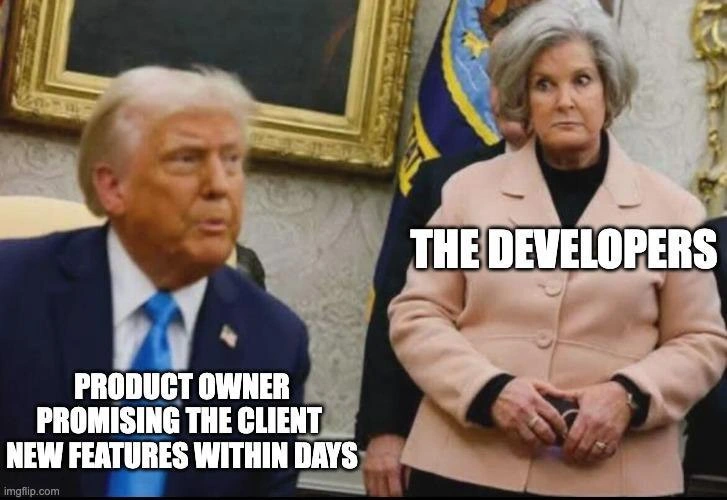
The Meme Template: Just a quick note on the image itself – it’s using a famous Oval Office photo. The man at the desk is meant to symbolize someone in authority making a grand statement (here, the Product Owner). The woman standing with that shocked, concerned look is symbolizing the team’s reaction. It’s a visual exaggeration (most product owners aren’t literally presidents!), but it drives home the point: a bold promise from the “boss” figure, met with alarm from the experts. This template is popular because the expressions are priceless: the PO looks so confident, and the developer persona looks like she’s seen a ghost. It captures the ProductManagementHumor perfectly – one side smiling, the other side mortified.
In short, at this level we learn: never promise on behalf of your team without checking. If you’re the developer, now you know why your seniors sometimes groan in meetings like these. If you’re the aspiring product owner or manager, take this meme as a gentle warning – always consult your developers before saying “sure, we can do that by tomorrow.” It’ll save everyone a lot of pain (and avoid you becoming the subject of the next DeveloperHumor meme!).
Level 3: Scope Creep Show
This meme is a front-row seat to a classic Agile horror story: a Product Owner cheerfully overpromising features on an impossible timeline while the dev team stands by in silent dread. The humor (and pain) comes from how real this scenario is in software organizations. It’s practically an Agile anti-pattern. The man at the desk (with a presidential vibe) is labeled “Product owner promising the client new features within days”, and the concerned woman standing represents “The developers.” Every experienced dev has seen this scope creep show before – features magically added to the plan, deadlines pulled out of thin air, and the team’s collective blood pressure spiking.
Let’s unpack why this is hilarious and horrifying for those in the know:
Unrealistic Deadlines: Promising “new features within days” triggers every developer’s fight-or-flight reflex. Software isn’t conjured with a wand; even small changes must be designed, coded, tested, and deployed. A deadline that’s only days away for a new feature is usually either a fantasy or a one-way ticket to crunch time. The boldness of that promise is ironically funny – it’s like saying “Sure, we’ll build the Pyramid by next Tuesday” in a team meeting. Developers see the looming burnout or a monumental last-minute scramble. It’s a textbook case of UnrealisticDeadlines (hello, tag!) we joke about in countless stand-ups.
Stakeholder Expectations vs. Reality: Why would a product owner do this? Often, it’s pressure from stakeholders or clients – they want new features ASAP to feel progress or keep a deal. The product owner, acting as the go-between (or meatshield in cynical terms), sometimes caves and says “Yes, absolutely, we’ll have that ready!” without consulting the team. It’s a form of stakeholder-pleasing that leads to StakeholderExpectations being wildly out of line with technical reality. In Agile theory, the product owner should manage expectations and prioritize realistically; in practice, some POs act more like salespeople, chasing client happiness at the devs’ expense. This meme nails that dynamic: the PO is all smiles making the promise, while “the developers” physically embody the DeveloperFrustration tag – you can almost hear them internally screaming, “Wait, what did he just commit us to?!”
Scrum Gone Wrong: In a healthy Scrum process, new features are negotiated in planning meetings and added to the backlog, scoped for future sprints based on team capacity (often measured in story points or velocity). A Product Owner should know the team’s limits and not promise outside that capacity. Here, clearly, Scrum practices have left the building. It’s Agile in name only – sometimes jokingly called Water-Scrum-Fall – where you do daily standups but management still imposes waterfall-style fixed scope and deadlines. The meme’s overpromising PO is breaking the Agile covenant: he’s essentially committing to extra work mid-sprint (or without a sprint at all), blindsiding the devs. This is prime AgilePainPoints material: the very pain point Agile was meant to solve (i.e., unrealistic commitments without team input) is happening despite the Agile framework. The irony isn’t lost on seasoned engineers. We’ve seen stand-ups turn into just status meetings for death-march projects because someone promised too much to a client. The meme exaggerates it for comic effect, but not by much!
Scope Creep and Context Switching: Adding “new features within days” on top of whatever the team is already doing is the definition of scope creep. ScopeCreep is dreaded because it derails progress: the team must suddenly juggle new tasks, drop planned work, and context-switch to please the client. It’s chaotic and guarantees lower quality. The developers’ horrified silence in the meme is them mentally cataloging all the half-finished tasks they’ll have to pause, the corners they’ll have to cut, and the nights/weekends they’ll sacrifice. There’s dark humor in their faces: it’s the “calm before the rant.” Every developer who’s been through a surprise “Oh by the way, we promised this feature by Friday” can relate to that exact exasperated, almost betrayed look. It’s funny because it’s true – an inside joke for anyone who’s slogged through surprise overtime due to a management promise.
Shared Trauma in Tech: The reason this meme hits home is the shared experience. It’s practically an initiation in the tech world: the moment you first see a manager or PM commit you to something absurd. The first time, you might actually gasp like the woman in the meme. After years, it becomes a cynical head-shake and maybe a meme-worthy eye roll. This scenario is DeveloperHumor gold because it’s a bit cathartic – we get to laugh at the absurdity of our jobs. That laughter has a sharp edge, though. The Cynical Veteran in every team might quip, “Looks like we’ll be pulling a miracle out of our hats again, folks,” which is code for “We’re screwed, better cancel weekend plans.” This gallows humor keeps developers sane when confronted with the inevitable client_commitments that defy logic.
Organizational Dynamics: Notice how “The Developers” (the woman) is silent, just giving that look. In real life, developers often watch in horrified silence during such overcommitments because contradicting the product owner or boss in front of a client can be politically tricky. There’s a power imbalance. The devs might slack each other under the table (
:facepalm: Did he really just say that?), but outwardly they stay professional. The plan (after the meeting) will be to either scramble to meet the promise or have a tough talk with the product owner privately. The meme captures that awkward freeze: the team can’t exactly yell “No, that’s impossible!” in front of a client, so they just stand there looking like deer in headlights. It’s a comedic image because we, the audience, can practically feel their stress while the oblivious (or overly optimistic) product owner barrels ahead.The Aftermath: The comedic tension also comes from imagining what happens next. Experienced devs know this movie doesn’t end well. If the product owner actually forces the team to deliver in days, it means frantic hacking, probably cutting corners (hello, bugs and technical debt), maybe a deploy at 2 AM, and a lot of pizza-fueled cursing. The product might ship “within days” but likely half-baked – then guess who gets the blame when it’s buggy? Or, alternatively, the team flat-out fails to deliver in time (because physics), and the client gets mad, trust is broken, and upper management wonders “what went wrong with the engineers.” It’s a lose-lose, and that tragic inevitability is played for laughs in the meme. The ProductManagementHumor here is so on point: PMs and POs overpromising features is practically a running joke in dev circles (akin to “it’s always DNS” for ops folks). We laugh at this meme to keep from crying about how often it really happens.
Historical Context – Nothing New: If you think about it, this dynamic predates Agile. Back in old waterfall days, sales teams would promise a bunch of features by a fixed deadline and the devs would be stuck in a months-long death march. Agile processes (like Scrum) were supposed to prevent that by involving the team in planning and using velocity to guide promises. Yet here we are – human nature and business pressures find a way to repeat the same mistakes. The meme using an Oval Office photo is no accident: it paints the product owner as a big-shot making grand promises like a politician, while the advisor (developers) knows it’s not that simple. It’s a power play and a PR move. (Historically, the actual photo was from a serious political meeting, which makes it extra funny when meme-ified; the high stakes of an Oval Office scene mirror how high-stakes these promises feel to engineers in the moment.)
In summary, this meme is a sardonic little play about AgilePainPoints: a product owner, under pressure to please, commits to an impossible timeline for new features (“within days!”) without team input. The developers’ aghast expression – stunned silence with eyes screaming “This is not okay” – is the punchline every engineer recognizes. It’s the relatable comedy of workplace dysfunction: you either laugh or you start writing your resume. The next time a product owner cheerfully says “oh, it’s just a small change, we can do it by Tuesday,” you’ll remember this meme and think here we go again. ScopeCreep, thy name is overcommitment. Welcome to the club, newcomers – popcorn’s on the backlog, enjoy the creep show!
Description
Meme constructed from a famous Oval Office photo: a suited man (face blurred) sits at a desk turning toward an older woman (face blurred) who stands with clasped hands and a concerned posture. White bold captions label the seated man at bottom-left: "PRODUCT OWNER PROMISING THE CLIENT NEW FEATURES WITHIN DAYS" and the standing woman at center-right: "THE DEVELOPERS". The visual conveys an executive cheerfully making commitments while the development team reacts with visible unease. Technically, it lampoons Scrum dynamics where a product owner commits to external stakeholders without consulting sprint capacity, leading to unrealistic timelines, scope creep, and release pressure for engineers
Comments
8Comment deleted
“Sure, we’ll deliver those ‘couple of features’ this week - right after I finish retrofitting the event-sourced, eventually-consistent, globally distributed monolith you signed off on last quarter.”
After 20 years in tech, you learn that 'within days' in product-speak translates to 'several sprints, three architecture reviews, two security audits, and a complete rewrite of the legacy integration layer we discovered halfway through' - but sure, let's tell the client it's just a quick config change
When the Product Owner commits to 'just a few quick features' in the client meeting without checking if the team is still recovering from the last 'quick win' that required refactoring three microservices, migrating the database schema, and somehow making it backward compatible with the legacy monolith that nobody dares touch
PO promised delivery in days; our Kanban says P95 is 21, so yes - days, just not contiguous ones
PO: 'Days.' Devs: *eyes Jira backlog* 'That's cute - hold my energy drink.'
When product promises “days,” but your queue depth says Little’s Law will see you in Q2
This is true. I've worked on a team for a customer from Saudi Arabia - we hated our PMs because this happened every f...ing time Comment deleted
Next level: the head of our sales & marketing department usually starts selling a feature the very same day he hears about theoretical possibility to implement it within an foreseeable time frame, — as if the feature was implemented already. Comment deleted