Skip to content
DevMeme
5956 of 7435
Cursor’s hypergrowth line outpaces AI unicorns in $1M-to-$100M ARR race
Startup Post #6523, on Feb 6, 2025 in TG

Cursor’s hypergrowth line outpaces AI unicorns in $1M-to-$100M ARR race

Why is this Startup meme funny?

Level 1: The Magic Beanstalk

Imagine you and your friends each planted a tiny seed at the same time to see how tall your plants would grow. Most of your friends’ plants grow bit by bit every day – after a year or two, they’re pretty tall, maybe up to your waist or as tall as you. But one friend’s seed, let’s call it “Cursor,” turns out to be a magic beanstalk. 🤯 In almost no time at all, Cursor’s beanstalk shoots straight up into the sky, way above everyone else’s plants, like in the fairy tale Jack and the Beanstalk. Meanwhile, the other plants named Wiz, Deel, OpenAI, and so on are growing at a normal good pace – they’re healthy trees or vines climbing steadily. But next to the magic beanstalk, those normal plants look tiny!

This picture is funny because in real life, things almost never grow that fast. It’s using the race of plants as a silly way to show company growth: each plant is a company making more and more money each year. Usually, even a fast-growing company takes a few years to get really big (like a tree taking time to grow tall). So seeing one company (Cursor) grow straight up instantly is like a cartoon – it’s an exaggeration that makes us laugh. It’s a bit like if several kids were running a race and one kid suddenly zoomed ahead with a jetpack. You’d chuckle because it’s just so over-the-top and unexpected.

The emotion behind it is a mix of astonishment and amusement. We’re amazed — “Wow, that’s crazy!” — but also amused because it feels like a clever tall tale. People in the tech world often joke with charts like this when a new gadget or idea becomes super popular super fast. It’s their way of saying “This new thing is growing ridiculously quickly!” in a fun, playful manner. So the magic beanstalk in this meme makes us smile, because we all know normal beans don’t grow overnight into the clouds, and normally companies don’t either. It’s a lighthearted way to poke fun at just how wild and hyped-up the story of Cursor’s growth sounds, almost like a fairy tale among the more normal stories.

Level 2: Race to $100M

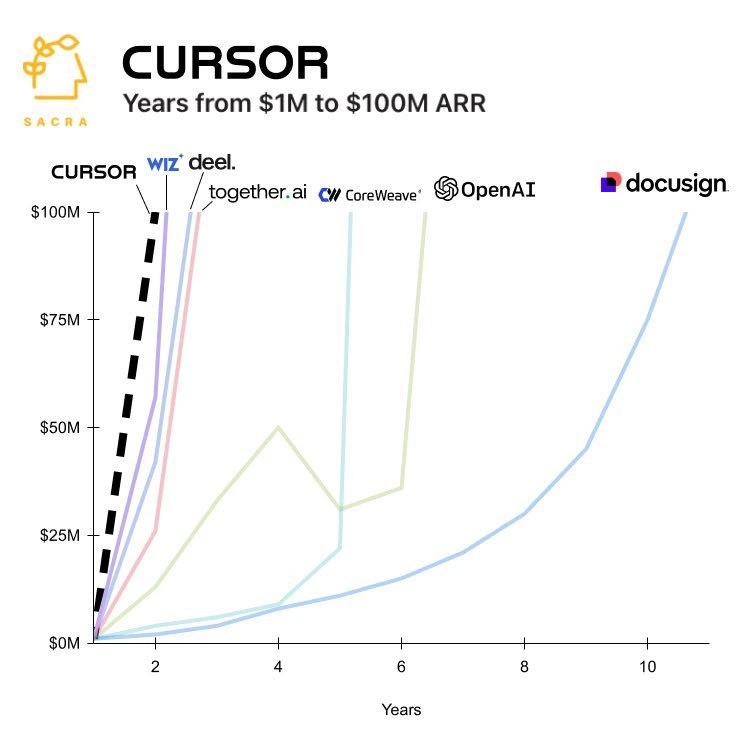
Let’s break down what’s going on in this chart, in plainer terms. The x-axis at the bottom shows years, and the y-axis on the left shows Annual Recurring Revenue (ARR) in millions of dollars. ARR is basically how much money a company makes from subscriptions in one year, and it’s a key number for any software-as-a-service (SaaS) business – it tells investors “this is how solid our recurring income is.” Growing from $1M to $100M ARR is a huge deal; $1M ARR means you’ve got some paying customers and a viable product, while $100M ARR means you’re an established big player (often nicknamed a “centaur” in tech lingo). The title of the chart “Years from $1M to $100M ARR” implies we’re measuring how many years it took each company to go from the $1M mark to the $100M milestone. In simpler words: it’s a race to $100M in yearly sales, and we’re comparing the racers.

The lines in the chart each belong to a company – think of them like runners in a race, each starting at the $0M line (well, effectively $1M when they enter the race) and trying to reach the $100M finish line at the top. A steeper line means the company is growing revenue faster. Here’s who’s in the race:

  • Cursor (black dashed line): This is an AI-powered coding tool (an editor with an AI assistant) that allegedly grew absurdly fast. Its line goes almost straight up, meaning Cursor zoomed from near-zero to $100M ARR in very little time. It’s the meme’s “prodigy sprinter.”
  • Wiz (blue line): Wiz is a cloud security startup. It’s known in real life for being one of the fastest-growing software companies – they reached high revenue quickly by helping companies find security issues in cloud systems. On the chart, Wiz’s line climbs sharply too, but compared to Cursor, it’s a bit more gradual (which is crazy because Wiz was already super fast).
  • Deel (pink/red line): Deel is a fintech/HR startup that helps companies hire and pay remote workers worldwide. Thanks to the remote work boom, Deel’s business exploded, and it got to $100M ARR very quickly as well (within a couple of years). Its line in the graph is steep, but again, not as steep as Cursor’s.
  • Together.ai (gray line): Together AI is a company in the AI space (as the name suggests, perhaps a platform for AI models or collaboration). Its growth was notable but more normal compared to these others. The line rises but more slowly, suggesting it took longer to approach that $100M ARR mark.
  • CoreWeave (light green line): CoreWeave provides cloud computing power, especially GPU servers for AI and graphics. Around the AI boom, demand for CoreWeave’s GPU cloud skyrocketed, so it saw very fast growth. Its line makes a big jump (you can see a steep climb, maybe a sudden bump around year 4) because they likely landed some huge contracts. Still, by the chart, CoreWeave took a few years to get near $100M – fast, but not insane fast.
  • OpenAI (teal line): OpenAI is the famous AI research-and-products company behind ChatGPT. While OpenAI has millions of users, turning usage into revenue took some time (initially it wasn’t selling much, then later came big deals and API subscriptions). Its line starts climbing later, but then shoots up by year ~5 or 6, reflecting how they went from near $0 ARR to a big number once enterprises started paying and Microsoft invested heavily. Still, on this chart OpenAI’s revenue growth pace looks modest next to the new startups – which is part of the joke, since we think of OpenAI as the AI giant!
  • DocuSign (pale blue line): DocuSign is an older company (founded in the early 2000s) that makes e-signature software. It eventually became huge, but in its early years SaaS adoption was slower. The pale blue line for DocuSign is the gentlest slope here, taking close to a decade to reach $100M ARR. It’s kind of the “slow and steady” reference point – by today’s standards, 8-10 years to $100M seems poky, but back then it was normal.

In the meme’s chart, Cursor is shown obliterating these timelines – its curve leaps to the top in what looks like near-zero time. This visual gag implies “Cursor achieved in maybe ~1 year what took even the best startups 2, 5, or 10 years.” That’s a massive claim. It’s referencing how in the recent AI boom, some new developer tools gained huge popularity (and paying users) incredibly quickly. Developers out there might recall how tools like GitHub Copilot or various AI coding assistants spread like wildfire. The meme specifically calls out Cursor, which is one such AI coding assistant/editor, to poke fun at the idea that any AI-related startup nowadays is boasting hypergrowth.

If you’re a junior dev or new to StartupCulture, you should know companies and investors love to brag with metrics like “ARR” and growth charts. A “hypergrowth” company typically doubles or triples its ARR every year. The normal path to go from $1M to $100M ARR might be, say, 5-8 years for a healthy growing startup. So when you see a chart claiming it happened almost overnight, it’s intentionally outrageous. It’s like hearing someone completed a tech speedrun: it sounds cool, but also a bit unbelievable. This meme plays on that feeling. All those other lines (Wiz, Deel, etc.) are already what we’d consider spectacular growth stories – each of them was often cited in tech news as one of the fastest to $100M. By drawing Cursor’s line so steep, the graphic is parodying the current AI hype cycle where every new AI tool tries to set a new record. It’s both celebrating how hot AI startups are, and subtly mocking the notion that “just add AI, and you get instant $100M!”

In short, the meme is a witty chart joke. It uses a real business metric comparison to generate laughs among tech folks. We see the familiar context (startups racing to massive revenue), we recognize the big names, and then we see this newcomer blowing past them in a cartoonishly dramatic way. It’s funny because it’s almost plausible in today’s climate of AI mania, yet it’s clearly an exaggeration. For a junior dev, think of it this way: it’s as if six famous chefs were in a cook-off and made amazing dishes in 2 hours, and then a newcomer shows up and somehow whips up a gourmet feast in 5 minutes. You’d be both astonished and a bit suspicious, right? That mix of astonishment and skepticism is exactly what this meme is riffing on in the context of startup growth.

Level 3: Rocketing Past Unicorns

In the startup world’s ARR sprint, this meme’s chart is the equivalent of watching one rocket-powered runner lap a field of champion sprinters. Annual Recurring Revenue (ARR) is the king of SaaS metrics – it measures how much money a company reliably brings in each year from subscriptions. Going from a modest $1M ARR to a whopping $100M ARR in just a few years is every StartupCulture founder’s dream (and every VC’s hype-fueled fantasy). The graph humorously pits several famed AI unicorns against each other in a race to that $100M mark. Each colored line represents a well-known high-growth company’s journey: Wiz, Deel, Together.ai, CoreWeave, OpenAI, and even old-guard DocuSign. Their curves all climb upward, some pretty steeply over 2, 4, 6, or 8 years – impressive by normal standards. But then there’s the thick black dashed line labeled Cursor, shooting almost straight up from the origin to $100M like a caffeinated rocket. It’s so vertical it practically screams “hold my beer, unicorns”.

Why is this funny to seasoned engineers? Because we’ve all seen “hockey stick” growth charts in pitch decks – those optimistic curves that suddenly inflect and go sky-high. But Cursor’s line is more like a hockey stick on steroids, an up-and-to-the-right trajectory so extreme it’s nearly vertical. Even legendary fast-growers like OpenAI (the poster child of the recent AIHype wave) appear sluggish next to Cursor’s impossible climb. OpenAI’s line might represent how it took a few years after launching GPT-based services to approach that revenue; no shame there, it was astonishingly quick in real life. Yet the meme exaggerates: Cursor makes OpenAI look like it’s pedaling a tricycle while Cursor itself broke the sound barrier. It’s a tongue-in-cheek arr-humor (ARR humor, get it?) about how every new AI startup out of nowhere claims to be the next rocketship 🚀.

Engineers with some industry experience also catch the whiff of TechHypeCycle absurdity here. In real life, reaching $100M ARR so fast is extremely rare – it usually means a perfect storm of massive market demand, a killer product, and often insane amounts of venture capital fuel. When a line goes almost vertical, cynical veterans smirk and think: “Either they found a cheat code for growth, or someone’s playing tricks with the scale.” We’ve been through enough hyped-up stories to ask hard questions: Is that revenue sustainable? How much of it is heavily discounted deals or one-time bursts? In the late ‘90s dot-com bubble, charts boasting meteoric user growth often preceded equally spectacular crashes. More recently, during the AI/ML gold rush, many dev tools and platforms have been glowing under the “peak of inflated expectations.” A dashed line like Cursor’s hints that we might be at peak hype: unbelievable growth that invites both envy and doubt.

On a deeper level, this meme pokes at the idea that slapping AI on your product is the new turbocharger in business. It’s riffing on the current AIIndustryTrends where venture capitalists feverishly fund anything AI-related and enterprise clients throw pilot budgets at AI tools. Cursor – an AI-powered code editor assistant – benefitted from this craze. Imagine rolling out a tool that writes or reviews code with GPT-like smarts; dev teams flock to try it, managers happily pay if it promises productivity gains, and boom – you’ve got revenue shooting up faster than scaling a trivial algorithm to O(n^n). The meme’s extreme graph suggests Cursor reached “centaur” status (tech slang for hitting $100M ARR) in record time, outpacing even the hottest AI unicorns of recent years. It’s both hype and satire: part of us marvels “wow, that’s incredible,” and another part chuckles “sure, and my code has zero bugs.”

Importantly, the visual gag is that Cursor’s growth line literally dwarfs all others. The black dashed line is so steep that all the other colorful trajectories (which in any normal comparison would be considered phenomenal) suddenly look quaint. For a senior engineer, it’s hard not to recall all the internal graphs and metrics they’ve seen massaged for board slides. We know real systems have bottlenecks – whether it’s user adoption, sales cycles, or just scaling pain – so when something appears to break those laws of growth gravity, it triggers a skeptical smile. It’s the quintessential TechTrends humor: taking the current craze (AI coding tools with insane valuations) and exaggerating it to where even AIHumor aficionados can laugh. After all, if every startup claims to be a rocket, here’s one that said “why stop at rocket? Let’s be a teleporting alien starship” and left the competition in hypothetical dust. The meme delivers a wink and a nod to anyone who’s seen behind the curtain of startup hypergrowth – it’s both a celebration of the dream and a satire of the hype.

Description

The graphic is a simple white line chart titled “CURSOR - Years from $1M to $100M ARR,” with a small yellow SACRA logo in the top-left. A thick black dashed line labelled “CURSOR” shoots almost vertically from the $0M origin to the $100M mark, implying extreme revenue acceleration. Thinner colored lines for “wiz”, “deel”, “together.ai”, “CoreWeave”, “OpenAI”, and a pale blue line for “docusign” rise more gradually, each beginning near $0M and curving upward across the x-axis tick labels 2, 4, 6, 8, 10 years. The y-axis is labeled at $0M, $25M, $50M, $75M, and $100M, and the x-axis simply reads “Years.” Visually, Cursor dwarfs the other well-known SaaS and AI growth stories, parodying startup hypergrowth benchmarks familiar to engineers following the AI tooling boom and ARR metrics

Comments

13
Anonymous ★ Top Pick That near-vertical “growth” line screams: ship one POST /v1/bill endpoint, cache everything in memory, and promise to circle back on consistency, observability, and SOC2 - right after the IPO
  1. Anonymous ★ Top Pick

    That near-vertical “growth” line screams: ship one POST /v1/bill endpoint, cache everything in memory, and promise to circle back on consistency, observability, and SOC2 - right after the IPO

  2. Anonymous

    Cursor hit $100M ARR faster than most engineers can finish arguing about whether AI will replace them - turns out the answer was 'yes, but you'll pay $20/month for the privilege.'

  3. Anonymous

    CURSOR's growth curve is so vertical it makes O(n²) look like a performance optimization. Meanwhile, DocuSign's trajectory is the visual representation of 'slow and steady wins the race' - or as we call it in 2024, 'pre-AI era growth rates.' The real question: did CURSOR achieve product-market fit, or did they just ship a feature that autocompletes the entire YC application?

  4. Anonymous

    Cursor hit $100M ARR faster than our CI can run npm install - apparently “bottom‑up adoption” just means devs expensing an LLM IDE before procurement notices

  5. Anonymous

    CURSOR’s curve is literally a blinking caret to $100M ARR - apparently when your IDE autocompletes code, finance autocompletes the revenue

  6. Anonymous

    Cursor hit $100M ARR faster than refactoring a legacy monolith - now that's a growth curve without the tech debt

  7. アレックス 1y

    “Hey! There’s a bubble!”

  8. Max 1y

    I tested windsurf, another AI coding editor, with Claude Sonnet 3.5 and in the end it cost me more time debugging than just writing it myself. Also, it completely fucked up my thought process.

    1. @DIRECTcut 1y

      windsurf pricing is absurd. charging ppl on filesystem operations is dumb as hell especially since there are free tools that do the same (like aider)

      1. Max 1y

        Jup, I paid 15$ out of curiosity - cancelled one week later.

  9. @DIRECTcut 1y

    Soon: “sudo chmod” is a Bash Premium command. Please upgrade to get full access

    1. @hafijuldev 1y

      When that happens, you can confidently give up on IT (and computer science)

  10. @hafijuldev 1y

    haha, reminds me of neofetch chap

Use J and K for navigation