Investor pitch: rent out GPUs to an AI startup and call it free money
Why is this AI ML meme funny?
Level 1: Money Doesn't Grow on GPUs
Imagine your friend boasts: “I found a way to get free money!” You’d be pretty skeptical, right? This meme is basically showing a guy who thinks he discovered a magic money trick in the world of computers and AI. It’s like if you gave your friend some money to start a lemonade stand, but only if they agree to rent your lemonade machine every day. You’re thinking: “Wow, I’ll get my investment back because they’re paying me rent, and later I can sell my lemonade machine for even more since lemonade stands are super popular now. I can’t lose – it’s free money!”
To a kid or anyone, the catch is obvious: you’re paying out money and taking it back from the same person — it’s just going in a circle. Plus, machines and stuff usually get old or break down, they don’t usually become more valuable like rare toys. If everyone suddenly loves lemonade, maybe your lemonade machine is worth a bit more for a while, but eventually a new better machine will come out or the craze will end. And if your friend’s lemonade stand doesn’t do well, they can’t pay you anyway. In short, the guy in the suit is acting like he’s found a cheat code for infinite cash, but it’s as unrealistic as a money tree. We all know money doesn’t grow on trees, and guess what — money doesn’t grow on GPUs (those fancy computer parts) either. The meme is funny because it’s pointing out that this “genius” plan of his is actually pretty silly once you think about it, no matter how confident he looks. It’s a reminder that whenever someone says something is “free money,” it probably isn’t free at all.
Level 2: GPUs & the AI Hype
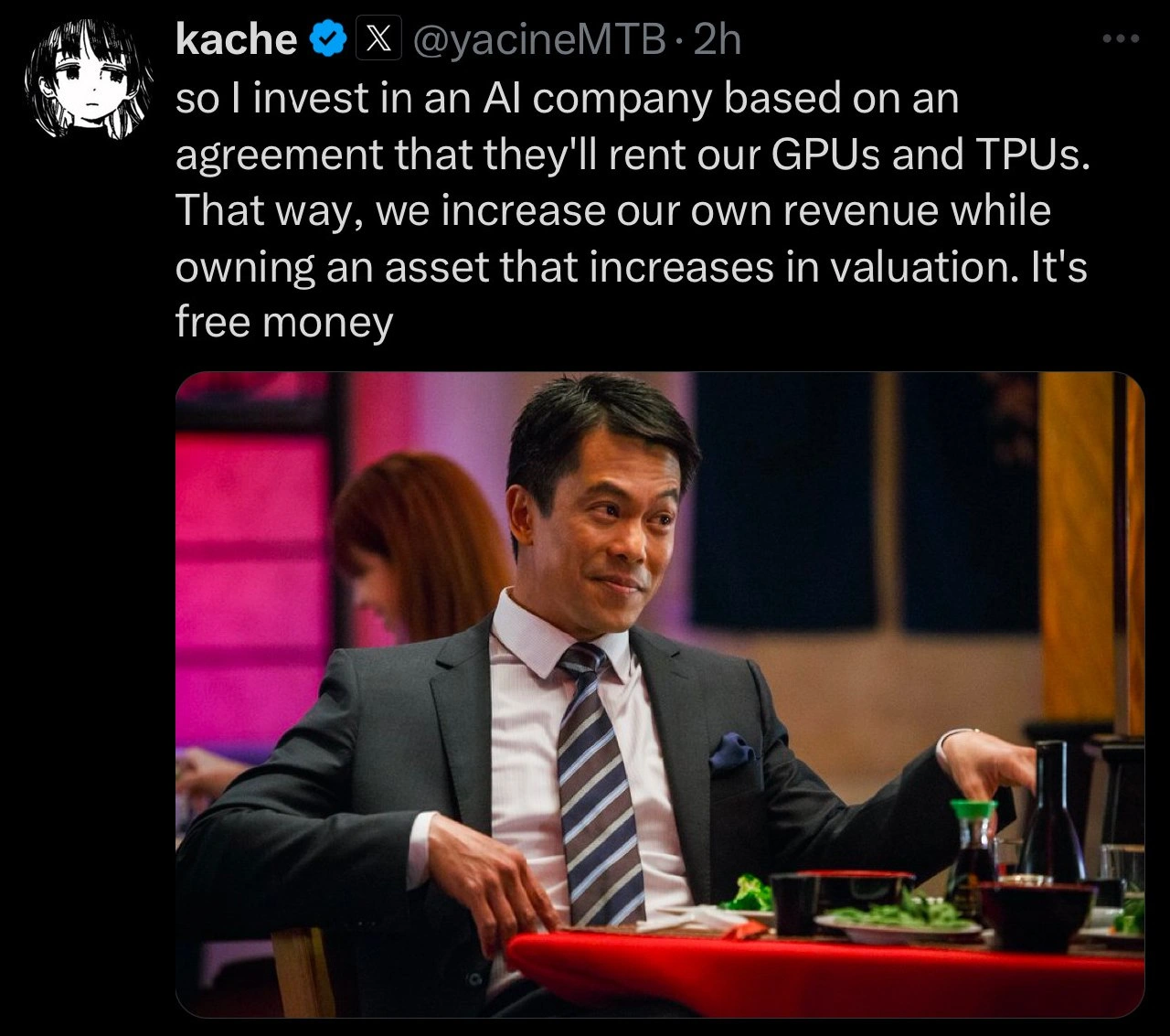
Let’s break down the basics of what’s going on in this meme. The meme is a screenshot of a Twitter post (classic twitter_screenshot_meme format) by a user joking about an investor pitch. The text of the tweet is:
“so I invest in an AI company based on an agreement that they'll rent our GPUs and TPUs. That way, we increase our own revenue while owning an asset that increases in valuation. It's free money.”
In simpler terms, the person is saying: “I’m going to put money into an AI startup, but with a catch: that startup must rent my GPUs/TPUs for their computing needs. By doing this, my own company earns more sales from the rental, and I still own the hardware which I believe will become even more valuable over time. I basically found a way to make money out of thin air!”
Now, what are GPUs and TPUs?
- A GPU (Graphics Processing Unit) is a special kind of computer chip originally made to render graphics (like in video games) really fast by doing many tasks in parallel. It turns out those skills are also great for MachineLearning tasks. Training AI models (like image recognition or language models) involves tons of math that can be done in parallel, so GPUs have become the workhorses of the AI boom. Think of a GPU as a massively-parallel engine that can perform thousands of multiplications and additions at the same time. In recent years, there’s been a gpu_shortage because every AI startup and research lab wants lots of GPUs to train the next ChatGPT or Alexa.
- A TPU (Tensor Processing Unit) is another type of chip, but it’s designed specifically for AI by Google. “Tensor” refers to the multi-dimensional arrays of numbers that are common in machine learning. Google created TPUs to speed up neural network computations even more. While GPUs are made by companies like Nvidia and are general-purpose (used for many kinds of computing tasks), TPUs are custom-built for AI workloads (especially for Google’s TensorFlow framework). They’re like a super-specialized tool for one job: crunching machine learning operations fast. Google Cloud lets companies rent TPUs as an alternative to GPUs for certain AI tasks – that’s where the tag tpu_leasing comes in. So both GPUs and TPUs are hardware accelerators that AI startups rent (often through cloud services) to do heavy computing without buying the physical machines.
Now, the investor’s idea in this meme: he wants to both invest in an AI startup and be that startup’s hardware landlord. Normally, an AI startup would pay a cloud provider (like Amazon AWS, Microsoft Azure, or Google Cloud) for access to GPUs/TPUs by the hour. Instead, this investor is saying “use my machines and pay me for it.” On paper, it sounds clever:
- The startup uses the investor’s hardware to build cool AI products.
- The investor’s company charges the startup rental fees for using those GPUs/TPUs (so the investor’s company’s revenue goes up).
- Meanwhile, the investor keeps ownership of those GPU/TPU devices, expecting that as AI gets even more popular, those devices can be resold or will be worth even more later (asset that increases in valuation).
- So the investor imagines getting two benefits: immediate income from rentals and a longer-term profit from selling the hardware later at a higher price. Hence calling it “free money.”
For a newcomer, a red flag here is the phrase “free money.” In real life, making money usually has costs or risks. If someone says a deal is “free money,” it often means they’re overlooking something important (or joking). In this case, a few obvious problems stand out, even to someone new to the industry:
- Hardware Depreciation: Normally, high-tech equipment loses value over time. Just like how last year’s smartphone is cheaper now than when it was new, the same is true for GPUs. Tech evolves fast—new models come out that are more powerful or efficient, so older ones become less desirable. The idea that a 2-year-old GPU or TPU will be worth more in the future is very shaky. It can happen in short bursts (for example, during a chip shortage or a cryptocurrency craze, used GPUs temporarily sold above retail price), but those situations don’t last forever. Betting on permanent appreciation is like betting that used cars will always go up in price – uncommon, to say the least.
- Operational Costs: Owning a bunch of GPUs isn’t automatically profitable. You have to store them (likely in a server room or data center), power them (GPUs consume a lot of electricity, especially when running AI computations 24/7), and cool them (they get very hot under constant use). All this means paying for facilities, electricity, cooling systems, and IT staff to maintain them. Those costs eat into the “free money” very quickly. It’s similar to owning a rental property: you earn rent, but you still have to pay for maintenance, property tax, repairs, etc.
- Reliability and Utilization: Just because you have hardware doesn’t mean it’s earning money all the time. Cloud providers solve this by renting to many customers so that their machines stay busy. If this investor is renting mainly to that one AI startup he invested in, what if that startup doesn’t need 100% of the hardware all the time? Idle GPUs = no rental income, but they’re still costing money sitting there. Or what if the startup goes bust (a lot of Startups do fail)? Then the investor is stuck with expensive hardware and no customers.
- Hype vs Reality: This is a classic case of AIHype influencing business decisions. Right now, everyone is excited about AI and there’s a narrative that “AI + anything = profit.” This meme pokes fun at that by taking it to an extreme. It’s basically saying: because AI is hot, even normally bad ideas (like counting your investment as revenue) start sounding reasonable to some folks. The AIIndustryTrends tag and AIHypeCycle concept refer to how there’s a cycle in tech where something new (like AI) is overly hyped, people think it will revolutionize everything and guarantee riches, then reality sets in. We’re in the “wild ideas fueled by hype” stage for AI hardware, and this meme is joking about one such wild idea.
- Conflict of Interest / Ethics: A more subtle point a junior might not catch: if you invest in a company and then force that company to become your customer, you might not have the startup’s best interest at heart. It’s like a bookstore investor saying “I’ll fund your bookstore, but you have to buy all your books from my publishing company at a markup.” It could hinder the startup’s success (what if they could get cheaper or better GPU service elsewhere, but are locked into this deal?). Experienced folks see it as a bit predatory or at least self-serving. Startups typically need freedom to choose the best tools, not obligations to pad an investor’s pockets.
The photo attached (the suit_guy_reaction image) shows a man in a sharp suit lounging at a restaurant with a smug expression. This visual is basically the meme’s wink: we all know this type of character from stories – the overconfident businessman who thinks he’s made a clever loophole in the system. The setting (nice suit, pocket square, fancy restaurant, blurred background with a bottle of sake on the table) screams “I’m successful and I know it.” It accentuates the smugness of the quote. The humor is amplified because the quote is so absurd to those in the know, yet the guy’s face says, “I’m a genius, right?”.
So, for a junior developer or someone new to tech:
- Why is this funny? It’s highlighting a silly, greedy idea that sounds like a guaranteed win but actually ignores basic facts. It’s like someone saying “I found a way to make money and eat ice cream all day without any downsides!” Seasoned folks laugh because they’ve seen schemes like this fail before.
- What should you take away? Be wary of anything that’s pitched as “all upside, no downside” – especially in tech. Whether it’s a new startup idea, or a claim about some technology, always look for the hidden costs or assumptions. And if someone says “it’s free money,” remember that’s almost never true. Even in the world of AI and fancy hardware, money doesn’t come for free — you earn it through providing real value or you’re taking on some risk to get it.
Level 3: The GPU Gold Rush
For experienced engineers, this tweet screenshot nails the absurdity of the current AI hardware land rush. The investor’s plan is basically double-dipping with a side of AIHype. He’s saying: “I’ll invest in your AI startup, but only if you rent our GPUs and TPUs for your computing needs. That way my company books revenue from your usage, and meanwhile our pile of GPUs skyrockets in value because AI is hot. It’s free money, bro!” It’s the kind of investor_logic that triggers eye-rolls in any veteran of the tech industry.
Why is it funny (and cringey)? Because it reads like a sketchy free_money_pitch one would see during a bubble. The man in the suit is smirking with overconfidence, embodying the hype-drunk investor who thinks he found a cheat code to unlimited profit. He’s basically treating GPU clusters like a money printer (the meme-y phrase “money printer go brrr” comes to mind) during this GPU Gold Rush era. In reality, we know there’s no free lunch – even cloud giants like AWS or Google invest billions in data centers and still have razor-thin margins on rented hardware.
This specific scenario lampoons a trend where everyone is rushing to buy or control AI accelerators (GPUs or Google’s TPUs) because training cutting-edge MachineLearning models requires massive computing power. With the explosion of large AI models, demand for these chips is through the roof, causing a gpu_shortage. Prices for top-tier GPUs (like NVIDIA’s A100s or H100s) have skyrocketed, and availability is scarce. In such a climate, the idea of starting a gpu_rental_business_model sounds like striking gold. The meme exaggerates this thinking to a ludicrous extreme: “We’ll own the shovels in this gold rush and charge the miners (startups) to use them, and those shovels will themselves become more valuable by the day!”
Seasoned devs recognize the hubris. Firstly, hardware usually depreciates – it wears out and gets outclassed by next-gen tech (remember how last year’s hot GPU is this year’s middling one?). Banking on asset_valuation_hype – the belief that your pile of silicon keeps gaining value – is pure ai_hardware_bubble mentality. We’ve seen analogous hype cycles before. For example, during the crypto mining craze, people hoarded GPUs thinking they'd print Ethereum and then resell the cards. Many ended up with fried cards when the bubble popped. A cynical veteran might recall the dot-com bubble or more recently the crypto/NFT bubbles where everyone thought they found a “can’t lose” formula. StartupCulture often has these moments where someone tries to bend the rules of basic business: e.g. counting an investment as revenue (which is essentially what’s happening here). This is like a company taking VC money and then recording that same money as sales by “selling” something back to the VC – a circular flow of cash that real accountants (and engineers with on-call scars) would frown upon.
The IndustryTrends_Hype being skewered is the idea that just because AI is the hot new thing, normal constraints don’t apply. Yes, AI is booming and AIIndustryTrends show investors throw money at anything AI-related. But that doesn’t magically eliminate costs or risks:
- Operational costs: Running GPUs 24/7 for AI experiments incurs enormous electricity and cooling bills. The meme’s pitch blithely ignores those. A data center full of GPUs is not a piggy bank; it’s a raging electricity gobbler and a maintenance headache. So much for “free” money when the power bill arrives.
- Supply-chain limits: As any hardware engineer knows, you can't summon more GPUs out of thin air. Chip fabs like TSMC have long lead times. The current gpu_shortage means even getting these GPUs/TPUs was hard; if their value went up, it’s partially due to scarcity. But scarcity can vanish if Nvidia cranks out more or if demand cools. Betting your business on a continued shortage is a gamble – if it eases, suddenly your “asset” drops in value.
- Competition: The big cloud players (AWS, Google, Azure) are already renting GPUs/TPUs at scale. They have economy of scale and expertise managing this gear. Our smug investor is basically proposing to become a mini-cloud provider for a single client (the startup he funds). Seasoned folks know how that movie ends: the startup either outgrows you or collapses, and you’re left with a bunch of out-of-date GPUs that nobody wants to rent anymore.
- Conflict of interest: There’s an unspoken joke about how sleazy this setup is. The investor is essentially investing money only to funnel it back to himself. It’s like lending someone cash on the condition they immediately buy your product. Sure, it inflates his revenue on paper (perhaps to impress other investors or board members), but it’s not new money — it’s the same money cycling around. This self-dealing might even border on Ponzi scheme vibes, which senior devs and tech historians will chuckle at, recalling infamous startup scams.
The image of the man in the suit at a fancy restaurant (with that confident lean and half-smile) perfectly encapsulates this suit_guy_reaction: he’s proudly explaining his genius plan, expecting everyone to applaud. You can almost hear him saying, “It’s free money,” with a smug grin. The blurred face and swanky setting add to the humor: it’s generic enough to be any slick-talking investor. The red tablecloth, the pocket square – it screams overconfidence. This is startup culture satire at its finest, where the swagger is big but the substance is questionable.
In summary, the meme mocks the AIHypeCycle where people genuinely start believing absurd propositions: that renting out expensive AI hardware to equally cash-burning AI startups is a guarantee of profit. Experienced engineers laugh (perhaps a bit bitterly) because we know every “money printer” scheme in tech – whether it was flipping internet domains in 2000, mining crypto in 2017, or renting GPUs in 2025 – eventually hits reality. The tweet’s punchline “It’s free money” is practically begging for Murphy’s Law to show up. If you’ve survived a production meltdown at 3 AM or watched a venture blow through cash, you know: whenever someone claims “free money” in tech, something’s fishy. The only thing free will be the lesson learned when this house-of-cards collapses.
Level 4: Perpetual Motion Economics
At the most theoretical level, this meme highlights an attempted violation of the tech industry's equivalent of conservation laws: there’s no free energy, and likewise no free money. The investor’s pitch is effectively a perpetual motion machine of profit — he believes he can cycle money through an AI startup and GPU rentals infinitely without loss. In physics, a device that produces unlimited energy from nothing is impossible due to thermodynamics (you can’t break the laws of energy conservation). Here, the economic thermodynamics are being ignored. The plan assumes the GPU (Graphics Processing Unit) and TPU (Tensor Processing Unit) hardware are magical assets that only gain value over time (as if defying Moore’s Law and normal depreciation) while simultaneously generating revenue via rentals. In reality, tech hardware obeys a form of economic entropy: servers require electricity, cooling, maintenance, and they age. Newer, faster chips come out regularly, meaning yesterday’s top-of-line accelerator might be tomorrow’s obsolete board.
This “rent and appreciate” scheme treats GPUs/TPUs like gold bars that can do work and also increase in price. But unlike gold (which just sits there), high-performance chips degrade with heavy use and typically lose value as technology advances. The only time a used GPU gains value is during an acute supply crunch — a temporary bubble when demand wildly outstrips supply (e.g. as seen in the recent gpu_shortage). Betting that this condition will hold indefinitely is like assuming a physical constant will change for your convenience. It’s pure speculative_hardware_investment thinking, akin to greater fool theory: buy an asset and hope someone else pays more later. The meme’s humor comes from seasoned engineers recognizing this “free money” pitch as a naive perpetual-profit fantasy that collides with hard realities of both physics and economics. Just as perpetual motion is forbidden by science, money-printing schemes like this are doomed by real-world costs and constraints. No system is 100% efficient, and here the inefficiencies (power bills, hardware failures, market changes) will eventually bite. The suit in the image lounges smugly as if gravity doesn’t apply to him, but gravity (and entropy) always wins. In short, the meme jokes about violating the No Free Lunch principle at a fundamental level: you can shuffle money around, but you can’t create value from nothing — economic thermodynamics always balances the books.
Description
The meme is a dark-mode Twitter screenshot from user “kache” (@yacineMTB, blue-check). The tweet reads in full: “so I invest in an AI company based on an agreement that they'll rent our GPUs and TPUs. That way, we increase our own revenue while owning an asset that increases in valuation. It's free money.” Beneath the text is a photo of a well-dressed man in a grey suit, striped tie, and pocket square lounging confidently at a restaurant table with a red tablecloth, assorted green garnish, soy-sauce bottle, and sake carafe; the man’s face (and a background diner) are blurred. Visually it conveys smug self-assurance, while the caption lampoons the current accelerator-hardware land-rush: selling GPU/TPU time to AI startups while betting on appreciating resale value. For experienced engineers, it highlights the speculative “AI-hardware = money printer” narrative that ignores supply-chain limits and real operating costs

Comments
43Comment deleted
New fintech play: mark H100s to “model-implied fair value,” rent them back to the ML team, ignore the 1 MW power bill - congrats, you’ve reinvented yield farming for PCIe slots
Ah yes, the classic "we'll be our own biggest customer" strategy - worked great for WeWork buying buildings from Adam Neumann and Enron trading energy with itself. Nothing says sustainable business model like circular dependencies in your cap table
Ah yes, the classic 'rent GPUs to yourself' arbitrage - where you simultaneously play landlord and tenant, inflating both sides of the balance sheet. It's like running a MapReduce job where the map phase is 'create revenue' and the reduce phase is 'ignore the circular dependency.' The real innovation here isn't the AI model; it's discovering that if you mark-to-market your own hardware fast enough, GAAP accounting can't catch you. Just remember: when the music stops and everyone realizes the TPUs are just expensive space heaters with no actual external customers, at least you'll own some very well-depreciated assets. It's not a Ponzi scheme - it's 'synergistic vertical integration of compute resources.'
Own the GPUs, not the models - because tensor cores compound returns faster than your next-gen hardware obsoletes
Nothing says “free money” like converting CAPEX into someone else’s VC‑funded OPEX: invest in the startup that rents our GPUs, book ARR here, mark up equity there, and call the circular dependency a compute flywheel
Perpetual‑motion‑as‑a‑business: flip CAPEX to OPEX by renting your H100s to your own portfolio company, recognize it as ARR, then explain to the auditor why the “customer” shares your LDAP
gratis und umsonst oder so idk* (*literally untranslatable play on words, sorry) Comment deleted
since both languages are germanic it's totally translatable gratis and free of charge or gratis and for free https://www.thesaurus.com/browse/gratis Comment deleted
you're losing the play on words in the process Comment deleted
how? they are etymologically exactly the same. Comment deleted
umsonst has a double meaning. you don't speak german I assume? Comment deleted
I speak German very well. usually this phrase is used when it's needed to indicate the small difference between being granted and acquiring without paying, which is not always the same. Comment deleted
completely wrong lol Comment deleted
there's no nuance here. "umsonst" just also means "for nothing", i.e. "useless" Comment deleted
this just doesn't apply here, since those meanings are orthogonal. but it can be used in some sort of a joke. Comment deleted
bruh do you know what a play on words is Comment deleted
ah yes, people telling a native speaker how their language works reminds me of my youth Comment deleted
to be fair, I natively speak austro-bavarian - my standard german is not that good. But that play on words works in both languages, so this mfer can go fuck himself Comment deleted
and I speak Hochdeutsch, I was aware of this joke, but it just logically doesn't fit here. Comment deleted
you learnt standard german in clown college because 1. it does and 2. you didn't even consider that possibility until I told you Comment deleted
I didn't consider because it doesn't fit. Comment deleted
sure, man. neither does my cock Comment deleted
don't put your cock where it shouldn't fit into. you may loose it as a result of such experiments Comment deleted
based Comment deleted
and you don't know about how and where I learnt German. but you can amuse yourself. go on. Comment deleted
I literally speak what's often called a dialect of the language. you're delusional if you think you know standard german better than me Comment deleted
I know a plenty of dialect speaking people. yes. their standard German is worse than mine. aaand for Austrians, especially dialect speaking we even put subtitles with a translation to proper German, because no man can understand that. I'm additionally quite fit in badisch and schwäbisch, and a bit fit in Berlin platt Comment deleted
you can claim to be the best german speaker in the world - if you didn't even know that one common idiom, I'm not going to believe you. you can claim it doesn't fit here all you want, but there's literally one way "gratis und umsonst" is used and just because you don't get it doesn't mean it's wrong. for fucks sake Comment deleted
okay man. whatever. I'm just amazed how you put just random word plays at random places. I tried to find a the closest fitting interpretation. since I still don't get how any of this can be useless. Comment deleted
there's no such thing as free money what he's doing is giving money to a business that (likely) isn't profitable. if it goes under, he will lose the investment. if it doesn't, the investment didn't change that if it's not a ridiculously large sum of money. the only "free money" he's getting out of this is just normal investing, which is basically gambling due to the erratic movements of the stock market. it seems like a smart move at first glance, but really he's just treading water. hence why I'm calling it worthless Comment deleted
even if it's going under and the money extends the life of the company somewhat, that still means he isn't getting the investment back, only whatever little money is used on GPUs after personnel expenses, taxes, etc. Comment deleted
and if it is profitable, which, it's an AI company, so very unlikely, unless maybe you're NVIDIA you're investing not only in a company that rents from you, but in a company that rents from your competitors. If the AI company deems your business less favourable than literally any other, you're paying money for your own demise. Comment deleted
so, no. there is no such thing as free money. if there was, everyone would be doing it. the only free money there is on the stock market is called market manipulation and is highly illegal Comment deleted
that enough of an explantion, dickhead? Comment deleted
yeah. from this I only could take that you have no idea what you are talking about, and your manner of constantly swear at me, reflects that level of intelligence. no point in further discussion. you are right. I am wrong. just chill down. Comment deleted
ah yes, so mr. investment banker over here has sacred knowledge about stocks. may he enlighten us with his wisdom or forever shut the hell up the swearing is on account of me being very annoyed about you. "no point in further discussion" but we felt the need to comment again, huh? you make yourself out to be smart, but you just want to be right Comment deleted
have you heard of positive-sum-game? there is nothing illegal in that. and strategies like this are quite common. they invest into a company so that this company can increase the value of their asset and pay part of that money back to get services to provide their own services to get even more income. strategies like this are quite fragile though. it may look smart in the beginning, but it's likely to collapse when any part of that cycle collapses, because then it changes into a zero-sum-game, where you need to be the first to take you money out of the system. Comment deleted
literally my point. the only method of gaining value is bound to end in one of the parties screwing the other over, and that's only if it goes well Comment deleted
a much better deal would be just paying them for an exclusivity contract Comment deleted
money isnt useless after all. Comment deleted
Free beer and free speech? Comment deleted
isn't that, like, just a convoluted example of market manipulation? Comment deleted
AI company needs money for rent still and if gpu company gives this AI company money for rent it's technically self investment with extra step Comment deleted