Skip to content
DevMeme
2150 of 7435
Delivering on Requirements, Ignoring the Dumpster Fire
Stakeholders Clients Post #2400, on Dec 1, 2020 in TG

Delivering on Requirements, Ignoring the Dumpster Fire

Why is this Stakeholders Clients meme funny?

Level 1: Clean Room, Messy Closet

Imagine your teacher tells you to clean your very messy room. You want to make your teacher happy fast, so you stuff all your toys, clothes, and junk into the closet and under the bed. On the outside, the room looks clean – you did exactly what your teacher wanted, right? You even give your friend a high-five saying, “We did it!” But inside the closet, it’s chaos: things are crammed in, maybe the door barely shuts, and if someone opens it, everything will crash to the floor. The whole house might be neat for a moment, but you’ve created a big hidden mess that could cause trouble later (imagine if something important is now lost or broken in that heap). In this story, the happy high-five is like the team celebrating that they delivered what was asked, and the closet full of junk is like the tangled, burning system behind the scenes. It’s funny in the picture because we all kind of know the feeling – being proud you finished the job, while secretly hoping no one looks too closely at how you did it. This meme uses that idea to poke fun at developers and bosses: sometimes people are so focused on getting what they want right now that they ignore the big mess that’s building up out of sight. The lesson? Just like truly cleaning your room means organizing it properly (not just hiding the mess), making a software project successful means building it the right way, not just quickly slapping features together. Otherwise, you end up celebrating in a “clean” room that’s one open closet away from a disaster.

Level 2: Quick Fix Fire Hazard

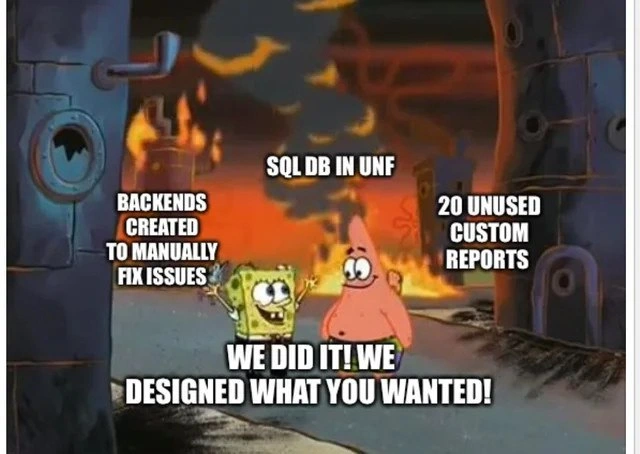
If you’re a newer developer, let’s unpack what’s going on here. The scene looks happy at first – two characters celebrating – but everything around them is on fire. That’s the joke: the team delivered what the client or stakeholder asked for (so they’re celebrating), but the way they did it has caused the system (the project) to become a disaster behind the scenes. In software, that behind-the-scenes disaster is often called technical debt – basically a fancy term for all the quick-and-dirty solutions and shortcuts taken along the way, which later cause big problems. This meme highlights three big examples of shortcuts that led to chaos: an ill-designed database, a bunch of hacky tools to fix constant problems, and a slew of features that nobody uses but still make the system more complicated.

First, the SQL database in UNF. SQL databases store information in tables, kind of like spreadsheets. There’s a whole practice of organizing these tables properly (called normalization) so that the data isn’t duplicated all over the place and is easy to update without mistakes. UNF here jokingly means “Un-Normalized Form” – implying the database is not organized well at all. It’s like if you had one giant spreadsheet for everything – customers, orders, products, all mixed together – with copy-pasted info everywhere. Sure, it might have been faster to set it up that way initially (one table is quick to make), but as the app grows, this design causes endless headaches. For instance, if a customer changes their name, you might have to find every row in that monster table and update it, and you’ll probably miss some. Things easily get out of sync. The meme shows that database as a building on fire, because a database that bad is basically a time bomb in real life – it leads to bugs and data corruption that have to be constantly “put out,” like fires.

Next, “backends created to manually fix issues”. This refers to little applications or scripts the developers built solely to correct things when the main system breaks. Imagine the main app is always messing up orders or accounts, so the team builds a separate admin website or runs scripts to manually adjust data every day. Instead of solving why orders or accounts got messed up, they just say “whenever it breaks, we’ll fix it by hand.” These extra backends are like having a bucket of water next to your perpetually leaky boat: you didn’t fix the leak, you just plan to bail water forever. In the meme, that bucket (the fix-it tools) is itself on fire – meaning even these manual fixes have become unmanageable. Often, such tools are thrown together quickly (because you’re under pressure to fix the immediate issue), so they can be pretty flimsy. Over time you might accumulate a dozen of them for different recurring problems. To a junior dev, building a quick script to fix data might seem clever (“hey, I fixed the bad data with this tool!”), but when you have a systemic problem that constantly needs such tools, it’s a red flag. It’s far better to fix the root cause in the main system – even if it’s harder – than to maintain a bunch of side tools that patch things up. Those side tools add complexity and can themselves break or cause new errors if used incorrectly.

Finally, “20 unused custom reports”. In many projects, the client or your boss will ask for a lot of features – say numerous reports that show different analytics or data slices. Eager to please, the team implements all of them. But often, it turns out only a few reports are actually used; the rest were “nice-to-haves” that nobody ends up looking at. Here we have feature creep – extra features piling up. For a junior developer, it’s important to learn that every feature has a cost beyond just building it: you have to maintain it in the code. Each of those 20 reports is like a piece of machinery: even if turned off, it still needs oiling. If the data format changes or you add a new business rule, you have to update all those reports too, used or not. So having 20 unused ones is pure overhead – it makes the codebase larger, testing harder (you’re supposed to test them, even if nobody uses them, because one day someone might), and it confuses the system’s purpose. Why are they unused? Possibly because the stakeholder requested everything under the sun “just in case,” or different managers each wanted their own pet report, but no one checked if they’d really be valuable. This is a misalignment between stakeholder expectations and actual user needs. In the meme, the building representing those reports is on fire, symbolizing that all that effort was basically wasted and is now just adding to the chaos.

So, putting it together in simpler terms: The developers did exactly what was asked of them (“designed what you wanted!”) without pushing back or thinking of long-term consequences. It’s like finishing an assignment by the due date but using a bunch of quick fixes and sloppy work to get there. On the surface, the project is “done” and the stakeholder is happy – hence the cheerful high-five. But underneath, the project’s structure is a mess – the equivalent of a city on fire. This meme is a humorous warning: just because your client is momentarily satisfied doesn’t mean your solution was good. In fact, if you take too many shortcuts and pack in too many unneeded features, you’ll spend the next months (or years) cleaning up that technical debt – essentially rebuilding the city you allowed to burn, hopefully with stronger materials the next time.

Level 3: Pyrrhic Feature Victory

“WE DID IT! WE DESIGNED WHAT YOU WANTED!”

This jubilant cry is pure Pyrrhic victory: the team delivered exactly what the stakeholder asked for, but at devastating cost to the system. The SpongeBob scene – two characters high-fiving amidst a burning city – nails the absurdity of celebrating stakeholder approval while the project’s architecture smolders in ruin. It’s a familiar dark comedy for senior engineers: success measured solely by feature delivery, even if achieving it meant torching every best practice in the book. The meme’s brilliance lies in labeling each burning building with a piece of the technical debt puzzle, painting a picture of a software project that has traded long-term stability for short-term applause. Let’s break down the arson scene:

  • SQL DB in UNF – The central pillar of any application, the database, is in an unnormalized form (UNF). In plain terms, the data schema is a dumpster fire. Instead of a well-structured relational design (where each piece of information lives in the right table with proper keys), this database likely has giant tables with redundant, repeating fields or jumbled one-table-to-rule-them-all designs. Senior devs cringe at UNF because it screams “we skipped database normalization to meet a rushed deadline.” The consequences? Endless data integrity issues. Perhaps two different records disagree on what a user’s address is, or some fields are just big blobs of comma-separated values. Every query or update becomes a fragile adventure. The team probably had to write convoluted stored procedures or cron jobs to keep this beast consistent – and even those are on fire. The visual of the DB building ablaze is perfect: the foundation of the software is literally burning, but hey, it technically holds some data!

  • Backends Created to Manually Fix Issues – This is the bandaid brigade. When core systems break so often that you build separate “backend” tools to clean up the mess, you know the architecture is in trouble. It’s common in high-technical-debt systems: rather than solving root causes, the team spawns a mini army of scripts, admin panels, and one-off services to patch data and restart stuck processes. Got orders stuck in the system because of that unnormalized DB? Build a manual fix tool for support staff to tweak records and push things through. Inventory counts keep going negative? Whip up a “reconciliation microservice” that runs nightly to set them back. These backends are essentially crutches keeping a limping system upright. And they breed like rabbits – each new category of bug begets its own fix-it script. The meme portrays these as a charred building, and rightly so: maintaining a constellation of fragile patch tools is itself a nightmare. They often bypass the normal app logic, so they can easily do more damage if used incorrectly. But in the heat of deadlines, creating them was faster than reworking the core system. It’s a hallmark of architecture trade-offs skewed entirely towards speed over sustainability: immediate problem solved, long-term stability sacrificed.

  • 20 Unused Custom Reports – Ah, the graveyard of over-engineered features. Stakeholders often request piles of custom reports (“We need quarterly sales by region, product, salesperson, moon phase… and 17 other variants”) just in case. The obedient team, under pressure to please, builds them all. Each report likely required new queries, new UI pages, maybe even additional data pipelines – adding complexity and code paths galore. The punchline: nobody ever uses them. Maybe the stakeholder glanced at one or two, but the rest sit idle, dead code from day one. Yet they still contribute to the system’s complexity and need maintenance whenever the data model changes (which, in this UNF database, is probably every other week due to emergency schema tweaks). This is a prime example of misaligned expectations and classic feature creep: implementing everything the client imagines without validating genuine need. A seasoned engineer sees those “20 unused reports” as pure waste – both in effort and in increased surface area for bugs. The meme captures it: an entire building (of code) fully built, now unused and on fire, possibly taking other parts down with it. It’s a figurative money bonfire, but on Jira it looked like a victory: all requested reports delivered! 🎉

The caption “We designed what you wanted!” drips with irony. It’s the development team celebrating a hollow win: the stakeholders/clients got exactly what they specified in the contract or meeting notes. From a project management standpoint, scope was delivered. But this meme is a bitter commentary on architecture and code quality suffering horribly in the process. The cheerful SpongeBob and Patrick represent developers (or more cynically, perhaps the non-technical managers) blissfully high-fiving over meeting requirements, while ignoring that the product’s foundation is scorched. It’s reminiscent of those war stories where a desperate team meets an immovable deadline by piling hack upon hack. Sure, the demo worked and the client signed off, but now the codebase is a house of cards. One deployment, one tiny change, and the whole thing might collapse – or require constant manual firefighting to stay afloat.

For veteran engineers, this scene is painfully relatable humor. It satirizes the disconnect between stakeholder expectations and sound engineering practices. The stakeholder says “jump,” the team asks “how high?” – and they do it, repeatedly, ignoring the design patterns or refactoring that could keep the code clean. After months of this, you have an application held together by prayer and duct tape, yet the only metric upper management sees is that features are “complete.” It’s developer gallows humor: we laugh because if we didn’t, we’d cry about how true it is. The meme throws shade at a universal truth in bad software projects: short-term wins can lead to long-term infernos. In the end, everyone toasts to delivering all requested features on time – while the on-call dev is secretly dreading the 3 AM emergency calls that will inevitably result from this unmaintainable mess. It’s a celebration on the deck of the Titanic, after hitting the iceberg. Congrats, we did what you wanted; please ignore the water rushing in.

Level 4: Unnormalized Chaos

At the core of this inferno is a rejection of fundamental software design principles. The database labeled “SQL DB in UNF” signals that the team ignored relational normalization rules – essentially keeping data in a chaotic, Un-Normalized Form. In relational theory, normal forms (1NF, 2NF, 3NF, etc.) are rigorous guidelines to organize data into tables so that each fact is stored once. When a database isn’t even in First Normal Form (1NF), it means fields might hold multiple values or redundant groups. This breaks the mathematical elegance of the relational model: without normalization, data anomalies run rampant. Imagine a customer’s name stored in five places – update one row and now your system contradicts itself in four others. These inconsistencies are theoretically guaranteed in a poorly normalized design, as formalized in database textbooks. The academic warning is clear: skipping proper schema design leads to insertion anomalies, update anomalies, and deletion anomalies, each a fancy term for “your data gets painfully out-of-sync.” The meme’s burning SQL building is a nod to this exact catastrophic entropy – the data model’s disorder is so extreme that the integrity (a formally defined property of databases) has gone up in flames.

So what happens when you defy the normal forms? You essentially incur a massive technical debt principal. This concept, coined by Ward Cunningham, is more than a buzzword – it’s a theoretical model comparing shoddy code to a financial loan. Here, every shortcut (like not normalizing the DB or whipping up hacky fixes) is the principal of the debt, and the “interest” is paid in endless maintenance and system instability. The second law of thermodynamics has a corollary in software: without continual effort to refactor and pay down debt, software entropy inexorably increases. Each “quick fix” adds disorder (entropy) to the system. Given enough unchecked fixes, the system’s complexity will approach chaos – exactly what we see as the city burns. In theoretical terms, this team’s architecture has reached a state of maximum entropy: every component is so coupled by ad-hoc solutions that the slightest change threatens the whole system’s balance. It’s a living example of Lehman’s Law of Software Evolution: over time, a program subject to change will become more disordered unless actively reorganized. Here, all reorganization was deferred, so disorder reigns.

Even classical architecture patterns have broken down. The scene is essentially a Big Ball of Mud – the formal name for a system with “haphazardly grown, sprawling sloppy architecture.” No clear modules or layering, just a mass of interwoven quick fixes. Each “backend to manually fix issues” violates the design principle of single source of truth, introducing parallel subsystems whose sole job is to bandage the main system’s wounds. The resulting inconsistency between the main path and the manual-fix path is something no design pattern in the GoF catalog can cleanly address – it’s an anti-pattern incarnate. Furthermore, the presence of “20 unused custom reports” is a direct affront to the YAGNI principle (You Ain’t Gonna Need It) from agile methodology. Theoretically, YAGNI urges never to implement a feature until it is necessary, to avoid exactly this kind of waste and complexity. By delivering a fleet of unused features, the team ignored this fundamental lean principle, bloating the system without any return on that complexity. In sum, the meme humorously illustrates a scenario where every classical rule was broken: the relational model’s normal forms, the managed growth of complexity, and the agile wisdom of avoiding feature creep. The result is systemic collapse – an expected outcome that any CS theory or software engineering 101 course could have predicted, had anyone cared to look past the immediate stakeholder demands.

Description

A meme using the 'We Saved the City' format from Spongebob Squarepants. In the image, Spongebob and Patrick are celebrating and cheering enthusiastically in the middle of a street in Bikini Bottom, which is completely destroyed and on fire in the background. The main caption reads, 'WE DID IT! WE DESIGNED WHAT YOU WANTED!'. Various labels are overlaid on the scene of destruction, pointing out the project's technical flaws: 'BACKENDS CREATED TO MANUALLY FIX ISSUES', 'SQL DB IN UNF' (Unnormalized Form), and '20 UNUSED CUSTOM REPORTS'. The meme satirizes development projects where the team meets the stakeholder's explicit, often flawed, requirements to the letter, resulting in a technically disastrous, unmaintainable system. The team's misplaced pride in their 'achievement' highlights the disconnect between delivering on a spec and building a quality product, a scenario painfully familiar to experienced engineers who have dealt with the consequences of poor project management and weak technical oversight

Comments

7
Anonymous ★ Top Pick This is what happens when 'The customer is always right' meets a team with no senior engineers to say 'No.' The resulting product has the half-life of a mayfly and the blast radius of a small tactical nuke
  1. Anonymous ★ Top Pick

    This is what happens when 'The customer is always right' meets a team with no senior engineers to say 'No.' The resulting product has the half-life of a mayfly and the blast radius of a small tactical nuke

  2. Anonymous

    Stakeholder sign-off checklist: UNF tables stacked like Jenga, a hotfix-as-a-service backend, and 20 bespoke reports nobody will ever open - congrats team, the fire passed UAT

  3. Anonymous

    After 15 years in the industry, I've learned that 'SQL DB in UNF' with 20 unused custom reports is just enterprise speak for 'we built a $2M Excel replacement that requires three backend services to maintain data integrity because someone's nephew said NoSQL was too trendy.'

  4. Anonymous

    Ah yes, the classic 'ship it and forget normalization' approach - where UNF stands for 'Utterly No Foresight' and those 20 unused custom reports are just pre-emptive technical debt for the next team. Nothing says 'enterprise-grade solution' quite like backends that exist solely to paper over database design decisions made during a sprint planning meeting. The stakeholders got their features, the database got its denormalization, and the on-call rotation got 20 new ways to page you at 3 AM. Everyone wins! Well, except the poor souls who inherit this masterpiece and discover that 'what you wanted' and 'what will scale past next Tuesday' were apparently mutually exclusive requirements

  5. Anonymous

    Enterprise MVP: UNF schema for “velocity,” a backend whose only endpoint is /fix-manually, and 20 bespoke reports nobody opens - still passes UAT because the demo was all mocks

  6. Anonymous

    Acceptance criteria met: a UNF schema, a fleet of remediation microservices, and a report catalog with zero MAUs - outputs shipped, outcomes incinerated

  7. Anonymous

    Built to spec: UNF DB for infinite flexibility, manual backend voodoo for eternal job security

Use J and K for navigation