When Scope Creep Wrecks the Deadline
Why is this Stakeholders Clients meme funny?
Level 1: Moving the Finish Line
Imagine you’re running a race, aiming for a finish line that’s just up ahead. You’ve been told where the finish is and how much time you have to get there. But then, while you’re sprinting, someone suddenly drags the finish line farther away mid-race. You try your best to catch up to this new spot, but of course you can’t finish when you originally thought you would. Then that same person who moved the line complains that you didn’t finish on time! 🤦 It’s both frustrating and a bit funny, right? In this meme’s story, the stakeholder (the person who wanted the feature) is like that rule-changer moving the finish line, and the developer (the person doing the work) is the runner who now can’t meet the original time. The joke comes from how silly it is to expect someone to meet a deadline after the target was moved. It’s an “are you kidding me?!” kind of situation that we can all shake our heads at and laugh about.
Level 2: Shifting Goalposts
Stakeholder: this means a person who has an interest in the project’s outcome – often a client, manager, or product owner who requests features and cares about deadlines. In this meme, the stakeholder expected a certain feature (a specific functionality in the software) to be finished by today. Requirements are the details of what that feature should do. Changing requirements mid-development (while the work is in progress) is generally risky, because the team has to adjust what they’re building on the fly. In Agile development (which uses short work cycles called sprints), the plan is usually set at the start of the sprint. Here, “mid-sprint” means halfway through that cycle, after work has begun. When the stakeholder came in and altered the plan during the sprint, it caused what we call scope creep – the project’s scope (all the planned work) expanded without proper adjustments to time. Scope creep almost always leads to delays – the deadline has to be pushed out to accommodate the extra work. Sure enough, that’s what happened here: the due date slipped, and the stakeholder is now unhappy that the feature isn’t ready. This is a classic case of misaligned expectations – the stakeholder assumed they could change the plan and still get the same delivery date, but the developer knew that was unrealistic. This kind of confusion happens because of a communication gap – either the stakeholder didn’t understand the impact of their late changes, or the team failed to communicate that the timeline would slip. In simple terms, the stakeholder moved the goalposts (changed the goal after the game started) but still expected the team to score by the original time.
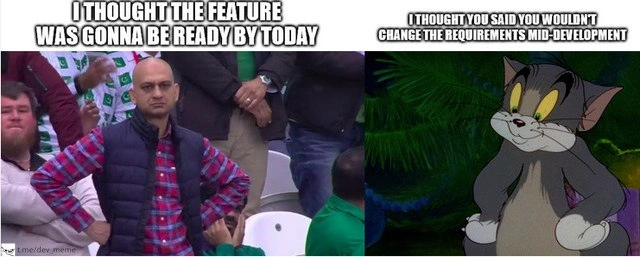
The meme’s two panels illustrate this tug-of-war. The left panel shows a real-life cricket fan from Pakistan who became a meme for his dramatic, disappointed pose during a match. He stands with hands on hips, looking utterly done with the situation. That’s the perfect representation of a stakeholder thinking, “What on earth happened to my timeline?” The bold white text at the top of that panel (classic meme Impact font style) indeed declares that he thought the feature would be done by now. The right panel features Tom the cat (from the Tom & Jerry cartoons) with drooping eyelids and a crooked grin. Tom’s expression looks sly and knowing. In the meme, he’s the developer character delivering the punchline – basically saying, “We didn’t finish on time because you kept changing what you wanted.” The caption on Tom’s image spells out that message in no uncertain terms. In other words, the developer is pointing out the broken promise in a cheeky way. This contrast – frustrated client vs. smirking engineer – is a common format in project management humor. One side complains about the result, the other side quips about the cause.
Level 3: Scope Creep Hydra
This meme captures a scenario every battle-hardened developer recognizes: the dreaded scope creep monster devouring a project’s timeline. It’s like fighting the mythical Hydra – finish one agreed requirement, and suddenly two new ones sprout mid-sprint. In the left panel, we have that famously exasperated cricket fan (the one with arms akimbo and a "you’ve got to be kidding me" face) perfectly embodying the stakeholder’s frustration. He’s essentially saying, "I THOUGHT THE FEATURE WAS GONNA BE READY BY TODAY." Meanwhile, the right panel shows Tom the cat from Tom & Jerry with a sly, half-lidded grin. Tom represents the developer, and his caption is the perfect sarcastic retort: "I THOUGHT YOU SAID YOU WOULDN’T CHANGE THE REQUIREMENTS MID-DEVELOPMENT." In other words, the dev is smugly pointing out that the missed deadline is a direct result of the stakeholder’s own last-minute changes. The visual contrast is golden: a real-life person fuming on the left versus a cartoon cat smugly calling out the hypocrisy on the right.
The humor here lands because it highlights a well-worn Agile pain point: stakeholders often want to have their cake and eat it too when it comes to scope vs. schedule. In a healthy Agile sprint, requirements are supposed to be locked down at sprint planning – you agree on what feature to build and the team gets a short, focused period (say two weeks) to deliver it. If new ideas or change requests pop up, they’re meant to go into the backlog for the next sprint. That’s the theory, anyway. In reality, business priorities can shift on a whim, and some stakeholders treat the sprint plan as merely a polite suggestion. They’ll barge in mid-iteration with “just one small change,” completely oblivious to how it derails the team’s flow and creates change request churn. By suddenly shifting requirements mid-development, they’ve essentially negated the original plan, yet they still expect the deadline to remain unchanged – a classic case of misaligned expectations.
The seasoned folks in tech recognize this as a project management anti-pattern. There’s even the classic Iron Triangle principle: you can’t fix scope, time, and resources all at once without sacrificing quality. Here the stakeholder tried to expand scope (more features/changes) while keeping time fixed – basically demanding a miracle or massive overtime. The result? The feature isn’t ready by today, and everyone’s playing the blame game. The developer’s smug Tom face is that of someone who’s seen this deadline pressure scenario play out a hundred times. It wordlessly says we could have delivered on time if you hadn’t moved the goalposts. (In software lingo, “moving the goalposts” means changing the target or requirements after work has started.) The dark irony is that this conversation is happening mid-sprint, a time when new changes are supposed to be off-limits. It’s a textbook case of a sprint derailment – the sprint goal got thrown out the window as new requests came flying in.
For veteran engineers, this scenario is equal parts comedy and therapy. You laugh because it’s true – after surviving enough scope-change fiascos, sometimes all you can do is smirk like Tom and think, “Well, what did you expect?”
Description
A two-panel meme contrasting the expectations of management with the reality faced by developers. The left panel features the 'Disappointed Cricket Fan' meme, showing a man with his hands on his hips, looking stern and unimpressed. The text above him reads, 'I THOUGHT THE FEATURE WAS GONNA BE READY BY TODAY'. This represents a project manager or stakeholder. The right panel shows a smug-looking Tom Cat from the cartoon 'Tom and Jerry', with his arms crossed and a knowing smirk. The text above him reads, 'I THOUGHT YOU SAID YOU WOULDN'T CHANGE THE REQUIREMENTS MID-DEVELOPMENT'. This represents the developer's sarcastic response to the manager's complaint. The meme perfectly captures the classic conflict between stakeholders who demand features by a certain deadline and developers who are frustrated by the ever-changing requirements (scope creep) that make those deadlines impossible. A small watermark for 't.me/dev_meme' is visible in the bottom left corner
Comments
7Comment deleted
The agile roadmap is less of a map and more of a real-time GPS that's constantly rerouting you through the bad parts of town because the destination keeps changing
We’d have shipped on time, but your requirements are eventually consistent - we’re still waiting for them to converge
After 15 years in this industry, I've learned that 'feature freeze' is just a suggestion, 'MVP' means 'Most Verbose Product', and the only constant in requirements is that they'll change right after you've refactored the entire codebase to accommodate the previous change
The eternal dance of software development: PMs promise stakeholders features 'by EOD' while simultaneously requesting 'just one small change' that invalidates three sprints of work. It's like asking why the bridge isn't finished while actively moving the riverbanks. Bonus points when they call it 'agile flexibility' instead of what it really is - requirements whiplash that turns your carefully architected solution into a Jenga tower of technical debt
Scope creep mid-dev: the only refactor that rewrites your entire backlog without a PR
You turned a two‑point CRUD into a cross‑service distributed transaction with GDPR and a new SLO at T‑48h; CAP theorem still applies to calendars
The release date was a hard SLA; the requirements were best‑effort UDP - so of course “ready today” depends on which packets you dropped mid-sprint