Ignoring 200 Code Warnings Like a Pro
Why is this CodeQuality meme funny?
Level 1: Check Engine Light? Keep Driving
Imagine you’re riding in a car and the dashboard lights up with a bunch of warning indicators – the oil light, the tire pressure light, maybe even the engine light. You might gasp and think “Oh no!” for a moment. Those are like the car’s way of warning you that something might need attention. But then you notice the car is still driving just fine. It hasn’t broken down; the engine is still running. So you shrug and say “Eh, it’s probably okay,” and keep driving anyway. 😅
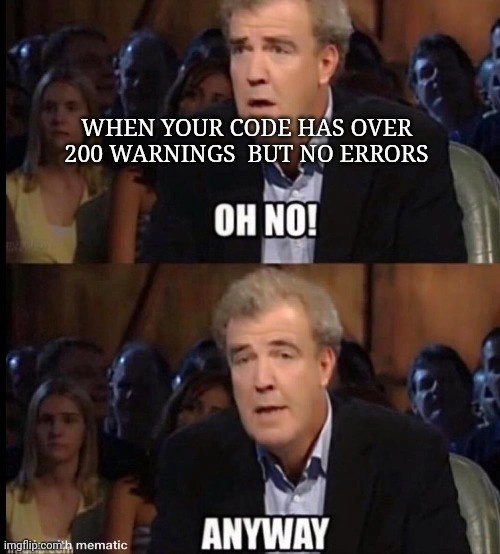
This meme is joking that writing code can be just like that. The computer (through the compiler) can give the programmer lots of warning signs that maybe something isn’t right under the hood. In the picture, the man says “OH NO!” seeing all those warnings, and then “ANYWAY” – meaning he decides not to worry about it. It’s funny because it’s a bit like ignoring a bunch of smoke alarms when you don’t see a fire. The code had 200 warning signals, but no big red error to force a stop, so the developer acts like everything is fine and just runs the program. We laugh because we know ignoring warnings (or dashboard lights) isn’t the smartest thing, but the relief of “well, at least it still works!” is a temptation we all recognize. Just like a car running with its check-engine light on, the code works... for now. The humor comes from that feeling of risky relief: deep down you know you should fix the problem, but you’re just happy nothing bad happened right away.
Level 2: Yellow Light vs Red Light
Let’s break down the technical bits for newer developers. A compiler is a program that takes your source code (in languages like C, C++ or Java) and converts it into an executable program or machine code. Compilers are very strict about code that violates the language rules. When something is outright wrong – say you forgot a semicolon, called a function that doesn’t exist, or mismatched types in an assignment – the compiler throws an error. An error is like a red stop light: 🛑 it means “I can’t create a proper program from this code.” The compilation process halts there; you have to fix the error to move on. For example, if you have:
int main() {
printf("Hello world") // Oops, missing semicolon here
return 0;
}
A C compiler will emit an error (perhaps “error: expected ‘;’ before ‘return’”) and refuse to produce an executable. No executable means you’re not running this program until the error is resolved.
Now, compiler warnings are different – think of them like a yellow caution light: ⚠️ “Hmm, this might be a problem, but it’s not breaking the rules.” A warning does not stop the compiler from creating the program. For instance:
#include <stdio.h>
int main() {
int unused = 42; // This variable is never used
printf("Hello, world!\n"); // Print a message
return 0;
}
This code will compile successfully (no errors), but most compilers with default settings will print a warning about the variable unused being set but never actually used. You’ll get something like:
warning: unused variable ‘unused’ [-Wunused-variable]
The compiler is hinting, “You have a variable that you never use – did you maybe forget to use it, or can you remove it?” The program will still compile and run, and the warning is just informational. You might see dozens of similar messages if your code has a lot of little issues like that.
So when the meme says “WHEN YOUR CODE HAS OVER 200 WARNINGS BUT NO ERRORS”, it describes a situation where the compiler is complaining a lot, but not enough to stop you. No errors means the program built successfully. 200 warnings means the compiler found 200 things that looked fishy. That’s like a car that starts and drives (engine is okay, so no “error” stopping you), but the dash is lit up with 200 warning lights about various issues. It’s technically operable, but yeesh, there are many signs of trouble!
Why would anyone let there be 200 warnings? This often happens in large or long-running projects. Perhaps the project was built without strict settings, and over time little issues piled up release after release. Every developer might think “I’ll fix those warnings later,” but if it’s not mandatory, later keeps getting postponed. This leads to what we call warning fatigue: there are so many yellow messages that people just tune them out, like background noise. The team might say, “well, that module always throws 50 warnings, it’s legacy code, don’t worry about it.” Essentially, they treat warnings as benign as long as the program works.
There’s a common best practice to combat this: treat warnings as errors. Most compilers and build systems have an option or flag (for example, -Werror in GCC/Clang) to elevate every warning to an error. If that was turned on, those 200 warnings would instead be 200 errors – the build would fail and force the developers to address each one. It’s a great way to keep code clean. However, not everyone uses this flag, especially if they inherit a codebase already swimming in warnings (flipping it on suddenly would grind development to a halt until all are fixed). So without -Werror, the compiler by default will politely notify you of issues but ultimately give you the green light to run the code anyway.
The meme’s second line “OH NO!... ANYWAY” is exactly the attitude of ignoring these caution signs. Jeremy Clarkson’s meme format (from Top Gear, where he jokes about something being dangerous and then immediately acts like it’s no big deal) is used here to poke fun at developers doing the same thing: noticing a problem and immediately moving on as if it didn’t matter. CodeQuality proponents will cringe at the idea of 200 warnings unaddressed, because each one could be a bug waiting to happen or at least messy code. And indeed, in a perfect world, you’d fix or clean up warnings as they appear. But in the real world of deadlines and massive codebases, people often cut corners. They think, “Well, it compiles. No error means it must be okay... let’s ship it.” The meme humorously captures that feeling of false relief. It’s making fun of our tendency to rationalize technical debt: “There’s a lot wrong here, but since nothing’s on fire right now, I’ll pretend it’s all good.” Oh no! – and then anyway.
Level 3: It Compiles, Ship It
This meme hits on a painfully familiar scenario in software development: you compile the code, 200 warning messages scroll by, but 0 errors, and you think “Eh, it’s fine, it runs!”. The top panel with Jeremy Clarkson exclaiming “OH NO!” represents that split-second of alarm a developer might feel upon seeing over 200 compiler warnings. That’s a lot of yellow text in your build log – it looks bad. In an ideal world, each warning is telling you about a potential issue: maybe an uninitialized variable that could cause a random crash, or a deprecated function that might be removed in the next library version. A hundred or two of those is a veritable minefield of CodeSmells and mini-red flags. Any seasoned engineer will tell you those warnings are telling a story about your code quality.
But then comes the second panel: “ANYWAY”. Clarkson’s deadpan dismissal perfectly captures the all-too-common developer reaction: a shrug and proceeding to ignore the warnings because the build succeeded. If the compiler isn’t outright failing (no error), many developers and teams will treat warnings as background noise. This is the classic “It compiles, let’s ship it!” mentality. The humor is in the cognitive dissonance: we all know 200 warnings are not good, but we’ve also been in situations (tight deadlines, frustrating legacy code, or 4:59pm on a Friday) where our internal dialogue is, “Oh no, there’s a ton of scary messages... anyway, push to production.” It’s funny precisely because it’s true – it’s a shared inside joke among programmers about our own bad habits.
There are real reasons behind this indifference. One is warning fatigue – when you see the same warnings over and over, you become desensitized. The first time, warning: unused variable 'tmp' catches your eye; the 200th time, you automatically gloss over it. In large legacy codebases, it’s not unusual to have dozens of benign warnings that everyone has collectively agreed to live with. Maybe fixing them is risky (touching that old module might break something else), or time-consuming with little immediate payoff. So the team’s unspoken policy becomes “no errors, no problem”. New developers joining such a project are often shocked: they were taught to keep code warning-free, yet here is professional code spitting out pages of warnings that everyone just ignores. Cue the Clarkson “Oh no” moment for the newbie... followed by the veteran dev saying “don’t worry about those, the build passes” – “Anyway.”
This meme also nods at the practice (or lack thereof) of treating warnings as errors. Many experienced devs advocate adding that -Werror flag to catch issues early. It forces you to treat every one of those 200 warnings like an error that stops the build. Great for CodeQuality, right? But imagine turning it on in a project that currently has 200 warnings – boom, you’ve got 200 build errors now. No one’s going home for the weekend until they’re fixed! Not all teams have the appetite for that kind of warning purge, so they defer it. Hence, warnings accumulate like dust. Each one is a bit of TechnicalDebt: a hint of something possibly wrong that isn’t being cleaned up. As the meme implies, we often just sweep that dust under the rug and ship the product. After all, the app runs, the tests (hopefully) pass, and users aren’t filing bug reports for “compiler warning in module X”. The immediate pressure is low, so the warnings remain, quietly mocking our lax standards.
The Clarkson meme format adds an extra layer of irony here. Jeremy Clarkson is known for his brash, dismissive one-liners on Top Gear, and “Oh no… Anyway” is a popular clip/meme for showing apathy after feigned concern. In a developer context, it hilariously personifies our inner voice when dealing with build outputs. The first panel’s “OH NO!” is us developers pretending we’re about to tackle those 200 warnings. The second panel’s casual “ANYWAY” is us immediately moving on, pretending nothing happened. It’s basically the developer version of whistling innocently after seeing a problem. We laugh at this meme because it’s a form of collective self-deprecation: Yup, I’ve been guilty of that. It highlights the eternal tension between what we should do (address warnings, improve code health) and what we actually do under pressure (ignore them since there’s “no error”). In short, it’s capturing a TechDebt snowball in progress – one “Anyway” at a time.
Level 4: If It's Not Forbidden
In compiler design, a warning is known as a non-fatal diagnostic – the compiler’s way of saying “Hmm, this looks sketchy, but it’s not explicitly illegal, so I’ll let it slide.” Under the hood, as the compiler parses and analyzes your code (building an AST, performing type checking, etc.), it labels certain dubious constructs with warnings. These are things that the language specification allows (hence not errors) but that often indicate probable bugs or bad practices. For example, in C or C++, using a variable that you never actually use, or having an assignment inside an if condition (if(x = 5)) doesn’t break the compiler’s grammar rules or type system, but it triggers the compiler’s spider-sense. The compiler essentially says, “Technically I can build this, but you might be doing something unintended.” Warnings emerge from static analysis passes that run after the code passes basic syntax/semantic checks. They flag things like possible uninitialized variables, deprecated API calls, or type conversions that might lose data. The key is that if it’s not forbidden by the language, it’s allowed – the compiler will still produce output. Warnings are the compiler being chatty: giving you hints or caution tape around code that could be a pitfall, without slamming the brakes on the build process.
Why not just treat these suspicious cases as errors outright? This comes down to language philosophy and the limits of static analysis. C/C++ compilers, for instance, follow the “trust the programmer” ethos: they won’t abort compilation on something that could be fine. A lot of warnings are about code that is valid but likely a mistake – the compiler can’t be 100% sure. (After all, solving whether some dubious pattern is definitively a bug can be as hard as the Halting Problem in the general case!) Instead, compilers give a gentle nudge. Historically, tools like the original Unix lint were separate programs precisely because early compilers stuck to errors only; over time, compilers have integrated these checks as warnings to help improve CodeQuality without forcing the issue. It’s a pragmatic split between soundness and completeness: catch many CodeSmells and probable bugs, but don’t block the build on what might be false alarms. Modern build chains offer flags like -Wall (enable a broad wall of warnings) and categorization of warning types (-Wshadow, -Wdeprecated, etc.) so developers can finely tune how pedantic the compiler should be.
That said, compilers also allow you to escalate warnings to errors — enter the treat_warnings_as_errors_flag (e.g. -Werror in GCC/Clang, or /WX in MSVC). This flag flips all those yellow flags to red: the build will fail even on things that would ordinarily be mere warnings. It’s a way to enforce zero-warning code. In theory, if everyone always used -Werror, codebases wouldn’t accumulate dozens of warnings... but reality is more complicated. Large legacy projects may throw hundreds of warnings that are infeasible to fix quickly without risking new bugs. So teams often leave -Werror off, especially during early development or on older code. The result? The compiler emits a deluge of “Hey, FYI…” messages and then cheerfully produces the binary anyway. The TechDebt interest is quietly compounding: every ignored warning today might be a bug that bites tomorrow. From a purist standpoint, those warnings are like entropy in a software system – without discipline (or strict compiler settings), they only increase over time. The meme humorously highlights this gap between what the compiler could enforce and what developers actually tolerate. It’s poking fun at how our tools dutifully raise yellow flags, and we, as drivers of the code, often just floor it through the caution zone because nothing immediately blows up.
Description
A two-panel meme featuring Jeremy Clarkson from the show 'Top Gear', popularly known as the 'Oh no! Anyway' format. In the top panel, Clarkson has a concerned and slightly shocked expression. The overlay text reads, 'WHEN YOUR CODE HAS OVER 200 WARNINGS BUT NO ERRORS', with a smaller caption below it saying 'OH NO!'. The bottom panel shows Clarkson with a calm, dismissive expression, and the caption simply says 'ANYWAY'. The meme humorously illustrates a common developer behavior: treating compiler or linter warnings with feigned concern before ultimately ignoring them because they don't prevent the application from building or running. This highlights the prioritization of functionality over perfect code quality, especially under pressure, and the tendency to accumulate technical debt by deferring non-critical cleanup tasks. The image has watermarks for 'imgflip.com' and 'mematic' in the bottom left corner
Comments
7Comment deleted
Treating warnings as errors is a sign of a junior developer. A senior knows the precise level of code decay the build server will tolerate before catching fire
“200 compiler warnings and zero errors - turns out our most battle-hardened resilience pattern is never enabling -Werror, which we’ll later document as ‘graceful degradation.’”
Those 200 warnings are just the compiler's way of documenting why the next team will need a complete rewrite in 18 months
Ah yes, the classic 'warnings are just the compiler's opinions' philosophy. 200 warnings is basically a code review from a very concerned colleague who you've learned to tune out. Sure, each one represents a potential null pointer dereference, unused variable, or deprecated API call that will definitely bite you during the next major refactor - but that's Future You's problem. Present You has a sprint to close and stakeholders who only care about green CI pipelines. Besides, if the language designers really cared, they'd make warnings break the build by default... right? *Narrator: They should have enabled -Werror*
200+ warnings and a green checkmark - that’s when you notice -Werror quietly vanished to hit Q4 OKRs; the interest starts compounding at merge
Warnings? The compiler's passive-aggressive invoice for tomorrow's prod outages we 'll fix next quarter
200 warnings, no errors? Congrats - you’ve built a distributed risk system; flip -Werror and watch CI reenact your next postmortem