The Developer's Last Resort: Consulting ChatGPT for Docker Errors
Why is this Debugging Troubleshooting meme funny?
Level 1: Asking the Class Clown
Imagine you’re working on a really hard puzzle and you just can’t figure it out. You’ve tried all the normal things: you read the instructions carefully, you asked your parents or friends for hints, and you even searched for answers in a book or online. But no one knows how to solve this exact puzzle. You feel totally stuck. Finally, you decide to ask the one person you normally wouldn’t go to for help: the class clown who always jokes around and doesn’t usually do their homework.
Going to the class clown is kind of a last resort. You’re thinking, “Well, I’ve got no other choice, maybe they’ll say something – even by accident – that helps me.” You know this friend might just give a silly answer or make something up, but you’re so desperate to get any clue that you ask them anyway.
In this simple story: the hard puzzle is like the Docker error that’s really tricky, the parents and friends you asked are like Google or other programmers who usually help, and the class clown is like ChatGPT – a helper who might not always give a serious or correct answer. The funny part is realizing you’re so stuck that you’ll even ask someone (or something) known for giving unpredictable answers. It’s a mix of feeling frustrated, a little hopeful, and a little embarrassed. That’s why the meme is funny: it’s showing a developer in that moment of “I have no other choice, please just tell me something that might help!”
Level 2: Stack Overflow Stumped
Let’s unpack what’s happening in simpler terms. The meme is about a programmer struggling with Docker, which is a tool used to create containers. A container is like a little isolated box that has everything an application needs to run (code, libraries, system tools) so that it works the same on any computer. Building a Docker container means running a series of steps (like installing packages, copying files) to create this box. Sometimes the build fails, meaning the process stops with an error message.
Now, usually when a programmer sees an error message, they’ll search online for that exact text. Why? Because often someone else had the same problem and asked about it on a forum like Stack Overflow (a popular Q&A site where developers help each other). For common errors, a quick Google search leads to solutions or explanations. But a “hyper specific error message” is one of those very detailed, weird errors that might be unique to your situation. For example, perhaps the error says a certain library file is missing during the Docker build, but that library name is very uncommon. When you search it, you find little or nothing useful. That’s when frustration kicks in.
In the meme’s text, the developer has reached the point of desperation. They tried all the usual debugging steps: checking Docker’s documentation, Googling, reading others’ experiences. Imagine getting zero useful hits on Google – not a single website knows about your error. That’s what we mean by Stack Overflow stumped: even the go-to community Q&A has no answers. It’s like shouting a question into the void.
So what do they do? They turn to ChatGPT, an AI assistant. ChatGPT is a large language model – basically a very advanced chatbot that can talk about almost anything, including programming problems. It has read a lot of stuff from the internet (up to its training cutoff), so it can often provide advice or at least plausible suggestions for technical issues. People have started using these AI assistants to help debug code or errors.
The funny part is that asking ChatGPT for help with code can be hit-or-miss, especially for a really odd error. ChatGPT might give a correct answer if the error or problem is something it “saw” during training (like in some documentation or forum). For example, it might recognize “Oh, that Docker error usually means the base image is missing a dependency, try adding this line to your Dockerfile.” That could save the day. But other times, if the error is truly one-of-a-kind, the AI might just guess. It could confidently tell you to do something that sounds reasonable but isn’t actually right for your case. Since ChatGPT doesn’t actually run or test anything (it just generates text), it can’t be sure its answer will fix your Docker build.
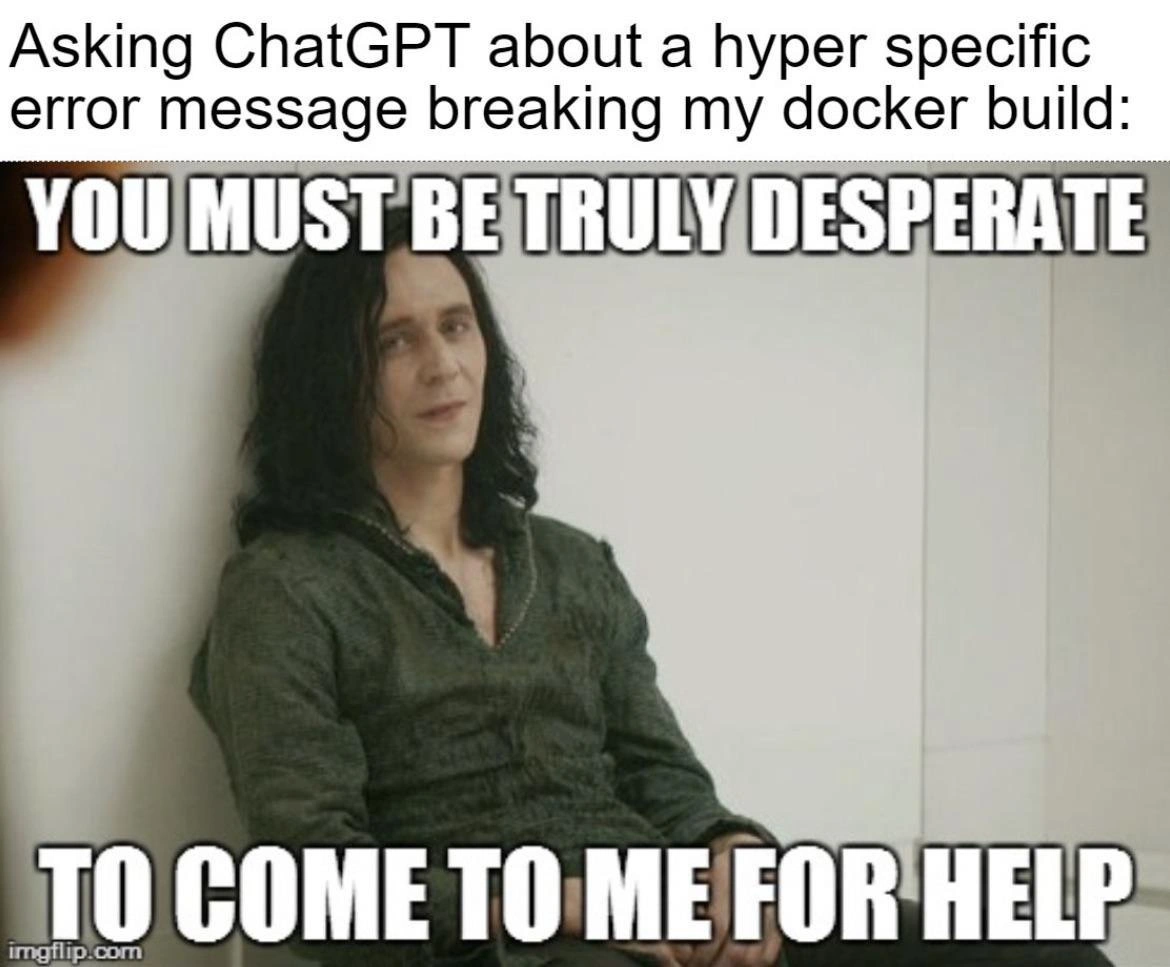
In the meme image, Loki (a character known for being a trickster in Marvel movies) is used to represent ChatGPT. Loki says, “You must be truly desperate to come to me for help.” This implies that normally you wouldn’t ask Loki (or ChatGPT) for help because you can’t fully trust them. Loki in the movies often betrays or tricks people. Similarly, ChatGPT might not always give a reliable solution. But if you’re truly desperate, you’ll ask anyway, because no one else can help at that moment. It’s a playful jab at how developers feel when they resort to AI: a mix of “I hope this works” and “I can’t believe I’m asking a bot because humans had no answer.”
This scenario is common enough to be humorous. Many developers have experienced a Docker build error or some setup issue that was so peculiar, no one had blogged or posted about it yet. It’s a rite of passage in programming to eventually encounter a problem that even the internet hasn’t solved publicly. Today, with tools like ChatGPT, the lonely developer has one more avenue to try. It’s new and a bit uncertain, which is why it feels like turning to a trickster character. The meme captures all that in one image and line of dialogue, making fellow developers laugh and nod, “Yep, been there.”
Level 3: Trickster Tech Support
In this meme, a developer’s Docker build is failing with some hyper-specific error that nobody on the internet seems to recognize. The humor hits home for seasoned engineers because it captures that rock-bottom debugging moment when you’ve tried everything “normal” and end up asking ChatGPT for help. The image uses Loki in a cell saying, “YOU MUST BE TRULY DESPERATE TO COME TO ME FOR HELP.” Here Loki represents ChatGPT – a powerful but unpredictable trickster. It’s a tongue-in-cheek way of saying: “Wow, you ran out of all other options if you’re coming to an AI chatbot with obscure Docker errors.”
For senior developers, this scenario is painfully relatable. Docker, which packages applications into containers, often promises “works on my machine” consistency. Yet when container builds break, they can produce cryptic error messages that send you down a rabbit hole. Maybe a library failed to install in the image, or some environment variable isn’t set, or the CI/CD pipeline’s network can’t reach a dependency server. Usually, a veteran dev will:
- Scour Google for the exact error text.
- Comb through Stack Overflow questions (often finding nothing or stale answers).
- Read obscure GitHub issue threads for a clue.
- Check official docs and still come up empty.
When all else fails, you do the unthinkable: ask an AI. The meme nails the feeling of standing at the gates of debugging Valhalla, pleading with a machine-learning oracle. It’s funny because ChatGPT is a last resort you know might be a mixed bag. This AI didn’t actually debug your code or container; it’s just predicting likely solutions from its training data. Sometimes it suggests a brilliant fix you hadn’t thought of, like tweaking a Dockerfile line or clearing a cache layer. Other times it confidently hallucinated nonsense (“Have you tried sacrificing a rubber duck to the container gods?” 😈).
The CICD BuildSystems angle here is real. In a production pipeline, a failing Docker build can block releases. Imagine it’s 3 AM and your container image won’t build before a deadline. You’re bleary-eyed, every search result is a dead end, and the team Slack is silent. In that dark hour, even Loki-GPT’s chaotic advice seems worth a shot. The meme’s Loki quote implies ChatGPT itself is mocking you: it knows you’re only here because the situation is dire. It’s a sardonic nod to developer pride – asking an AI feels like admitting defeat, like going to the trickster you swore you’d never trust. Yet here you are, because a bizarre Docker error has broken your spirit.
In short, the meme jokes about developer desperation in the face of containerization woes. It satirizes how modern devs will consult a flashy AI assistant for help with an esoteric build error, akin to bargaining with a villain for a favor. Seasoned folks laugh (perhaps a bit bitterly) because they’ve lived this: when your build pipeline is on fire and even Stack Overflow has forsaken you, summoning ChatGPT can feel simultaneously pathetic and hopeful. It’s the new “break glass in case of emergency” for debugging hell.
Description
The meme shows the character Loki from the Marvel Cinematic Universe, smirking at the viewer. The top text reads, 'Asking ChatGPT about a hyper specific error message breaking my docker build:'. Overlaid on the image of Loki is the text 'YOU MUST BE TRULY DESPERATE TO COME TO ME FOR HELP'. This meme captures the feeling of a developer who has exhausted all conventional debugging options for a complex Docker issue and is now turning to an AI like ChatGPT as a final, desperate measure. It humorously personifies the AI as a powerful but potentially untrustworthy entity, reflecting the skepticism experienced developers often have towards AI-generated solutions for nuanced, specific technical problems
Comments
21Comment deleted
Using ChatGPT for a mysterious Docker build error is the modern equivalent of copy-pasting a shell command from a sketchy forum. You might fix the problem, or you might accidentally summon a Cthulhu-level dependency conflict
You know the container gods have abandoned you when your sleek Alpine multi-stage build dies on “libstdc++.so.6 not found” and ChatGPT’s fix is basically “¯\_(ツ)_/¯ FROM debian:latest” - fine, Loki, ship the 800 MB image, I just want CI green
The real irony is that after 20 years of copying from Stack Overflow, we're now asking an AI that was trained on... Stack Overflow. At least ChatGPT won't mark your Docker question as duplicate while your production build is on fire
We've reached the point where asking an LLM to hallucinate a solution to your Docker build error is somehow more productive than reading the actual 47-line stack trace that just says 'layer failed' without specifying which of your 23 multi-stage build steps actually broke. At least ChatGPT will confidently suggest adding `--no-cache` and pretend it understands your Alpine base image's glibc incompatibility issues
LLM diagnosis for "failed to solve with frontend dockerfile.v0: exec format error" on arm64: try --no-cache - perfect if your goal is converting CI minutes into heat
Nothing says 'production-ready' like asking a stateless LLM to debug a stateful BuildKit cache: it confidently prescribes 'RUN apt-get update'... in an Alpine image on an air-gapped CI runner
Docker errors so niche, ChatGPT channels Loki: 'Desperate enough to feed me your entire build log? Bold move.'
Me trying to print the file content on RouterOS ssh Comment deleted
Spoiler: the /file print file=MyFile.txt is not the correct one. Comment deleted
ChatGPT can help with rare errors much better than just google/stackoverflow/docs. Comment deleted
Exactly. Having all the information, including the source code and dev mailing lists, it should be much more capable to answer such questions Comment deleted
if chatgpt can answer the question, and the dev can't, the dev is incapable. Comment deleted
sure dev should be able to answer, but the question was about chatgpt vs google Comment deleted
Lmao Comment deleted
Nah, there’s too much changing variables underneath Comment deleted
Chatgpt will always answer it. Just won't get the answer right Comment deleted
When you know how to ask, you already know how to do it but you are just lazy to ready the doc… Comment deleted
That's about the art of googling, nothing more. Docs may be written poorly and deprecated, but if you've been taking some desperate-scrolling time, you'll find some guy in 2005 on linux org complaining bout some underlying syscall what may lead you to your solution Comment deleted
real. Comment deleted
Literally had this yesterday, I was so desperate, I asked gpt to go over the steps it proposed to troubleshoot connectivity… And it worked! It didn’t pinpoint the error, but provided just enough information so I noticed it myself Comment deleted
... but if you're doing that worse than chatgpt -- yeah, go read the friendly manual Comment deleted