The Thin Line Between Enterprise Code and Spaghetti Code
Why is this CodeQuality meme funny?
Level 1: Same Mess, Different Dress
Think about a chef in a fancy restaurant and a kid cooking at home, both making a pot of spaghetti. The chef is wearing a clean blue suit or a crisp uniform and the kid is in a t-shirt. You’d expect the chef’s kitchen to stay spotless and the kid to make a mess, right? But by the time they’re done, both kitchens are splattered with sauce and noodles. 🍜 The chef might have the title and the outfit, but cooking spaghetti can get messy for anyone. In the end, spaghetti sauce stains don’t care who you are! This meme is funny for the same reason: it shows a super professional-looking programmer and a regular programmer ending up with the same kind of mess. The words “WE ARE THE SAME.” mean that even if one person looks very professional and the other seems sloppy, when it comes to writing computer code, they both can end up tangling things up. It’s a warm, silly reminder that everyone has goof-ups – no matter how grown-up or expert they appear. We all spill a little sauce sometimes, and that makes us more alike than we thought, which is why it makes us smile.
Level 2: Untangling Spaghetti Code
Let’s break this meme down in simpler terms, especially if you’re new to coding or haven’t had the “pleasure” of dealing with an old codebase. The meme compares "professional code" with "spaghetti code", suggesting they might actually be the same in practice. So what do these terms mean?
Spaghetti code: This is a nickname for code that’s a tangled, unstructured mess – like a heap of cooked spaghetti where you can’t follow one noodle from start to finish. In code, that usually means everything is interwoven and it’s hard to trace the program’s flow. For example, imagine a single function that runs hundreds of lines, hopping in and out of conditions and loops without clear organization. The origin of the term dates back to old programming days (when people used a lot of
gotostatements that could jump around the code, making it as twisty as spaghetti). You don’t need to know that history, though, to identify spaghetti code. You feel it whenever you think, “Wow, this code is all over the place!”Professional code: This implies code written with industry standards, best practices, and good CodeQuality in mind. Think of things like clear structure, well-named variables, modular functions, and plenty of tests and documentation. It’s the kind of code you’d be proud to show others or the code that gets published in a company’s repository after careful review. When someone says “I write professional code,” they’re boasting that their code is high-quality, maintainable, and maybe even elegant.
The funny part is the meme says these two – the proud professional and the spaghetti coder – are the same person. That points to a couple of things. First, even great developers have written code that doesn’t work or ended up messy. Second, it’s a bit of a roast of those who act superior about their coding; the meme suggests that under the hood, their work might not be as flawless as they claim.
To illustrate, here’s a tiny example of what spaghetti code can look like, versus how a pro might avoid that:
# Spaghetti code example (messy, all-in-one logic)
def handle_order(order):
# Many nested conditions make this hard to follow
if order.is_expedited:
process_expedited(order)
if order.user.is_vip and order.total > 100:
apply_vip_discount(order) # nested deep
if order.address is None:
order.address = get_default_address(order.user) # even deeper nesting
else:
# non-expedited orders
log_order(order)
if order.retry_count > 3:
alert_support(order) # special case buried inside else
# ... imagine many more intertwined conditions ...
In the code above, the logic twists and turns with nested if statements. It’s doing a lot in one place: checking order status, applying discounts, handling missing addresses, alerting support for retries, etc. If something went wrong in this function, you’d have to read through every line and condition to figure it out – that’s like untangling a knot of noodles. A more “professional” approach might separate these concerns: one function to handle expedited shipping, another to apply discounts, another to notify support, each called in a clear sequence. The details aren’t important here; the point is that well-structured code is easier to read and modify, whereas spaghetti code feels chaotic.
Now, Technical Debt is a term you might hear when discussing why spaghetti code happens, even in big companies. It’s an analogy: imagine you’re building something and you cut a corner to save time (like taking out a loan). It works for now, but there’s a “debt” to pay later because that corner you cut will need fixing. If you keep piling on quick-and-dirty solutions, you accumulate technical debt, and eventually, just like financial debt, the “interest payments” (in the form of bugs, slowdowns, and refactoring effort) come back to haunt you. For instance, a developer might think, “I know this code isn’t great, but I’ll fix it when I have more time.” If that time doesn’t come, five more features get built on top of that shaky code, and soon it’s a wobbly Jenga tower. All software projects have some technical debt; it’s often a trade-off between doing something the right way vs. the fast way.
Code smells are another concept worth knowing. A code smell is like a hint that code might have a deeper problem. It doesn’t mean the code is definitely wrong, but it “smells funny.” For example, a function that’s 500 lines long is a smell (because it probably does too much). A class named DataManagerHelper2 is a smell (why is it “2”? What happened to 1? 😜). Spaghetti code, by definition, has a lot of these smells: lots of global state, functions that touch everything, inconsistent naming, etc. In the meme context, the “spaghetti code that does not work” line is basically pointing out a code smell extreme – code so messy it outright fails.
So how does this relate to a junior developer’s experience? Imagine you just wrote your first big program. Maybe it’s a school assignment or a personal project. It grew over time, and you started hacking in new features wherever they fit. Now the code runs, but you’re the only person who can understand it (and even you get confused sometimes). Then you go on social media and see a developer from Big Tech bragging about their sophisticated systems. You might feel a bit insecure, like “Wow, my code is so primitive compared to theirs.” This meme is here to say: Don’t worry, even that person has been where you are. In fact, they might still be fighting through a mess of their own.
The phrase “WE ARE THE SAME” is funny because it’s using a known meme format (we_are_the_same_template). Typically, this format has someone pointing out a difference and then concluding both are identical in some overlooked way. Here, the difference was “professional code” vs “spaghetti code,” and the surprise is that they’re ultimately the same category of struggle. It’s a bit like a straight-A student telling a C student, “I procrastinate and panic-study just like you do.” You wouldn’t expect that admission, so it’s both relieving and amusing.
Finally, let’s touch on the emotional core: self_deprecating_meme humor in the developer community is about acknowledging our own faults and laughing. The hashtag #notSame in the post actually contradicts the meme’s text, which is deliberate irony. The poster might be jokingly saying “I’m totally not as messy as you… (except I am, haha).” The takeaway for a newcomer is healthy humility: even top developers have had their share of CodingMistakes and messy projects. They’re just more experienced at eventually cleaning them up – or hiding the mess. 😉 Every engineer, from a hobbyist to a pro, has at some point stared at their screen in frustration because something was not working and the code was a jumble. This meme simply shines a light on that universal moment and gets us all to chuckle in agreement.
So, if you’re new to coding: strive to write clean, maintainable code, but don’t beat yourself up when things get tangled. It happens to everyone. The difference is that experienced devs have learned to recognize the spaghetti early and untangle it (or laugh about it and schedule a refactor sprint). As the meme humorously points out, behind the scenes, everyone makes CodingMistakes. Your heroes in tech have spilled some pasta sauce in their day, trust me. 🍝
Level 3: Professional Pasta Paradox
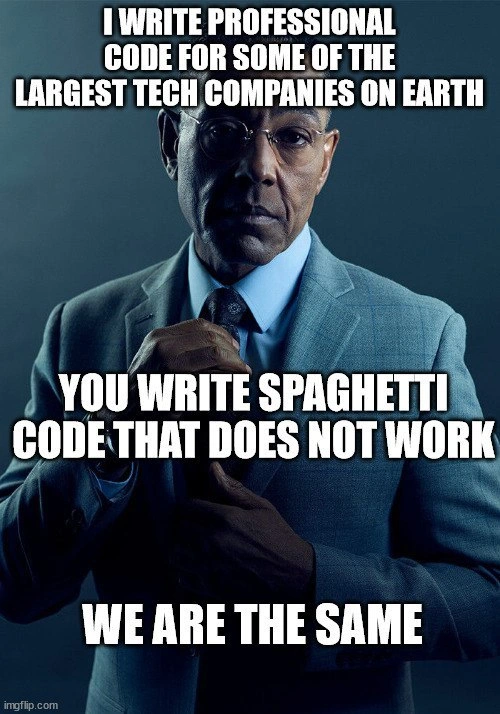
Under the crisp suit of enterprise software, there's often a tangled mess of code at its core. In the meme image, the man in the sharp blue suit adjusting his tie embodies that suit-and-tie coder archetype – a picture of corporate professionalism and confidence. The punchline “WE ARE THE SAME.” is a wry nod to a truth every senior developer eventually learns: even at the largest tech companies on Earth, behind all the polished process and style guides, there lurks plenty of SpaghettiCode. The top caption boasts “I write professional code…” and the middle retorts “You write spaghetti code that does not work.” It sets up a contrast between proper, high-quality code and messy, broken code. But the final line smashes that wall, admitting there’s no real difference – a comedic twist showing that “professional” code can be just as messy. It’s a CodeQuality reality check wrapped in irony.
Why do experienced devs smirk at this? Because they've seen the gap between coding ideals and reality. Many of us have cracked open a mission-critical codebase at a FAANG-level company expecting beautifully engineered modules, only to find a jungle of outdated classes and // TODO: fix this comments sprinkled like parmesan on a pasta pile. There’s an almost comforting schadenfreude in realizing that the code running multi-billion dollar systems can be as kludgy as a weekend hackathon project. The meme captures the Professional vs. Spaghetti dichotomy perfectly: a worldly, executive-looking programmer who secretly knows his fancy title doesn’t save him from the same TechnicalDebt nightmares as the rest of us. It’s the classic case of the emperor having no clothes – or rather, the architect having no clean code.
This humor is rooted in shared software engineering experiences. Impostor syndrome runs rampant in our industry; junior devs assume experts write flawless code, while experts know all code has flaws if you look close enough. The suit-wearing figure could be a senior engineer or CTO-type proclaiming high standards, and the “you write spaghetti” could be him chastising a newbie’s messy project. But then he acknowledges “we are the same”, effectively saying: I’ve written awful, tangled code too. It’s a humble confession that even enterprise_vs_hobbyist developers fight the same battles with complexity. The result is funny and relieving at the same time.
Let’s unpack a few real-world reasons behind this universal_technical_debt phenomenon:
Deadline-Driven Chaos: In big companies, release deadlines can be as unforgiving as in a startup. When crunch time hits, developers often implement quick fixes and hacks to make things “just work” before launch. Those fixes tend to bypass ideal design, introducing code smells (subtle warning signs like duplicate code or odd couplings). Over years, such hacks accumulate into the giant hairball we politely call a codebase. So that pristine “professional code” might only look clean in documentation; the real thing has patchwork fixes deep down, the kind an architect might call spaghetti with a resigned sigh.
Feature Creep and Layered Legacy: Software grows and evolves. A simple program from five years ago at a big company might now have dozens of bolt-on features, each with its own exceptions and edge cases. Picture adding new noodles to a spaghetti bowl—eventually it’s overflowing and tangled. Legacy code (old code that still does its job) often doesn’t play well with newer patterns, so developers write glue code to connect things. Glue code can turn into goo code pretty fast. 🕸️ Even a project that started with a clean architecture can become a big ball of mud architecture – a term architects use for systems with no clear structure, just a bunch of pieces slapped together. It’s both a joke and a sad reality that the most common software architecture in the world isn’t microservices or MVC or clean hexagonal design; it’s “big ball of mud” – in other words, spaghetti.
Conway’s Law in Action: Conway’s Law observes that the structure of software mirrors the structure of the organization that builds it. In a huge tech enterprise, there are many teams and committees. Ever been in a codebase where Module A calls Module B, which references Module C, but only when Service D is offline? That’s likely because Team A, B, C, D all built their pieces with only partial coordination. The result is a system of tangled interconnections — essentially spaghetti code at the architecture level. The dev in the suit might champion best practices in meetings, but even he must integrate code from different teams with conflicting assumptions, which can turn a clean design into a plate of enterprise entanglements.
Human Factors and Murphy’s Law: No matter how professional, developers are human. We get tired, we make mistakes, or we jury-rig something at 3 AM during an outage and promise to “clean it up later.” (Spoiler: later can take a long time to arrive.) That quick patch might live on in the code for years, confusing the next person who reads it. As a result, the CodingMistakes of individuals become institutional knowledge (“Oh, that module? Don’t touch it, nobody knows exactly how it works, but it’s been running since 2015”). In big companies, you can even have entire teams managing piles of legacy spaghetti, because rewriting it is like trying to replace the engine of a plane while flying.
Lack of Refactoring Time: Ideally, professional teams allocate time to refactor (rework messy code into cleaner code). In practice, business pressures often prioritize new features or urgent bug fixes over behind-the-scenes improvements. So even when everyone knows the code is smelly, taking the time to rewrite that old module doesn’t happen until something breaks horribly. The meme hints at this implicitly: both the high-class coder and the scrappy coder wind up with code that “does not work” quite right. The difference is one might have a tie on while debugging the mess. 👔💻
The DeveloperFrustration captured here is almost therapeutic. It’s saying, “Look, we all deal with this. It’s not just you.” Seasoned devs share war stories of encountering some convoluted 10,000-line Singleton or a maze of if statements written by a predecessor. They’ll laugh and say, “Yep, turns out the core service was basically one script held together by hope. We’re still untangling it.” This meme channels that exact vibe. The hashtag #notSame is used ironically by the original poster because the whole joke is that in truth, we are all the same in our coding struggles. That’s why it hits home for the coder community – from the intern dealing with a messy college assignment to the veteran maintaining a decade-old enterprise system, we’re united by the spaghetti monster that is imperfect code.
In short, the Professional Pasta Paradox (fancy suit on the outside, spaghetti code on the inside) is a well-known secret among developers. The meme cleverly uses the formal image and bold text to set us up for a punchline we half-expected but love seeing confirmed. It’s both a joke and a solidarity wink: whether you’re deploying to a world-class production server or just running a script on your laptop, you’ve probably seen things fall apart in similarly messy ways. And it’s okay – welcome to the club, we have spaghetti! 🍝😅
Description
This meme uses the 'We are not the same' format featuring actor Giancarlo Esposito, who is known for his role as Gus Fring in 'Breaking Bad'. He is depicted in a sharp suit, adjusting his tie with a serious, confident expression. The meme has three lines of white text. The top text says, 'I WRITE PROFESSIONAL CODE FOR SOME OF THE LARGEST TECH COMPANIES ON EARTH'. The middle text says, 'YOU WRITE SPAGHETTI CODE THAT DOES NOT WORK'. The final, punchline text at the bottom subverts the usual format by stating, 'WE ARE THE SAME'. The humor lies in this cynical and relatable admission. It suggests that the perceived gap between elite, 'professional' code at major corporations and amateur, messy 'spaghetti' code is non-existent. For experienced engineers, this hits home by acknowledging the reality of technical debt, legacy systems, and deadline pressures that often lead to compromised code quality, even in the most prestigious of tech environments
Comments
7Comment deleted
The only difference between my spaghetti code and FAANG's spaghetti code is that theirs is served on a distributed platter, costs a million dollars a month in cloud bills, and is called a 'mission-critical legacy system'
The only real difference between your weekend spaghetti code and our Fortune-100 microservice mesh is that ours comes with a 90-slide deck explaining why the noodles are “domain-driven.”
After 20 years in the industry, I've learned that the only difference between enterprise spaghetti and startup spaghetti is that one comes with a Confluence page explaining why it's actually 'architectural linguine' and a JIRA ticket marked 'Won't Fix - Working as Designed'
Turns out the main difference between 'enterprise-grade' code at FAANG and your side project isn't the architecture patterns or test coverage - it's just the number of layers of abstraction hiding the spaghetti, and whether the tech debt is measured in millions or just your personal shame. At least your spaghetti code doesn't require three microservices and a distributed tracing system to debug
At FAANG scale, spaghetti just gets renamed “service mesh” and assigned SLOs - Conway’s Law ensures the marinara matches the org chart
Mine's just scalable spaghetti - containerized regret serving millions without total collapse
After two decades, I’ve learned the only difference between your spaghetti and our “enterprise-grade” spaghetti is that ours ships behind three feature flags, six retries, and a blameless postmortem