Honest Developers and Unimplemented Features
Why is this GameDev meme funny?
Level 1: Just Add a Sign
Imagine you’re at a public swimming pool, but the pool isn’t ready for people to swim in. Maybe the pool has no water in it or the lifeguard didn’t show up. Instead of letting people jump in and get hurt or disappointed, the staff puts up a big sign that says, “Sorry, no swimming today.” They’re basically saying, “We know you wanted to swim, but we can’t let you, and here’s a sign so you understand.” In the meme’s game, the people who made the game did the same thing. They didn’t have time to teach the game’s hero how to swim (imagine not having the toy or part that lets your action figure swim), so they just placed a sign in the game that says “PLEASE DO NOT SWIM” and even admits “There isn’t an animation for it,” which is like saying “we didn’t finish that part.” It’s funny because instead of hiding the problem, they were very open about it in a silly way. It’s like if you were putting on a school play and one scene wasn’t ready, so you just put a note on the stage that says “Scene Missing – Pretend there’s something cool here!” Everyone would giggle, but they’d understand. In simple terms, the game creators solved a problem by telling the truth with a sign, and that honesty turned a letdown into a laugh.
Level 2: Please Do Not Swim
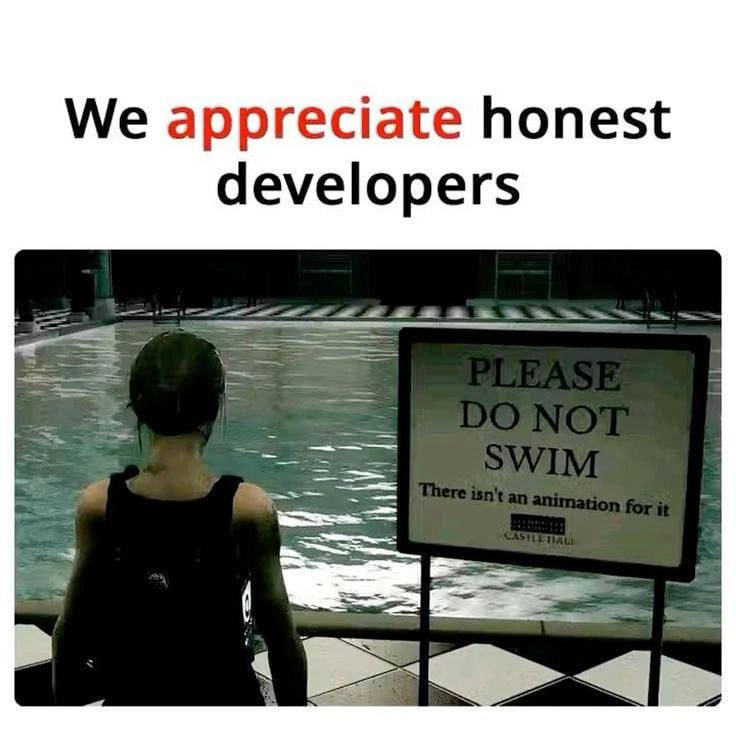
Let’s break down what’s happening in this meme in simpler terms. We have a screenshot from a video game: a player character (seen from behind, wearing a backpack) is standing in front of a big indoor pool. The water in the pool looks really realistic with reflections and ripples, which suggests the game’s GameEngine did a great job rendering visuals. But here’s the catch: there’s a sign by the pool that says, in all caps, “PLEASE DO NOT SWIM”, and just below that in smaller letters, “There isn’t an animation for it.” This sign is literally in the game world, as if placed by the game’s developers to communicate with the player. In other words, the developers are telling you through the game environment itself: “Hey, we didn’t make a swimming animation, so please don’t try to swim!” It’s a funny and direct message – the kind of candid admission you rarely see so blatantly in games.
Why would they do this? In game development, making a character able to swim isn’t as easy as flipping a switch. An animation in a game is a sequence of images or movements that show the character performing an action (like walking, jumping, or in this case, swimming). If the game doesn’t have a swimming animation ready, the character has no pre-made movements for being in water. If a player tried to jump in the pool anyway, a few things could happen:
- The game might let them go in water, but the character would look very odd (maybe just standing or T-posing while moving through water, because the game has no instructions on how to pose the body for swimming).
- Worse, it could cause bugs: the character might get stuck, or the physics might freak out because the GameEngine wasn’t told how to handle a swimming state.
- Or the game might have to abruptly prevent it by some generic means, like an invisible wall or just instantly killing the character (which some older games infamously did if you stepped in deep water without a swim feature).
Rather than risk any of that, the developers chose a simple solution: don’t let the player swim at all. In software terms, this is like using a feature flag set to “off” — they decided the swimming feature is not going to be active in the released game. What’s unusual is how they conveyed it: instead of just silently blocking the action or removing the pool, they literally put a sign in the virtual world to tell players “no swimming.” This sign is an in-game, or diegetic, way of communicating. Diegetic means it exists within the game’s story world (like a road sign or poster a character could realistically see in the environment). Here it’s as if the game’s world had a rule posted by some in-world authority, but the reason listed (“There isn’t an animation for it”) breaks the fourth wall a bit – it’s clearly the developers speaking directly to the player in a tongue-in-cheek way. It’s an example of a scope_based_ux decision: the user experience (UX) is being shaped by the scope of the project. “Scope” refers to the list of features and content the developers planned to include. As release day neared, it looks like swimming fell out of that scope – there just wasn’t enough time or resources to implement it properly.
Let’s talk about why adding swimming is a big deal in game development, especially if it wasn’t planned from the start:
- New Animations Needed: The character would need a full set of swimming animations (paddling, treading water, climbing out of the pool, etc.). Creating these means animators have to either hand-craft them or use motion capture, then integrate those animations into the game. This isn’t quick – it can take days or weeks to get animations looking good.
- Coding & Physics: The programmers would need to write code for a new “swimming” state in the GameEngine. The game’s code likely has something called a state machine for the character (states like idle, walking, running, jumping). Adding “swimming” means adjusting how controls work in water, adding buoyancy or resistance so you float instead of just falling, and ensuring the camera behaves underwater. Water might need properties like depth that trigger drowning if you stay too long, etc. It’s a chunk of work.
- Level and Design Adjustments: If players can swim, the designers have to think: can they reach new areas by swimming? Do we need to put invisible walls or design the pool differently so they can’t escape the level boundaries via water? What if they drop an item in water? Suddenly a whole bunch of design questions pop up.
- Testing: Every new feature needs testing. Swimming could introduce bugs (like weird interactions with other systems). Testers would have to try lots of scenarios: what if the player tries to swim carrying an object? What if they use a health pack underwater? Does the game crash if they pause while in water? All that has to be checked.
Considering all that, if the game is close to launch and swimming wasn’t implemented yet, adding it could seriously delay the release or divert a lot of team energy from polishing other core parts of the game. This is where DeadlinePressure comes in: the game likely has a fixed release date (maybe marketing campaigns are lined up, or it’s promised to players). The pressure to ship on time is huge. So the team makes a tough call: no swimming feature. That’s a classic EngineeringTradeoffs moment – sacrifice one feature to ensure the rest of the game is solid and on schedule. It’s not an easy choice, but it’s often the right one for the greater project good.
Now, usually when features are cut, developers try to hide that fact or remove any temptation of it. For example, they might drain the pool in the game (no water means no one expects to swim), or simply put invisible barriers so you can’t even step into the pool. What makes this scenario meme-worthy is the honesty and humor. The sign they put is basically the dev team winking at the players and saying, “Yep, we know you’d try to swim… we didn’t have time for that, so please don’t.” It’s turning a missing feature into a little joke. In software terms, think of it like an app that hasn’t implemented a certain button yet, but instead of hiding the button, the app shows the button grayed out with a tooltip that says “Coming in a future update – we’re working on it!” It’s a bit of transparency that most users actually appreciate, because it’s better than the app just crashing if you click that button. Here the sign is the game’s equivalent of a “coming soon” or “not available” note.
For a junior developer or someone new to GameDevelopment, there are a few key lessons wrapped in this funny image:
- Technical Debt vs. Shipping: Sometimes you knowingly leave something unfinished (that’s a form of TechnicalDebt) in order to ship the product on time. The “debt” here is that maybe later they’ll have to add swimming properly (perhaps in a patch or sequel), or live with the fact that the pool is just decorative. The developers took on that debt and communicated it openly.
- Communication and UX: How you communicate missing features matters. The devs chose a user-friendly approach by embedding the info in the game world. It’s actually a decent DeveloperExperience_DX practice in a way – they spared themselves angry bug reports like “Your game is broken, I jumped in water and nothing happened!” by proactively telling players what’s up.
- Relatable Developer Experience: Nearly every developer can relate to this: whether you’re building a game, a website, or an app, there will be times when a promised feature isn’t ready. Maybe you comment out that part of the code, or you put a big “Under Construction” banner on that section of the website. It’s a bit stressful (nobody likes cutting features), but seeing this meme, devs laugh because we’ve all been there. It’s a rite of passage in development to realize that sometimes, done is better than perfect.
And let’s not forget the positive spin: by doing this, the devs turned what could be a negative (no swimming? aww...) into a charming aspect of the game’s personality. Players shared this meme because they found it funny and endearing — the opposite reaction of what you’d expect from “missing content.” In the end, telling the truth in a humorous way probably saved the devs a lot of grief. Instead of logging a FeatureRequest asking for swimming or complaining about a glitch, players are in on the joke. So the meme isn’t just about a pool; it’s about how creativity and honesty under pressure can actually win players’ hearts (and laughs) even when something didn’t go as planned.
Level 3: Diegetic Feature Flag
At first glance, this meme is a love letter to GameDev realism and the absurd compromises made under extreme DeadlinePressure. The developers literally implemented a diegetic feature flag – a fancy way to say they turned off a feature (swimming) through an in-game element (the sign). Instead of a config toggle or an invisible wall, they plopped a sign in the game world that bluntly states "There isn't an animation for it." It’s both hilariously honest and deeply pragmatic. Seasoned engineers recognize this as the quintessential EngineeringTradeoffs moment: do we delay the release to build a full swimming system, or do we ship on time with a cheeky production_hack? The sign is essentially a FeatureFlag in plain sight, visible to players and doubling as an apology. It says, “Yes, we know you’d love to jump in the pool, but we didn’t have time to make that work – sorry (not sorry)!”
Consider what adding swimming properly entails in a modern GameEngine: new player states, physics for buoyancy, underwater effects, and of course a fully animated swimming motion. That means coordinating the asset pipeline – artists and animators crafting swim cycles, programmers integrating those assets, and QA testers finding all the ways a player could possibly glitch out under water. All that for one feature, when the clock is ticking. Instead, the team chose scope reduction in the most transparent way possible. They basically said, “Feature not ready? Fine, we’ll just tell the player upfront.” This kind of brutal honesty is both rare and refreshing, and the meme’s header “We appreciate honest developers” (with appreciate highlighted in red) playfully acknowledges that. Every veteran developer has experienced that end-of-cycle triage where you decide what gets cut. Here, the swimming feature got the axe – or rather, got fenced off with a big sign – and the devs even lamp-shaded it for a laugh.
From a senior perspective, this is a case of choosing the lesser evil and owning it. The alternatives could have been far worse: imagine allowing the player to swim without an animation. The character might T-pose or clip through the water, breaking immersion and possibly the game. Or the devs could’ve rushed a half-baked animation, leading to janky, bug-ridden swimming that players would definitely complain about. Instead, the team embraced the lack of a feature as part of the narrative. This transforms a potential bug or missing content into an in-joke that actually boosts the DeveloperExperience_DX (for the devs and the savvy players alike). It’s a clever form of TechnicalDebt admission — they’re openly acknowledging “yeah, we owe you a swim feature, maybe later.” Experienced devs nod knowingly here: it’s better to ship a stable game without swimming than delay everything or ship a broken swimming mechanic. In other words, scope_based_ux in action: the user experience is intentionally shaped by what was in scope for the project timeline. The players can’t swim, but they also won’t crash the game trying to. The humorous sign softens the disappointment and even earns goodwill, because players appreciate the candor.
This meme perfectly satirizes that release day crunch-time decision-making. Every senior engineer has war stories of last-minute cuts or quirky fixes to hit a deadline. In enterprise software you might hide a greyed-out button or disable an API call; in a game, you might place a cheeky in-world message like this. It’s essentially a asset_pipeline_shortcut manifested as a piece of the game’s world. The pool’s water looks gorgeous with all those realistic reflections (the art team clearly did their job), but without a swim animation the programming team had to improvise. And improvise they did – with a solution that’s equal parts FeatureRequests deflection and player comedy. As an industry practice, this touches on the idea of shipping a Minimum Viable Product: deliver what’s core and leave the rest on the cutting-room floor (or promise it in a patch). Seasoned devs appreciate how truth is often stranger (and funnier) than fiction in game development. The honesty of the sign effectively says to the community, “we prioritized polishing what’s there over building what isn’t — thanks for understanding.” In the end, the meme gets a chuckle because it’s a snapshot of RelatableDeveloperExperience: mixing creativity, constraint, and a dash of humor to turn a potential failure into a feature (or at least a funny footnote).
To really break down the trade-off the devs faced, here’s a quick comparison:
| Approach | Work Required | Outcome for Players |
|---|---|---|
| Implement Swimming | Massive effort: design proper swim mechanics, create a new animation (plus character rigging, motion capture or hand-animation), adjust water physics, handle camera underwater, extensive bug testing. Weeks of work. | Players can dive in and swim realistically, enhancing immersion. (But development is delayed; other parts of the game might suffer or the release might slip.) |
| “Please No Swimming” Hack | Minimal effort: add a sign asset with text, maybe an invisible collider to block the pool. A developer can do this in a day. | Players cannot swim at all, but the game ships on time. The honesty gets a laugh and prevents glitches. (Feature is missing, but it’s wrapped in a tongue-in-cheek explanation.) |
In short, the meme highlights a creative shortcut that any senior dev recognizes: when in doubt (or in crunch), put up a sign and move on. It’s a hilarious intersection of game design and engineering pragmatism. The community’s reaction (“we appreciate honest developers”) underscores that, at the end of the day, players would rather have a stable game with a humorous quirk than a delayed (or broken) game with that one extra feature. This high-level view reveals why the image is so funny: it’s missing_swim_animation turned from a shameful omission into a comedic moment, made possible by developers who know exactly what they’re doing (and what they don’t have time to do).
Description
A meme with a top caption that reads, 'We appreciate honest developers,' with the word 'appreciate' highlighted in red. The image below is a screenshot from a video game, showing a female character from behind, looking at an indoor swimming pool. To the right, a sign is posted at the edge of the pool. The sign reads, in all caps, 'PLEASE DO NOT SWIM,' and below that, in a smaller font, 'There isn't an animation for it.' The bottom of the sign has some illegible text, possibly 'CASTLE HALL'. The humor stems from the developers breaking the fourth wall and using an in-game object to honestly and directly inform the player about a technical limitation - the lack of a swimming animation. This is a meta-joke that developers find relatable, as it reflects the reality of cutting features to meet deadlines and the creative ways they might handle such limitations
Comments
9Comment deleted
This is the most effective way to close a Jira ticket: resolve it as 'Won't Fix' and deploy the explanation directly to production
Why burn sprint points on spline-IK water physics when a diegetic "feature flag" sign ships in one commit?
After 20 years in the industry, you learn that the most elegant solution to implementing swimming mechanics is often a well-placed invisible wall and an honest commit message explaining why the sprint backlog just got lighter
This perfectly captures the senior engineer's dilemma: do you spend three sprints implementing a full swimming physics system with buoyancy calculations, collision detection, and state machine transitions for a feature 2% of players will use, or do you just... put up a sign? Bethesda chose the path of radical honesty - no invisible walls, no instant death triggers, just a straightforward 'we didn't build this.' It's the architectural equivalent of returning a 501 Not Implemented instead of a cryptic 500 error. Sometimes the most elegant solution is admitting what's out of scope, though your PM might disagree when players start asking why the $60 AAA title can't handle basic H₂O interaction
Call it diegetic feature toggling: ship the water shader, disable “swim” with a sign - far cheaper than blend trees, IK, navmesh, and drowning states before Q4
Sometimes the cheapest water physics is a 'PLEASE DO NOT SWIM' asset - basically a feature toggle rendered in-world, and the movement state machine approves
Managers love 'honest' devs - until we admit 'there isn't monolith scalability for it'
Welcome to the Matrix. Go take a header into that green glowing code, let's find the animation together. 😂 Comment deleted
Welcome to GTA3 prior to San Andreas. Comment deleted