Skip to content
DevMeme
6349 of 7435
High-Stakes Power Transfer: Laptop to Phone
Hardware Post #6963, on Jul 18, 2025 in TG

High-Stakes Power Transfer: Laptop to Phone

Why is this Hardware meme funny?

Level 1: Big Jug, Little Cup

Imagine you have a big jug of water and a little cup that’s empty. You pour water from the big jug to fill the little cup. The little cup now has water (yay!), but the big jug used up some of its water to do that. Using your laptop to charge your phone feels just like this. The laptop is the big jug full of energy, and the phone is the little cup that needs a drink. It’s funny because you’re using something really big to help something really small. It’s a bit like using a big truck to deliver a single slice of pizza – the job gets done, but it’s a huge effort for a tiny need. We laugh at the idea because the big device (laptop) is doing extra work and losing energy just so the small device (phone) can keep going. It’s a silly, relatable situation: the big friend is getting tired to keep the little friend alive, and that goofy imbalance is exactly why the picture makes us smile.

Level 2: Laptop to the Rescue

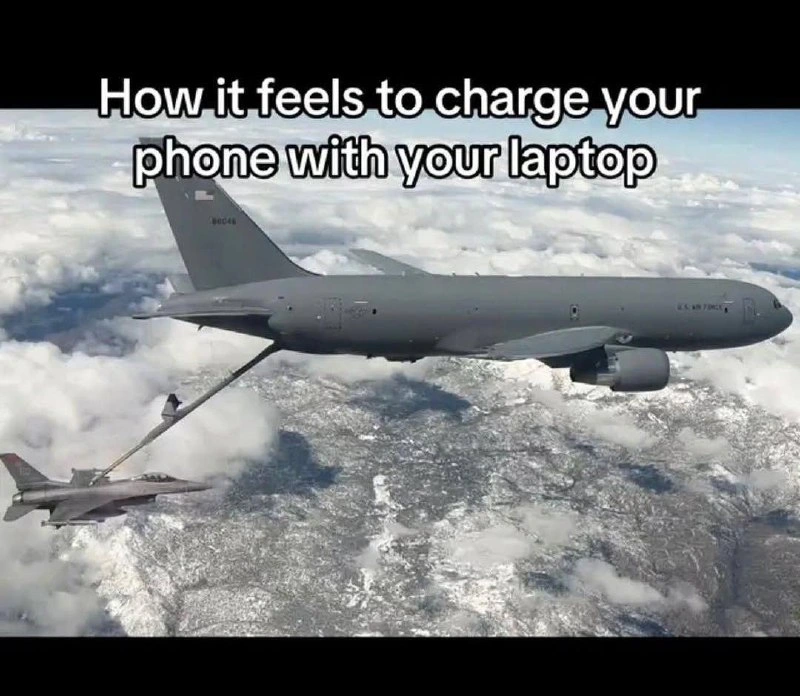
In simpler terms, this meme jokes about using your laptop as a big phone charger. The picture shows a huge refueling plane connecting to a small jet. Likewise, imagine your laptop is the big plane and your smartphone is the little jet. The caption "How it feels to charge your phone with your laptop" sums it up: it often feels like overkill. A laptop is a powerful computer with a large battery, and a phone is a tiny device with a much smaller battery. When you plug your phone into your laptop’s USB port, the laptop’s battery loses power to fill up the phone – just like a tanker plane giving fuel to a fighter mid-flight. This scenario is common in a developer’s life (hence the RelatableDeveloperExperience tag). For example, if you’re a mobile app developer testing your app, you keep your phone connected to the laptop for debugging. The side effect? The phone is charging from the laptop the whole time. Your laptop essentially becomes a charging station for the phone.

Let’s break down why this is a bit funny and peculiar:

  • Size and capacity mismatch: Laptops have big batteries (often rated in tens of watt-hours) while phones have much smaller ones. It’s like using a fire hose to water a single potted plant. Sure, it works, but the scale is off.
  • Laptop as a power bank: A power bank is a portable battery pack dedicated to charging devices. Here, the laptop is acting like one – an expensive, oversized one. Many modern laptops even support “USB power share” features, meaning they can charge phones even when the laptop is asleep or off, drawing from their own battery reserves.
  • Overkill but handy: From a junior dev perspective, it might seem logical: “My phone is dead, but my laptop has juice, so why not use it?” It’s a life-saver when you have no wall outlet around. But it’s also overkill because you’re using a full computer (with its own power-hungry components like CPU, RAM, and maybe even fans running) just to do the simple job of charging a phone.

Key terms in this context include USB-C, which is the cable/port type that many new laptops and phones use. USB-C isn’t just for data; it also negotiates power delivery. This means when you plug a phone into a laptop, they “talk” to decide how much voltage and current the phone can take. Thanks to this USB-C Power Delivery protocol, your phone might charge fast (drawing maybe 5 to 9 volts at a couple of amps). But drawing that power will make your laptop battery drain faster. So if your laptop isn’t plugged into the wall, its battery percentage will start dropping. Developers find themselves watching their laptop’s battery bar fall, essentially feeding the phone. It’s a bit of a tech oddity: the device that’s supposed to do heavy computing work is now performing a simple task at its own expense. This resonates as DeveloperHumor because we’ve all seen our powerful development rig humbled into a mere phone charger during crunch time or travel. It’s both practical and comically disproportionate, which is why the meme strikes a chord with anyone who’s been in that situation.

Level 3: Tanker-Class Overkill

This meme highlights the absurd mismatch in scale when using a laptop to charge a phone. In the image, a massive KC-46 Pegasus aerial refueling tanker (the lumbering gray aircraft) extends its fueling boom to a much smaller F-16 fighter jet below. For experienced developers, this immediately reads as hardware humor about over-provisioning resources: the laptop is the tanker carrying a huge fuel reserve (battery power), and the phone is the tiny jet needing a top-up. The joke lands because a laptop’s battery is orders of magnitude larger than a phone’s battery, yet using it as a charger feels like using a sledgehammer to crack a nut. It’s a classic case of overkill power supply for a trivial task – a tanker-class solution to a fighter-sized problem.

On a technical level, modern laptops with USB-C Power Delivery (PD) can act like flying refueling stations. USB-C ports are bidirectional – not only can they draw power to charge the laptop, but they can also supply power out to charge peripherals. This means your high-end developer workstation can double as a giant power bank for your phone. The irony is that while the laptop’s battery might hold 5–10 times the energy of a phone’s (just as a KC-46 carries far more fuel than an F-16 can), it’s not an efficient transfer. Every step of converting and sending power over USB wastes energy as heat (charging inefficiency), so you burn through disproportionate laptop battery just to give your phone a little boost. Seasoned engineers chuckle (or cringe) at this because it’s the tech equivalent of a tanker refueling a sports car – technically possible, unquestionably helpful in a pinch, but slightly ridiculous in scale.

This image also taps into the daily DeveloperExperience of juggling device batteries. Picture a dev after a full day of Zoom calls, Slack pings, and running Docker containers: the laptop is at 5% battery, the phone is dying too. Desperate, you tether the phone to the laptop via USB-C. Now you’re literally draining one expensive resource to prop up another. It feels like that tanker and fighter in midair: one engine is gulping fuel from another just to stay airborne a bit longer. It’s funny because it’s too real – every developer has ended up using their $2000 laptop as a makeshift phone charger at some point (often while on-call or traveling), essentially turning a development machine into an overpriced glorified power outlet. The humor comes from that painfully relatable imbalance: our mighty laptops (designed for compiling code and running VMs) reduced to powering a phone like a life support line. In a world of sleek tech solutions, this is a tongue-in-cheek reminder that even cutting-edge hardware sometimes gets used in the most surprisingly inefficient ways – much to the amusement of anyone who’s been there.

Description

A photograph showing a large, gray military aerial refueling tanker plane flying high above a snowy, cloud-dusted landscape. A refueling boom extends from the rear of the tanker down to a much smaller fighter jet flying in formation behind it, transferring fuel in mid-air. Overlaid on the top of the image is the white text caption: 'How it feels to charge your phone with your laptop'. The meme creates a humorous and dramatic analogy, comparing the slow, power-draining process of charging a phone from a laptop's battery to a critical, high-precision military operation. It perfectly captures the feeling that the laptop (the tanker) is sacrificing its own vital energy reserves to keep the more mobile but power-hungry phone (the fighter jet) operational, often with a significant cost to its own 'mission endurance' or battery life

Comments

8
Anonymous ★ Top Pick My laptop's battery doesn't just experience discharge when charging my phone; it undergoes a full-scale tactical resource reallocation, and my CPU fan starts spinning up like it's preparing for takeoff
  1. Anonymous ★ Top Pick

    My laptop's battery doesn't just experience discharge when charging my phone; it undergoes a full-scale tactical resource reallocation, and my CPU fan starts spinning up like it's preparing for takeoff

  2. Anonymous

    Sure, the USB-C PD spec negotiates nicely - until your laptop plays KC-46 tanker and you realise you’ve spun up a c5.24xlarge just to keep an F-16’s cockpit light on

  3. Anonymous

    Just like aerial refueling has a 30% fuel transfer efficiency loss, using your laptop's USB-C PD to charge your phone while compiling code is basically running a distributed battery drain algorithm where both devices race to zero, but at least the phone wins

  4. Anonymous

    When your laptop becomes a glorified power bank with wings - sure, you can charge your phone, but now you're just redistributing the problem across your device fleet. It's like running a distributed system where both nodes are critically low on resources, and you're hoping the load balancer (your USB-C cable) can somehow create energy from nowhere. Spoiler: thermodynamics still applies, and now both devices are racing to see which hits 5% first

  5. Anonymous

    USB‑C PD in practice: a 96Wh laptop burning Docker and Chrome magnanimously offers 5V/500mA so I can get the 2FA SMS - enterprise resource allocation, but for electrons

  6. Anonymous

    Charging a phone from a laptop is DR failover for power management - works briefly, then both batteries open an incident

  7. Anonymous

    Laptop USB ports: spec'd for data transfer, jury-rigged for power delivery that drains donor faster than recipient fills

  8. @adorogov 11mo

    And how does it feel when your phone decides to charge your laptop instead?... (true story)

Use J and K for navigation