The Three Hardest Things in CS, Plus an Off-by-One Error
Why is this CS Fundamentals meme funny?
Level 1: Counting to 3 Is Hard
Imagine your teacher tells the class, “There are three really hard things about doing homework,” and then they list out five things instead of three. 😄 Not only that, but the first thing on the list is “Neat handwriting”, the second is “Remembering stuff”, the third is “Counting pages”, the fourth is some gibberish you can’t even read (maybe they meant “Paying attention” but it’s all spelled wrong), and the fifth is “Neat Handwriting” again. You’d probably giggle, right? The teacher said “three things” but clearly lost count, repeated one item twice, and even wrote one of them so poorly that no one knows what it says. It’s silly and funny because the teacher ended up doing all the things they claimed were hard: they had trouble counting, trouble writing clearly, and trouble remembering not to repeat themselves!
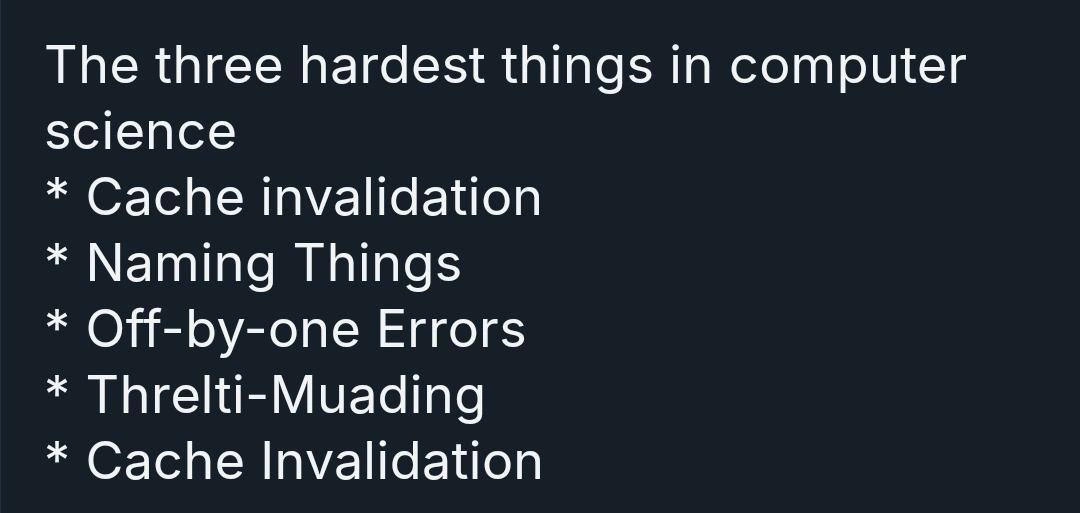
That’s exactly what this meme is showing, but in the world of computers and programming. It starts by saying “The three hardest things in computer science” and then whoops! it actually shows a list of five things. The person who made the list miscounted – just like the teacher in the example. They even wrote one of the items in a confusing way (it’s supposed to be “multithreading,” a big word for doing many computer tasks at once, but they spelled it all wrong as “Threlti-Muading”). And they wrote “Cache Invalidation” twice – basically repeating the same thing at the start and end of the list.
So why is this funny? It’s a joke where the list itself is doing those hard things poorly, to prove a point. In simpler terms:
- Counting in programming can go wrong by one, and the list count went wrong (we expected 3, we got 5).
- Naming things in programming is hard, and one item has a crazy name no one understands.
- Remembering to update or remove stuff (that’s what cache invalidation is about) is hard, and the list forgot to remove a duplicate, showing the same thing twice.
It’s like the meme is saying, “See? Even making a simple list can get messed up in these ways!” For someone not into programming, just think of it as a goofy list where the author messed up every possible way: bad counting, bad spelling, and repeating themselves. We laugh because the person set out to list the hardest things – and then actually demonstrated each mistake while doing so. It’s a bit like a clown act where the clown says, “I’m an expert juggler!” and then immediately drops all the balls. The clown’s failure is the joke. Here the “expert” list-maker can’t count or spell properly, making us laugh and nod.
In the end, the meme is poking fun at how even experts can struggle with basic-sounding tasks. It uses a funny self-made mistake to show that in computer science, things that sound easy (“just name it clearly,” “just count the items,” “just update the data when it changes”) can actually trip people up. You don’t need to know exactly what “cache invalidation” or “multithreading” means to get the humor – you can see they duplicated something and botched a word. It’s a reminder that everybody makes silly mistakes, and sometimes the simplest things are the trickiest. And that shared chuckle helps programmers feel a bit better about the times they’ve made just the same kind of mistake.
Level 2: The Usual Suspects
Let’s break down what’s going on in this meme in more straightforward terms. It’s basically listing three things that programmers traditionally say are the hardest parts of their job – but ironically, the list itself has mistakes that show those very parts. The items on the list are:
Cache Invalidation – In simple words, a cache is like a short-term memory for a computer or program. For example, your web browser keeps a cache of images from websites so it doesn’t have to download them every time. Invalidation means clearing or updating that memory when it’s no longer correct. The hard part is knowing when to do that. If you invalidate (clear) too soon or too often, you lose the benefit of caching (things get slow again). If you invalidate too late or not at all, users might see outdated data. Think of it like having a fridge with leftovers: you need to throw them out at the right time – not too early (wasting good food) and not too late (eww, spoiled!). In programming, deciding when to refresh or remove cached data is tricky because the program has to guess if the data has changed elsewhere. This meme puts “Cache invalidation” on the list twice (at the top and bottom) – that’s a joke on how a bad cache can mistakenly give you the same thing twice or fail to get rid of old data. Everyone who’s dealt with web development or distributed systems has run into a bug where something updated didn’t show up for some users because of caching. It’s so famously difficult that engineers semi-jokingly crown it one of the hardest problems in CS. Seeing it listed here (twice!) confirms for any coder: “Yep, caches can be a real headache.”
Naming Things – This refers to the task of coming up with good names for variables, functions, databases, servers – basically anything in code that needs a label. It sounds trivial, but picture this: you write a function that calculates an invoice total. Do you name it
calculateInvoiceTotal()?calcInv()?getTotal()? A good name should ideally be clear, descriptive, and not too long. But in a big project, there might be dozens of totals and calculations, and you also worry about not clashing with existing names. Plus, what if tomorrow that function does more than just invoices? The name might become misleading. This is why naming is considered hard: it’s surprisingly easy to choose a name that later turns out to be confusing or inaccurate. There are entire discussions about naming conventions (rules like “use camelCase” or “start boolean variables withis”, etc.) intended to make naming more consistent. But even with rules, you often end up scratching your head for a while thinking “What should I call this thing?”. In the meme’s list, one item – “Threlti-Muading” – is basically a nonsense name. It looks like someone mashed the keyboard or got the spelling horribly wrong. That’s on purpose! It’s illustrating a naming failure. If we try to decode it, it’s likely meant to be “Multithreading”, which is another hard concept (managing multiple tasks at once). But the meme author deliberately gave it a terrible name (misspelled and confusing) to make the point that naming stuff is tricky. For a new developer, it’s good to realize that choosing good names in code is an art. If you’ve ever had a project where every variable was namedxordata1, data2, data3, you know how frustrating bad naming can be. This item on the list is basically saying: finding the right words in code matters, and it’s not easy!Off-by-one Errors – This is a fancy term for a very common programming bug: when you count one too many or one too few. It often happens in loops or array indexing. For example, say you have an array of 10 items. If you start counting at 1 and go to 10, but your language actually indexes arrays from 0 to 9, you’ll either miss the first item or overshoot the end. An off-by-one error can cause you to skip processing the last element of a list, or try to access an element that doesn’t exist (which can crash a program). They’re called “off-by-one” because you’re off by exactly one count. A classic beginner mistake is confusing
<and<=in a loop condition. Consider this C snippet:
int numbers[3] = {10, 20, 30};
for (int i = 0; i <= 3; i++) {
printf("%d\n", numbers[i]); // Bug: i goes from 0 to 3 inclusive, but valid indices are 0 to 2
}
Here, the programmer wanted to print 3 numbers, but wrote <= 3 instead of < 3. That means i will take the values 0,1,2,3 – four iterations. When i becomes 3, numbers[i] is out of bounds (since the array’s last index is 2). This is an off-by-one error in code. The loop runs one time too many and causes a problem. These errors are sneaky because the code looks almost correct; it’s just one symbol (an =) off. In the meme, saying “three hardest things” but listing five is an exaggerated off-by-one (in fact, off-by-two) error as a joke. It’s like the person lost track while numbering the list 🤦. New developers quickly learn about this the hard way: maybe your first attempt at iterating through a list doesn’t hit the last element, or a condition runs one time extra and you get an error. It’s such a common bug/edge-case that it’s become an inside joke. The meme’s mis-numbered list is poking fun at that very human slip-up – even the act of counting items can go wrong by one.
- Multithreading (Concurrency) – That weird “Threlti-Muading” term is meant to be “Multithreading,” albeit jumbled up. Multithreading means having a program do multiple things at the same time (using threads). Imagine a cooking analogy: instead of making a salad, then boiling pasta, then frying veggies one after the other, you do them all in parallel in different pans (if you’re talented enough in the kitchen!). In computing, this can make programs faster or more responsive. But it’s hard because you have to coordinate the threads. If two threads try to change the same data at once, or one thread is using data that another thread is modifying, you can get messed up results (like two people trying to write on the same whiteboard simultaneously, ending up with a smeared mess). This can lead to problems called race conditions or deadlocks, which are notoriously difficult to debug. So, why did the meme include it in such a funky way? Probably to embody the idea that even talking about multithreading can get confusing and tangled. The misspelling is a humorous way to show something went wrong – akin to a thread synchronization bug scrambling data. For a junior developer, you might not have dealt with threads yet, but eventually you will, and you’ll discover that parallel programming requires a lot of careful thought. It’s commonly cited along with naming and caching as one of those things that experienced devs lose sleep over. So the meme is basically adding “multithreading” to the hall of fame of hard problems, but doing it in a way that also illustrates a naming error (two birds with one stone!).
To tie it all together: the meme lists things that every programmer eventually struggles with. It’s funny because the person writing the meme made the very mistakes they are joking about:
- They couldn’t count to three correctly (ending up with five items).
- They duplicated an entry (like a cache that didn’t get cleared).
- They butchered the spelling of a term (showing how not to name things).
If you’re new to coding, you might not yet have felt the pain of these, but give it time – you’ll encounter all of them! You’ll rename a variable 5 times until it feels right. You’ll wonder why your website isn’t showing updated info, then realize the old version was cached. You’ll run a loop and get an array out-of-bounds error, then facepalm realizing you iterated one step too far. And if you venture into threading, you’ll likely spend a day chasing a weird bug caused by two things happening at once unexpectedly. This meme is basically a lighthearted heads-up from the developer community about common pitfalls. It says: “Even these seemingly simple tasks – naming, counting, remembering to clear stuff – are harder than they look in computing.” And it wraps that message in a goofy example that demonstrates each pitfall in action. That’s why developers find it clever. It’s not just listing problems, it’s performing them. For a newcomer, it’s a glimpse into the kind of tongue-in-cheek wisdom you hear around senior engineers: some problems never go away, you just get better at laughing about them.
Level 3: The Off-by-One Tradition
This meme riffs on a classic developer joke that’s been circulating for decades. The original gag goes: “There are only two hard things in computer science: cache invalidation, naming things, and off-by-one errors.” 🤭 Notice anything off? It claims “two” hard things, then names three. That little counting mistake is the joke — it deliberately contains an off-by-one error to illustrate one of the very things it mentions. Seasoned engineers love this kind of self-referential humor because it’s an inside wink at shared pain points. Here, the meme has taken that formula and turned the dial up a notch: it says “The three hardest things in computer science” but then lists five items. It’s an off-by-two error now (we got even more than we bargained for), and it doesn’t stop there. The list actually demonstrates each problem it talks about:
Miscounting (Off-by-one Errors): We expected 3 items, but the list has 5. The author literally failed at counting – a tongue-in-cheek nod to the dreaded off_by_one bug. In coding, an off-by-one error might mean your loop runs one time too many or too few, often causing subtle edge case bugs. By overshooting the count in the meme itself, the creator is basically shouting, “See? Counting properly is harder than it looks!” It’s the same kind of mistake newbies make when they write a
forloop and accidentally iterate one index past the end of an array. Every experienced programmer has introduced a fencepost error at some point, so seeing it parodied here gets a knowing chuckle.Poor Naming (Naming Things): One item on the list is written as “Threlti-Muading”, which isn’t a term anyone recognizes. It’s obviously a mangled, typo-ridden attempt at naming something. If you decode it, it looks like they meant “Multithreading” (concurrency), but the spelling went off the rails. This silly term is poking fun at how naming conventions and choosing good names are difficult. In real projects, a badly named variable or function (say,
doStuff()or a misspelled class name) can confuse everyone who reads the code later. Here, the meme demonstrates a terrible name firsthand – you literally can’t tell what “Threlti-Muading” is at first glance. It’s a playful way to highlight that naming things is so hard, we sometimes end up with nonsensical labels in our code. (Ever come across a variable namedflag2ordataFinalFinaland wonder what it means? Same problem – naming is tough!). The misspelling also adds an extra layer of humor for eagle-eyed readers: it’s a subtle threading_typos joke, implying that even discussing concurrency can tie your brain (or your tongue) in knots.Redundancy (Cache Invalidation): The list includes “Cache invalidation” twice – at the top and at the bottom. This duplication is no accident; it’s part of the meta-joke. By repeating that entry, the meme illustrates the very problem of cache invalidation itself. Think about it: one of the hardest things in CS is cache invalidation, which is all about removing or updating duplicated data that’s no longer accurate. If you fail to invalidate a cache, you might end up with the same thing showing up twice or stale data sticking around. Here, the meme “failed to invalidate” its own list – it cached “Cache Invalidation” at the start and then unintentionally (or intentionally for humor) kept it again at the end. 😅 It’s as if the list forgot it already listed that item (kind of what happens when cache invalidation goes wrong and you see outdated info repeatedly). For developers, this hits home because most have battled a bug where something updated in one place didn’t propagate, and the old value showed up again unexpectedly. Plus, listing it twice cheekily suggests: cache invalidation is so hard, it deserves to be first and last on the list of headaches! The repetition drives home the running joke in software engineering that “cache invalidation is one of the two (or three) truly hard problems” – apparently, it’s such a big deal it counted twice.
Beyond those specific gags, the meme also smuggles in multithreading (via that scrambled name) as a kind of “bonus” hard thing, effectively expanding the classic trio into a chaotic list of five. By doing so, it’s updating the “S-tier list” of programmer problems. The poster’s caption – “Updated S-tier list just dropped!” – plays on the idea of an S-tier (a gaming/streamer term for top-ranked) list of challenges. In other words, these are the top of the top difficulties that always plague programmers, and the list has been humorously “updated” with extra entries (and errors) for 2025. Seasoned devs find this funny because it’s a mix of developer_humor and commiseration: we constantly deal with these issues. No matter how long you’ve been coding, you’ve wrestled with picking the right name for something, scratched your head over why some cached data isn’t refreshing, or spent an hour debugging only to find a +1 in the wrong place. And yes, if you’ve ever dived into writing multi-threaded code, you know that can open an even bigger can of worms (race conditions, deadlocks, oh my!).
The brilliance of this meme is that it practices what it preaches: it demonstrates each concept through a fault in the list itself. It’s bullet_list_irony at its finest. The list_size_mismatch (3 vs 5) and the typo are deliberate, crafting a multi-layered joke. For those in the know, this self-incriminating humor is both relatable and cleverly constructed. Each of the “hard things” is a well-known CS_fundamental pain point:
- Naming – every project, every language, you face it. (What do we call this variable? Is this function name clear enough?)
- Cache invalidation – from web development (clearing browser cache, CDN cache issues) to distributed databases, it’s the bane of consistency.
- Off-by-one errors – an ever-present boogeyman in loops, array indexing, and any time you deal with numerical boundaries.
- Concurrency – not explicitly spelled out in the text (well, it’s spelled incorrectly), but any experienced dev reading “Threlti-Muading” will think “ah, threads… concurrency is indeed a nightmare”.
These are such common culprits for bugs (SubtleBugs often hiding in plain sight) that everyone from a junior coder to a grizzled architect has stories (or horror stories) about them. The meme gets an extra nod of approval because it’s self-consistent in its inconsistency: it manages to poke fun at all three original hard problems by embodying them. It’s the kind of layered joke that you laugh at, then maybe forward to your team saying, “Whoever made this meme nailed it – it’s so true.” After all, nothing bonds developers quite like collectively griping about the fundamental stuff that should be easy but never is. In summary, the meme is a classical_cs_joke remix: it lists the perennial problems in programming and cheekily demonstrates each one. It’s funny because it’s true – and because it lets us laugh at our own persistent challenges.
Level 4: Fundamental Complexities
Even in its silliness, this meme touches on inherently complex problems in computing. Each listed item corresponds to a deep challenge at the core of computer science – challenges that arise from fundamental constraints of logic, language, and system design:
Cache Invalidation: This is shorthand for the cache consistency problem, a notorious issue in distributed systems and performance engineering. A cache stores a copy of data closer to where it’s used (think of a web browser keeping images so it doesn’t re-download them). Invalidation means updating or discarding those copies when the original data changes. It sounds simple, but ensuring all copies across a system are fresh is hard. In fact, it brushes against the CAP theorem in distributed computing: you can’t have perfect consistency, availability, and partition-tolerance at the same time. In practice, deciding when to invalidate a cache (immediately vs. eventually) and which nodes to inform is a complex trade-off. If you get it wrong, one part of your system serves outdated info while another has new info – a consistency nightmare. There’s a whole field of study on cache coherence protocols (for CPUs and distributed caches alike) and they’re still error-prone and subtle. The meme jokingly repeats "Cache Invalidation" twice, almost as if a stale cached entry showed up again – a wink at how tough it is to eliminate redundant or outdated data. The duplication humorously mimics a failure to invalidate: the list “forgot” it already had that item, much like a cache that didn’t get the memo to clear old data.
Naming Things: At first glance, naming seems purely a human concern, but it connects to the profound challenge of mapping concepts to identifiers – essentially an issue of semantics. In programming, choosing the right name for a variable, function, or concept is crucial for understanding, yet there’s no algorithm or formula for it. It’s a blend of logic, domain knowledge, and even linguistics. In theoretical CS, names are just labels with no inherent meaning (consider lambda calculus, where variables are often
x,y,zwith alpha-conversion to avoid clashes). But in real-world software, good naming is what makes code self-documenting and maintainable. The difficulty of naming is so well known that it’s jokingly elevated to a “hard problem” – not because of computational complexity, but because it’s intrinsically a human cognitive challenge. In essence, naming things is about creating a correct abstraction and communicating intent, tasks that even AI and formal methods struggle with because they require understanding context and future use. In the meme, the gibberish “Threlti-Muading” (a mangled attempt at “Multithreading”) exemplifies naming gone wrong: it’s an unreadable, context-free label. This highlights how a poorly chosen or misspelled name can render even a simple concept indecipherable. It’s a comically exaggerated case of failing at one of the supposedly hardest tasks – underlining just how important clear naming is.Off-by-one Errors: These are a classic example of how simple logic can mask subtle complexity. Off-by-one errors (sometimes called fencepost errors in algorithm textbooks) occur when a developer misjudges a boundary condition by one. This might happen due to the way arrays are indexed (starting at 0 instead of 1), or confusion between using
<vs<=in a loop. Formally, this is a minor arithmetic mistake, but it represents a deeper truth: rigorous correctness is hard. It only takes a tiny error in a condition to make an entire algorithm fail on an edge case. In formal verification and algorithm design, getting boundary conditions right is critical – many proofs and bugs hinge on that exact ±1 issue. The joke’s premise “three hardest things… and then listing five” is a meta-instance of an off-by-one (or off-by-two) error. It’s as if the meme’s author incremented a counter too far when counting the list items. This self-referential mistake humorously illustrates the pervasiveness of off-by-one bugs: they can crop up anywhere, even in a joke about themselves. On a theoretical note, detecting off-by-one errors falls under ensuring program correctness; it’s not that the problem is unsolvable (mathematically you can prove loop invariants to catch these), but human minds often slip on these details. It’s a reminder that discrete math and precise reasoning lie under even trivial-sounding code tasks, and missing by one can have outsized consequences (like a fence that ends up with one post too many or too few, hence the name).Concurrency (Multi-threading): Although scrambled as “Threlti-Muading”, this clearly hints at multithreading, a notoriously hard area of systems programming. Concurrency introduces nondeterminism – multiple threads (independent sequences of instructions) interleave in unpredictable ways. Ensuring correctness in a concurrent program can require reasoning about all possible interleavings of operations, which explodes into combinatorial complexity. In theoretical terms, problems like deadlock detection or verifying thread safety often approach NP-hardness or even undecidability for the general case. The challenge of multi-threading is backed by formal models like the Dining Philosophers problem and the use of complex synchronization primitives (mutexes, semaphores) to avoid races. The meme’s misspelling itself is a playful nod: it’s as if concurrency is so confusing that even the word got jumbled – a metaphor for how multi-threaded programs can jumble data if not handled carefully. It’s also a sneaky inclusion beyond the promised “three” items, acknowledging that concurrency is often mentioned in the same breath as the other hard problems. In practice, debugging a race condition or ensuring memory visibility across threads can feel like solving a puzzle where the pieces move on their own. The scrambled name conveys that things quickly get garbled when threading issues strike, symbolizing the cognitive load developers face when reasoning about parallel execution.
In sum, this meme isn’t just a random list of headaches – it captures three (or more) perennial pain points each rooted in a fundamental aspect of computing: managing state consistency (cache invalidation), conveying meaning (naming things), handling discrete boundaries (off-by-one errors), and orchestrating parallel processes (concurrency). The humor lands so well because these problems are perennial: no matter how high-level our languages or powerful our tools, these issues keep resurfacing. They’re tied to core truths of CS – from the theoretical limits of synchronization and logic, to the very human limits of clarity and attention to detail. The meme’s self-referential mistakes (miscounting, duplication, gibberish naming) act out the truth that even experts stumble on these basics. It’s a playful reminder that some problems are intrinsically hard not due to lack of knowledge, but because they sit at the intersection of computers’ inflexibility and humans’ fallibility.
Description
A simple text-based image on a dark navy-blue background with white text. The title reads, 'The three hardest things in computer science'. Below the title is a bulleted list with five items, which are: '* Cache invalidation', '* Naming Things', '* Off-by-one Errors', '* Threlti-Muading', and '* Cache Invalidation'. This meme is a layered, meta-joke based on the classic computer science aphorism that 'there are only two hard things in Computer Science: cache invalidation and naming things.' The humor arises from several points: first, the title claims there are three hard things, but the list contains five, which is a classic 'off-by-one error' - a problem that is itself on the list. Second, 'Cache invalidation' is listed twice, comically emphasizing its notorious difficulty. Finally, 'Threlti-Muading' is a deliberate, humorous misspelling of 'Multi-Threading,' another famously complex topic

Comments
19Comment deleted
This list has an off-by-one error, which is on the list, which proves the list is correct. Now, let's go rename all the variables and invalidate the cache before we think about this any further
Just like our "three" microservices that now number five (plus the canary clone), the list proves architects can make an off-by-one bug while trying to solve cache invalidation - yet still name it something nobody can grep for
After 20 years in the industry, I've learned the real hardest problem in computer science is explaining to the PM why fixing cache invalidation bugs takes longer than 'just clearing the cache' - especially when the bug report itself contains an off-by-one error in the repro steps
This meme is the software equivalent of a proof by contradiction - it claims to list three hard problems but demonstrates all of them simultaneously by having five items, repeating cache invalidation (because we forgot we already invalidated it), including an off-by-one error in the count, and introducing 'Threlti-Muading' which is either a brilliantly obscure variable name or proof that naming things really is impossible. It's the kind of joke that makes you simultaneously groan and appreciate that whoever wrote it understood the assignment so well they failed it perfectly
In distributed systems, the “three hardest problems” frequently evaluates to five - an inclusive upper bound, a misnamed enum, and a duplicate courtesy of TTL drift, otherwise known as cache invalidation doing its thing
We labeled it “three,” returned five from a stale read, garbled multi‑threading under contention, and still forgot to invalidate the result
Cache invalidation lists twice because one invalidation is never enough - classic distributed systems humility
threlti-muading is a good one Comment deleted
All are good Comment deleted
- knock-knock - an async function! - who's there? Comment deleted
-knock knock -race condition Comment deleted
SSStttarrtttiinnnngg all pprcesssorrss... Guess how many cores are there? Comment deleted
4 at least? Comment deleted
given 4 n-s Comment deleted
I think you still haven't solved cache invalidation Comment deleted
Also you ficked up with the capital i Comment deleted
Should be a numbered list Comment deleted
Starting with 1 Comment deleted
Race conditions Comment deleted