Skip to content
DevMeme
7299 of 7435
That Damned RGB Triangle: Where Every Graphics Career Begins
Graphics Post #8000, on May 16, 2026 in TG

That Damned RGB Triangle: Where Every Graphics Career Begins

Why is this Graphics meme funny?

Level 1: The First Puzzle Piece

It's like someone telling the story of how they got hopelessly hooked on jigsaw puzzles: "It all started so innocently... someone handed me one piece. Just one pretty, colorful piece." The colorful triangle is the very first thing anyone learning computer graphics makes — simple, bright, and satisfying. But behind that one piece is a ten-thousand-piece puzzle that takes over your desk, your weekends, and your life. The girl at the party isn't telling a story about a triangle. She's telling the story of the moment a tiny taste of success tricked her into a lifetime of beautiful suffering — and anyone who's ever said "just one more level" of anything knows exactly how that feels.

Level 2: Hello, Triangle

What you're actually looking at in panel two:

  • The RGB triangle: The standard first exercise in graphics APIs like OpenGL or Vulkan. You define three corner points (vertices), give each a color — pure red, green, blue — and the GPU fills in the middle by blending. It's the graphics equivalent of print("Hello, world").
  • Vertex: A point in space with attached data (position, color). Three vertices = one triangle, the basic building block of all 3D graphics. Every game character you've ever seen is thousands of these.
  • Interpolation: The automatic blending you see in the gradient — the GPU smoothly transitions values between vertices. It's why the triangle's center is a muddy mix of all three colors.
  • Shader: A small program you write that runs on the GPU and decides where vertices go and what color each pixel gets. Even the humble triangle requires two of them.

The relatable junior moment: you follow the tutorial, the triangle appears, and you feel like a wizard. Then you try to load a 3D model, get a black screen, and spend three days learning that graphics code doesn't crash — it just silently renders nothing.

Level 3: 1,200 Lines Before the First Pixel

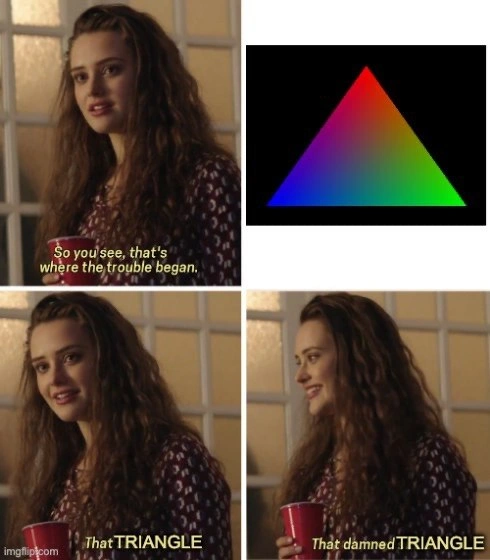
The meme's 13 Reasons Why party-scene format — curly-haired narrator, red Solo cup, the rueful "So you see, that's where the trouble began" — is built for origin stories of ruin, and graphics programmers instantly recognize theirs: panel two's RGB-interpolated triangle on a black void, the "Hello, Triangle" that opens every OpenGL and Vulkan tutorial ever written. "That TRIANGLE. That damned TRIANGLE."

The joke's precision lies in what that first triangle actually costs and what it actually promises. In legacy OpenGL you could get it in thirty lines; in Vulkan, the famously explicit modern API, the canonical hello-triangle runs north of a thousand lines — instance creation, physical device selection, logical devices, queues, swapchains, image views, render passes, pipeline layouts, shader modules, command buffers, and synchronization primitives — all to paint one gradient triangle. The tutorial euphoria of seeing it appear is the industry's most effective recruitment scam: the dopamine hit arrives precisely once, after which the learner discovers that everything beyond the triangle (lighting, shadows, transparency sorting, frustum culling, the entire shader zoo) scales in difficulty exponentially while the visible payoff scales linearly.

Hence the "trouble began" framing. The triangle is the gateway drug of graphics programming and game development: it convinces you the field is approachable, then introduces you to NaN-colored geometry, black screens with zero error messages, driver-specific behavior, and debugging by changing the clear color to magenta and praying. The character recounting it at a party like a traumatic backstory is every graphics dev explaining how a single tutorial in their teens led, fifteen years later, to them knowing what a swapchain recreation bug feels like at 2 AM before a milestone build.

Level 4: Barycentric Confessions

The gradient inside that triangle isn't decoration — it's a live demonstration of the mathematics every GPU executes billions of times per frame. The three vertices are assigned pure red, green, and blue, and the rasterizer fills every interior pixel using barycentric coordinates: each point $P$ inside a triangle can be written uniquely as $P = \alpha A + \beta B + \gamma C$ with $\alpha + \beta + \gamma = 1$, and those same weights linearly blend the vertex attributes. The smooth wash of color you see is the hardware whispering, "I interpolate everything this way" — colors today, texture coordinates and normals tomorrow.

It goes deeper. In a real 3D scene, naive linear interpolation in screen space is wrong after perspective projection — attributes must be divided by depth, interpolated, then un-divided (perspective-correct interpolation), a hyperbolic correction baked into silicon since the late 1990s precisely because early hardware that skipped it produced warping textures. And the reason everything is triangles at all is mathematically load-bearing: three points are always coplanar, always convex, and barycentric weights are unique — properties that quads and arbitrary polygons can't guarantee. The triangle isn't a tutorial simplification; it's the irreducible primitive the entire raster pipeline is built on. Her trouble began with the one shape that cannot be decomposed further.

Description

A four-panel meme using the '13 Reasons Why' party scene format featuring a young woman with long curly hair holding a red Solo cup. In the first panel she says 'So you see, that's where the trouble began.' The second panel shows the iconic RGB-interpolated triangle on a black background - the classic 'hello world' of graphics programming, with red, green, and blue vertices blending across the surface. The bottom panels show her saying 'That TRIANGLE' and 'That damned TRIANGLE.' The joke is that rendering this single vertex-colored triangle is the gateway drug into the deep, painful world of graphics programming - OpenGL/Vulkan boilerplate, shaders, and GPU pipelines - and everything goes downhill from there

Comments

29
Anonymous ★ Top Pick 1,200 lines of Vulkan boilerplate later, you too can render the triangle that ruined her life
  1. Anonymous ★ Top Pick

    1,200 lines of Vulkan boilerplate later, you too can render the triangle that ruined her life

  2. @Daonifur 1mo

    Instead of opening Pandora's box, they OpenGL

  3. @acidbong 1mo

    speedrunning Raylib

  4. @deadgnom32 1mo

    a black-red triangle?

  5. @Agent1378 1mo

    Should have used

  6. Max 1mo

    No color spaces in this space please.

    1. @Supuhstar 1mo

      YEAH WHITES ONLY

      1. @Supuhstar 1mo

        [This silly sarcastic post brought to you by a brown person]

        1. @RiedleroD 1mo

          oh hey a fellow system. hiya ^^

          1. @Supuhstar 1mo

            Meowdy! ^^

        2. @blue_bonsai 1mo

          Damn

  7. @death_by_oom 1mo

    This is an English only chat, please adhere to the rules

    1. @Dark_Embrace 1mo

      I missed the chat 🙈

  8. @Dark_Embrace 1mo

    I was wondering, where the f my photo went 😅

  9. Eugene 1mo

    You're not getting the joke

    1. @Agent1378 1mo

      Please explain

      1. Eugene 1mo

        The triangle in the meme is the first thing that's rendered on the screen when one's learning graphics programming, whether it's OpenGL or something else. Graphics programming seems easy at first but soon enough turns out to be a massive rabbit hole with lots of headache guaranteed. So yeah, all the trouble begins with that damned triangle.

        1. @Agent1378 1mo

          Ohh, I see, thanks

        2. @Daonifur 1mo

          Honestly found it easier than working in engines, aside from 3D stuff

        3. @zs3n0ugh 1mo

          I just hated every second of OpenGL classes in uni. I had to choose between Chaos Theory and "introduction into computer graphics". Should have picked the damn math...

          1. dev_meme 1mo

            "The damn math" Seems like you either don’t love triangles enough or math, or both 🤓

            1. @azizhakberdiev 1mo

              triangles, as in three angles, Euler angles

        4. dev_meme 1mo

          Hey! To meme this meme was about ONE MORE step forward Graphics and games are good for joke starter, but without billions of investments in GPU we would never have all those sophisticated LLMs 🌚

          1. dev_meme 1mo

            Hate to explain jokes but gonna intervene when someone may think that this channel finally posted something not about AI 🌚🌚🌚

  10. @SamsonovAnton 1mo

    Not only is xy diagram the worst thing to judge color gamut (mostly ergonomic improvement on the original rg diagram), but the whole idea of representing volumetric information in a planar view, even with more advanced u'v' or a*b*. 🧐

  11. @Agent1378 1mo

    Its a middle slice where most colors are perceived, 50% lightness (in hsl terms or smth.) or smth. Because with more light it all goes to white, colors are lost. The same with less light - all goes to black, also no colors. Talking about other shortcomings - well , thats our eyes, dread it, run from it, destiny still arrives.

    1. @SamsonovAnton 1mo

      Absolutely not! Color gamut of a device has complex shape in a perceptually uniform space like L*a*b*, with different luminosity levels for each primary stimulus (RGB, CMYK or whatever), so there is no single "slice" where the chromatic saturation is at maximum. Color perception is not static and depends on multiple factors, both external and internal to the observer, so any given stimulus can be perceived differently according to many conditions.

      1. @Agent1378 1mo

        I was talking about classic cie 1931 that describes human eye perception not device gamut

        1. @SamsonovAnton 1mo

          It was the first attempt to objectively measure color perception, in the times when there was no possibility to inspect the spectral characteristics of retina directly, as well as the output signals it produces. Lack of computing power led to simple formulae. However, even if that was feasible at the time, color perception is much more complex than that, because it goes all the way to the cerebrum: the basic output that the eye produces (which is not trivial by itself) is further "adjusted" by the brain. Even the most advanced models developed currently, like CIE L*a*b* 2000 (1976 space + ∆E:2000 difference formula) and CIE CAM 2016 cannot provide flawless result in the general case. But using 1931 models nowadays other than for purely technical low-level data representation for specific uses is totally lame. Please, refrain from it and do not spread ignorance. 🙏

Use J and K for navigation