When Debugging All Night Ends in Total Existential Computer Regret
Why is this Debugging Troubleshooting meme funny?
Level 1: When Toys Betray
Have you ever tried to fix a toy or solve a puzzle for a really long time, and no matter what you do, it still doesn’t work? After hours of this, you might feel so upset that you say something dramatic like, “Ugh, toys are a terrible idea!” Of course you don’t truly believe all toys are terrible, but in that moment of frustration it kind of feels that way. This meme is just like that, but for grown-up programmers with their computers. The developer worked all night trying to fix their computer program and it still wouldn’t work. In a tired, defeated sigh they basically say, “Computers… what a mistake.” It’s funny because it’s such a big, exaggerated reaction born from frustration. Just like blaming all toys or all puzzles when one of them gives you trouble, the programmer is jokingly blaming all computers because one program was buggy. It captures that exhausted feeling when you’ve tried everything and just want to dramatically throw up your hands – and we can all laugh because we know he doesn’t really hate computers, he’s just super frustrated at that moment.
Level 2: Stack Overflow of Emotions
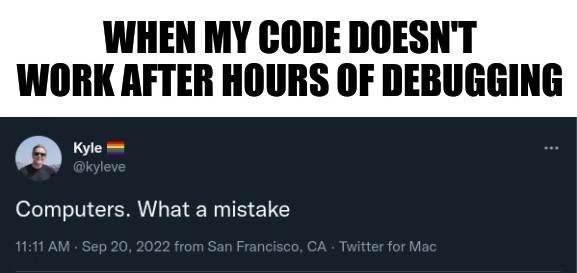
The meme shows a big bold caption "WHEN MY CODE DOESN'T WORK AFTER HOURS OF DEBUGGING" followed by a screenshot of a tweet that says, "Computers. What a mistake." If you’re newer to coding, here’s what’s going on: the developer has spent hours debugging – that is, trying to find and fix the errors (called bugs) in their program – and nothing is working. Debugging is like being a detective for code. You use tools or print out values to figure out why your program is misbehaving. It’s a core part of Troubleshooting software issues. For example, you might run your code step by step, or insert print("got here") lines to see which parts execute. After a few hours of this with no success, a coder’s mind gets tired and frustrated.
BugsInSoftware can be extremely stubborn. Sometimes a bug is caused by a tiny mistake that's really hard to notice. Imagine a scenario in code like this: you intended to add up numbers and return the total, but you accidentally returned the wrong thing. For instance:
def add_items(numbers):
total = 0
for n in numbers:
total += n
return sum # BUG: should return 'total', but mistakenly returns the built-in 'sum' function
If you ran print(add_items([1, 2, 3])) here, you'd get a weird output like <built-in function sum> instead of the expected 6. A tired developer might stare at this for ages, not immediately realizing that return sum is wrong. It’s a simple typo bug causing a big headache. Debugging such issues at 3 AM can make you feel absolutely defeated.
The tweet in the meme, "Computers. What a mistake," is played for humor through exaggeration. The developer isn’t literally giving up computers forever (probably), but at that moment it feels like the entire concept of computing has betrayed them. This is a form of DeveloperFrustration that many programmers experience. We have a joking term for these dramatic moments: DebuggingFatigue. That’s when after trying fix after fix, your brain is so drained that you start feeling hopeless and say things you don't really mean, like "I hate this, I’m quitting tech." It’s the emotional equivalent of a soccer player saying “I hate soccer” after losing a hard game.
Notice the meme uses a tweet_format_meme style. That means the punchline is delivered as a tweet screenshot, which is common in developer humor. Tweets often capture relatable feelings in a short, shareable way. The time and location on the tweet (11:11 AM, San Francisco) aren’t crucial to the joke, but they add a bit of realism – it’s an actual tweet by a real developer (Kyle). Even pros in the tech capital have moments where they throw up their hands and joke that all of computing was a bad idea. And speaking of “bugs,” fun fact: the term bug for a computer error famously comes from an actual moth that got stuck in an early computer in the 1940s! (When you’ve been debugging all night, you might half-wonder if a real insect is messing with your machine, too.)
In summary, the meme is highlighting a DeveloperPainPoints rite of passage: spending a long time debugging and feeling utterly defeated when the fix remains elusive. The humor is that the developer becomes so frustrated they humorously blame Computers themselves. It’s like saying, “I’ve tried everything, I’m exhausted – maybe the real problem is these darn computers existing!” It’s an exaggerated, tongue-in-cheek expression of burnout that many new coders eventually find themselves understanding all too well.
Level 3: Kernel Panic at Dawn
Debugging marathons can push even the most hardened engineer into an existential spiral. Picture this: it's past 3 AM, you've been stepping through the same tangled code for hours, and nothing makes sense anymore. The meme's top caption "WHEN MY CODE DOESN'T WORK AFTER HOURS OF DEBUGGING" sets the stage for this all-too-familiar scenario. After an all-night battle with an elusive bug, the punchline arrives as a deadpan tweet:
Computers. What a mistake. – @kyleve, presumably moments after a soul-crushing debug session.
This blunt tweet is both absurd and achingly relatable. It's the kind of nihilistic humor a weary developer might mutter under their breath as the sun comes up and the code still doesn't run. The phrasing is hilariously broad: instead of blaming a specific language or a particular API, the developer condemns the entire invention of computers. It's a grand, sarcastic overreaction that any programmer running on fumes can identify with. After squashing one bug only to have five more surface, you start questioning not just your code but reality itself: "How is any of this binary sorcery supposed to work? Were computers a bad idea from the start?"
The senior engineers reading this are nodding knowingly (and maybe suppressing a PTSD chuckle). We've all experienced the Debugging_Troubleshooting nightmare where a simple fix turns into an odyssey. Maybe you were chasing a memory leak through countless valgrind logs, or sprinkling console.log() statements like fairy dust in hopes of illuminating a logic flaw. Each failed attempt chips away at your confidence. Eventually, a completely rational sleep-deprived voice in your head goes: "Who thought writing instructions for silicon chips was a good plan anyway?!" This meme nails that breaking point.
From an industry perspective, the humor also stems from how DeveloperFrustration transcends specific tech stacks or experience levels. It doesn’t matter if you’re debugging a front-end NullPointerException or a back-end race condition in a distributed system — the DeveloperPainPoints converge into the same despair. There’s a dark joke among veterans: "It's always DNS." Often the root cause of a production outage is something trivial and unrelated to your hours of code review (like a misconfigured domain name). Here, the equivalent twist is that after hours of DebuggingFrustration, the cause of the failure might be something incredibly simple like a one-character typo. But by the time you discover that, you're too exhausted and done to even get angry; you just aim your fury at Computers in general.
In fact, many of us have had that post_debugging_regret where we dramatically consider changing careers. One minute you're a proud software engineer; the next you're googling "how to start an alpaca farm" because a maddening bug made you question every life choice. The tweet’s timestamp 11:11 AM hints that Kyle might have started debugging the night before and by late morning hit rock bottom. The location tag (San Francisco) adds irony: right in the heart of Big Tech, a programmer declares the entire field was a mistake. It’s a bit like a chef in Paris exclaiming “Food, what a disaster.” The juxtaposition is golden.
Ultimately, the meme resonates because it’s a perfect storm of DeveloperHumor and truth: after relentless failures, even the most logical problem-solvers among us will throw up our hands and jokingly denounce the very machines we dedicate our careers to. It's a shared catharsis. We laugh because we've been there – staring at a bug report at dawn, feeling defeated, and uttering some version of "I swear, computers were a bad idea." This meme takes that private despair and turns it into a succinct, darkly funny one-liner that the whole tech world can groan at in solidarity.
Description
The meme is split into a caption and a tweet screenshot. At the very top, huge bold black capital letters declare, "WHEN MY CODE DOESN'T WORK AFTER HOURS OF DEBUGGING." Beneath it sits a dark-mode Twitter post from user Kyle (@kyleve) that reads, "Computers. What a mistake," with metadata "11:11 AM · Sep 20, 2022 from San Francisco, CA · Twitter for Mac." The stark, defeated tweet perfectly mirrors the developer’s despair hinted at in the caption, creating a punchline that any engineer who has single-stepped through failing code for hours can appreciate. It humorously highlights how relentless debugging sessions can erode confidence in both the codebase and the very concept of computers themselves

Comments
6Comment deleted
After six hours hunting a “bug” that was really 400 ms of clock skew between two Kubernetes nodes, I’m starting to think the true defect was humanity outsourcing reality to NTP
After 20 years in this industry, I've debugged race conditions in distributed systems, untangled circular dependencies in microservices, and even fixed a memory leak that only manifested on Tuesdays - but nothing prepared me for discovering the bug was in code I wrote six months ago with a comment that says "// TODO: fix this properly later."
After enough debugging sessions, every senior engineer reaches that philosophical inflection point where they question not just their code, but the entire Turing-complete universe. 'Computers. What a mistake' perfectly captures that moment when you've exhausted your mental stack, your git bisect led nowhere, and you're seriously considering whether Alan Turing's theoretical machine should have remained purely theoretical. It's the heat death of debugging - when the entropy of your codebase finally exceeds your ability to care
Computers never err - they just eternally preserve your 'temporary' hacks as eternal truth
Attached gdb to chase a deadlock; it instantly vanished - our stack implements the observer effect better than our business logic
Six hours in, it only fails when logging is off - classic race condition blessed by the CPU’s memory model. Determinism: just another feature flag we forgot to ship