Google Doge vs Buff Firefox spar over Manifest V3 and ad-blocking APIs
Why is this WebDev meme funny?
Level 1: No Umbrellas Allowed
Imagine you’re playing outside, and some naughty kids keep trying to splash you with water balloons every day (those water balloons are like annoying ads that you don’t want). Luckily, you have a super helpful friend who always stands next to you with a big umbrella just to protect you. Every time a water balloon flies your way – splat! – it hits your friend’s umbrella instead of you, and you stay dry. Hooray! That friend is like your very own ad-blocker, catching the bad stuff so you can have fun without getting wet.
Now one day, the playground’s boss (the person in charge, kind of like the owner) walks over with a stern face and says, “New rule: No umbrellas allowed here!” Uh oh. This means your friend isn’t allowed to use the umbrella to protect you anymore. The next time those pranksters toss a bunch of water balloons, your friend has to put the umbrella down, and splat, splat, splat – you get soaked completely. Not fun at all, right? It feels unfair because you lost your protection and now you’re dripping wet with muddy water.
But then, something great happens. The boss of the next-door playground waves you over and says, “Hey kiddo, over here you can keep your umbrella! We don’t have that no-umbrella rule. If you play here, your friend can still shield you from those water balloons all day long.” Suddenly, you have a choice: stay in the first playground and get wet, or go next door where your friend can keep you dry. Easy decision – you’d probably go where you’re protected!
In this story, the first playground boss who banned umbrellas is like Google Chrome making a rule change that stops your ad-blocker from working properly (taking away the “umbrella” that keeps the ads off you). The second playground boss is like Mozilla Firefox saying, “We won’t take away your protection – you can use your umbrella here freely.” The meme shows this situation in a funny way using two dog pictures: one dog (Google) is small and upset, saying you can’t use your ad-blocker, and the other dog (Firefox) is big and muscular, defiantly saying, “Too bad, I’m going to let people keep their ad-blocker!” It’s amusing because it’s like watching a bully try to make everyone put up with something annoying, and then a brave friend stands up and says, “No, I won’t let you do that!” The big strong dog (Firefox) protecting your “umbrella” makes us cheer, because we all love it when someone stands up to a bossy bully. The meme is basically celebrating that our “umbrella” – our ad-blocker that keeps the web comfortable – is safe and sound with Firefox, no matter what rules Google tries to make.
Level 2: Defending the Blockers
Let’s break this down in simpler terms. In the world of WebDevelopment, a browser extension is like a little app you add to your web browser to give it extra features or superpowers. One very popular kind of extension is an AdBlocker – it literally blocks advertisements (and often those hidden trackers that watch what you do online) so that websites are cleaner, faster, and less creepy. Extensions have a special file called a manifest that basically lists what they can do and what permissions they need. Think of the manifest like a permission slip or a rulebook for the extension.
Now, Manifest V2 is the older set of rules for how extensions worked. Under Manifest V2, ad-blocker extensions had a lot of freedom: they could actively listen to every network request your browser was about to make and cancel ones that matched a big “bad list.” For example, an ad-blocker could say, “Hey browser, if you’re about to grab anything from ads.example.com or any known ad server, just block it.” This was done through an API call (browser.webRequest.onBeforeRequest with a blocking option) that let the extension act like a security guard for each web request. It’s how extensions like uBlock Origin or Adblock Plus have been so good at zapping ads and stopping tracking scripts — they had the power to intercept everything and filter out the unwanted stuff in real time.
Google decided to introduce Manifest V3, which is a new version of that rulebook for Chrome extensions (and by extension for all Chromium_browsers like the new Edge, Opera, Brave, etc., since they share Chrome’s engine). Manifest V3 changes that freedom quite a bit: extensions will no longer be allowed to use that on-the-fly request blocking method. Instead, they have to use a different approach where they give the browser a set of declarative rules in advance. You can imagine it like this: under V2, the ad-blocker was a bouncer checking each person (each web request) at the door and tossing out the bad guys immediately as they came. Under V3, the ad-blocker has to hand the nightclub owner (the browser) a list of “bad guy identifiers” ahead of time and then step back. The browser will on its own block anything matching that list, but if something new or sneaky isn’t on the list, it might slip through because the bouncer isn’t at the door actively making decisions anymore. Also, Chrome put some limits on how big that block list can be. The bottom line is that this new system (Manifest V3) might not catch everything an active, intelligent ad-blocker could catch under the old system. It’s more rigid. Google’s argument for this change is that it makes the browser run faster and safer — the browser doesn’t have to pause and consult an extension’s code for every single request, and malicious extensions would have a harder time misbehaving if they can’t intercept everything.
However, to a lot of developers and savvy users, it sounded like Chrome was taking away a really useful ability. It’s effectively dumbing down how ad-blockers work. Many people love their ad-blockers not just to avoid annoyance but to protect their privacy, since those extensions also stop trackers (invasive ads, analytics scripts, etc.) from following you around online. So when Google announced it would retire Manifest V2 (the powerful version) and force everyone onto Manifest V3, a lot of folks were upset. Some even suspected Google might have an ulterior motive beyond just speed or security, given that Google’s main business is selling ads. It’s a bit like if the biggest candy shop owner in town also became the dentist who says you shouldn’t eat candy – there’s a conflict there. People couldn’t help but think, “hmm, Google making it harder to block ads in Chrome… who benefits from that, really?”
This is where Firefox stepped in and shifted the narrative. Firefox is the major browser that isn’t built on Google’s Chromium engine – it’s like Chrome’s top competitor from the old days (and still around fighting the good fight today). When Google announced the Manifest V3 changes, Mozilla (the organization behind Firefox) basically said, “We’re not going to rush to remove those old capabilities that power ad-blockers. In fact, we will still support Manifest V2 features so that those content-blocking extensions keep working as they used to.” In plain terms, Firefox decided it will not cripple ad-blockers the way Chrome is doing. They made it clear that your AdBlocker is safe on Firefox: the extensions that block ads and trackers will continue to have the same powers on Firefox that they’ve always had. The meme sums this up with the Firefox side saying, “I will still support Manifest V2. Your AdBlocker is safe.” Firefox even said that other browsers that are based on Firefox’s technology (like some privacy-focused browsers or the Tor Browser, which is built on Firefox) will also keep supporting the old manifest version for now. So, Firefox positioned itself as a sort of safe haven for these extensions.
So what we end up with is a split in the browser wars. On one side, Google Chrome (and all the browsers aligned with it) are saying, “We’re moving to the new system (Manifest V3), even if it means weakening what extensions can do.” On the other side, Mozilla Firefox is saying, “We’re sticking with the old system (Manifest V2) for the sake of user choice and privacy, so we won’t break those powerful extensions.” This has big implications for BrowserCompatibility. It means extension developers now have a tougher job if they want to support both Chrome and Firefox. They might have to maintain two versions of their extension or at least include special cases: one that follows Chrome’s new rules and one that uses the old rules for Firefox. It’s extra work and complexity. It’s reminiscent of how web developers often had to deal with differences in Chrome vs. Firefox vs. Internet Explorer for websites — now it’s happening with extensions. Not ideal for developers, but they’ll manage. At least in this case, the developers who care about robust ad-blocking have a platform (Firefox) that still lets them do everything they want.
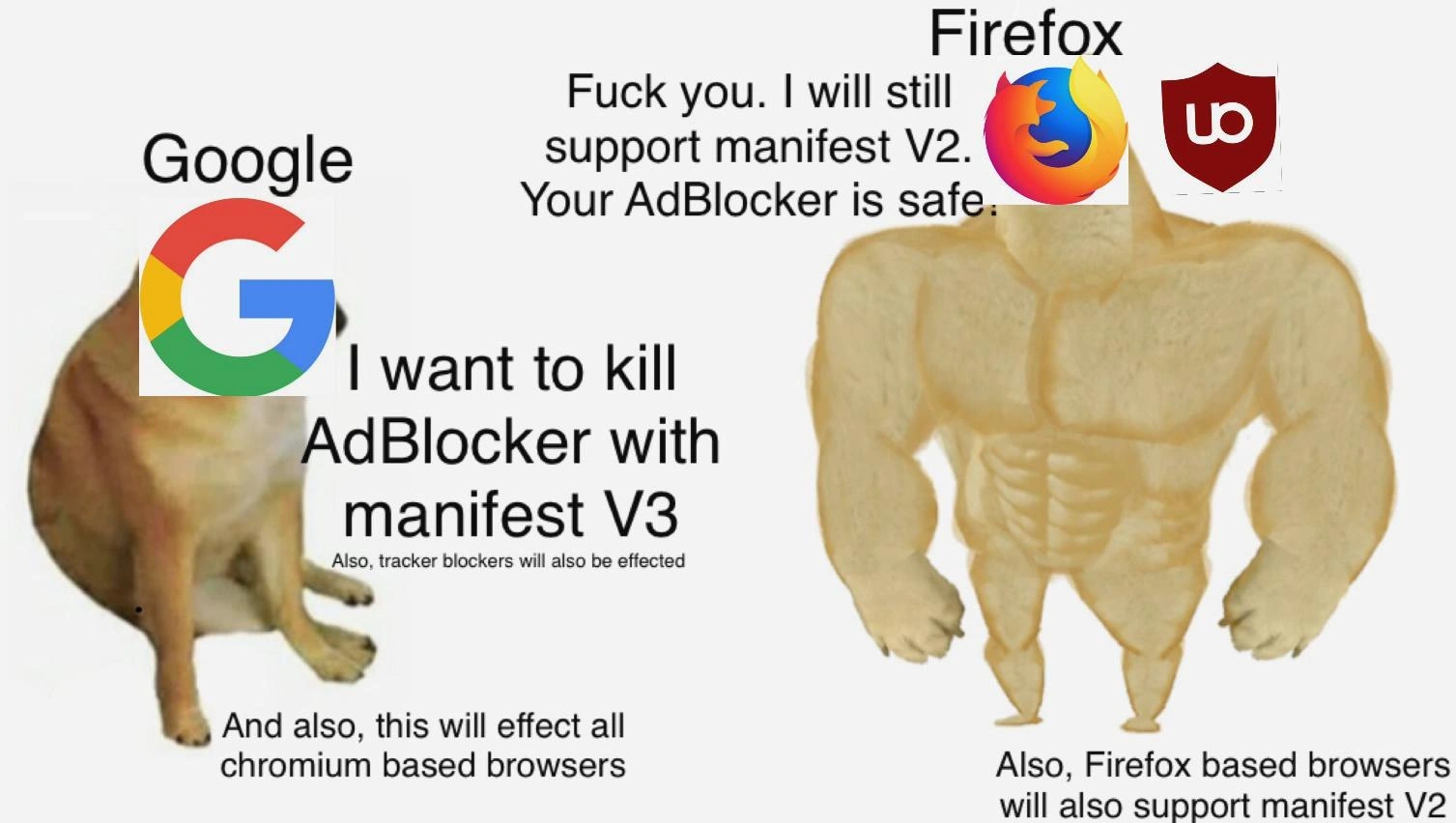
Now, let’s talk about the meme format. It uses the popular “Doge” meme style where you have a weak, sad-looking Doge (Shiba Inu dog) on the left and a muscular, macho Doge on the right. The left side represents the wimpy or bad stance, and the right side represents the strong or good stance in whatever comparison is being made. In this meme, the left side has the Google logo on the Doge’s head, making Google look like the sad, weak one, saying: “I want to kill AdBlocker with Manifest V3... And also, this will affect all Chromium-based browsers.” You can almost hear the whiny, villainous tone. It’s highlighting Google’s plan to restrict extensions (and the fact that it drags everyone using a Chrome-like browser along). On the right side, we have the buff Doge with the Firefox logo (and an uBlock Origin shield icon) on its head, looking proud and angry on our behalf. This side says: “Fuck you. I will still support manifest V2. Your AdBlocker is safe.” That’s Firefox’s stance – basically giving a big defiant NO to Google’s change and assuring users that Firefox won’t mess with their ad-blockers. The language is intentionally crude and exaggerated (Firefox saying “F*** you” to Google) to amp up the drama and humor.
Why is this funny to developers and techies? For one, it flips the real-life power dynamic on its head in a satisfying way. Google is a huge corporation with about two-thirds of the browser market share – they’re the Goliath. Firefox has a much smaller slice – the David in this fight. Yet the meme portrays Firefox as the buff, heroic figure and Google as the weak, scheming one. That’s because in this context (supporting ad-blockers vs. undermining them), the community sees Firefox’s position as the strong, principled stance, and Google’s as the weak or greedy stance. It’s comedic exaggeration: Firefox isn’t literally a muscle-bound tough guy, and Google isn’t literally a puny dog, but visually representing them that way lets everyone in on the joke. It captures our emotional perspective: we want the good guy (Firefox in this case) to be the strong hero, and we enjoy seeing the bad guy (Google’s move here) looking pathetic.
The meme also resonates because it’s full of the frustration and relief that developers were feeling. Frustration at Google for making a change that feels user-unfriendly, and relief (even joy) that Firefox isn’t following blindly and is even openly opposing that change. The “Fuck you” in the meme is jarring in a funny way – we don’t expect Firefox to curse out Google, but the bluntness mirrors how strongly people felt about this. It’s like the meme is saying what a lot of people wished they could say to Google in that moment. For developers, it’s a bit of dark humor about how one giant company’s decision can cause a ton of extra work or lost functionality, and how grateful we are that there’s at least one browser saying, “We won’t do that to you.”
In summary, this meme is showing a browser extension battle over ad-blockers: Chrome (Google) on the “bad” side making a move that could hurt ad-blockers, and Firefox on the “good” side standing up for them. It uses a familiar internet meme format (weak vs buff Doge) to make it visual and funny. And it strikes a chord with web developers and privacy-conscious users because it’s about more than just a joke – it’s about a real change that could affect our daily browsing and the principles of an open, user-first web. Seeing Firefox act all tough and protective in the meme is both funny and a little heartwarming to those who value their freedom to control what they see online.
Level 3: Declaring War on Ads
At the deep technical level, this meme is poking at a very real showdown in browser extension land: Google’s Manifest V3 vs. the older Manifest V2. These manifest versions are basically the rulebooks for what a browser extension can do. Google’s plan with Manifest V3 is essentially to neuter ad-blockers by changing the extension API in a way that limits their powers. It’s like Google is declaring war on ads in a backwards way – by declaring war on the AdBlocker extensions themselves.
Manifest V2 (the status quo for years) let extensions use the chrome.webRequest API to intercept and block network requests in real-time. For example, an ad-blocker like uBlock Origin could listen to every web request and say “Nope, that one is an ad or a tracker – block it!” using custom code logic. This gave developers fine-grained control to filter out ads and trackers (tracker_blocking) with dynamic rules. It’s powerful, but in Google’s eyes, perhaps too powerful and potentially slow or abuse-prone.
Enter Manifest V3: Google’s new policy (browser_policy) for extensions that replaces that flexible system with a more locked-down one called the Declarative Net Request API. Instead of letting extensions execute custom code on each request (webRequest with "blocking"), Manifest V3 demands extensions declare all their blocking rules upfront in a static manifest file. The browser will then handle blocking automatically, but extensions can no longer loop in arbitrary JavaScript logic on the fly. In theory, this is safer and faster – no more untrusted extension code running for every request – but it also dramatically limits what an ad-blocker can do. Complex filtering logic or adapting on the fly? Gone, unless it fits in the pre-approved rule schema. There’s also a hard limit on how many rules an extension can use (for Chrome it might be on the order of 30k rules), which sounds like a lot until you realize big filter lists easily approach or exceed that. In effect, Google is saying “we’ll let you block stuff, but only in this narrower, pre-defined way.”
To an extension developer or a privacy-conscious user, this felt like a one-two punch: fewer capabilities and fewer ways to block ads. It’s no wonder the meme’s “Google” side (represented by the sad Doge with the Google “G” logo) is saying “I want to kill AdBlocker with Manifest V3.” It’s an exaggeration, sure, but not far from how many devs perceived it. The caption even adds “tracker blockers will also be affected” – meaning not just ads, but extensions that stop those sneaky trackers would lose effectiveness. And because Chrome’s technology underpins all Chromium-based browsers (Edge, Opera, Brave, etc.), Google’s decision ripples out to almost the entire browser ecosystem: “and also, this will affect all Chromium based browsers.” It’s like one policy change to rule them all (except one notable rebel…).
Now look at the Firefox side of this clash – the buff Doge with the Firefox logo (and that red shield icon of uBlock Origin, the famous open-source ad blocker) on its head. Firefox is essentially flexing and saying “F you, I’m keeping Manifest V2 support, your ad-blockers are safe with me!” In real-life terms, Mozilla (the developers of Firefox) announced that, despite Google’s move, they will continue to support the old WebExtensions API capabilities that Manifest V3 tries to remove. In other words, Firefox will let ad-blocker extensions continue doing their thing as if it’s still Manifest V2. The meme even notes “Also, Firefox based browsers will also support manifest V2,” implying any browsers built on Firefox’s engine (Gecko) will likewise preserve these features. It’s a bold stance in this round of BrowserWars: the dominant player (Chrome/Google) pushes a restrictive change, and the smaller player (Firefox) openly decides “Nope, not gonna cripple our extensions like that.”
This contrast is hugely relatable to developers. It highlights a classic BrowserCompatibility headache born from divergent browser decisions. If you’re a maintainer of a BrowserExtension like an ad-blocker, Google just forced you to rewrite or drop some advanced features for Chrome users – potentially making your extension less effective on the most popular browser. Meanwhile, you can still run the fully-powered version on Firefox. So now you have to support two versions or watch one half of the user base lose out. It’s a tough spot: do you maintain a super-feature-rich version just for Firefox’s smaller audience? Or dumb everything down to the lowest common denominator (Manifest V3) so that Chrome’s huge audience can still use it (albeit with fewer capabilities)? Neither option is great, and the meme dramatizes that frustration by painting Google as the bad guy and Firefox as the muscle-bound savior.
Why is Google doing this at all? Officially, they argue it’s for security and performance. By limiting extensions to declarative rules, Chrome can handle blocking internally, supposedly making page loads faster and browsers safer (since an extension can’t, say, inject slow or malicious code into every request if it doesn’t get to run code per request). It’s a bit like a locked-down sandbox for extensions: less freedom but also less risk. They also cite that malicious extensions have abused the old webRequest API in the past. However, the tech community couldn’t help but notice the elephant in the room: Google’s primary business is advertising. Powerful ad-blockers are, quite literally, blocking Google’s revenue. Conflict of interest, anyone? Many devs and users suspect that Manifest V3 is at least partly an attempt to kneecap ad-blocking under the guise of a technical improvement. (Google even edited their public FAQ, removing a claim that “content blocking is still possible,” which only made folks more cynical.) That only fueled the skepticism that this change is less about speeding up Chrome and more about speeding up Google’s ad profits.
On the other side, Mozilla Firefox has a reputation for prioritizing user privacy and choice. By pledging to support the older, more powerful extension capabilities, Firefox is appealing to power-users and developers: “Hey, if Chrome won’t let you block all those nasty ads and trackers, we still will.” It’s a savvy move in this Browser War – essentially painting Chrome as the villain undermining user freedom, while Firefox rides in like a buff hero to save the day (or at least save your favorite ad-blocker). The meme’s profane Firefox quote “F** you. I will still support manifest V2. Your AdBlocker is safe*” is obviously not an actual Mozilla statement, but it captures the fighting spirit that many in the community wished Firefox would express. It’s Firefox channeling a bit of rebel energy, flexing those WebDev muscles in defense of users.
From a historical perspective, this is fascinating because it’s a rare split in what had become a unified cross-browser extension ecosystem. A few years back, Firefox actually transitioned to a Chrome-like extensions model for the sake of consistency (moving to the WebExtensions API in their own browser, which was essentially Manifest V2 compatible). For a while, Chrome, Firefox, and others all supported more or less the same extension capabilities, making life easier for developers. But now Google’s pushing Manifest V3, and Mozilla is basically saying “not so fast.” It’s reminiscent of the old days when Internet Explorer and Netscape had incompatible add-on frameworks – not a fun time for devs! We’re not fully back to those dark ages yet (Firefox does plan to adopt parts of Manifest V3 for compatibility, but crucially will keep allowing the old blocking method for genuinely needed extensions). Still, this divergence has that familiar whiff of extension_api_changes causing a rift.
The meme format itself – the “weak vs. buff Doge” – is tailor-made for this scenario. The left side shows the Google Doge looking feeble, whining about Manifest V3 and its broad collateral damage (“Also, tracker blockers will be affected” and dragging all Chromium browsers into the change). The right side shows Firefox as the super-jacked Doge, bluntly telling Google off and reassuring users that ad-blockers will remain safe on its turf. Visually and textually, it’s exaggeration for comedic effect: Google (an absolute giant in reality) is depicted as a cowardly, skinny dog here because the community views this particular move as user-hostile and greedy – not exactly a strong look. Firefox, relatively small in market share, is shown as a burly protector because it’s doing the right thing for users and developers, standing up to the giant. The juxtaposition is both hilarious and satisfying for anyone rooting for the underdog (quite literally the under-doge in this meme).
To break down the core issue the meme highlights, here’s a quick comparison of the two sides:
| Chrome’s Manifest V3 (Google – Weak Doge) | Firefox Keeps V2 (Firefox – Buff Doge) |
|---|---|
Removes the old webRequest blocking API – extensions can no longer run custom code on each network request. |
Retains full webRequest blocking API – extensions can still run their own logic to decide which requests to block. |
| Uses Declarative Net Request: extensions must predefine block rules (and face limits on how many rules they can have). | Allows dynamic, unlimited filtering rules (no strict cap enforced – more freedom for complex filters and updates). |
| Forces extensions to use an ephemeral background script (a service_worker that sleeps when not in use) for efficiency. | Continues to support persistent background scripts for extensions (the extension can keep running in the background as needed). |
| Justified by Google for security/performance (less extension control = less abuse surface and potentially faster page loads). | Chosen by Firefox for user choice & privacy (don’t break users’ beloved extensions; empower devs to create robust privacy tools). |
| Affects all Chromium-based browsers uniformly (Chrome, Edge, Opera, Brave inherit these limits unless they actively revert them). | Becomes a unique selling point for Firefox (and its forks): a safe haven for fully-powered ad-blockers and privacy extensions. |
In essence, the meme humorously encapsulates a serious tech tussle: Google making a browser policy change that many see as hostile to user interests, and Firefox standing firm to support the status quo that benefits users (and the developers of extensions those users rely on). Developers find this funny and on-point because it’s a perfect snapshot of a BrowserWar philosophy clash – a big player making a controversial change that feels tone-deaf to the community, and a smaller player using that moment to fiercely differentiate itself. The added spice is that it’s about ad-blockers – tools near and dear to many users’ hearts – so the emotional stakes are high. When buff Firefox says “Your AdBlocker is safe,” it’s grabbing a shield (in the meme literally the uBlock Origin shield) and casting itself as the protector of the browsing realm, while Google’s scrawny Doge is left looking like the greedy tyrant taking people’s defenses away.
And that final touch? Firefox dropping a bleep-worthy “Fuck you” directed at Google. That’s something you’d never see in official corporate communications, which makes it absurd and therefore laugh-out-loud funny. It’s the meme author voicing what a lot of developers were feeling in 2022: a mix of anger and defiance. Seeing a buff cartoon Firefox essentially say what we all felt – “Up yours, Google!” – was both cathartic and comical. This meme captures that collective developer sentiment in a nutshell: Chrome is making our lives (and users’ lives) harder by throttling ad-blockers, and Firefox is the unexpected hero swooping in with a big muscular “no way, not on my watch.” It’s a perfect storm of tech drama and meme humor for the web dev community.
Description
Meme uses the "weak Doge vs buff Doge" format on a white background. On the left, a small sad Doge body has the Google "G" logo pasted over its head and is captioned: "Google - I want to kill AdBlocker with manifest V3. Also, tracker blockers will also be effected. And also, this will effect all chromium based browsers." On the right, a muscular Doge body has the Firefox logo and the uBlock-Origin shield pasted on its head. It is captioned at the top: "Firefox - Fuck you. I will still support manifest V2. Your AdBlocker is safe:" and at the bottom: "Also, Firefox based browsers will also support manifest V2." The meme humorously contrasts Google-Chrome’s plan to deprecate WebExtension Manifest V2 (limiting ad-blocker capabilities) with Firefox’s decision to keep V2 support, highlighting browser-compatibility pain points and the impact on extension developers and privacy-minded users
Comments
6Comment deleted
Manifest V3: Google’s way of teaching extension devs about backpressure - you get one service-worker and 30 k filter rules to block an internet’s worth of trackers, while Firefox keeps handing out unbounded streams like it’s still 2009
The real irony is that Google's 'Don't be evil' motto got deprecated faster than Manifest V2, but at least Firefox still maintains backward compatibility with user privacy - something even the most senior architects can't refactor out of their conscience when the ad revenue team comes knocking
Ah yes, the classic architectural decision: deprecate a powerful API that users love because it 'impacts performance,' then watch your competitor gain market share by simply... not doing that. Google's Manifest V3 is the enterprise equivalent of removing sudo access because some users might misconfigure their systems - technically defensible on paper, catastrophically tone-deaf in practice. Meanwhile, Firefox is out here playing 4D chess, positioning itself as the last bastion of user agency while Chromium-based browsers collectively march toward a future where ad-blocking requires a PhD in declarativeNetRequest rule optimization. Nothing says 'don't be evil' quite like forcing 60% of the browser market to adopt API changes that coincidentally benefit your $200B advertising business
Manifest V3: Chrome's 'security upgrade' that suspiciously aligns ad revenue with API deprecation - Firefox keeps the webRequest endpoint open for business
MV3 is replacing a programmable firewall (webRequest) with a pre-approved YAML (declarativeNetRequest) - great for ad‑revenue KPIs, terrible for dynamic filtering like uBlock
Manifest V3: ad blockers become 30k static rules in a narcoleptic service worker because the browser’s threat model is ads, not users; Firefox’s design review: keep webRequest and remember who the “agent” in user agent is