Privacy Under Google’s Umbrella
Why is this DataPrivacy meme funny?
Level 1: The Tiny Umbrella
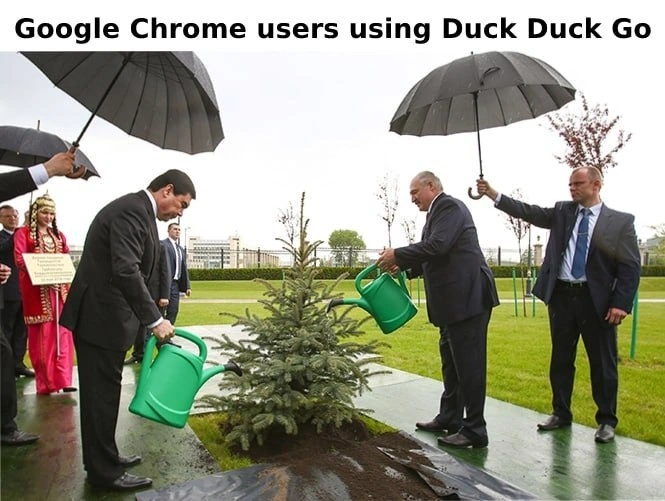
This is funny because it is like standing in heavy rain, pouring a little water on a plant, and saying, "I fixed the watering problem." Using DuckDuckGo in Chrome can help with search privacy, but it does not magically make the whole browser private. The joke is about doing one smart thing and then acting like it solves the entire messy situation.
Level 2: One Layer Helps
A search engine is the service that answers your web searches. Google Search and DuckDuckGo are search engines. A browser is the application that loads websites. Chrome is a browser. They are related because many people search from the browser's address bar, but they are not the same thing.
Using DuckDuckGo inside Chrome changes who handles the search query. That can be useful if you do not want your searches used for a profile by the search provider. But Chrome can still be signed into a Google account, can still sync things like bookmarks or history if enabled, and still runs websites that use cookies, trackers, analytics scripts, and browser fingerprinting.
Browser fingerprinting means websites can combine details like screen size, fonts, browser version, extensions, time zone, and graphics behavior to recognize a device even without a normal login. AdTech uses many small signals to connect activity across sites. That is why privacy tools are usually layered: private search, tracker blocking, cookie controls, separate browser profiles, careful extensions, and sometimes a VPN or Tor depending on the threat model.
So the tree-watering picture is a good metaphor. DuckDuckGo is the watering can: it can help one specific part. Chrome and the surrounding web tracking ecosystem are the rainstorm: much bigger than that one action.
Level 3: Privacy Theater Weather
The meme text says:
Google Chrome users using Duck Duck Go
Below it, several suited officials water a small evergreen while rain is already falling, and aides hold umbrellas over them. The visual contradiction is doing the technical work: the people are performing a helpful action in an environment where that action is already being overwhelmed by the surrounding system.
That maps cleanly onto OnlinePrivacy and DataPrivacy in the browser stack. DuckDuckGo as a search engine can reduce search-level tracking because the query provider is no longer Google Search. That matters. But the browser is still Chrome, a Google product with its own account integration, sync features, telemetry surfaces, extension model, cookie/storage behavior, site permissions, and fingerprintable browser characteristics. Privacy is not a single toggle hiding behind the address bar; it is a layered system.
The joke is not that using DuckDuckGo in Chrome is useless. That would be too simple, and also technically lazy. The joke is that some users treat the search engine switch as if it automatically neutralizes the rest of the stack. It is like encrypting one message field while leaving the envelope, sender, recipient, timestamp, and delivery route nicely printed for anyone who was already watching the mailroom.
For developers and security-minded people, this lands because BrowserSecurity and BrowserFingerprinting are full of these partial mitigations. A privacy improvement in one layer can be real while still failing to solve the larger threat model. If the concern is "Google should not see my search queries," changing the default search engine helps. If the concern is "I want minimal tracking across browsing, ads, identity, sync, extensions, and third-party scripts," then the browser choice, account state, settings, extensions, and network behavior all matter too.
The umbrellas make the satire sharper. The officials are protected from the rain while watering the tree, just as a user may feel personally protected by the privacy brand while the broader ecosystem remains wet. It is the solemn confidence of a compliance meeting compressed into one JPEG.
Description
The image is a meme captioned `Google Chrome users using Duck Duck Go` above a photo of suited officials watering a small evergreen tree in the rain while aides hold umbrellas over them. Visually, the people appear to be carefully nurturing the tree while still staying covered, creating a contradiction between action and environment. The technical joke is that using DuckDuckGo inside Google Chrome may improve search privacy but still leaves the user inside a browser ecosystem associated with telemetry, tracking surfaces, and Google integration. It is a compact critique of privacy theater: changing the search engine is not the same as changing the whole data collection stack.
Comments
9Comment deleted
Switching to DuckDuckGo inside Chrome is like encrypting the payload and then mailing the metadata to the ad network on a commemorative postcard.
better download duckduckgo browser Comment deleted
still chromium-based, use iceweasle instead Comment deleted
who said? Comment deleted
pov: you always using torbrowser Comment deleted
No no download torbrowser extension for chrome Comment deleted
searx enjoyer here Comment deleted
oh, that's good. Comment deleted
Ecosia would be more accurate Comment deleted