The terrifying silence of a non-idempotent API
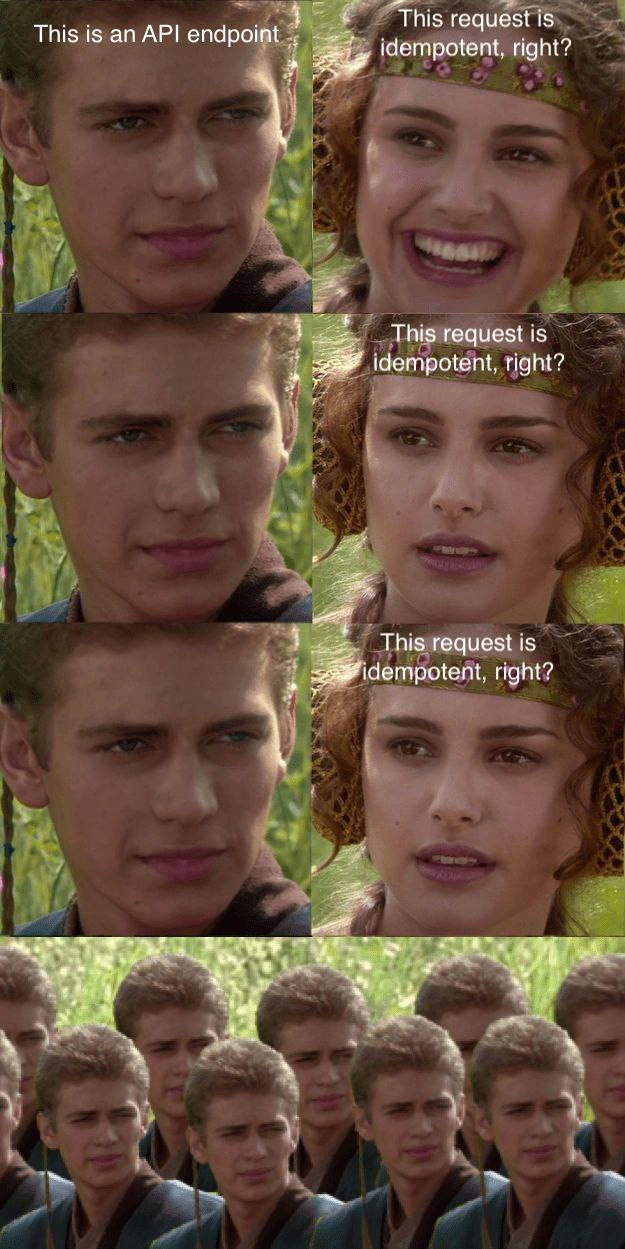
Why is this API meme funny?
Level 1: Candy Machine Surprise
Imagine you have a candy vending machine that is supposed to give you one candy each time you put a coin in. You put in a coin, clink, and wait… but nothing comes out right away. You think maybe the machine didn’t register the coin (maybe a little glitch). So, you decide to put in another coin to make sure you get your candy. Suddenly, the machine rumbles and drops two candies – one from the first coin (just delayed a bit) and one from the second coin. Now you have two of the same candy, when you really only wanted one!
This is funny in a “uh-oh” kind of way. The machine was supposed to only give you one candy even if you tried again, but because it didn’t realize the first candy was already on its way, it gave you a duplicate on the second try. In the meme’s story, something similar happened with a computer request. The person asked a server for something, didn’t hear an answer (like not seeing the candy), asked again, and ended up with two of the same result (like getting two candies). The picture shows a whole bunch of identical Anakin characters appearing, just like a machine accidentally spitting out extra candies or a copy machine printing the same page over and over. It’s showing in a silly way that if you’re not careful, asking for something twice by mistake can give you double what you expected. The joke is basically: They said doing it again wouldn’t cause a problem… but look, now we have duplicates everywhere! It’s like a friend promised pressing a button twice wouldn’t do anything extra, but it actually made a funny mess with lots of copies.
Level 2: Retried Request Ripple
Let’s break down the technical jargon and scenario step by step. We have an API endpoint (think of an API like a function on a server that clients can call over the network). The term idempotent in programming and web APIs means that if you perform a certain action multiple times, the result will be the same as if you did it once. In other words, no matter how many times you repeat the request, you won’t get additional side effects after the first success. For example, a properly designed “delete user” operation could be idempotent: delete user 123 once, they’re gone; try deleting user 123 again, and nothing changes because the user is already gone. The second call doesn’t create a second deletion event — it’s effectively a no-op.
Now, the meme’s text says “idempotent” in quotes, hinting that someone claimed the request is idempotent, but reality disagreed. The context here is an API call (likely an HTTP POST request) that creates something on the server (maybe a new record in the database). Normally, POST is not idempotent by default — each POST could create a new resource (like a new user, order, or entry) every time you call it. If you call it twice, you might end up with two identical records. To make such an operation idempotent, developers have to add special handling.
The phrase “breeds duplicates after every network hiccup” describes a common bug: suppose a client (like your frontend code or another service) sends a request to this endpoint to create a record. The server receives the request and actually creates the record in the database, but right when it’s sending back the success response (200 OK or 201 Created), something goes wrong – maybe a network timeout or a transient error (like a brief server hiccup or the connection dropping). The client never gets the response, so it doesn’t know the operation succeeded. Many clients are built with retry logic for robustness, meaning they’ll try the same request again if it failed or didn’t get a response. So the client says, “Hmm, I didn’t get an answer. Let’s try one more time.” It resends the exact same create request. The server, not realizing this is a retry of the same action, dutifully processes it again, inserting a duplicate record. Now we have two records (duplicates) where there should have been one. Each time there’s a glitch and a retry, another duplicate insert pops out, like a copy machine. This is that "ripple effect" of a retried request: one small hiccup caused the action to echo twice, producing double results.
Why is this considered a design flaw or API bug? Because a well-designed idempotent endpoint would prevent the duplicate side effect. How can we do that? Enter the concept of an idempotency key. An idempotency key (or token) is a unique identifier that the client generates and sends with the request (for example, in a header or as part of the request body) whenever it wants to make sure an operation isn’t repeated. The server then checks: if it has seen this key before, it means this exact operation was already performed, so instead of doing it again, it can just return the previous result (or say “already processed”). If the key is new, it processes the request and remembers the key and the result. In practice, this might mean the server stores the key in a database table along with the outcome. That way, if the network flakes out and the client retries with the same key, the server knows it’s a duplicate and skips creating another record. Many robust APIs (like payment systems) require the client to include such a key for every payment request, precisely because they anticipate network issues and user retries. It’s like putting a unique serial number on each request, so the server can say “ah, I’ve handled this #12345 already, no need to do it again.”
Another design strategy is to use HTTP PUT instead of POST for certain operations. PUT is defined to be idempotent when used properly: for example, PUT /resource/123 with the same data should always result in resource 123 having that data, no matter how many times you PUT it. The server can enforce that by treating the URL or an ID as the identifier of the resource. If a PUT with the same ID comes again, it just overwrites or confirms the same record rather than creating a new one. In contrast, POST /resource typically creates a new resource with a new ID each time (thus multiple POSTs create multiple items). In the meme scenario, it sounds like the developers possibly misused POST (or a PUT) without following the idempotent design pattern, or they simply called it idempotent in documentation but didn’t implement the safeguards. This is why the meme’s final panel shows multiple Anakin clones: it’s the literal image of duplicate data appearing because each retry unintentionally made a new entry.
Let’s illustrate how this might happen with a pseudo-sequence of events in an API call:
Client: POST /api/v1/item {"name": "Anakin"}
Server: (creates item id=101, but network times out before response)
Client: *no response, assumes it didn’t go through*
Client: POST /api/v1/item {"name": "Anakin"} (retry)
Server: (creates another item id=102, returns success)
In this sequence, two separate items (let’s say user or record) are created with IDs 101 and 102, both having name "Anakin". Now the database has duplicates. If the server had an idempotency check based on, say, a unique request ID or the content of the request, it would have caught the second POST and responded differently (maybe “OK, already done” without creating a new one).
For a junior developer or someone new to APIDevelopment, these terms can be confusing, so think of it this way: idempotent = no harm in doing it twice. Non-idempotent (like a regular POST) = doing it twice doubles the effect. The meme is relatable because many of us in our early projects have seen something like a form double-submit issue. For example, have you ever clicked a submit button twice by accident and ended up sending two of the same form? Perhaps you got two emails instead of one, or two posts on a forum. That’s essentially the same bug! The web page should have prevented the second click or recognized the duplicate submission, but if it didn’t, you duplicated your action. In a backend API context, the “network hiccup” is basically the machine’s equivalent of you not seeing a confirmation and clicking again.
The tags like idempotent_request, duplicate_inserts, retry_logic, and idempotency_key_missing all describe pieces of this puzzle:
- idempotent_request: a request designed to be safely repeatable (so if you retry it, it’s like you did it once).
- duplicate_inserts: what happens when an idempotent design fails – you insert the same record twice (or more). Not good for data integrity!
- retry_logic: the part of code that tries again after a failure. It’s usually a good thing to have, because networks and servers can be flaky, but it needs to be paired with idempotent operations or else you get chaos.
- idempotency_key_missing: a cheeky way of pointing out that the developers forgot or omitted the unique key method. Without the key, the server can’t tell a retry apart from a totally new request; it’s “missing context” to handle the repetition.
- rest_api_misdesign: basically, the API wasn’t designed according to RESTful best practices in this case. In REST, if you want retries not to mess things up, you either use the proper HTTP methods semantics or additional measures. Here, that design principle was violated.
- http_post_side_effects & multiple_retries_gone_wrong: emphasize that a
POSTtypically does have side effects (creating data), and if you get multiple retries, things go wrong by multiplying those side effects.
In simpler terms: The meme is teaching a lesson. The developer should have built the API to handle repeated calls gracefully, but they didn’t. So every time a retry happened (maybe due to a timeout or a 500 error), the system naively did the same thing again, leading to multiple copies. It’s making fun of that oversight. And it uses Star Wars imagery — particularly the scene with clones — as a clever visual pun to drive the point home. If you know Star Wars, you know Episode II is literally about making a huge clone army; the meme repurposes that idea to represent a “clone army” of duplicated requests/results.
For someone starting out in development, the takeaway is: be careful with actions that aren’t naturally idempotent. If you are creating or modifying data on the server, think about what happens if the same exact request comes in again. Was the first one finished? Will the second one accidentally do it twice? If that would be a problem (and usually it is), you need to plan for it. This could mean adding checks in your code, using unique constraints in your database (so it rejects a duplicate insert if it’s truly identical), or using those idempotency keys or proper HTTP methods. These are considered API design best practices because they make your service more robust and error-tolerant. That way, a minor glitch won’t turn into a major bug of duplicated data.
The meme is funny once you understand all this because Padmé’s line “This request is idempotent, right?” is exactly what a cautious user or developer might ask. And the joke is that the developer’s silence (Anakin’s face) and the eventual appearance of clones means the answer was a resounding “Nope!” Now duplicates are everywhere. It humorously captures a scenario that’s both a developer humor moment and a cautionary tale: calling something idempotent is not the same as doing the work to make it idempotent.
Level 3: The Idempotent Illusion
This meme hits home for experienced engineers by highlighting a classic API design anti-pattern. The dialogue frames from Star Wars Episode II are a setup: Anakin (the developer) confidently introduces an API endpoint, and Padmé (maybe a tester or the API consumer) asks with a trusting smile, “This request is idempotent, right?” In the third frame Anakin’s face is blank — a nervous silence. Padmé’s smile fades as she repeats the question more pointedly: “...idempotent, right?” By the final panel, the truth is revealed: a whole formation of Anakin clones appears, representing duplicate entries spawned by each retry of that request. It’s a hilarious (and painfully relatable) punchline: the so-called “idempotent” endpoint wasn’t idempotent at all, and every network glitch or retry unleashed an army of duplicates.
Why is this so funny to developers? Because we’ve all seen this happen (often at 3 AM in production). An endpoint – often meant to create a new record via POST – is advertised as idempotent, but the implementation doesn’t actually guard against multiple insertions. Maybe the developer assumed duplicates “won’t happen often,” or misunderstood what idempotence requires. The meme skewers this false sense of security. It’s the idempotent illusion: thinking “retrying that call won’t duplicate anything” while your database is secretly shouting, “Begun, the clone war has.” 🧨 In real life, this plays out when a client times out waiting for a response and decides to “try again,” or when an optimistic retry logic is built into the client or load balancer for resilience. If the server-side code isn’t prepared, each retry is treated as a brand new request, and multiple inserts slip in. Suddenly, you have duplicate user accounts, double charges to a credit card, or a dozen of the same support tickets – all thanks to a supposedly idempotent API that wasn’t actually idempotent. It’s a prime example of a bug in software that is both maddening and comically common in real-world APIDevelopmentAndWebServices.
Let’s unpack the elements being satirized:
- Labeling POST as idempotent: According to HTTP specs and APIDesignBestPractices,
POSTis generally not idempotent. It’s meant for creating subordinate resources (like “create a new order”), and calling it twice usually creates two items. If a team claims their POST is idempotent, they need extra safeguards. Perhaps they meant to implement it like aPUT(where the client provides a resource identifier so repeats don’t create new ones) or to use an idempotency key, but if they didn’t, it’s just wishful thinking. - Missing Idempotency Key / Token: The meme text specifically calls out “without enforcing idempotency keys.” An idempotency key is a token (often a UUID or client-generated string) that the server uses to recognize subsequent retries of the same operation. It’s like saying, “Hey server, if you’ve seen this token before, don’t do the operation again – just return me the result from the first time.” In many payment APIs (Stripe, PayPal, etc.), this is how they prevent charging a customer twice if the network blipped during the first charge. In our scenario, clearly no such mechanism was in place. Every retry was treated as a fresh call, breeding yet another data clone.
- Network hiccups and retry storms: Experienced folks know that network timeouts or transient errors (
HTTP 500server errors, for instance) often trigger clients to retry automatically. Cloud load balancers and HTTP client libraries are sometimes configured to retry idempotent methods (like GET or PUT) by default. But if a dev mistakenly made a critical operation a retryable call without true idempotence, the system is basically lying to itself. A tiny hiccup (say, a momentary DB lag or a dropped response packet) can lead to multiple identical calls in quick succession. The result? Duplicate entries galore. This is a relatable developer experience because nearly every senior developer has a war story of some script or service that kept retrying and wreaked havoc – maybe filling logs with duplicate messages or inserting tons of redundant data until someone hit the kill switch. - API misdesign and technical debt: This meme also nods to REST API misdesign. In a well-designed RESTful system, if you need an operation to be repeatable without side effects, you either use the proper HTTP verb (e.g.,
PUT /resource/{id}where the client controls the{id}so that repeating the call just updates the same resource) or implement a robust duplication check. Simply marking something idempotent in the docs or assuming the client won’t call twice is a recipe for bugs. Seasoned devs have learned (sometimes the hard way) that you must design idempotency into the API. If you don’t, you accumulate technical debt: someone later has to clean up those duplicate records or add the missing idempotency feature under pressure. - The shared trauma & humor: What makes this meme funny (beyond the Star Wars reference) is that it spotlights a common mistake with a bit of dramatic irony. The audience (developers) immediately suspects that Padmé’s hopeful “right?” will be met with disaster because we’ve been there ourselves. The final reveal of clone after clone triggers a knowing groan-laugh. It’s an inside joke among developers: “Remember that time the payment endpoint double-charged customers because of a timeout retry? Ugh, never again!” We laugh because it’s better than crying after you’ve had to deduplicate a production database at midnight. The Star Wars Anakin/Padme meme template amplifies it — the use of Anakin clones from Episode II: Attack of the Clones is a brilliant visual pun. Clones are literally what you get when idempotence fails! The absurdity of an entire clone army (mass duplication) emerging from what should have been a single request really drives home how a small oversight (missing an idempotency check) can explode into a bug of galactic proportions.
In sum, from a senior developer’s perspective, this meme humorously encapsulates an API design lesson written in scars: don’t just say it’s idempotent – prove it (or you’ll face the clones). Everyone who’s maintained a large-scale system recognizes the scenario. We chuckle, and maybe cringe a little, because we know exactly how those duplicates happened and that it’s our responsibility to stop it from happening again. The meme is a light-hearted reminder that in software, trust but verify applies — if an endpoint’s idempotency isn’t actively enforced, then it’s just an illusion waiting to be shattered by the next network glitch.
Level 4: Exactly-Once is Sci-Fi
At the most theoretical level, this meme pokes fun at a distributed systems pipe dream: guaranteeing an operation runs exactly once across an unreliable network. In computer science terms, an idempotent operation is one that can be applied multiple times without changing the result beyond the initial application. Formally, if we have an operation ( f ), then ( f(f(x)) = f(x) ) for all ( x ) — applying it again doesn’t further alter the state. This concept originates from mathematics (think of how abs(abs(x)) = abs(x) or how flipping a light switch up twice is the same as flipping it up once). In the context of web services and REST APIs, idempotence is crucial for safe retries: you want the end state on the server to be the same no matter how many times a client repeats a request.
Why is this so important? Because in real-world distributed systems, the network is never 100% reliable. Packets can drop, responses can timeout, and clients might not know if the server acted on a request. The classic Two Generals Problem and the fallacies of distributed computing (especially the first fallacy: "the network is reliable") illustrate that you can never be sure a message was delivered or received only once. This is why robust systems embrace at-least-once delivery with idempotent processing or exactly-once effect through protocols. If an API call doesn’t acknowledge in time, a client will try again. Without precautions, that means the server might process the same instruction multiple times. Exactly-once delivery across an unreliable channel is effectively a myth (or at least requires complex coordination, like a transaction or unique tokens). As one famous distributed systems aphorism goes: "Exactly-once is a lie; at-least-once with idempotency is the reality."
In the meme’s scenario, the developer labeled an endpoint as "idempotent" — implying that duplicate requests won’t have additional impact. But as any seasoned engineer knows, just calling something idempotent doesn’t magically make it so. Under the hood, you typically need mechanisms like idempotency keys, deduplication caches, or atomic database constraints to actually enforce that property. For example, a client might send a unique request ID (X-Idempotency-Key) with each request, and the server will remember if that ID was seen before: if so, it returns the cached result instead of performing the action again. This is how you achieve an effectively-once outcome on top of at-least-once delivery. In distributed messaging systems or microservice architectures, similar techniques apply — consumers keep track of processed message IDs or use de-duplication in queues to prevent processing the same message twice. The fundamental theoretical constraint here is that without such coordination, repeated operations cause state changes each time. The meme humorously demonstrates this by showing an army of clones: every retry has spawned a new duplicate result. The image of identical Anakins lining up is a perfect visual metaphor for unintentional duplicate side effects due to the lack of true idempotency. It’s a nod to how even advanced concepts like idempotence can go awry if not properly engineered: a sly commentary on the gap between specification and implementation. In summary, at a deep theoretical level this meme underscores a key distributed computing insight — you can’t assume a single invocation semantics in a world of unreliable communications, you have to design for idempotency or accept the onslaught of clones (duplicate operations) when things inevitably hiccup.
Description
A four-row meme using the 'Anakin and Padmé' format from Star Wars. In the first row, a stoic Anakin Skywalker is labeled 'This is an API endpoint,' and a smiling Padmé Amidala asks, 'This request is idempotent, right?'. The second and third rows repeat the exchange, but Padmé's smile fades into a look of concern as Anakin remains silent and stares blankly. The final row shows Padmé's concerned face next to a panel filled with numerous copies of Anakin, signifying the disastrous result of a non-idempotent operation. The joke is about API idempotency, a principle where making the same request multiple times produces the same result as making it once. The meme humorously illustrates how calling a non-idempotent endpoint (like creating a resource) multiple times can lead to unwanted duplicate records, a common and painful bug in backend and distributed systems
Comments
9Comment deleted
The difference between a junior and senior dev is the senior has PTSD from a non-idempotent payment API that was hit with a retry storm on Black Friday
Your architect said the POST was idempotent; the database audit log says otherwise - turns out eventual consistency doesn’t cover eventual bankruptcy
The real horror isn't the duplicate charges from your non-idempotent payment endpoint - it's explaining to the CTO why your 'simple retry mechanism' just created 47 identical user accounts because someone's network hiccupped during onboarding
When your API client implements exponential backoff but your endpoint doesn't implement idempotency tokens, you don't get eventual consistency - you get eventual bankruptcy from processing the same payment 47 times. The real tragedy isn't that Anakin turned to the dark side; it's that Padmé's client library didn't include a request deduplication layer, and now there are multiple Anakins in the database with no CASCADE DELETE in sight
Idempotency prevents duplicate charges in APIs; repeated questions in reviews just duplicate the meeting
Asked for a single user DTO, the GraphQL resolvers lazily hit the ORM, fanned out through 16 microservices, and the trace looks like a youngling roll call - p99 latency achieved, wisdom not
Nothing disproves “exactly once” faster than eager retries around a non‑idempotent POST - congrats, you’ve built a user factory
"What does that even mean? WOMAN SPEAK ENGLISH! I don't understand your fancy language here. I am self taugth professional from the university of my childhood bedroom." Comment deleted
Monad is just a monoid in the category of endofunctors Comment deleted