Staring into the abyss of unreadable code
Why is this Bugs meme funny?
Level 1: Recipe with Doodles
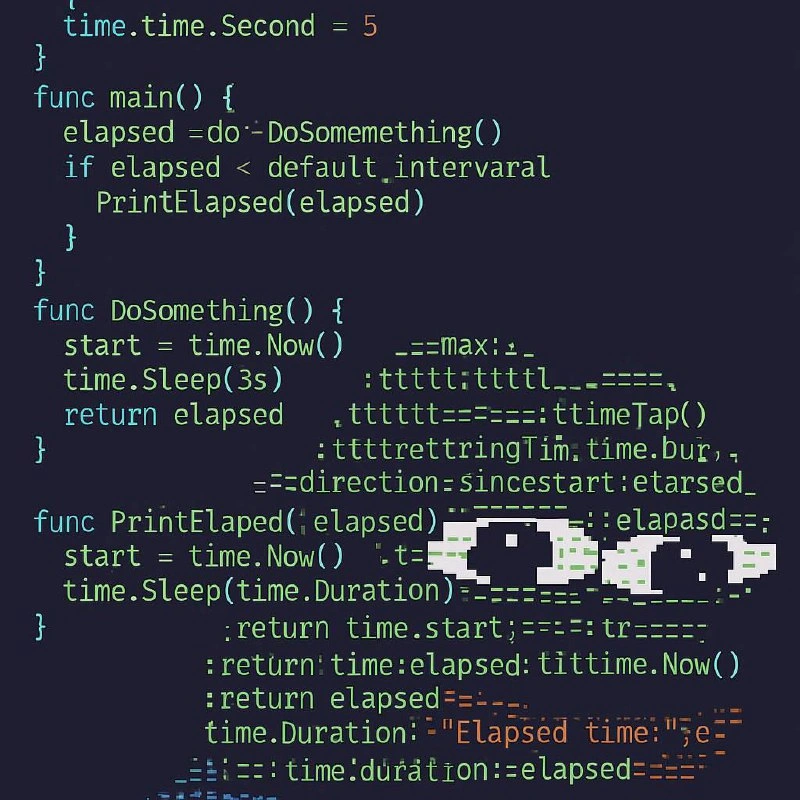
Imagine you have a recipe for baking a cake, and in the middle of the recipe someone drew a big pair of goofy eyes and doodles all over the instructions. You’re reading the steps — “add two cups of flour, stir in eggs” — and then suddenly there’s this cartoon stare gazing at you, with instructions broken up by random scribbles. You’d probably stop and say, “Huh? What am I supposed to do next?” You might even give up on the recipe because it stopped making sense. In this analogy, writing code is like writing down a recipe for the computer to follow. The computer (or a tool checking the code) is like the person trying to read the recipe. If you fill the code with funny drawings or typos, the computer gets utterly confused, just like you did with the doodled recipe. The meme is joking that the tool which checks the code (think of it like a strict teacher grading an assignment) saw those silly eyes and all the mistakes and basically said, “Nope, I’m out!” It’s funny because normally computers are super serious and precise — they don’t actually quit out of frustration, but to us it feels that way when the code is super messy. In simple terms, mixing a neat task (coding a program) with random art and mistakes is bound to fail, just like a recipe book mixed with cartoons would leave a chef scratching their head. The humor comes from seeing something that should be straightforward (the code instructions) turned into a jumbled art project, and imagining the poor rule-following computer just throwing up its hands in defeat.
Level 2: Linter Tantrum
Let’s step back and explain some of these terms and why this situation is so absurd to anyone writing code. In software development, a linter is a tool that examines your source code for mistakes, bad practices, or anything that could cause bugs. It’s like a spell-checker and grammar-checker combined, but for programming. In Go (often called GoLang), we use linters and formatters (golint, go vet, gofmt, etc.) to maintain CodeQuality – ensuring the code follows certain style rules and doesn’t have obvious errors. Now, imagine a linter encountering this particular file. It’s full of what we call code smells and outright errors: things that indicate poor coding. The meme jokes that the linter would essentially throw a tantrum or run away because the code is so hopelessly wrong.
Why is the code “hopelessly wrong”? First, there’s the issue of ASCII art smack in the middle of it. ASCII art means making pictures or designs out of text characters (ASCII refers to the character encoding standard). It can be fun in documentation or comments, but here the developer put the art in the actual code logic. The visual gag is a pair of eyes staring out from the code, made of text symbols. But a computer doesn’t see eyes – it sees a random sequence of characters that don’t form any valid command. It’s as if someone inserted a bunch of cartoon drawings into a set of step-by-step instructions – the result is complete confusion.
Next, consider compiler errors. A compiler is the part of the build process that translates code into something the machine can run. Compilers are very strict; even a single-character typo can prevent the whole program from compiling. In this snippet, nearly every line has something that would make the compiler complain. For example, the code calls a function DoSomemething() but there is no properly matching function defined (there’s DoSomething() spelled slightly differently). This is like telling the computer “hey, go do X” without ever teaching it what X is – it will error out with “I have no idea what ‘DoSomemething’ means.” Similarly, default_intervaral is used in a comparison but never defined anywhere. That’s another error: you can’t compare elapsed < default_intervaral if default_intervaral doesn’t exist (and even if it did, the spelling is likely wrong). The linter (and compiler) would flag that as “undefined: default_intervaral.”
Then there’s basic syntax. In Go, some syntax elements have very specific uses. A colon : has meaning when paired with = (in :=) or after labels. Writing do:- in the code as shown is just nonsense to the language – there’s no construct “do:-” in Go. The poor static analyzer tries to read it and goes “Um, what are you trying to do here?” Each punctuation mark in code is expected to be part of some valid statement. Randomly placed punctuation is like random words in a sentence that make it gibberish. So the linter would report a bunch of “syntax error” messages for those lines with ASCII drawings because they break the Go syntax rules utterly.
Let’s talk about what a code review is, since this meme title references it. In professional software development, before code gets accepted into a project, other developers review it – they check for mistakes, readability, and adherence to standards. It’s a bit like proofreading someone’s essay. If a junior developer submitted code like this, the reviewer would send it back long before it ever runs. CodeReviews aim to catch exactly these kinds of issues (though typically far less dramatic!). Typos in function names, using variables that haven’t been declared, or writing nonsensical lines are all big red flags. In fact, this code wouldn’t just fail a review – it wouldn’t even pass the automated build or tests that usually run as part of the submission process. Modern development setups have continuous integration systems that run linters and tests automatically when you push code. Here, we joke that the linter “quits,” but in practice it would output a list of error messages and stop the process from continuing. The end result is the same: this code would be blocked from ever merging into the real codebase.
So why is this funny to developers? Because it’s an exaggeration of a worst-case scenario. It’s developer humor poking fun at what not to do. It combines a playful element (ASCII art eyes, which we don’t expect inside real code) with a nightmare of bugs (typos and misuse everywhere). Developers often joke that sometimes code is so bad that even the tools meant to help us (like linters) can’t handle it. We know in reality the linter doesn’t have feelings – it will dutifully list out each error. But saying it “quit” personifies the tool and conveys that feeling we get when reading terrible code: “Ugh, I give up.” It’s relatable because every programmer, especially those working in teams, has encountered code that made them want to just close their laptop and walk away for a moment. This meme simply cranks that scenario up to 11 by making the code as ridiculous as possible.
In summary, at a junior-friendly level: the meme shows a Go program that’s been trashed with mistakes and even a little picture made of text. The computer cannot understand this at all – it’s as if the code is written in broken language. The linter, which is like a watchdog for code health, sees this mess and (jokingly) decides to stop working rather than attempt to process it. It’s a humorous reminder that while programming is a creative field, there’s a fine line between creative and crazy. Writing clean code means no random art in the middle of your functions, correct spelling for your variables, and making sure every piece of the code makes sense. Otherwise, our tools – and teammates – will rightfully “panic” or quit on us until we clean it up.
Level 3: Code Review Horror Show
From a senior developer’s perspective, this code snippet is a code review horror show come to life. It’s as if someone checked in a practical joke instead of a serious commit. The humor hits hard because any experienced engineer has seen their share of bad code, but this takes it to another level by intentionally sprinkling ridiculous errors and ASCII art into the source. Let’s enumerate the carnage lurking in this supposed Go code:
Typos Everywhere: The function names and variables are profoundly misspelled. We have
DoSomemethinginstead ofDoSomething,PrintElapedinstead ofPrintElapsed, anddefault_intervaralinstead ofdefault_interval. In a real code review, seeing one letter off in a name is an immediate red flag – it screams lack of attention to detail. Here nearly every identifier is typo-riddled. A senior dev would likely double-check if the author’s keyboard was malfunctioning or if these misspellings were some bizarre attempt at obfuscation. It’s both funny and painful: funny as a gag and painful as a thought of this going into a codebase.Variables Used Before Declaration: The snippet shows
elapsedbeing used without any prior declaration (elapsed = do:-DoSomemething()). In Go, every variable must be declared (withvaror:=) before use. Using an undeclared variable results in a compiler error. This is a fundamental bug – it’s like referring to a person by name in a story before you’ve introduced who they are. Any half-decent code linter or compiler would flag that immediately. For a reviewer, this indicates the code probably never even ran once before being shared. It’s basically shouting, “I didn’t even bother to compile-test this.”Stray Syntax and ASCII Art Chaos: The most obvious “WTH” moment is the ASCII art eyes in the middle of
func DoSomething()andfunc PrintElaped(). To achieve those eye shapes, the code’s indentation and characters are contorted into something that no compiler could interpret. Lines of code look like they’ve been deliberately broken: you can see fragments like:=direction:=sincestart:=etarcsedorbiting around the eye drawings. This isn’t even commented-out art – it’s smack in the middle of the function bodies. It means the code’s structure is completely disrupted. Curly braces and semicolons in Go can only do so much; you simply can’t have free-floating colons:and equal signs=in the middle of nowhere. A code reviewer would probably rub their eyes (no pun intended) and ask if this is an April Fools commit. The ASCII eyes are cute in a non-code context, but in a production code review they’d be the stuff of nightmares.Logic and API Misuse: Even ignoring the art, the code’s logic is nonsense. For example,
time.Sleep(3s)is not valid Go syntax. In Go, to sleep for 3 seconds, you’d writetime.Sleep(3 * time.Second). The snippet’s3slooks like someone tried to invent a pseudo-syntax just to shorten the call (or position thesas part of the art). It’s a bug; the compiler won’t know what3smeans. Also, the functionPrintElaped(elapsed)presumably should print or return something, but in the screenshot it’s empty (apart from more chaotic text). Andfunc PrintElaped(elapsed)is defined with a parameter but inside tries to usetime.startandtime.elapsedas if those were valid things (they’re not). All signs indicate this code would never run – it’s a cluster of code smells layered on top of each other.
When a senior dev sees code like this, the first reaction is a mix of horror and dark humor. On one hand, it’s obviously a joke – no one in their right mind would intentionally merge this into main. On the other hand, it satirizes real issues in sloppy code: minor typos that break functionality, poor naming (default_intervaral not only is spelled wrong but also tells us nothing clear – interval of what?), and the idea of trying to be “clever” in code where it isn’t appropriate. The CodeQuality lesson hiding in the humor is that code is meant for both computers and humans to read, but primarily it must execute correctly. Here, someone prioritized an amusing visual gag over even basic correctness. It’s essentially making fun of what happens when a developer treats the source file like a canvas for self-expression at the expense of sanity.
The linter’s “quitting” is a personification of our internal code quality tools throwing their hands up. In reality, if you ran go build or a linter on this file, you’d get a flood of error messages. A seasoned engineer has seen long error outputs, but the meme imagines the scenario going one step further: the linter not just reporting errors, but tapping out entirely. It’s like a code reviewer leaving a comment that just says, “I can’t even... please rewrite this from scratch,” because giving detailed feedback feels hopeless.
To give you an idea, if we tried to compile this, we might see errors such as:
$ go build main.go
# command-line-arguments
./main.go:5:16: syntax error: unexpected '-', expecting expression
./main.go:8:12: undefined: default_intervaral
./main.go:15:2: missing return at end of function
Each of those is the compiler or tool basically screaming, “This code is nonsense!” The meme’s joke compresses all that into a single action: the linter just rage-quitting. It resonates with developers because we’ve all seen code so bad or weird that it makes us feel like quitting the review or refactor. In code review vernacular, this snippet would earn a swift “Request Changes” with an extensive (and slightly exasperated) comment thread – after everyone in the room finishes laughing, of course. The tension captured here is the eternal struggle between creative freedom and maintainable code. Sure, code can be art, but when you’re on the clock, your team (and the tools) would much prefer you not channel Picasso in the main.go.
Level 4: ASCII vs AST
At the deepest technical level, this meme is highlighting a collision between creative ASCII art and Go’s strict formal grammar. In Go (and most compiled languages), source code must conform to a precise syntax defined by a context-free grammar (often specified in Backus-Naur Form). The Go compiler (and by extension, any Go linter or static analysis tool) first runs a lexical scanner and parser over the code to build an Abstract Syntax Tree (AST) – a tree representation of the code’s structure. In our snippet, the characters have been arranged into visual art (those cartoon eyes made of underscores _, equal signs =, and colons :), but from the compiler’s perspective this is pure lexical gibberish.
Let's break down why the parser chokes. The sequence elapsed = do:-DoSomemething() is utterly baffling to Go’s grammar rules. In Go, := is the short variable declaration operator (e.g. x := 5 declares and sets x). Seeing do: might make the parser think you're defining a label named do (since label: is a valid construct for goto statements). But then -DoSomemething() immediately following do: makes no sense – it’s as if a unary minus operator - is hanging out with no proper operand or as if we started to subtract a function call from... nothing. The parser is left asking “Where’s the rest of this expression?” The ASCII art is essentially introducing tokens (like ::::ttttt:::: or ==max::== as seen around the eye shapes) that don’t correspond to any valid production in Go’s grammar. It’s a bit like randomly shuffling grammar symbols into a code file – the parser can’t reconcile them into any valid AST, leading to a cascade of syntax errors.
A Go linter, such as golint or go vet, typically operates by either constructing an AST or using the compiler’s AST to analyze code for issues (unused variables, style problems, potential bugs, etc.). If the code doesn’t even compile (due to those crazy characters and typos), the linter doesn’t get a well-formed AST to inspect. In strict analysis tools, a parse error usually means the tool halts or reports an error and then quits – which is exactly what the meme jokes about. The phrase “the linter quits” anthropomorphizes the static analyzer, suggesting it took one look at this syntax-highlighted nightmare and decided to throw in the towel. From a technical standpoint, it’s the inevitable outcome: feed nonsense tokens into a compiler or linter, and you’ll either get a stream of error messages or possibly even trigger an unhandled exception in the tool if it wasn’t built to handle such egregious input (imagine a particularly brittle linter encountering an ASCII art face and just crashing in confusion). This is the compiler’s equivalent of a nervous breakdown – the strict rules of the language have been so thoroughly violated that the poor tool just gives up.
It’s worth noting that ASCII art can exist in code in controlled ways (for example, as string literals or comments) without breaking the parser. There’s a rich history of playful coding – from elaborate comment banners to the International Obfuscated C Code Contest (IOCCC) where code is contorted into artwork but still compiles. The key difference is that in those esoteric cases, the code still respects the language’s formal grammar (maybe by encasing art in a multi-line string or cleverly using only permissible syntax). In our meme’s case, the author didn’t even try to satisfy the grammar – the art is just plunked amid the code with no regard for syntax. It’s basically syntactic vandalism. The result: the Go compiler’s parser has a fit, the AST never materializes, and the linter process effectively says “I can’t even.” The humor here taps into that fundamental rigidity of compilers: a computer will do exactly what you tell it, but if you tell it complete nonsense, it won’t politely guess your intent – it will error out spectacularly. And here, the nonsense is so flamboyant (literal cartoon eyes in the code!) that even the software tools are portrayed as throwing up their hands.
Description
A screenshot of code written in a Go-like syntax is displayed against a dark purple background. The code is filled with syntax errors, typos, and logical flaws, such as 'elapsed = do-DoSomething()', 'default_intervaral', and a function returning an undefined variable. Overlaid on the right side of the code is a jumble of corrupted text and glitched characters, creating a chaotic effect. Peeking through this visual noise are two large, white, pixelated cartoon eyes, staring intently at the flawed code. The meme visually represents the surreal and painful experience of trying to debug or comprehend poorly written, buggy, or 'cursed' code, where the code itself seems to be falling apart while being watched
Comments
22Comment deleted
This isn't just legacy code; it's a cognitohazard that causes compiler errors just by looking at it. The bug isn't in the code, the bug is the code
Somewhere between the ASCII eyes and “time.Sleep(3s)”, go vet filed for burnout and go fmt just pretended the file never existed
After 15 years of debugging race conditions and mysterious timing bugs, you finally understand why Go's time.Sleep() takes a Duration instead of milliseconds - it's measuring how long until your sanity completely unravels and the code starts staring back at you
When your performance monitoring is so aggressive it literally watches your every function call. This Go code's timing instrumentation has achieved sentience and is now judging your 3-second sleep() calls with the disappointed gaze of a senior architect reviewing a junior's first PR. The eyes say 'I see you measuring elapsed time... but have you considered using context.WithTimeout instead?'
Protip: if your Go “benchmark” sets time.Second = 5 and measures with Sleep, the only throughput you improved is how fast the code reviewers’ ASCII eyes roll - wrap time behind an interface or enjoy flaky tests forever
To measure elapsed time, just Sleep(5) - because in prod, stakeholders love 'responsive' UIs that ponder existence
Nothing says rigorous benchmarking like resetting the clock in PrintElaped, calling time.Sleep(time.Duration), then wondering why pprof reports 100% of your time in logging
bro invented new unicode (and words (and syntax)) Comment deleted
tittime.Now() Comment deleted
Elaped? 🤓 Comment deleted
El Aped Comment deleted
was this the only problem you noticed? Comment deleted
The only problem that is related to public API. The internals are not relevant, as long as it works (I didn't tested). Comment deleted
I am certainly sure this is just AI slop again Comment deleted
why did you have to say "certainly sure" as if there is any doubt in the first place Comment deleted
Lmao Comment deleted
how about instead of variations of "elapsed" we instead talk about Comment deleted
tit time 😏 Comment deleted
NOW Comment deleted
:3 Comment deleted
me when i take estrogen: Comment deleted
Does it compile? Comment deleted