When the whiteboard diagram becomes a production system
Why is this DesignPatterns Architecture meme funny?
Level 1: When Ideas Get Real
Imagine you draw a picture of a cool castle using just a few simple shapes – a big cube for a building, a cone for a tower, a sphere for a dome. On paper, it looks neat and clean. But then, magically, every shape you drew comes to life as a real object in your room! Suddenly there’s a huge cube, a giant cone, and a massive sphere all crowded together, bumping into the walls and furniture. Your simple idea of a castle turned into a chaotic pile of actual blocks everywhere. It’s funny in the same way this meme is funny: an idea that seemed easy and tidy became very real and messy. Everyone was acting all cool about the plan (“Yeah, this will be great, no problem!”), but when the plan actually happened for real, it was overwhelming. The joke is basically showing that feeling – how a plan can seem perfect in our imagination, but when our ideas run wild and become real things, we end up with a big, goofy mess that makes us laugh and say, “Wow, that did NOT go as expected!”
Level 2: Blueprint to Code
Let’s break it down more simply. UML (Unified Modeling Language) is like a blueprint for software. When you draw a UML class diagram, you’re sketching out concepts: boxes for classes or objects, lines for relationships like “inherits from” or “contains a.” It’s abstract – meaning it’s about ideas and plans, not actual running code. An abstract class or concept in programming is kind of like a general template (for example, an abstract class Animal that represents the idea of an animal). A concrete class or object is a real, specific thing you can use in code (like a Dog or Cat class that implements the Animal template). In a perfect world, this planning makes coding easier: you think through the design first so you don’t just improvise everything in code.
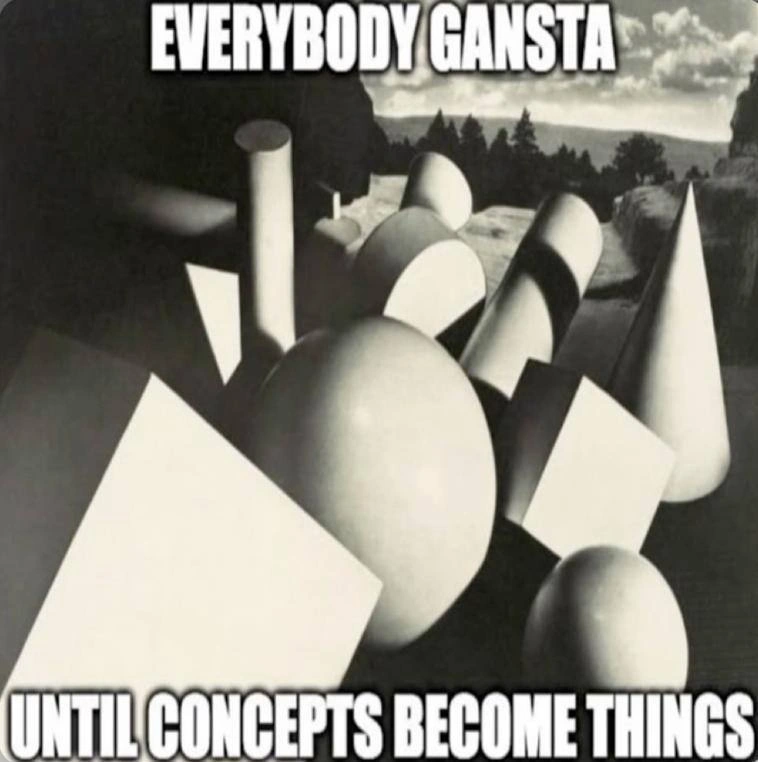
The meme jokes about what happens when we go straight from blueprint to code in a very literal way. The top text “Everybody gangsta” is slang for “everyone acts cool or confident.” The bottom text “until concepts become things” completes the thought: everyone feels confident about a plan until those abstract ideas turn into real, tangible things you have to deal with. In a software context, that means it was all good when it was just a concept on a whiteboard, but it gets overwhelming when actual code objects start multiplying. Think of a time you designed a system on paper with, say, 5 classes and ended up implementing 50 classes because each concept sprouted variations, helpers, and factory classes. That’s an example of object_model_sprawl. The neat diagram “escaped” – it didn’t stay minimalist. Instead, it spawned a bunch of concrete objects everywhere, just like in the image where simple shapes are scattered all over a landscape.
Why is that funny or noteworthy? Because it’s DeveloperHumor rooted in truth: new developers might not expect it, but often the real code is much more complicated than the high-level design suggested. DesignPatterns come into play here. A design pattern is a typical solution to a common problem (like a recipe in coding). For example, the Factory Pattern might tell you to make a general ShapeFactory interface with multiple ConcreteShapeFactory classes to create shapes. That sounds tidy in theory, but if you apply it indiscriminately, you suddenly have a lot of classes (one factory per shape type, plus each shape class itself). Each ArchitectureTradeoffs decision (like adding more abstraction for flexibility) makes the system a bit more complex. When taken too far, it becomes OverEngineering – building something far more complicated than what you actually need. Over-engineered code can be harder to read and maintain, hurting CodeQuality. So the meme is a light-hearted warning: be careful turning every little concept in your design into its own class or object. It pokes fun at that moment of realization when a developer sees their simple idea turned into a tangled mess of objects and goes, “Uh… this got out of hand.” In short, the image uses those giant cubes and cones as a metaphor for what happens when a simple plan is implemented too literally: you get a pile of stuff that’s way more than you bargained for, which is funny because we’ve all been there in software development.
Level 3: From UML to OMG
In this black-and-white fever dream of a meme, we see a UML diagram’s worst-case scenario: abstract shapes (cubes, cones, spheres) that were nicely contained in a design doc have busted loose into reality. The top caption "EVERYBODY GANSTA" followed by "UNTIL CONCEPTS BECOME THINGS" is a tongue-in-cheek reference to a popular meme format. Here it means every software architect feels like a confident gangsta swaggering through an architecture review until their high-level concepts actually turn into concrete code things. It’s hilariously relatable to developers who’ve watched a neat diagram explode into a zoo of classes at runtime. The meme visualizes an abstract_vs_concrete catastrophe: our once-tidy concepts (represented by idealized geometric forms) have spawned concrete objects everywhere, just like an over-eager code generator turned a design document directly into a sprawling object graph. This is the nightmare scenario of when_design_docs_compile without mercy.
What’s going on technically? The joke targets the gap between DesignPatterns_Architecture ideals and messy implementation reality. In theory, modeling something with Unified Modeling Language (UML) should lead to clean, organized code. You draw some class boxes with inheritance arrows, feeling like a boss. But in practice, if you literally implement every box and line, you can end up with a concept_to_class_explosion – an avalanche of classes, interfaces, factories, and subclasses breeding like Tribbles. Senior engineers recognize this as a form of OverEngineering: applying every fancy pattern in the book until the codebase is drowning in indirection and tiny classes. The meme’s surreal heap of shapes humorously represents an object_model_sprawl, where an initially elegant model spawns so many objects that the system’s simplicity and CodeQuality are crushed under their weight. It’s like the codebase is yelling “OMG!” after blindly following the UML blueprint. (Fun fact: OMG also stands for Object Management Group, the committee behind UML’s standard – a sly double meaning that seasoned architects might smirk at.)
The humor cuts deep because it lampoons a real developer experience: the architect or team lead proudly presents a grand design – perhaps leveraging half the Gang of Four design patterns – and everyone nods along, feeling gangsta about how scalable and elegant it looks on paper. But when coding starts, suddenly there are dozens of classes named AbstractShapeFactory, ShapeFactoryImpl, ShapeFactoryManager, and so on, each spawning instances of CubeObject, SphereObject, ad infinitum. Every concept from the diagram has indeed become a thing in the code. Maintaining this is a headache: you navigate layers of abstraction just to find simple logic, and adding new features means touching a dozen files. The ArchitectureTradeoffs that were theoretical (“we’ll be so flexible for future changes!”) turn into RealWorldTradeoffs like slower development and harder debugging. Seasoned devs have fought these battles: undoing a needless abstraction layer at 3 AM to fix production, or painstakingly refactoring a SoftwareComplexity monstrosity that grew from an overzealous design. This meme nails that collective trauma with dark humor. It’s essentially saying: design is gangster cool until it hits reality – then it might just shoot your project in the foot. Developers who’ve been there can’t help but laugh (and maybe cry a little) at how accurately this absurd pile of shapes captures their experience of a runaway design turning into unmanageable code.
Description
A surreal, black-and-white image shows large, solid geometric shapes - spheres, cylinders, cubes, and cones - scattered across a landscape under a cloudy sky. The image has a heavy, imposing feel. The meme text, in a bold white font, is placed at the top and bottom. The top text reads, 'EVERYBODY GANSTA,' and the bottom text says, 'UNTIL CONCEPTS BECOME THINGS.' This meme uses the 'Everybody Gangsta Until...' format to satirize the software development lifecycle. 'Concepts' represent the clean, abstract, and often perfect world of architecture diagrams, high-level design, and theoretical planning. 'Things' represent the messy, complex reality of implementation, where simple ideas become tangled code, unforeseen edge cases, and operational burdens. The joke resonates with experienced engineers who know the pain of translating a beautiful plan into a functioning, maintainable system

Comments
8Comment deleted
It's all elegant microservices and clean APIs on the whiteboard. Then you start coding and realize it's just a distributed monolith held together by YAML and regret
Every ‘pure abstraction’ in the design review eventually compiles into a namespace full of concrete pain
After 20 years in the industry, I've learned that every elegant microservices diagram becomes a distributed monolith, every 'simple' event-driven architecture becomes a debugging nightmare, and every promise of 'we'll refactor it later' becomes technical debt that outlives three CTOs
Every architect is confident drawing boxes and arrows on a whiteboard until those perfectly aligned microservices diagrams have to handle actual network partitions, eventual consistency, and the realization that your 'simple' event-driven architecture now requires a PhD in distributed systems theory just to debug why Customer Service B didn't receive the OrderCreated event from Service A... again
Gangsta with platonic ideals until floating-point precision turns your perfect sphere into an ellipsoid mess
Everyone’s a visionary in the review - until every noun on the slide becomes its own service with a schema, a contract, SLOs, and your on‑call rotation
Everyone’s fearless at the whiteboard - until the “Concept” gets a UUID, invariants, a migration script, and two conflicting consistency models
SHRDLU Comment deleted