Skip to content
DevMeme
1385 of 7435
Underestimating Task Complexity
Bugs Post #1558, on May 10, 2020 in TG

Underestimating Task Complexity

Why is this Bugs meme funny?

Level 1: Never That Simple

Imagine you have a really easy homework assignment and you think, “I’ll be done in 20 minutes.” You start working on it, feeling confident. But then, as you do it, you realize there are hidden problems. Maybe the math problem you thought was one-step actually has a tricky twist, or while cleaning your room (thinking it’s just a quick tidy-up), you discover a whole mess under your bed that you didn’t know about. Suddenly, that quick task isn’t quick at all — it might take you an hour or more to finish. You feel surprised and a little annoyed because it was supposed to be simple.

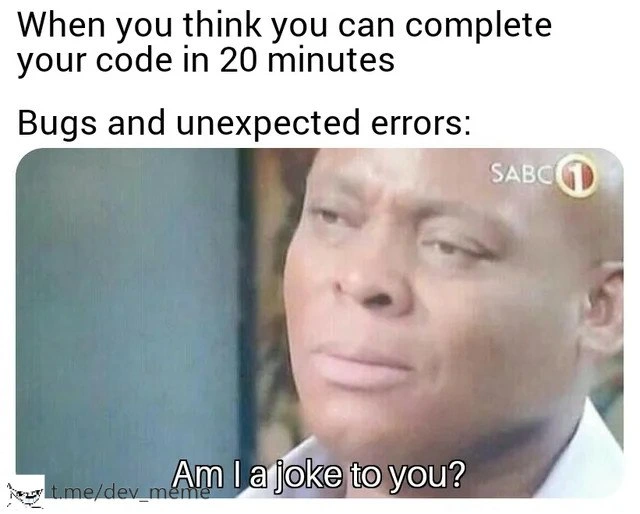
This meme is playing with that exact feeling, but in the world of coding. The programmer thought their coding task would be super quick (just 20 minutes). That’s like you thinking your homework or chore is tiny. But then surprise! Lots of unexpected little problems (we call them “bugs” in code, kind of like little gremlins in the computer) pop up. It’s as if those problems are saying, “What, you thought we wouldn’t be here? Think again!” — just like finding that hidden mess makes your quick chore much longer. The man in the meme image saying “Am I a joke to you?” is like those problems feeling offended that the programmer ignored them.

In simple terms, the joke is showing the difference between what we expect and what reality gives us. We laugh because we’ve all been in that spot: we plan to do something quickly, but then unexpected stuff happens and it takes waaaay longer. It’s funny in hindsight because it’s so common. Just like you might laugh later about how cleaning your room ended up taking the whole afternoon, developers laugh about thinking “I’ll finish this code in 20 minutes” and then spending hours fixing surprises. The meme is a little reminder that nothing is as easy as it seems — especially in programming! So the next time you plan to do something fast and it gets complicated, you can remember this joke and know everyone goes through the same thing. It’s a funny way to say, “Hey, we’ve all been there. Tasks always have hidden surprises!”

Level 2: Not So Quick Fix

Let’s break down the meme in simpler terms. The text at the top says, “When you think you can complete your code in 20 minutes.” This sets the stage: a developer honestly believes their coding task will be really quick. Maybe they need to add a small feature or fix what looks like a tiny bug. They feel confident it’ll be done in a snap, kind of like saying, “Oh, this is easy, I’ll be finished before my coffee gets cold.”

Then comes the second line, “Bugs and unexpected errors:” followed by the reaction image of a man looking very unamused with the caption, “Am I a joke to you?” This image is from the popular “Am I a joke to you?” meme format, often used when someone feels underestimated or not taken seriously. In this meme, it’s as if the bugs in the software themselves are speaking. The bugs are personified as the guy in the image, glaring at the developer. They’re basically saying, “Oh, you thought I wouldn’t be a problem? You thought this would be easy? Think again!” It’s a humorously exaggerated way to show the bugs feeling offended that the coder didn’t expect them.

Now, why is this funny to developers? It’s because it’s a relatable developer experience. Bugs (which are mistakes or errors in the code) have a sneaky habit of appearing when you least expect them. An unexpected error is exactly what it sounds like: a problem that pops up that you didn’t see coming. Every programmer, especially those just starting out, has had that moment where they think, “I’ll just quickly finish this task,” and then boom – the program crashes or throws a bunch of error messages. Cue a long debugging session! Debugging is the process of finding and fixing those errors. It can be tricky and time-consuming, especially when the bug isn’t obvious. So, the meme is highlighting that contrast between the expectation (quickly done in 20 minutes) and the reality (hours of troubleshooting). In tag terms, this is the classic DeveloperExpectationsVsReality situation.

Let’s connect this to a junior developer’s perspective. Suppose you’re new to coding and you’re given a task that seems straightforward. Maybe it’s a homework exercise or a simple feature for an app you’re tinkering with. You estimate, “Hmm, this should only take me about 20 minutes.” That’s your time estimation – basically your guess of how long the work will take. Estimating time in software is a skill that even veterans struggle with, because there are often hidden complexities. As a newbie, you might not realize all the things that could go wrong. So you dive in, start coding, and initially things seem fine. Then you run your code... and it doesn’t work. You get a red error message, or the program does something weird. Uh-oh, there’s a bug. Now you have to debug – maybe it’s a typo, maybe you didn’t consider what happens if a user inputs a negative number, maybe a library function you’re using behaves differently than you assumed. One small error can cause a chain reaction of issues. What you thought was a quick fix turns into an hour of testing different solutions, Googling error messages, and maybe asking a colleague or friend for help. By the end, you’re thinking, “I can’t believe that took so long.” It’s a humbling experience!

The meme resonates because it captures that facepalm moment exactly. The bugs saying “Am I a joke to you?” is just a fun way to admit we often underestimate how many problems (bugs) are lurking in our code. It’s like the bugs are reminding us, “Hey, we exist, don’t forget about us!” It highlights a bit of DeadlinePressure as well – if you promised to finish in 20 minutes and it takes 2 hours, you might feel the crunch if someone is waiting on you. Developers often joke about this because it happens all the time. It’s not that programmers are bad at their job; it’s that software can be very complex and full of surprises. Even simple tasks can hide complications under the surface.

For a junior coder, the takeaway is: don’t worry, it’s normal for things to take longer than you expect. That’s why experienced developers pad their time estimates – they know about the unknown unknowns. And when things do go sideways, you just roll up your sleeves and debug the issues one by one. The humor in this meme is a friendly nod from the programming community saying, “Yep, been there, done that!” Everyone finds it funny because we’ve all felt that moment of “Oh no, not another error…” The meme uses a bit of internet pop culture (the reaction image) to make the point in a lighthearted way. In short, coding always involves some unexpected hurdles, and that contrast between our optimistic planning and the bugs’ reality check is what makes this joke so spot-on.

Level 3: Famous Last Words

Ever heard a developer say, "This will only take 20 minutes"? Those are basically famous last words in software development. The meme captures this perfectly: a programmer’s cocky TimeEstimation collides with reality, and the Bugs in the code are practically rolling their eyes. The top text of the meme sets up the optimistic premise (finish coding in 20 minutes!), and the bottom image delivers the punchline with that deadpan “Am I a joke to you?” look. It’s as if the bugs and unexpected errors themselves are personified, glaring at the dev for daring to underestimate them. This scenario is painfully familiar in our field – a classic case of DeveloperExpectationsVsReality where confidence meets its nemesis: the unforgiving complexity of real code.

In the trenches of coding, underestimating tasks is almost a rite of passage. Seasoned engineers have learned (the hard way) about the planning fallacy – we’re all optimistically biased to guess things will go quicker than they do. There’s even a notorious adage, Hofstadter’s Law, which states:

“It always takes longer than you expect, even when you take into account Hofstadter’s Law.”

In other words, even if you know your project is likely to run late, it still runs later. 😅 Why? Because software has a way of hiding edge cases and gotchas until you’re neck-deep in debugging. That one-line change you thought was trivial can ripple through the system in unexpected ways. Maybe that “quick fix” introduces a regression (breaking something that used to work), or you discover the module you’re touching wasn’t designed the way you assumed. Perhaps an external API you depend on starts returning crazy data that your code doesn’t handle. By 3 AM, your DebuggingFrustration is through the roof and those 20 minutes have long expired.

Let’s be real: experienced devs have a healthy fear of the phrase “just a small change.” They know a seemingly minor tweak can explode into a Debugging_Troubleshooting nightmare. The meme hits home because it’s a shared industry truth: no battle plan survives first contact with a bug. Murphy’s Law lurks in every code deployment – if something can go wrong, it will (and usually right before the deadline). What starts as a quick coding session can turn into an epic bug-hunt. Here’s a timeline that every developer will recognize:

  • T=0 – Confidently start the "20-minute" fix with a fresh cup of coffee. DeadlinePressure is low, optimism is high.
  • T=20 – The code is written… and it crashes on run. An “unexpected error” appears. Okay, didn’t see that coming. Time to debug.
  • T=60 – Found the initial bug and fixed it, but now 5 other tests are failing. Each fix reveals another hidden issue. Coffee mug is empty; patience is draining.
  • T=120 – Finally, the app runs without errors. Two hours later, that 20-minute task is done and you’re left muttering at the screen.
  • T=121 – Browser tab shows a new production bug report. You stare at it in silence, channeling the meme’s face: "Am I a joke to you?" 😤

By now, it’s clear why the meme is so relatable for developers. We’ve all been in this situation, often more than once. The humor comes from recognition: it’s funny because it’s true. The codebase basically says “Hold my stack trace” the moment you underestimate it. It’s a universal DeveloperHumor moment – you plan a quick victory, but the code fights back like a final boss battle you didn’t know was in the level. This meme also pokes at Deadline culture: the pressure to deliver fast can tempt us into rosy estimates (“sure, I can do it in 20!”) which reality promptly disproves. The BugsInSoftware love to humble over-confident devs.

From an architectural standpoint, there are reasons these “surprise” bugs pop up. Modern software is built on many layers (libraries, frameworks, APIs, services) interacting in complex ways. Change one thing, and something else down the line might break. It’s like a Jenga tower: removing what looks like a harmless block can make the whole structure wobble. Technical debt and legacy code make this worse – old, messy code has undocumented features (read: lurking bugs) that awaken when disturbed. Even with good practices, you can’t anticipate everything. As the saying goes, “the last 10% of the project takes the other 90% of the time.” That extra hidden complexity is where all the unexpected errors live.

Despite the dark humor, there’s a lesson under the joke. Seasoned devs pad their estimates (you say 20 minutes? better make it an hour) because they know TimeEstimation in programming is an art of managing uncertainty. They write tests and use debuggers to catch issues, but even then, things slip through. The meme’s popularity in dev circles (with tags like #BugsInSoftware and #CodingHumor flying around) shows that everyone recognizes this gap between expectation and reality. It’s almost comforting to know it’s not “just you” — even the best developers get schooled by surprise bugs now and then. So the next time someone boasts, “I got this, 20 minutes tops,” you’ll know why the rest of the team exchanges knowing smirks. They’ve seen this movie before, and they know the bugs might have the last laugh.

Description

The image uses the 'Am I a joke to you?' meme format. The top text reads, 'When you think you can complete your code in 20 minutes'. Below this, it says, 'Bugs and unexpected errors:'. The image itself is a close-up of a man with a serious, questioning expression, with the caption 'Am I a joke to you?' at the bottom. The SABC 1 logo is visible in the top right corner. This meme perfectly encapsulates the classic developer experience of grossly underestimating how long a task will take. What seems like a simple, 20-minute code change often spirals into hours or days of debugging unforeseen issues, a painful reality rooted in the inherent complexity and unpredictability of software development. It's a humbling and universally relatable experience for developers at all levels
Comments

7
Anonymous ★ Top Pick The first rule of programming estimates: take your best guess, double it, and then add three days for that one cryptic error message from a library you've never heard of
  1. Anonymous ★ Top Pick

    The first rule of programming estimates: take your best guess, double it, and then add three days for that one cryptic error message from a library you've never heard of

  2. Anonymous

    Every time I pencil in a “quick 20-minute tweak,” the Heisenbug Committee forms a cross-service quorum and books my entire sprint

  3. Anonymous

    Twenty minutes is just enough time to discover your elegant solution breaks three integration tests, triggers a race condition in production, and somehow violates a business rule nobody documented but everyone apparently knew about

  4. Anonymous

    Every senior engineer knows the universal constant: actual_time = estimated_time * π * Murphy's_Law_coefficient. That '20 minutes' estimate? It's really just the time it takes to read the error message, realize your assumptions about the codebase were adorably naive, and begin the archaeological dig through three layers of abstraction to find which microservice is actually throwing the exception. The bugs aren't mocking you - they're just reminding you that hubris is a runtime error, not a compile-time warning

  5. Anonymous

    “Give me 20 minutes” - the incantation that summons flaky tests, expired cloud creds, and a prod-only Heisenbug hiding behind a “safe” feature flag

  6. Anonymous

    Every '20-minute' change is 5 minutes of code and 115 minutes of yak-shaving through transitive dependency pinning, stale feature flags, and a flaky integration test that only fails when the CI cache is cold

  7. Anonymous

    20 minutes? That's the time before your 'simple fix' unearths a Heisenbug thriving only in prod-like loads

Use J and K for navigation