Skip to content
DevMeme
1384 of 7435
Brain Real Estate: Vim Keybindings vs. Everything Else
IDEs Editors Post #1557, on May 10, 2020 in TG

Brain Real Estate: Vim Keybindings vs. Everything Else

Why is this IDEs Editors meme funny?

Level 1: One Track Mind

This meme is funny because it shows someone with a one-track mind. The programmer cares so much about his keyboard tricks that he forgets a basic thing like a name! Imagine a kid who loves dinosaurs memorizing dozens of dinosaur names and facts. When a new classmate says, “Hi, I’m Jason,” the kid is so distracted thinking about T-Rex and Triceratops that he later calls the classmate the wrong name by accident. 😅 In the same way, the comic shows a developer who has learned every special keyboard shortcut for his favorite editor (so he doesn’t have to use the mouse). His brain is so packed with those little tricks that when someone introduces themselves, he doesn’t store the name properly. A moment later he calls poor Jason “Jarvis” – completely wrong! It’s a silly exaggeration that makes us laugh because it’s a bit true: when you only think about one thing all the time, you might forget other simple things. In other words, he was so busy thinking about coding shortcuts, he forgot a person’s name! The humor comes from that extreme obsession and the social blunder it causes.

Level 2: Keybindings vs Names

This comic shows a programmer so obsessed with Vim (a classic text editor) and its shortcuts that he forgets a new acquaintance’s name seconds after hearing it. Let’s break down why that’s funny:

Vim and keybindings: Vim is a powerful text editor that programmers often run inside a terminal. It’s old-school but very efficient once you learn it. Instead of relying on menus or a mouse, Vim users do everything with the keyboard. Specific key presses in Vim perform editing commands – these are called keybindings (bindings of actions to keys). Vim is a modal editor, which means your keys do different things depending on the mode you’re in. For example, in "Normal mode" your keystrokes are interpreted as commands, while in "Insert mode" those same keys just type letters into the file. Vim has a reputation for a steep learning curve because you need to memorize a bunch of one- or two-letter commands to use it fluently. But devotees love it since it lets them code very quickly without ever lifting their hands from the keyboard.

For example, in Vim:

  • Pressing i switches you to Insert mode so you can start typing text.
  • Pressing Esc returns you to Normal mode, where keys will execute commands instead of typing.
  • The keys h, j, k, l move the cursor left, down, up, and right (replacing the arrow keys, so you don’t need to move your hand to arrow keys or mouse).
  • Typing :wq (and hitting Enter) tells Vim to write (save) the file and quit the editor.

These are just a few vim_keybindings; there are dozens of them, and hardcore Vim users try to internalize as many as possible. The payoff is that they can navigate and edit text at lightning speed. The yellow-shirt character in the comic clearly has Vim’s shortcuts on his mind all the time. The joke exaggerates this by showing that his brain prioritizes remembering Vim commands over something as basic as a person’s name!

"Sick of using your mouse?" In the last panel, the Vim-loving character asks, “Aren't you sick of using your mouse to program?” This might sound odd if you’re new to this topic – what’s wrong with using a mouse? It’s a playful reference to a common attitude among power-users of keyboard-driven tools. Many Vim enthusiasts genuinely feel that moving your hand to the mouse and clicking around is slower or less efficient than using the keyboard for everything. They pride themselves on a workflow where the mouse is almost obsolete. This ties into the larger IDEs_Editors debate. There’s been a long-running, tongue-in-cheek rivalry (often called the editor wars) between different coding environments. For instance, Vim versus Emacs is a famous one (two very configurable text editors from the old days, each with fanatical fans), and more recently Vim vs modern IDEs like Visual Studio Code or IntelliJ. It’s like sports team rivalries for developers – people playfully argue about which is best. So when the character immediately brings up the mouse question after meeting Jason, the comic is highlighting how overzealous he is about his tool. He can’t even do a normal introduction without slipping in a jab at GUI-based coding. That’s what we mean by tooling obsession – being so into your tools that you try to convert others at every chance.

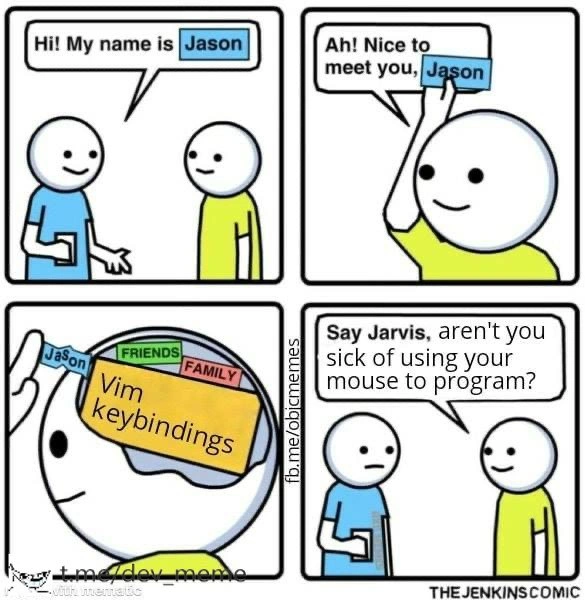
Brain space and memory overflow: The third panel gives a visual representation of the programmer’s mind. Inside his head, there’s a bulletin board with sticky notes. You can see a tiny note that says “Jason” and other small notes for “Friends” and “Family”, but they’re almost completely covered by a huge yellow note labeled “Vim keybindings”. This indicates that thoughts about Vim commands are taking up the majority of his mental space, leaving barely any room for remembering people’s names or other personal details. It’s a playful metaphor that a developer’s brain can only hold so much info at once – and this guy chose to fill it with editor shortcuts! In computing terms, we might compare this to a memory_overflow situation. (In case you haven’t heard that term: a memory or buffer overflow happens when a program tries to use more memory than it’s supposed to, and in doing so it overwrites some existing data by accident.) Here, the joke is that his brain “overflowed” with Vim knowledge and effectively overwrote the memory where Jason’s name was stored. So when he tries to recall the name, it’s gone – the data got pushed out by the giant Vim note. That’s why in the final panel he confidently calls the guy “Jarvis” instead of Jason, not even realizing his mistake.

The punchline (forgetting the name): Calling Jason “Jarvis” is the big goofy moment that drives the joke home. He got the name utterly wrong! Jarvis might just be a random name his brain coughed up, or it might be a sign that he defaulted to something techy (Jarvis is famously the name of Iron Man’s A.I. assistant – a detail a lot of nerdy folks know). Either way, it shows he truly didn’t remember Jason’s actual name at all. The humor here comes from relatability and exaggeration. It’s relatable because many developers have experienced “brain clutter” – maybe you’ve had so much code or shortcut knowledge crammed in your head that you momentarily blank on something simple in real life, like a name. And it’s exaggerated to comic effect (most of us wouldn’t forget a name that fast, but the cartoon takes it to an extreme to make the point). Essentially, the meme is a friendly jab at programmers who let their developer_brain_space be completely dominated by their tools and tech trivia. It says, “hey, maybe cut back on memorizing every little shortcut – you just forgot a person’s name because of it!” It’s all in good fun, blending a bit of truth (we do get really into our tools) with a lot of humor.

Level 3: Cache Miss: Name Not Found

In software, when a high-priority process consumes too much memory, lower priority data might get swapped out or overwritten. That’s exactly what the yellow-shirt developer’s brain has done here. The first panel shows him apparently saving the name Jason to memory (pointing at his temple like "got it"), but by the last panel we see a comedic brain memory overflow: a giant sticky note of Vim keybindings completely dominates his mental bulletin board, literally covering up “Jason” (along with notes for “FRIENDS” and “FAMILY”). It's as if his brain’s LRU (Least Recently Used) cache decided that people’s names were not as frequently accessed as his everyday keyboard shortcuts, and evicted poor Jason’s name from active memory. The result? A cache miss when he tries to recall that name – leading him to serve up “Jarvis” (oops, wrong entry!) instead of “Jason.”

This meme pokes fun at a classic aspect of programmer culture: the tendency to become so engrossed in mastering our tools that those tool-specific details overshadow everything else. It’s riffing on the age-old editor wars in development – the passionate divide between devotees of different text editing environments (for example, the classic CLI-based Vim versus more graphical IDEs like VS Code or IntelliJ). Vim users, in particular, are known for their almost monk-like dedication to doing everything with the keyboard. They’ll brag about not touching the mouse for months and knowing dozens of key combos by heart (practically burned into muscle memory) to speed up editing. Here, the yellow character is the archetype of a Vim zealot: he immediately pivots from introductions to evangelizing his setup – “Say, Jarvis (…err Jason), aren't you sick of using your mouse to program?” That line is a dead giveaway he’s itching to preach the Vim gospel. It's an exaggeration, but not far off – many of us have met that colleague who can’t resist suggesting their favorite tool for everything. The joke lands because it's an extreme version of reality: the dev’s brain is so full of important obscure shortcut lore that basic social info gets temporarily paged out (leading to comical name_forgetting).

On a technical level, this also evokes the idea of cognitive load. A developer’s working memory (like a CPU register set) has limited slots. If those slots are all occupied by thoughts about Esc, :wq, and gg (classic Vim commands), there's not much space left for ephemeral data like the name you heard 5 seconds ago. The sticky-note metaphor in the comic illustrates this brilliantly: “Jason” was pinned up there, but it got covered almost immediately by the big Vim cheat-sheet note. It’s like a buffer in an application being overwritten by new input. The outcome is a kind of brain segmentation fault when he tries to retrieve the name. He knows it started with a "J", so his mind auto-completes with a familiar tech term – Jarvis (notably the AI butler from Iron Man, a geeky reference that his subconscious probably finds more salient than a random real name). This absurd mental swap is hilarious to developers because it rings true in spirit: after spending days mentally indexing keyboard shortcuts or debugging code, trivial facts like someone’s name can feel like they were stored on a corrupted tape drive. Who among us hasn’t momentarily blanked on a coworker’s name or a simple word because our brain was busy juggling code and commands? That shared experience, amplified to cartoon absurdity, is what makes us laugh (and maybe cringe a bit) at this scenario.

Description

A four-panel comic from 'THE JENKINS COMIC' illustrates a developer's skewed priorities. In the first panel, a character in a blue shirt introduces himself: 'Hi! My name is Jason'. The second panel shows a developer in a yellow shirt responding, 'Ah! Nice to meet you, Jason', as he takes a name tag. The third panel reveals the developer's brain, where the 'Jason' name tag is placed in a tiny slot, while a massive portion of his brain is dedicated to 'Vim keybindings', overshadowing smaller sections for 'FRIENDS' and 'FAMILY'. In the final panel, the developer, having already forgotten the name, asks, 'Say Jarvis, aren't you sick of using your mouse to program?', to the other character's visible annoyance. The humor stems from the stereotype of programmers, particularly Vim users, who become so engrossed in their tools and optimizing their workflow that it dominates their thoughts, sometimes at the expense of basic social interactions. It perfectly captures the evangelistic enthusiasm of developers who prefer a keyboard-centric approach and view mouse usage as inefficient
Comments

7
Anonymous ★ Top Pick My brain's memory manager aggressively garbage collects short-term social data to expand the heap space for crucial information, like how to exit its own process
  1. Anonymous ★ Top Pick

    My brain's memory manager aggressively garbage collects short-term social data to expand the heap space for crucial information, like how to exit its own process

  2. Anonymous

    Years of Vim have forced a trade-off: every new person I meet is swapped to disk so I can keep ‘di(’ in L1 cache

  3. Anonymous

    After 15 years of explaining to recruiters that JSON isn't a typo in my resume, I've finally accepted that my parents naming me Jason was basically a lifelong merge conflict with every API documentation I'll ever write

  4. Anonymous

    When your brain's memory allocation is so dominated by Vim keybindings that you've essentially created a memory leak in your social interaction module - forgetting someone's name immediately after hearing it, but able to recall `:wq` faster than your own birthday. The real tragedy isn't the name confusion; it's that he's about to evangelize Vim to someone whose name he can't remember, which is peak senior engineer energy

  5. Anonymous

    Years of Vim rewires your hippocampus: you meet “Jason,” your brain reads j as down and a as append - by the time you hit Esc he’s “Jarvis” and you’re proposing :set mouse=

  6. Anonymous

    My brain runs LRU caching - 'Jason' was evicted to keep hjkl and :wq hot, and the mouse is legacy

  7. Anonymous

    Jason's brain: no cache misses from mouse hunts - pure hjkl traversals, O(1) navigation at scale

Use J and K for navigation