Code Readability vs. Mathematical Notation
Why is this CodeQuality meme funny?
Level 1: Clear Labels vs Code Names
Imagine you have two friends organizing their stuff. One friend believes in clear labels for everything. When they pack boxes, they write labels like “Toys”, “Books”, or “Clothes” on each box. The other friend thinks that’s too much work and just writes a single letter on each box – like putting “T” on one box and “C” on another – without any explanation. Now picture the first friend’s reaction when they come to help unpack: they see a bunch of boxes labeled “T, C, R, X…” and go, “What on earth is in these?!”
This is just like what’s happening in the meme, but with code. The first friend is like the programmer who wants descriptive names (clear labels), and the second friend is like the mathematician who uses one-letter names (secret code only they understand). It’s funny because you can imagine the confusion. The programmer friend would be saying, “Please just write the full word so everyone knows what it is!” while the mathematician friend is shrugging like, “I know what it means, isn’t that enough?” We laugh because each approach makes sense to the person using it, but when you mix them together, it’s like labeling all the jars in your kitchen with random letters – pretty silly for anyone else trying to figure it out!
Level 2: What’s in a Name?
To a newer developer or someone learning coding, this meme highlights a simple but important point: how we name things in code versus in math. In programming, a variable is like a labeled box that holds some value. Good coding practice says the label should be clear about what’s inside. This is part of basic code quality and readability. For example, if you have a variable that counts users, calling it userCount is much better than just u or x. Descriptive names act like signposts for anyone reading the code. There’s even a principle in software development that code is read much more often than it’s written, so you should make it easy to read. That’s why you’ll hear about naming conventions and clean coding guidelines in beginner tutorials – they’re there to help you pick names that make sense (use total_score instead of just t, for instance).
Mathematics, on the other hand, uses a different style. If you’ve taken algebra or any math class, you’ve seen how equations use single letters: $x, y, z$ for variables, or maybe $r$ for radius, etc. In math, that’s perfectly normal. An equation like $y = 2x + 5$ is short and to the point – and usually there’s an explanation in English like “x is the input, y is the output.” Mathematicians are used to this concise notation. They might even use the same letter $r$ in two different formulas to mean two completely different things, and it’s not confusing to them because each formula has its own context or little story around it. But in a large program, if you reused the variable name r for ten different purposes all over the place, it would be very confusing! In coding, each variable ideally has one specific role, and its name reflects that role.
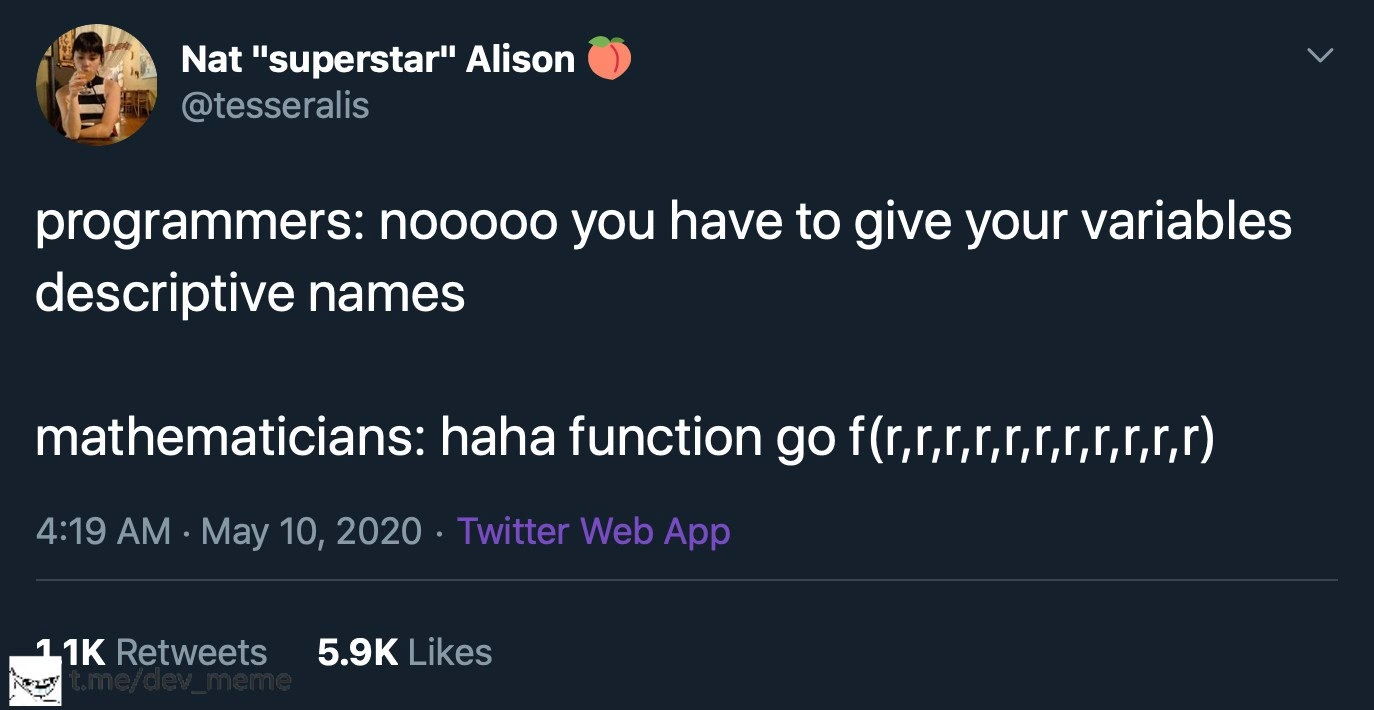
The tweet’s joke exaggerates this difference. The “programmers” side is basically yelling: “Give your variables meaningful names!” – because that’s drilled into us as a key lesson for writing understandable code. The “mathematicians” side fires back with a goofy example: f(r,r,r,r,r,r,r,r,r,r). That looks like nonsense in a real program – you normally cannot have ten function parameters all named the same (and if r is one variable, passing it 10 times into a function is redundant). But it’s poking fun at how in math you might see something like $f(x,x)$ (using the same value $x$ in both slots of a function) and nobody bats an eye. The meme takes it to the extreme with ten repeated r’s to really drive the joke home.
Let’s compare how a piece of code might look in a mathematician’s minimal style versus a more readable programmer style:
# Mathematician-style naming (terse and not very descriptive)
def f(a, b):
return a*a + b*b # computes a^2 + b^2 (sum of squares)
result1 = f(3, 4)
print(result1) # Outputs 25, but what is 25? Hard to tell just from the names.
# Programmer-style naming (descriptive and clear)
def sum_of_squares(first, second):
return first*first + second*second # also computes a^2 + b^2
result2 = sum_of_squares(3, 4)
print(result2) # Outputs 25, and it's clear this is 3^2 + 4^2.
In the first case, the function is called f and its parameters are a and b – super short names. You’d have to read the code or a comment to know it’s doing a sum of squares. In the second case, the function name sum_of_squares and the parameter names first and second already give hints about what’s happening. Even without the comment, you can guess that it’s adding two squared numbers. That’s the benefit of descriptive naming: it makes code self-documenting, which is a fancy way of saying the code explains itself through clear names and structure.
So, the meme is funny to people in tech because it shows a tug-of-war between these two approaches. If you’re new to coding, take the programmer’s advice here: prefer clear, descriptive names when you can. It might feel easier to just use x or y (especially if you’re used to math homework), but in a real program you’ll thank yourself later (and your teammates will thank you too!) when the code is easy to understand. Meanwhile, the mathematician’s approach isn’t “wrong” in their domain – it’s just a different habit that works for short equations. But it definitely looks out of place in a big codebase. The collision of these worlds creates the kind of inside joke you see in this meme.
Level 3: The Two Hard Problems
For seasoned developers, this meme hilariously exposes the culture clash between clean code ideals and the shorthand habits of pure math. It’s the classic showdown: descriptive variable names vs. minimalist notation. The tweet sets the stage with exaggerated voices:
- Programmers: “Noooo, you have to give your variables descriptive names!”
- Mathematicians: “Haha, function go $f(r,r,r,r,r,r,r,r,r,r)$.”
In other words, the software engineer is horrified by single-letter variables, while the mathematician gleefully piles ten identical $r$ symbols into a function call. The contrast is instantly recognizable to anyone who’s straddled these worlds, and that’s why it’s so funny — it’s relatable tech humor highlighting opposing naming conventions.
From the programmer’s perspective, good naming is a cornerstone of code quality. Code readability and maintainability hinge on clear identifiers. We’ve all inherited code with variables named x or data or tmp scattered everywhere — it’s a nightmare! Descriptive names act as documentation: totalRevenue or userAge immediately convey purpose, whereas a lone r could mean anything. Teams and style guides enforce these naming conventions: many linters will actually warn you about single-letter variable names (except for trivial loop indices like i or j), considering them a bad practice. There’s even a well-known joke in software development circles:
“There are only two hard things in Computer Science: cache invalidation, naming things, and off-by-one errors.”
Seasoned devs chuckle at this because it rings true — naming things is notoriously tricky. Picking a good name forces you to understand the problem better. Modern coding style guidelines (inspired by Clean Code and similar principles) put huge emphasis on meaningful naming. We treat code as communication to future engineers (including future you), not just instructions for the computer. So a programmer sees f(r,r,r,r,r,r,r,r,r,r) and cringes: Which r is which? Why are there ten of them? What does f even do? It looks like an obfuscated code contest entry or someone’s attempt at code-golfing for the shortest program. Also, a function with ten parameters in real production code would raise eyebrows – that’s function argument overload in more ways than one – and here they’re all the same argument repeated, which just amplifies the absurdity. In a code review, a senior dev would be all over this: “Please rename these variables to something descriptive, and um… why are we passing the same value 10 times?!” The meme perfectly captures that visceral reaction in a humorous way.
Now, from the mathematician’s side, this behavior is normal and efficient in their realm. In mathematical notation, single letters are the norm: $x, y, z$ for variables, $f$ for a function, maybe $r$ for a radius or an arbitrary number. This has been the convention for centuries, and it works because equations typically come with context. A math paper might say “Let $r$ be the number of rabbits” and then proceed with $f(r)$ without spelling everything out each time. Mathematicians juggle formulas where brevity is a virtue – it lets them see the structure of an equation at a glance. Ten $r$’s in $f(r,r,\ldots,r)$ is obviously a tongue-in-cheek exaggeration (real mathematicians would at least use subscripts $r_1, r_2,\dots,r_{10}$ if they meant ten different values!). But the joke lands because in math you could get away with something nearly as opaque by programming standards. For instance, an identity matrix might be notated as $(\delta_{ij})$ using a delta symbol, and you’re expected to know $\delta_{ij} = 1$ when $i=j$ and $0$ otherwise – no verbose name like “isSameIndexIndicator” needed, just a terse symbol. It’s a very different context. Mathematicians often rely on surrounding text or well-known conventions to clarify what a symbol means. They might think, “Why write radius 10 times when I can just put $r$?” Over a short proof or equation, that’s usually manageable. In fact, many textbooks reset their variable names in each new chapter or proof – r in one theorem has no relation to r in the next – and that’s acceptable because each exists in its own self-contained context.
The humor really pops when these two mindsets meet. For someone steeped in software engineering CodeQuality guidelines, reading mathematician-style notation feels like deciphering hieroglyphs without a key. On the flip side, a mathematician might chuckle at how overly verbose code appears (“Why do you need to call it calculate_average_temperature_celsius? Just call it $T$!”). This meme exaggerates both voices for effect, and clearly it struck a chord – just look at those engagement numbers on the tweet. It’s poking fun at the programmer vs. mathematician dynamic: one person’s elegant shorthand is another person’s incomprehensible gibberish. And indeed, in real life discussions you’ll hear both sides playfully gripe. Software devs groan about academic code full of single-letter variable names, and mathematicians roll their eyes at coding rules that forbid single letters (“C’mon, it’s obvious $m$ means mass!”). The collision of these naming philosophies is hilarious because both sides feel justified in their approach. Each evolved to suit its own environment, but when those worlds collide online, you get comedy gold like this meme.
Level 4: Arbitrary Names, Same Meaning
At the theoretical computer science level, a variable name is essentially arbitrary and has no effect on the logic or outcome of a function – a concept known as alpha equivalence. In formal terms, you can rename a bound variable in an equation or an algorithm and nothing fundamental changes as long as you update every occurrence consistently. For example, in mathematics one often says “Let $x$ be a number such that…” but it could just as well be “Let $r$ be a number such that…” – the choice of letter doesn't alter the truth of the statement. Similarly, in a program, whether we name a loop counter i or counter doesn’t change how the code executes; the compiler (or interpreter) treats these as just distinct symbols that point to storage locations or registers. This invariance – the idea that any name will do – is deeply ingrained in both math notation and programming language theory.
However, while any name works in theory, the choice of name carries information for humans. Mathematicians historically optimized for concise symbolic manipulation: using single letters (often with subscripts or superscripts for distinctions) to keep equations visually tidy and general. In advanced math and theoretical CS (like lambda calculus), single-letter parameters (λx.x for the identity function) make formal proofs easier by eliminating verbose clutter. The trade-off is that understanding these dense formulas requires the reader to hold context in mind: they must remember what each symbol represents from definitions or conventions. As a result, mathematicians developed a mental shorthand where single-letter variables are rich with implied meaning (e.g. $r$ might implicitly stand for a radius, $n$ for a count or natural number). The notation’s brevity is a feature, not a bug, when you’re fluent in the context.
Programming, although rooted in mathematics, grew into an engineering discipline where codebases can be millions of lines long and maintained by many people. In such an environment, alpha equivalence still holds (the machine truly doesn’t care if you call a variable data or banana), but human collaborators absolutely care. That’s why refactoring tools exist to rename variables without changing behavior – it’s purely to improve clarity, not correctness. In short, theoretical foundations tell us names are interchangeable, but practical software development treats naming as a serious matter of communication. This meme’s humor emerges from that contrast: mathematically, f(r,r,r,r,r,r,r,r,r,r) could be seen as just $f$ applied to the same value $r$ ten times – a valid though nonsensical scenario – and the exact letters mean nothing beyond position. But to a programmer’s eyes, it looks like utter chaos because we’ve learned that how you name something can be as important for understanding as what the code is doing.
Description
This image is a screenshot of a tweet from the user Nat 'superstar' Alison (@tesseralis). The tweet humorously contrasts the coding practices of programmers with those of mathematicians regarding naming conventions. It reads: 'programmers: nooooo you have to give your variables descriptive names' followed by 'mathematicians: haha function go f(r,r,r,r,r,r,r,r,r)'. The profile picture shows a person in a striped shirt, and the tweet is dated May 10, 2020. The joke leverages the 'haha X go brrr' meme format to highlight the tension between software engineering's emphasis on long-term readability and maintainability (using self-documenting names like 'customerAddress') and the mathematical tradition of using concise, single-letter variables where context is king, making formulas compact but often impenetrable to outsiders

Comments
7Comment deleted
A mathematician's idea of self-documenting code is just citing the 198-page paper it's based on in a comment
Math: f(r,r,r) → ℝ; code-review bot: “Too vague - rename r to regionallyAdjustedRecurringRevenueRate,” instantly pushing the file past the 120-column limit the same bot enforces
After 20 years in the industry, I've finally accepted that the mathematician who wrote our core algorithm with variables named 'a', 'b', and 'c' has job security forever - nobody else can understand it well enough to replace it, including the AI code assistants
This perfectly captures the eternal tension between 'code is read more than written' and 'but the proof is so elegant!' Meanwhile, senior engineers know the real nightmare isn't f(r,r,r,r,r,r,r,r,r,r,r) - it's inheriting a codebase where someone thought 'data', 'data2', 'dataFinal', 'dataFinalActual', and 'dataFinalActualThisTime' were descriptive names. At least mathematicians are consistently cryptic
Mathematicians optimize for LaTeX column width; we optimize for 3am MTTC - mean time to comprehension
Productionizing research: the API is f(r,r,r,r,r,r,r,r,r,r). Sprint 1 is adding types and named params; sprint 2 is the postmortem for swapping r5 (rate) with r6 (radius)
Mathematicians drop 'f(r,r,r)' in the PR; six months later, it's your 'temp_radius_preprocessed' haunting the oncall rotation