The Vanilla HTML Psychopath
Why is this Frontend meme funny?
Level 1: No Fancy Tools
Imagine all your friends have super fancy robot helpers to do their chores, but one day you see a kid down the street doing everything by hand – no robots, just a broom and a dustpan. All the other kids might stop and stare like, “Whoa, is he crazy? Why isn’t he using the cool robots like everyone else?” They’re so used to relying on those tools that doing things the simple way seems wild. That’s exactly what’s happening in this meme. In the world of making websites, most people use special helper tools (like big computer programs) to help build the site. But the person in the joke didn’t use any of those – he just built the website with the basic stuff (kind of like using paper and crayons instead of a fancy computer). The reaction is playful and exaggerated: everyone is treating him like he did something shockingly daring or “crazy,” even though building it by hand is perfectly fine. In simple terms, it’s funny because the guy did something very basic, and everyone else had gotten so fancy that they forgot you could even do that! It’s like discovering you can just use your hands to build something and calling that person wild for not using the high-tech gadgets. The meme makes us laugh because it shows how silly we can be when we think the normal, simple way is absurd just because we have gotten used to the complicated way.
Level 2: Just HTML?!
At its core, this meme highlights a divide in web development approaches: using modern frameworks vs. just writing HTML by hand. Let’s break it down in simpler terms. HTML (HyperText Markup Language) is the basic language that defines the structure of web pages – things like headings, paragraphs, links, buttons, etc. If you open an HTML file in your browser, you’ll see the website layout described by those tags. In contrast, React, Vue, and Ember are popular front-end JavaScript frameworks (tools or libraries) that developers use to build web interfaces. In today’s front-end culture, many developers assume you’ll use a framework like these to create any new website or application, especially if it’s interactive. So when this tweet says someone built a website with “No React. No Vue. No Ember,” it means they skipped all the usual fancy tools and just wrote the page directly. The punchline – calling that person a psychopath – is a joking exaggeration. It humorously implies that only a crazy person would do something so basic in an era of complex tools! 🤓
Why would that be considered crazy (in jest)? Well, frameworks like React and Vue help manage the complexity of modern web apps. For example, with React, instead of manually writing HTML files, you write components in JavaScript (often using a syntax called JSX that looks like HTML). The framework handles updating the web page efficiently when data changes, using techniques like the virtual DOM (a kind of in-memory version of the page that helps React figure out what needs to change without reloading everything). Vue.js and Ember.js have their own ways to make building large, interactive sites easier – Ember provides a lot of structure out-of-the-box, and Vue offers a gentle learning curve with template-based syntax. These tools are great if you’re building something like a dynamic dashboard, a social media site, or any app where parts of the page need to update often in response to user actions without a full page reload. That style of building websites is often called making a Single Page Application (SPA) – the page loads once and then JavaScript takes over handling all the interactive changes and navigation.
Now, here’s the catch: not every website needs that level of complexity. If you just want to make a simple homepage or a basic form, you can absolutely do it with just HTML, maybe a little CSS for styling, and a sprinkle of plain JavaScript for interactivity (we often call that Vanilla JS, meaning “plain” JavaScript with no extra framework). In fact, the web ran on plain HTML for years before these frameworks appeared. The tweet is funny because it treats that old-school approach as if it’s some terrifying, unheard-of stunt. It’s as if a developer saw someone skip all the modern setup – no npm install, no build tools, no giant node_modules folder – and just start typing out <html>…</html> and thought, “What kind of maniac would do that?!” Of course, in reality, writing HTML isn’t scary or wrong at all; it’s just less common in professional environments nowadays, which is exactly what the humor is pointing out.
Let’s clarify some terms mentioned and implied:
- Framework: In this context, a framework is a collection of programs and guidelines that helps you build web applications. React, Vue, and Ember are frameworks (or close cousins to frameworks) for building the front-end, meaning what runs in the browser for users to see and interact with. They provide structures for your code, so you’re not reinventing the wheel for things like updating the screen or handling user input.
- Raw HTML: This means writing the actual HTML code directly, as opposed to generating it indirectly through a framework. For example, creating a navigation menu by literally typing out
<ul><li>Home</li><li>About</li></ul>in a file, rather than using a React component that eventually renders that HTML for you. - Overengineering: This tag from the meme’s context refers to using a solution that’s far more complex or powerful than necessary. Here, the implication is that using React or another heavy framework for a simple site might be overkill (overengineering), yet many of us do it by default.
- FrontendPainPoints: This refers to the common difficulties in front-end web development. Things like making sure a site works on all browsers, managing lots of interactive elements efficiently, or keeping your code organized as it grows – these are pain points that frameworks try to solve. But the joke is that sometimes the tools add new pain points, like large bundle sizes or steep learning curves, and we forget that the simplest pain-free solution for a small problem might just be plain HTML.
To a newer developer (or someone learning web dev), it might seem obvious to start every project with something like create-react-app or Vue CLI because that’s what many tutorials and companies use. The tweet jokes about a guy who doesn’t do any of that – he just opens a file and starts typing HTML. “Like a Psychopath.” The phrasing is meant to be comedic hyperbole. In plain language, it’s saying: “I saw someone building a website the simplest way possible, and it blew my mind because nobody does that anymore!” It’s important to note they’re not literally insulting someone’s mental health; in developer humor, calling a choice psychopathic is a facetious way to say “wildly outside the norm.”
Imagine the typical steps to create a small website nowadays:
- Using a framework: You’d initialize a new project (often using Node.js and a bunch of starter files), then write your site’s structure in JavaScript files, possibly run a local web server for development, and have a build process to bundle everything into something the browser can use. For instance, with React you might write a component:
You’re writing something that resembles HTML (function Hello() { return <h1>Hello, world!</h1>; } export default Hello;<h1>Hello, world!</h1>) but it’s actually inside a JS function and needs to be processed by the React toolchain to show up in a browser. - Not using a framework: You’d create an
index.htmlfile and type:
Then open that file directly in a web browser. That’s it – your page is live (on your computer). If you wanted interaction, like an alert on a button click, you could even add a little script right in the HTML or link a<!DOCTYPE html> <html> <head><title>My Site</title></head> <body> <h1>Hello, world!</h1> </body> </html>.jsfile, and it would work without any build steps.
The difference in approach is huge. The meme humorously suggests that skipping all those modern steps is almost scary. Seasoned devs who see this might laugh and think, “It’s true, we act like you must use a framework, even when you really don’t have to.” Newer devs might find it funny because they feel the pressure too – everyone talks about React/Vue/etc., so the idea of doing a project without any of those feels “naked”. But here’s the educational takeaway: You absolutely can build things with just HTML (and CSS/JS). It might be the right choice if your project is small or simple. Frameworks are tools for specific needs – they shine when an app is complex, with lots of dynamic content. If those needs aren’t there, using a framework can be like using a bulldozer to plant a flower. This meme just exaggerates that notion for comedic effect.
In summary, the tweet jokingly brands a developer as crazy for writing a website using only basic tools, highlighting how common (and perhaps overused) fancy frameworks have become. It’s tech humor that resonates with anyone who knows the current state of front-end development. Remember, there’s nothing “psychopathic” about writing plain HTML – it’s the original way to make websites – but among devs today it’s unexpected enough to be a punchline. The joke reminds us not to take our shiny tools for granted, and that sometimes the simplest solution is sitting right there in a .html file.
Level 3: Vanilla HTML Insanity
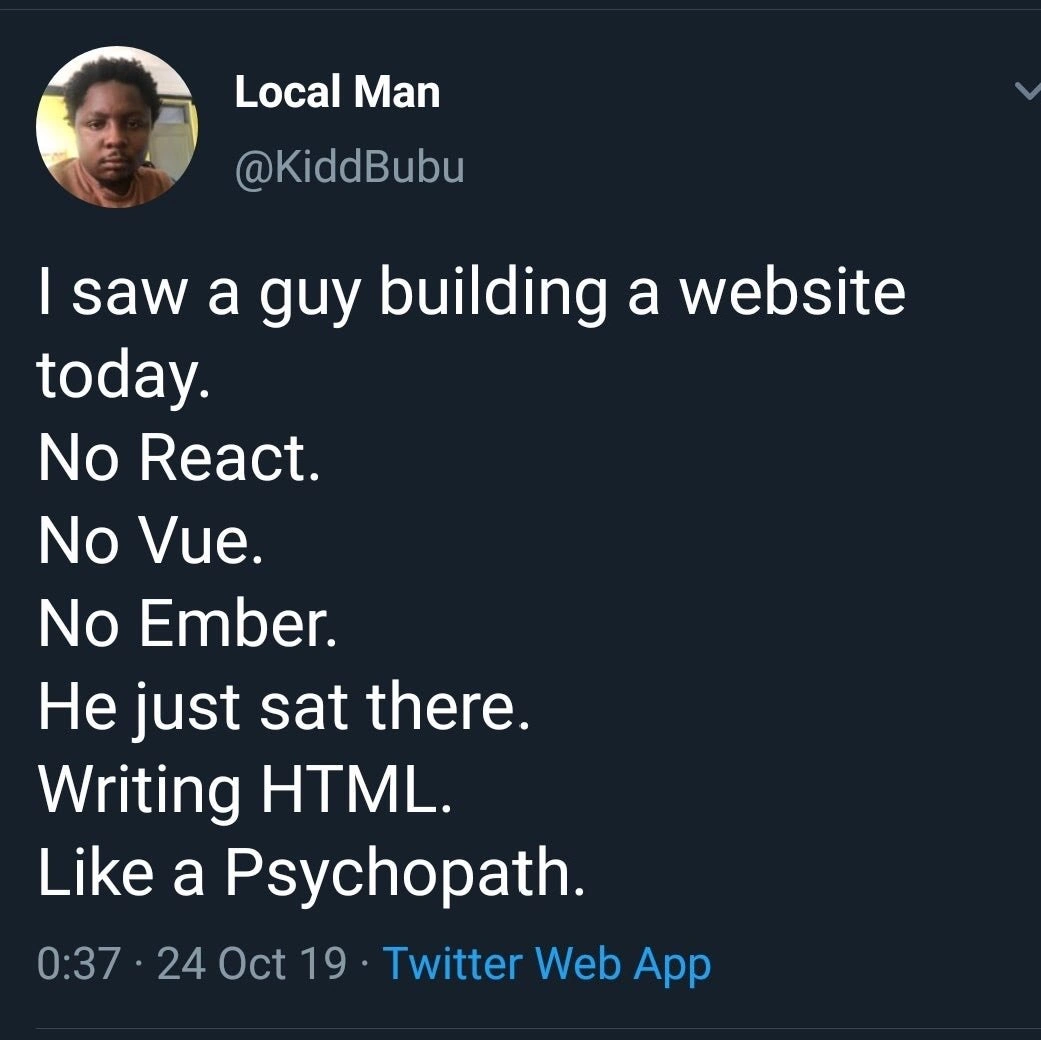
In modern Frontend development, the idea of building a website by hand-coding raw HTML from scratch – with no React, no Vue.js, no Ember – feels almost heretical. This meme captures that exact shock. It’s poking fun at our industry’s framework addiction: we’ve become so used to spinning up heavy JavaScript frameworks for every project that seeing someone go frameworkless triggers equal parts horror and admiration. The tweet (presented as a dark-mode screenshot) reads, in a deadpan list: “No React. No Vue. No Ember. He just sat there. Writing HTML. Like a Psychopath.” This absurd overreaction is hilarious to experienced devs because it satirizes how over-engineered our default approach to WebDev has become. We’ve reached a point where choosing simplicity – just HTML – is viewed as “raw markup madness”.
From a senior developer’s perspective, the humor cuts deep: it’s a commentary on FrameworkChurn and the unspoken rule that every new app must be a Single Page Application (SPA). We remember a time when building a website meant opening a text editor, writing <div>s and <span>s, and uploading an .html file. But fast-forward to ~2019 (when this tweet was posted), and the idea of not using a sophisticated front-end stack is almost unthinkable on a serious project. The meme exaggerates this cultural shift by implying that someone working directly with HTML is as unhinged as a horror movie villain. It’s FrontendHumor highlighting how our tool choices have become almost religious. React, Vue, and Ember are all major front-end frameworks (or libraries) that abstract away the manual work of managing the DOM (Document Object Model). They each come with their own philosophies – e.g. React’s virtual DOM and component model, Vue’s reactivity and templates, Ember’s convention-over-configuration – but they share a common goal: making dynamic web UIs easier to write and maintain. In doing so, they’ve become so pervasive that deviating from them feels like breaking a sacred rule of WebDev.
The tweet’s author lists those frameworks to emphasize none were used – a true frameworkless_frontend. For seasoned devs, this conjures real-world memories. Maybe you’ve witnessed a junior dev suggest, “This can just be a static HTML page,” only to have the team react as if someone proposed coding in binary. “What, no build tools? No npm packages? Are you insane?!” It’s funny because it’s true: we’ve internalized the idea that even a simple “Hello World” website should be an npm project with dozens of dependencies. The meme exaggerates this knee-jerk reaction. Calling the HTML author a “psychopath” is obviously hyperbole – a tongue-in-cheek way to say “this person is insanely bold (or naive) for not following the status quo.” The FrontendPainPoints being referenced include the immense complexity we deal with today: bundlers, node_modules folder the size of a house, and endless JavaScript fatigue. The guy “just writing HTML” has sidestepped all that, and ironically, that makes him the crazy one in our eyes.
Let’s appreciate the technical contrast being highlighted. With a modern framework-driven approach, creating a web page typically involves a lot of moving parts:
- Framework way: Install Node.js, run a scaffolding tool (like
create-react-app), pull in hundreds of npm packages, and write your UI as JavaScript code (JSX or component syntax). You’ll spin up a dev server, employ a virtual DOM diff algorithm (in React’s case) to update the page, and manage state across components with libraries or built-in patterns. Your simple “Hello World” now lives inside a full-fledged app environment. - Old-school way: Open your editor, create an
index.html, write some plain HTML tags and perhaps a sprinkle of inline script or CSS. Save, double-click the file to open in a browser, and you’re done. No build step, no dependencies, just the browser parsing your HTML directly.
The meme finds humor in the audacity of simplicity. In an age where even overengineering has become normal, a developer going “all_in_on_html” is like someone showing up to a high-tech race on a bicycle – it technically works, but everyone else at the race track thinks they must be crazy to even try. The senior devs “recoiling” at this approach recognize the scenario all too well. We’ve seen the pendulum swing: early web pages were 100% handcrafted HTML; then came the jQuery years (simpler than frameworks but still an abstraction over raw DOM); and now we’re in the SPA era, assembling everything via JavaScript frameworks. Many of us have subconsciously come to believe that more abstraction = more professionalism. So when confronted with a colleague who writes a page with just a <head> and <body> in a text file, it triggers a mix of disbelief and guilty nostalgia. After all, under the hood, even our mighty frameworks ultimately produce plain HTML for the browser to render. It’s a bit like seeing the Matrix’s code for what it is.
Why is this so relatable? Because it lampoons real industry tendencies. We’ve all encountered that project where a simple promo site ends up as a full-blown React app with a Redux store, or where a developer is considered “brave” (or foolish) for not loading half of npm to make a form. The meme’s comedy lies in role-reversal: historically, using a huge framework for a trivial page would seem overkill (a bit crazy), but today not using one is what raises eyebrows. It’s a gentle jab at ourselves as developers: maybe, just maybe, we sometimes use far more machinery than necessary. And if a lone coder resists the framework frenzy? They’re playfully branded a psychopath – the “psycho” who sees through the hype and writes directly in the raw materials of the web. For veteran devs, the joke lands with both laughter and a smidge of self-awareness. We chuckle because we remember that pure HTML isn’t dangerous at all; what’s crazy is how conditioned we are to think everything must be a Javascript-powered SPA. This tweet cleverly flips the narrative, holding up a mirror to the Framework First mindset and making even the most battle-scarred engineers say, “Heh, guilty as charged – and that psychopath might actually be onto something.”
Description
A screenshot of a tweet from the user Local Man (@KiddBubu). The tweet, posted on October 24, 2019, reads: 'I saw a guy building a website today. No React. No Vue. No Ember. He just sat there. Writing HTML. Like a Psychopath.' The image captures a sentiment common in modern web development, where the use of complex JavaScript frameworks is so ubiquitous that choosing to write plain, 'vanilla' HTML is seen as an act of insanity. The humor is derived from this exaggeration, poking fun at the industry's dependency on frameworks and the perception that simple solutions are somehow primitive or wrong. For experienced developers, it's a wry observation on the cyclical nature of web development trends and the tendency to over-engineer simple projects
Comments
7Comment deleted
My therapist told me I have an unhealthy dependency on abstractions. I told her that's just a high-level summary of the problem
Sure, but while the rest of us are still hand-tuning webpack loaders, his single index.html is already at a 12 ms TTFB - who’s the real menace?
The same developer who writes vanilla HTML probably still deploys with FTP and somehow has 99.9% uptime while your Kubernetes cluster is having its third "intermittent networking issue" this week
Ah yes, the rare sighting of a developer writing raw HTML in 2019 - probably the same person who thinks 'npm install' is just a suggestion and that a 500MB node_modules folder for a landing page is 'a bit excessive.' Meanwhile, the rest of us are three abstraction layers deep, debugging why our React component won't render because we forgot to spread props through a HOC wrapped in a context provider
He shipped an HTML-only page; Lighthouse hit 100/100 and the platform guild opened a Sev-1 because the 900kB “app” artifact was missing from the build
Vanilla HTML: the only frontend stack where tree-shaking isn't needed because there's no forest of deps to begin with
He shipped an MPA with no build step, zero npm dependencies, and TTI under 100ms; the postmortem concluded the root cause was bypassing the JavaScript industrial complex