Skip to content
DevMeme
675 of 7435
The Unexplainable Bug Fix
Debugging Troubleshooting Post #763, on Oct 31, 2019 in TG

The Unexplainable Bug Fix

Why is this Debugging Troubleshooting meme funny?

Level 1: A Secret Trick

Imagine you have a door that always gets stuck. Every time you try to open it, it won’t budge. Then one day, you discover a secret trick: if you pull the doorknob up a little and then push really quickly, the door opens! It’s a weird little method that only you know. Now your friend sees you do this and asks, “Hey, how did you get that stuck door open?” You realize that to explain it, you’d have to talk about how the door’s hinges are loose and how lifting it helps, and it’s just too much detail. So instead you smile a bit and say, “Eh, it’s a special trick – you wouldn’t get it.” 😉

This meme is just like that scenario, but for computer programmers. The “bug” is like the stuck door, and the one-line fix is the secret little trick that makes it work again. The programmer in the meme fixed a very tricky problem with a solution that’s so odd or complicated to explain that they joke with their colleague by saying, “You wouldn’t get it.” It’s funny because we’ve all had something we fixed or did that we didn’t feel like explaining fully, either because it’s too hard to explain or the other person might just look at us confused. The meme uses a famous scene of the Joker saying “You wouldn’t get it” to capture that feeling. In simple terms, it’s showing a programmer who did some magic-like quick fix and when asked about it, they basically say, “It works, but the reason is kind of a long story – one that only I understand right now.” It’s a playful way to say sometimes things are fixed with a special trick that’s hard to share.

Level 2: Mystery Patch Unraveled

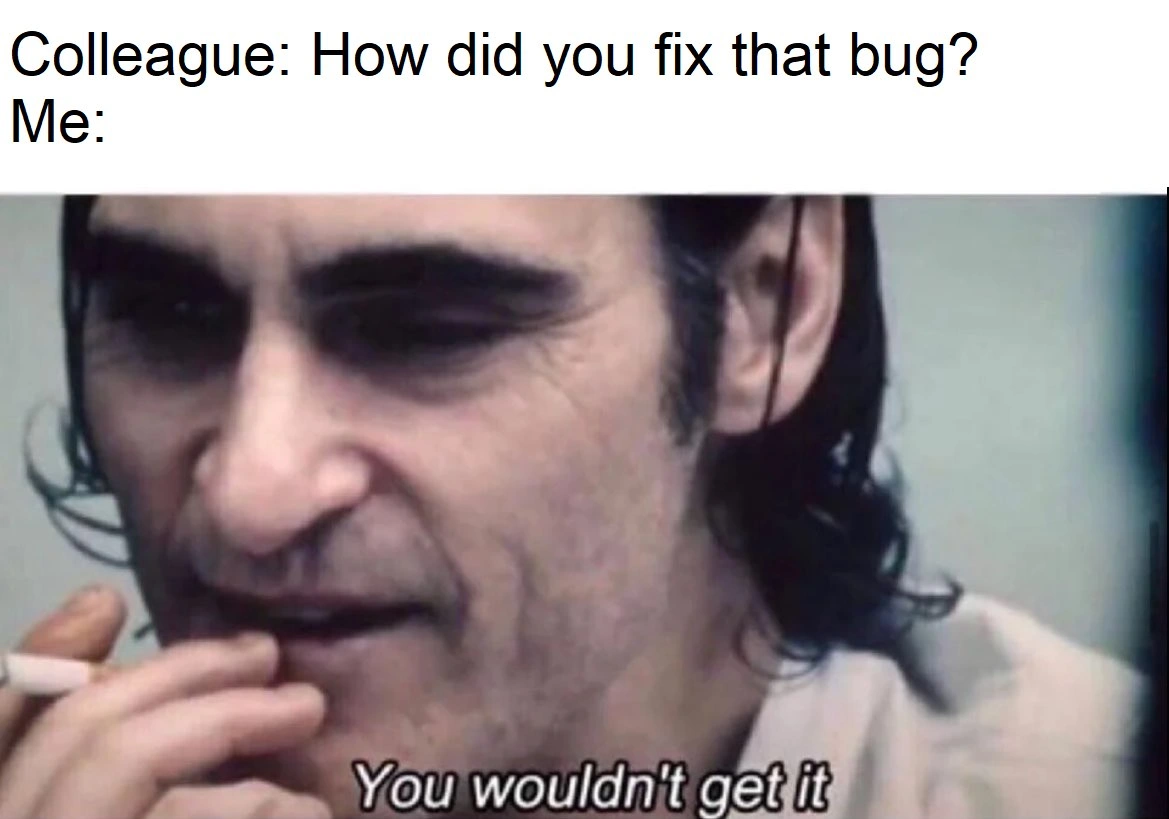
Let’s demystify what’s going on for less experienced developers. In this meme, a colleague asks: “How did you fix that bug?” and the person who fixed it responds with “You wouldn’t get it.” The image is Joaquin Phoenix as the Joker, from a scene where he basically says the same line. It’s a way of saying, “The explanation is complicated and maybe a bit out there.” The humor comes from the idea that the fix was a strange one-liner change in the code that solved a bug in a way that’s hard to explain in simple terms. It’s like the fix is beyond mortal explanation – an exaggeration meaning it’s too complex or weird for an ordinary explanation.

What kind of bug fix are we talking about? Possibly a very odd solution to a programming problem. A bug is an error or flaw in software that causes it to behave in unexpected or wrong ways. When something is broken in a program (for example, an app keeps crashing or giving wrong results), developers debug it – that is, they investigate and try to troubleshoot the issue. Once they figure out a way to correct the problem, the change they make to the code is a fix. A hotfix usually refers to a quick change deployed to a live system (often to address an urgent issue in production, which is the environment where the software is running for real users).

Now, most bug fixes are logical: you find the mistake in the code and correct it. But sometimes, especially in complex or legacy code (old code that has been around a long time), the direct cause isn’t obvious. The program might have hidden interactions or side effects (when one part of the code affects something else unexpectedly). For example, imagine a program where adding a simple print statement like print("Hello") unintentionally makes things work – perhaps because it changes the timing of events. That sounds bizarre, right? Developers actually have a term for bugs that seem to change or disappear when you try to check them: a Heisenbug (named after the Heisenberg Uncertainty Principle, because observing the bug changes it). In these cases, the fix might not be straightforward at all. You might end up doing something unusual like adding a short delay, re-ordering two operations, or toggling a configuration flag that isn’t even documented.

These kinds of fixes rely on tribal knowledge. Tribal knowledge in a software team means important know-how that isn’t written in the official documentation but lives in the heads of the developers (usually the ones who have been around the longest or have dealt with similar issues before). For instance, an experienced developer might remember, “Oh, whenever feature X freaks out, try restarting service Y or clear the cache,” even though that’s not obvious to anyone else. It’s called tribal because it’s passed along informally, like stories in a tribe. If a newer developer (the colleague in the meme) hears the solution without that background, it sounds almost mystical or like a random guess.

Let’s break down some terms and ideas to clarify the scenario:

  • Duct tape debugging: This is a tongue-in-cheek term. Think of how you might use duct tape to quickly fix something broken at home — it’s not a pretty or permanent solution, but it works for now. In programming, a duct tape fix is a quick and dirty code change to solve a problem temporarily or under pressure. It often bypasses the proper, long-term solution in favor of immediate relief. The meme suggests the fix was a bit like using duct tape: effective but not something you’d brag about as a elegant solution.
  • Race condition: This is a type of bug common in programs that do many things at once (multithreading or asynchronous code). It happens when two or more parts of the program (“threads”) try to access or change the same data at the same time, and the final outcome depends on who wins the “race” – which one runs first or faster. A simple example: two people editing the same document at the same time without knowing about each other, and each one’s changes might overwrite the other’s. Race conditions can cause unpredictable issues that are hard to reproduce. The tag legacy_race_condition suggests the bug here might have been caused by a long-standing race condition in the code. Those are notoriously hard to fix properly because they might require redesigning how concurrent tasks are coordinated. Instead, a quick fix might involve, say, forcing one part to always wait a tiny bit (hence something like Thread.sleep(100) in the code) so that the other part always goes first. It’s like imposing a tiny delay to make sure things happen in order. It’s not a robust solution, but it can stop the problem in a pinch.
  • Mysterious side-effects: In programming, a side-effect is when a function or operation does something that isn’t obvious from its name or main purpose, like modifying a global state or timing of events. A mysterious side-effect means something you didn’t expect at all. For example, maybe writing to a log file also unintentionally clears some buffer because of how the system is set up. If a developer discovers that doing X before Y prevents a crash (even though X and Y seem unrelated), they’ve found a hidden side-effect that they can use as a fix. It’s mysterious because it’s not how the system is supposed to behave, but it’s how it actually behaves due to some quirk.
  • “You wouldn’t get it” (Joker reference): The image in the meme is from the movie Joker (2019) where the Joker character slyly dismisses someone by saying “you wouldn’t get it.” This line has become a meme on its own. People use it when they do something or know something strange or complicated, and if someone asks about it, they reply with “you wouldn’t get it” as a humorous way to avoid a long explanation. In a developer meme context, it implies the person fixed the bug with a method so quirky that they’re jokingly saying “Even if I told you, it wouldn’t make sense to you.” It’s a playful exaggeration — of course the colleague could get it if you explained from the start, but it’s such a long, weird story that it’s funny to pretend it’s beyond ordinary comprehension.

So, the colleague questioning in the caption (“Colleague: How did you fix that bug?”) is a setup we all recognize. Often after a bug is fixed, team members are curious about what the problem was and how it was solved, partly to learn and partly to avoid the issue in the future. When the me (the developer who fixed it) answers with “You wouldn’t get it,” it’s a humorous way of saying the fix is so unexplainable or embarrassing (perhaps it was a hack) that it’s better left unsaid. It’s not literally that the colleague is incapable of understanding; it’s that the journey to the solution was so convoluted or based on gut feeling and past experience that the explanation would sound crazy.

This meme falls into categories like Debugging_Troubleshooting, Bugs, and CodeQuality because it’s highlighting a debugging scenario (fixing a bug) and hinting at a lack of code quality (since the fix is a single-line hack rather than a clean solution). It’s a bit of developer humor that resonates as SharedPain – meaning many who write code have experienced that painful, head-scratching bug and that awkward feeling when the “fix” is something hard to justify. The tags like duct_tape_debugging and tribal_knowledge_fix point to exactly that kind of situation: a quick patch relying on unwritten knowledge.

For a newer developer or someone who hasn’t been in the trenches of a messy software project, this meme is basically saying: Sometimes codebases and bugs get so complicated that the fixes can be weird and only make sense if you’ve been dealing with that system’s odd behaviors. It highlights the gap between textbook solutions and real-world fixes. In school or in tutorials, problems have logical solutions you can explain step-by-step. In real life, especially on large or old systems, you might encounter a bug that you resolve with something seemingly strange — like adding a tiny delay or initializing something early — and if someone asks “why does that fix it?”, you might honestly reply “I’m not 100% sure, but it works. It has to do with some internal quirk.” In other words, “it’s complicated.”

That feeling can be both funny and frustrating. Funny, because it’s almost ridiculous that a professional engineer ends up doing what looks like superstition or a “voodoo” fix; frustrating, because as developers we prefer solutions we can logically explain. The meme leans into the funny side of it. By using the Joker’s “You wouldn’t get it,” it’s as if the dev is half-jokingly embracing the mysterious nature of the fix, like a magician who won’t reveal their secret. It’s a bit of gallows humor about the reality of debugging. Everyone laughing at this meme has likely had that experience where you do something small and random to the code and suddenly the bug goes away, and you’re left thinking, “I have no idea why that worked, but I’ll take it.”

In summary, the meme is an inside joke in the developer community. It says: “I solved the problem with a one-line change so odd and context-specific that I can’t easily make you understand without a novel-length explanation, so let’s just say – you wouldn’t get it.” It’s not that we don’t want to help our colleagues; it’s that sometimes the journey to a fix is so convoluted (involving tribal knowledge, odd system behaviors, and maybe a dash of luck) that it defies a quick summary.

Level 3: Single-Line Sorcery

Picture a bug fix so peculiar that describing it feels like reciting an arcane spell. The meme’s scenario is a veteran developer being asked by a colleague, “How did you fix that bug?” and the dev basically channels the Joker’s smirk: “You wouldn’t get it.” This isn’t arrogance for its own sake—it’s a dark joke about those beyond-explanation fixes developers sometimes pull off under pressure. Why wouldn’t the colleague get it? Because the solution was an obscure one-liner that exploits some quirk of the system, the kind of duct tape debugging trick only tribal knowledge can conjure. It’s a nod to the shared pain among developers: sometimes a mysterious side-effect or a legacy race condition is tamed not by elegant refactoring, but by a single line of black magic code that simply makes the problem vanish.

In real life, these “you wouldn’t get it” moments often happen at 3 AM on a production hotfix. The codebase is on fire, users are screaming, and you desperately need to stop the bleeding. So you reach for a quick fix that you know is a bit hacky. Maybe you flip an obscure feature flag or add a dummy initialization that by all logic shouldn’t matter—but due to some convoluted chain of events in the software, it works. Try explaining that in a morning standup: “Well, I inserted a 0.5 second delay to prevent a thread timing issue, and that somehow fixed the crash.” 🤦‍♂️ There’s an unspoken understanding among senior devs that some fixes are so context-dependent and weird that any explanation would require a whole history lesson on the codebase. The meme nails this feeling by using the Joker’s famous “You wouldn’t get it” line, implying that the full story is practically insane.

Why is it funny? Because every seasoned engineer has been there. It’s a shared joke about the absurdity of debugging: one moment you’re sacrificing hours to trace a bug, the next moment a one-line change (that shouldn’t fix it, but does) saves the day. That mix of relief and “WTF just happened?” is hard to convey. Often the “fix” isn’t something you’re proud of from a CodeQuality perspective; it’s more like a ritual you learned by surviving past incidents. It might rely on undefined behavior or side-effects that are the stuff of nightmares in a code review. As a result, veteran devs develop a tongue-in-cheek cynicism: they’ll fix the bug with their secret sauce but dodge elaborate explanations because they know how crazy it sounds. It’s easier (and funnier) to just channel that Joker energy and say, “Trust me, it’s fixed, but you wouldn’t get the details.”

Let’s break down typical examples of these arcane hotfixes that leave colleagues scratching their heads:

  • The Magic Flag: Enabling a hidden setting or feature flag – e.g. ENABLE_LEGACY_MODE=true – to bypass a new failing code path. It’s a one-line config change that miraculously avoids the bug by reverting to a stable old behavior.
  • The Time Tweak: Inserting a tiny delay or ordering tweak. For instance, adding Thread.sleep(100); in a multi-threaded app to remedy a race condition. Suddenly, no more crashes. It feels like sorcery because you haven’t fixed the root cause, just changed the timing so threads don’t collide.
    // Magical hotfix inserted at 2 AM:
    Thread.sleep(100);  // HACK: Brief pause to let threads sync (works around the race condition)
    
  • The Dummy Call: Calling a seemingly irrelevant function to trigger a side-effect. Imagine there’s a bug where a network connection isn’t initialized unless you poke it. The one-line fix might be something silly like calling ping("localhost") or writing a log message at just the right place, which incidentally initializes some state and stops the failure.

Each of these fixes has a rational explanation deep down: maybe the flag avoids a bad code path, the sleep introduces a needed scheduling gap, or the dummy call forces an initialization. But to truly get it, you’d have to dive into a hairy tangle of code, historical decisions, and unpredictable behavior. It’s the kind of knowledge you accumulate after wading through a swamp of legacy code or reading a 200-comment issue thread on why a particular line exists. In other words, it’s tribal lore. If a new colleague presses, the senior might grimly recall how they discovered the fix (perhaps a tale involving a memory leak that only manifested under full moon 🌕), but sparing the grisly details is often the merciful choice. The humor here comes from that unspoken bond: developers laugh because they know exactly what it means to have a fix that defies logic and would make zero sense to anyone not intimately familiar with the system’s dark corners.

At its core, this meme is poking fun at the nearly supernatural status some bug fixes attain. We often nickname them “voodoo fixes” or “black magic” in the team, half-joking that the codebase must be appeased by offering a specific incantation. It highlights a gap between best practice (write clear, maintainable code) and reality (sometimes you’re lucky just to find a fix, no matter how odd). It’s also a subtle nod to the pride (or embarrassment) of the senior dev: they saved the day with a one-liner, but explaining it would mean confessing that the system is held together by chewing gum and luck. Instead, with a sly grin and a drag of the metaphorical cigarette, they reply, “You wouldn’t get it.”

Description

A two-part meme using a still from the movie 'Joker' (2019). The top section contains text on a white background that reads: 'Colleague: How did you fix that bug? Me:'. Below this, the image shows Arthur Fleck (played by Joaquin Phoenix) as the Joker, looking weary and smoking a cigarette. A subtitle at the bottom of the image reads, 'You wouldn't get it.' The meme captures the feeling of solving a bug so convoluted, obscure, or dependent on esoteric knowledge that explaining the fix to a colleague would be more effort than the fix itself. This is highly relatable for senior engineers who have dealt with issues in legacy systems, race conditions, or bizarre edge cases where the solution defies simple explanation

Comments

7
Anonymous ★ Top Pick The fix involved a race condition that only occurred on Tuesdays if the moon was waxing gibbous and the CI server felt particularly uncooperative. The PR description just said 'tweaked timing issue'
  1. Anonymous ★ Top Pick

    The fix involved a race condition that only occurred on Tuesdays if the moon was waxing gibbous and the CI server felt particularly uncooperative. The PR description just said 'tweaked timing issue'

  2. Anonymous

    Sure, I could explain how toggling a deprecated feature flag eliminated the race condition - right after I present a 73-slide deck on the scheduler semantics we accidentally inherited from 2008

  3. Anonymous

    I added a sleep(100) to a completely unrelated service and now our distributed trace spans finally correlate correctly across time zones, but explaining why would require a whiteboard, three sequence diagrams, and a deep understanding of how our load balancer's health checks accidentally became a timing oracle

  4. Anonymous

    After 6 hours of debugging, three Stack Overflow tabs, two rubber ducks, and one existential crisis, I fixed it by adding a 50ms sleep() before the database call. The root cause? A race condition in a third-party library that's been deprecated since 2019 but is still a transitive dependency four levels deep. Do I understand why it works now? Absolutely not. Will I document this? That would require understanding it. Will it pass code review? Not if I explain it honestly

  5. Anonymous

    It was a one-line change: add a memory barrier after the CAS; it only reproduced in prod without debug logs because the JIT stopped reordering - so, no, I can’t TL;DR that

  6. Anonymous

    We didn’t fix it so much as achieve eventual correctness - one memory fence, a jittery retry, and a sacred 'do not touch' comment later

  7. Anonymous

    Added a memory barrier where the optimizer was outsmarting the cache coherence protocol - observing it fixed the Heisenbug instantly

Use J and K for navigation