Computer Science vs. Engineering: The Alien Tech Test
Why is this CS Fundamentals meme funny?
Level 1: Play First, Study Later
Imagine you and a friend discover a super strange alien gadget – like a magical computer from another planet. Your friend is very careful and a bit scared, saying, “Whoa, we don’t know how this works. It could be dangerous! We should learn about it first.” That’s the sensible approach, right? But you’re more like the other person in this story: you grab the gadget excitedly and somehow get it to start playing your favorite video game. Instead of reading any alien instruction manual or worrying, you’re already having fun with it! Your cautious friend’s jaw drops in disbelief.
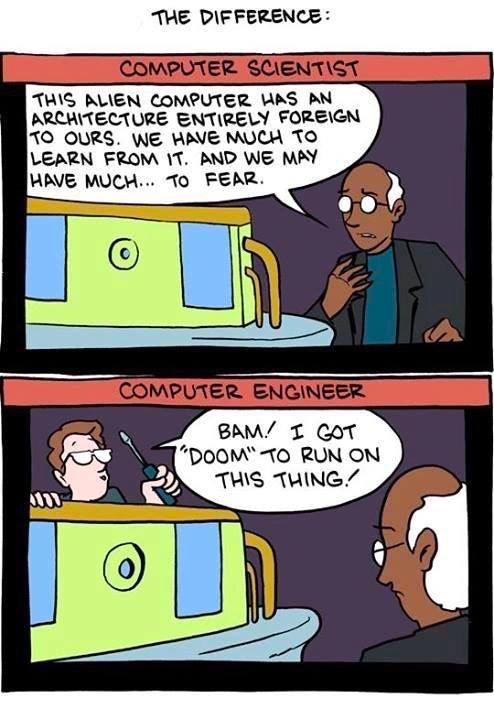
This meme’s joke is just like that scenario. One character (the cautious friend) wants to be serious, learn, and be careful with the unknown alien computer. The other character (the playful friend) immediately uses the alien computer to play a game (in the comic it’s a famous game called DOOM). It’s funny because it shows two totally different reactions to the unknown: one person sees a mystery to slowly unravel, and the other sees a cool toy to play with right now. The humor comes from the idea of skipping the boring stuff (like reading manuals or doing research) and jumping straight into the fun part. It’s like getting a brand new toy and ignoring the instructions completely – instead, you just start pressing buttons to see what it can do. And hey, it works! You’ve made the alien machine do something familiar (play a game), even though you have no clue how you did it so fast.
The cautious friend’s worry (“we have much to fear”) makes the situation even more comical, because while he’s talking about fear and caution, the other friend is literally playing a game named “DOOM” (which sounds scary) on the alien device with a big grin. It’s as if someone found a mysterious box and instead of handling it carefully, they plugged in a PlayStation and started a game on it. The contrast is silly and joyful. In simple terms, this meme is laughing at how some people experiment first and ask questions later. It’s a playful nod to the idea that sometimes diving in and trying something (even a video game) can tell you a lot – and it’s certainly more fun in the moment!
Level 2: Porting DOOM 101
Let’s break down what’s happening in simpler terms. We have an alien computer – basically a machine from another world – and it’s totally unlike any computers we know. In panel one, the Computer Scientist character is saying, “This alien computer has an architecture entirely foreign to ours…” Here, architecture means the way the computer is built and how it processes instructions (the fundamental commands that tell the computer what to do). Different computers can have different “architectures.” For example, your PC and your smartphone have different types of processors (desktop CPUs vs. mobile ARM CPUs) – they speak different machine languages. An alien_cpu_architecture would be a CPU design that’s beyond any of those, something humanity has never seen. The scientist is basically awed and cautious; he wants to study this new device carefully. When he says “We have much to learn from it. And we may have much… to fear.” he’s treating it like a serious discovery that could be dangerous or revolutionary. This is a classic computer scientist approach: emphasize understanding the theory and implications first.
In panel two, under the Computer Engineer banner, our enthusiastic engineer proudly shouts, “BAM! I got ‘DOOM’ to run on this thing!” DOOM here refers to a famous video game from 1993. It’s a first-person shooter known for its fast 3D graphics and demons – a landmark game in gaming culture. Why DOOM? It turns out that getting DOOM to run on various gadgets has become a fun benchmark in tech circles. It’s such a common challenge that it’s almost a meme in itself (often called the “running DOOM meme”). People have run DOOM on all sorts of unlikely devices just to prove they can – from cash registers to tiny digital displays. So, the engineer in the comic skipping straight to running DOOM is a humorous nod to that trend. It’s like he’s saying, “Who cares what this alien computer manual says? I made it play my favorite game!”
Now, porting a game like DOOM to another system means modifying the game so it can work on that system’s hardware and operating environment. Games are software, and software is usually written to work with a specific type of processor and set of instructions (the original DOOM was written for MS-DOS PCs using an Intel x86 processor). If you take that same program and try to run it on a totally different brain (say, a Mac’s PowerPC chip, or an Android phone’s ARM chip, or an alien processor from outer space), it won’t work out-of-the-box. You need to port it – which often involves recompiling the source code of the game for the new machine, and adjusting parts of the program that talk to hardware (like graphics or sound) so that they talk to the new machine’s hardware correctly. In other words, porting is translating the game to the new machine’s language.
The joke is that the engineer managed this extremely quickly – almost instantaneously – with just a screwdriver in hand. In reality, porting software to an unknown machine (especially an alien one!) is a huge challenge. It’s a process usually done by embedded systems programmers or low-level developers who understand hardware. They’d have to figure out things like: What kind of processor does this alien console use? How does its memory work? How can I draw to its screen? How do I read input from its controls? There’s no documentation, so it would involve reverse-engineering (which means figuring out how a system works by exploration and testing, since you don’t have the design specs). Reverse-engineering an alien device could mean poking at it with tools, measuring signals, or trying out code to see what happens – essentially what our engineer is symbolically doing with that screwdriver “stylus.”
So why DOOM specifically? It’s partly for the comedic reference (everyone in tech knows DOOM is the go-to hacking challenge), but also because running a game is a pretty thorough test of a computer. If you can make a complex game run, you’ve likely overcome multiple technical hurdles: drawing graphics, handling input, managing memory and performance. Low-level programming is all about writing code that interfaces directly with hardware, and DOOM’s code, being from the early ’90s, does a lot of direct hardware interfacing (like drawing pixels directly to video memory). Getting it to run on a foreign machine means the engineer had to implement those low-level parts for the alien hardware. That’s why the computer scientist is stunned – the engineer leapfrogged over weeks of study and got empirical results immediately. It’s like skipping to the end of a puzzle.
To put it simply, the Computer Scientist in the meme values knowledge and precaution: he wants to document the alien CPU, to understand it fully before doing anything crazy. The Computer Engineer values practical achievement and experimentation: he just wants to see it do something cool right now. In tech terms, it’s theory vs. practice, or planning vs. prototyping. Both roles exist in real life. Sometimes you really do need to read the manual and understand a system (especially if it’s something critical or potentially dangerous). Other times, tinkering and quick prototyping teaches you a lot faster. This meme exaggerates that difference for comic effect. The engineer’s attitude is also a bit of classic tech humor: “Documentation? That’s boring – I made it play a game instead!” And indeed, among programmers, asking “Can it run DOOM?” is a tongue-in-cheek way to judge a new platform’s capability. It’s part of engineering humor and gaming culture intersecting. For instance, when a new smart gadget comes out, you might see a joke comment, “Cool smartphone, but can it run DOOM?” even if nobody actually wants to play this old game on a fridge or watch – it’s just a way to say a device is truly programmable and powerful if it can handle that game.
In summary, the second panel’s punchline tells us the engineer successfully ported DOOM onto the alien machine. That implies he wrote some custom code to make the game compatible with the alien hardware – an impressive embedded software development stunt done at lightning speed. The scientist’s shocked face says it all: sometimes the practical demo blows the theoretical approach out of the water. And for the rest of us, it’s just hilarious to imagine the very first thing humanity does with advanced alien tech is… use it to play a 90’s video game about shooting monsters. Classic.
Level 3: But Can It Run DOOM?
For seasoned developers and tech enthusiasts, this comic hits on a well-known engineering humor trope: whenever a new device or platform is discovered, the inevitable question arises – “But can it run DOOM?” This stems from a long-running joke in gaming culture and hacker circles that if something has a CPU (no matter how exotic or underpowered), someone will eventually try to get the 1993 video game DOOM running on it. In the meme’s two panels, we see the archetypal computer_scientist_vs_engineer contrast. The Computer Scientist is cautious, intellectual, maybe a bit dramatic: he gazes at the alien console and muses about learning from its foreign architecture and even whispers about having “much to fear.” This represents the scholarly approach – emphasis on theory, understanding, and potential risks. Perhaps he’s thinking of all the groundbreaking algorithms or the potential security implications of an advanced alien system. In stark contrast, the Computer Engineer is the hands-on hacker, practically giddy with excitement as he proclaims, “BAM! I got ‘DOOM’ to run on this thing!” The scientist is left speechless, which is exactly the punchline: the engineer’s first instinct wasn’t to analyze or document the alien technology, but to interact with it in the most delightfully human way – by running a video game. It’s a perfect encapsulation of theory versus practice.
This resonates strongly with those in systems programming and embedded software development fields. It pokes fun at how practitioners often approach new hardware. While formal documentation and understanding are crucial (and the scientist’s concerns are valid if this were a real first contact scenario!), there’s a shared joke that many engineers can’t resist immediately trying something flashy once they have raw access to a new device. And what’s flashier to a geek than running DOOM, the classic demon-blasting FPS, on some gadget never meant to handle it? It’s basically the “Hello World” of hardware hacking, but cranked up to 11. Instead of printing a humble text message, why not spin up a whole 3D game? The meme humorously suggests that the first contact protocol for engineers might be to gauge a new computer’s capabilities by playing with it, literally. Why carefully map out alien op-codes and system calls when you can brute-force a port of DOOM and see what breaks (or what works)?
There’s a rich history behind this joke. Ever since id Software released DOOM’s source code to the public, enthusiasts have taken it as a challenge to port the game to every platform imaginable – often just to prove it’s possible. This led to the doom_on_everything phenomenon. We’ve seen DOOM running on an ATM, on digital oscilloscopes, on old Nokia phones, on a smart refrigerator’s display, and yes, even on a pregnancy test’s tiny screen (seriously!). If a device has a processor and at least a few kilobytes of memory, someone somewhere will try to get DOOM running on it just for bragging rights. It’s the ultimate hardware_porting_challenge: equal parts absurd and impressive. By referencing this, the comic immediately taps into that shared nerdy knowledge. A senior developer will chuckle because they recall countless forum posts and news blurbs about the latest crazy DOOM port – from running_doom_meme threads showing the game on an Apple Watch, to YouTube videos of DOOM on an Arduino with a 1-inch display. It’s become a communal game in itself to ask of any novel hardware, “Alright, but can it run DOOM?”
Beyond the gaming reference, the meme also reflects a workplace or project dynamic familiar to experienced engineers. It’s the classic scenario: one person advocates a careful, methodical approach (“Let’s fully understand the new system’s design and document everything”), while another person jumps straight into a quick and dirty prototype (“I hacked it to do something cool over the weekend!”). Neither is wholly right or wrong – real progress often needs both mindsets – but the joke exaggerates it. Here, the stakes are comically high (alien technology!) and the engineer’s quick prototype is comically outlandish (running a 90’s shooter game on it) which makes the contrast even funnier. We recognize a bit of ourselves in that over-eager engineer, especially those of us in LowLevelProgramming professions: there’s a visceral thrill in making a machine do something tangible. And what could be more tangible than blasting imps on a screen? Meanwhile, the scientist’s cinematic line “we have much… to fear” parodies the thoughtful, sometimes overly cautious attitude – as if the alien computer might unleash Skynet if not properly understood. In response, the engineer essentially says “fear? Nah, check it out – it plays DOOM just fine!” It’s a wonderfully irreverent answer to theoretical concerns. (As a side note, choosing a game called “DOOM” as the first program to run on alien tech might actually be something to fear if the aliens interpret it as a message – not exactly a peace offering to show them a space marine wreaking havoc! But hey, that’s the engineer’s pragmatic bravado for you.)
Ultimately, this meme gets experienced devs nodding and laughing because it captures the spirit of engineering humor: celebrating a clever hack and the joy of immediate results, while playfully ribbing the more academic approach. It’s a reminder that in tech, there’s a time for serious research, but there’s also a time for fun experiments – and sometimes those fun experiments can unlock understanding faster than cautious study. After all, once DOOM is running, you’ve effectively proved that you grokked a huge chunk of the alien system’s architecture (even if nothing’s written down yet!). As an inside joke, “But can it run DOOM?” has become shorthand for “How powerful or compatible is this system, really?” The engineer in the comic answered that in the boldest way possible.
Level 4: Xenoarchitectural Bootstrapping
At the highest technical tier, this meme highlights the herculean low-level programming feat of getting a complex program like DOOM running on an alien CPU architecture. Imagine encountering a machine with an instruction set completely unknown to humanity – its registers, memory model, even logic gates might defy our conventional designs (who knows, maybe it’s not even binary!). The computer scientist’s instinct is to map out this foreign Instruction Set Architecture (ISA) from first principles: figure out how instructions execute, how memory is addressed, the endianness (byte order), clock speed, interrupts, etc. In contrast, our bold computer engineer dives right in to achieve code execution on this mysterious hardware, effectively performing reverse-engineering on the fly. This is xenoarchitectural bootstrapping at its finest – they’re establishing a software beachhead on alien silicon without any documentation.
From a systems perspective, porting DOOM to a new architecture means confronting all the gritty details of systems programming. DOOM’s original code (released in 1993 for Intel’s 32-bit x86 processors) contains performance tweaks and assumptions specific to PCs of that era. To run it on an extraterrestrial machine, the engineer must create a bridge between the game’s requirements and the alien hardware’s capabilities. This could involve writing a custom compiler backend or assembler targeting the alien instruction set so that the DOOM source code can be recompiled into native alien machine code. If the engineer doesn’t have the luxury of source code (though in DOOM’s case the engine source became open-source in 1997), they might even craft an emulator: a program on the alien computer that imitates a known architecture (like emulating a PC or an ARM chip) so that the existing DOOM binary could run. Each approach demands intimate knowledge of how CPUs execute instructions and handle things like memory access and I/O. It’s like creating a Rosetta Stone for code: mapping high-level game logic down to the alien device’s fundamental operations.
Consider the hardware porting challenge here: DOOM isn’t a trivial “Hello World”; it’s a resource-intensive first-person shooter that pushes hardware with 3D calculations, graphics rendering, and real-time input handling. The engineer has to interface with the alien computer’s graphics output to draw the game’s pixelated demons, and tie into whatever input mechanism exists (maybe those yellow handrails are some alien touch interface?). They’re effectively writing device drivers and perhaps a minimal operating system layer on the spot. For instance, on a typical PC DOOM draws to a VGA frame buffer in memory; on an unknown console, the hacker would need to locate or create a frame buffer equivalent – perhaps poking memory-mapped display registers until the alien screen lights up with familiar fiery pixel art. This is bare-metal embedded systems work, likely involving carefully crafted assembly code to match the alien CPU’s expectations for how instructions and data are formatted. If the alien machine uses a radically different data size or word alignment, the game’s data structures (like 32-bit integers for calculating positions and angles) might need adjustment. The engineer must have quickly deduced critical architectural details such as word size (are we dealing with a 128-bit machine? 256-bit?), and whether the architecture is Von Neumann or Harvard (unified program/data memory or separate?). The screwdriver “stylus” in the comic hints at a tongue-in-cheek method of direct hardware poking – perhaps a play on using a JTAG interface or logic probe to inject code. It’s absurd, but it symbolizes that hands-on hardware debugging approach: literally touching the circuits to get results, versus theorizing from a safe distance.
On a theoretical computer science level, this scenario tests the universality of computation. The famous Church-Turing thesis implies that any Turing-complete system can simulate any other – so if this alien computer is Turing-complete (a reasonable assumption if it’s truly a “computer”), then in theory it can run DOOM’s algorithms. The challenge is translating those algorithms into the alien computer’s language. It’s a bit like solving an extreme cross-platform compatibility puzzle. One might even say the engineer found a quick “proof of concept” that the alien machine is compatible with our computational paradigm by actually running our software on it. In doing so, they bypassed months of careful study with a brute-force trial-by-fire: if DOOM runs, we have a working baseline understanding. Of course, there’s irony here – the computer scientist frets about unknown dangers (“we may have much… to fear!” he says) while the engineer merrily executes a program literally named “DOOM” on the alien system. If one were being cheeky, this is akin to executing a payload on an unknown system as a form of “hello.” It demonstrates a fearless (if not reckless) confidence that any system’s secrets can be uncovered by running real code and observing what happens. Reverse-engineering the alien console through a DOOM port means the engineer learned a ton about the machine’s architecture implicitly: how it handles graphics, how fast it can compute, possibly even its quirks (imagine discovering “Oh, this alien CPU has no floating-point unit, had to implement fixed-point math for the 3D engine!”). In summary, at this deep-dive level, the meme underscores bold systems hacking – treating an alien device as just another computer that can be conquered through clever engineering and a legendary game’s code as the spearhead.
Description
A two-panel comic illustrating the difference between a Computer Scientist and a Computer Engineer. The top panel, labeled "COMPUTER SCIENTIST," shows a man looking worriedly at a strange, alien-looking computer. He says, "THIS ALIEN COMPUTER HAS AN ARCHITECTURE ENTIRELY FOREIGN TO OURS. WE HAVE MUCH TO LEARN FROM IT. AND WE MAY HAVE MUCH... TO FEAR." The bottom panel, labeled "COMPUTER ENGINEER," shows a younger engineer with a screwdriver popping up from behind the same machine, excitedly proclaiming, "BAM! I GOT 'DOOM' TO RUN ON THIS THING!" The first man looks on with a dismayed expression. This meme humorously contrasts the theoretical, cautious approach of computer science with the pragmatic, hands-on problem-solving of computer engineering, encapsulated by the classic "Can it run Doom?" benchmark for new hardware
Comments
7Comment deleted
A computer scientist sees a black box and asks 'What can we learn from it?'. An SRE sees the same box and asks 'Can I get root and does it have a stable API?'
Some study ISA whitepapers; others just cross-compile, disable the MMU, and call it a successful benchmark
The computer scientist spent three years writing a paper on the alien system's novel memory model while the engineer already has a Kubernetes cluster running on it and is debugging why the pods keep getting abducted
The eternal divide: Computer scientists see an unknown ISA and start drafting papers on computational theory and architectural paradigms. Engineers see the same thing and immediately check if it has enough registers to run a 1993 game engine. Both are valid approaches, but only one results in 'Doom' running on your smart toaster by Friday
Bring-up checklist: reset -> clocks -> DRAM -> UART -> framebuffer -> input -> Doom; once the WAD renders, the architecture review becomes a retro
CS diagrams the alien pipeline stalls; the engineer yanks JTAG pins until it fetches instructions
Unknown ISA bring-up checklist: clock, memory map, interrupts, serial - and whether Doom boots, because nothing validates your ABI like a WAD screaming at your framebuffer