Cursed Frontend Development: The 'useJQuery' React Hook
Why is this Frontend meme funny?
Level 1: Old Horse, New Car
Imagine you have a super modern car – sleek, electric, self-driving – and then you decide to hitch an old horse in front of it to help pull it. Then you proudly announce, “This is the greatest car upgrade ever!” and even tell the car company they should start doing this in all their new models. It sounds silly, right? This joke is just like that. It’s someone taking a brand-new high-tech solution and mixing it with a really old-fashioned solution, then bragging that it’s the best idea ever (even claiming they officially suggested it to the experts). It’s funny because everyone can see you normally wouldn’t do that. The humor comes from acting overly proud of something clearly absurd. Even if you’re not into programming, you can appreciate the image of someone attaching a horse to a high-tech car and insisting they improved it. It highlights how ridiculous it is to combine old and new in that way and pretend it’s a genius move.
Level 2: When React Met jQuery
This meme plays on some basic web development ideas in a funny way. Let’s break it down. React is a popular JavaScript framework for building interactive user interfaces on websites. It introduced something called React Hooks – special functions (with names like useState or useEffect) that let React components handle things like data, state, and side effects more easily. All custom hooks by convention start with the word “use”. For example, a developer might write useAuth for authentication logic or useFetch to fetch data, following that naming pattern.
On the other side, jQuery is an older JavaScript library that was extremely popular before frameworks like React. jQuery made it easy to select parts of a webpage and update them (for example, hide a button or animate a popup) with simpler commands. It was basically the go-to tool for web pages in the 2010s, but nowadays React and other frameworks have their own ways of doing those things.
Now, normally you do not need jQuery when you’re using React – in fact, mixing them can be awkward. React likes to handle the page updates its own “reactive” way (through something called a Virtual DOM), and jQuery directly changes the page in a way React isn’t aware of. So they’re usually kept separate. That’s why the idea of a hook called useJQuery is amusing: it’s like saying, “Hey, let’s take this old jQuery tool and plug it into our modern React app as a hook!” It’s a playful suggestion because it sounds like merging two generations of tools. React devs would chuckle at this because it’s unconventional – sort of a tongue-in-cheek “ultimate hook” that no one actually asked for. The meme’s title even calls it “an essential hook for your React applications,” which is clearly joking since no serious React guide would list jQuery as essential for React apps.
The top comment in the screenshot adds another layer to the joke. The commenter says, “This is the pinnacle of hooks evolution. I have raised a PR that strengthens that position.” Let’s unpack that: “pinnacle of hooks evolution” basically means “the highest point that hooks have reached.” So this person is joking that useJQuery is the best hook idea ever, the peak of where hooks were headed. Obviously, they don’t actually mean it seriously – it’s sarcastic praise for a silly idea. Then they say they “raised a PR.” PR stands for Pull Request, which is a way developers contribute code to a project (especially in open-source communities on platforms like GitHub). Raising a PR means they wrote some code and asked for it to be added to the codebase. When the commenter claims they did that “to strengthen that position,” they are humorously pretending they actually went ahead and wrote code to make useJQuery a reality. It’s a form of bragging for comic effect – they’re acting as if this joke idea is so great that they immediately contributed to it. In developer humor, saying you’ve made a pull request for a joke feature is like saying “I’m so on board with this joke, I’m making it happen!” It’s unlikely they literally did so, but it completes the gag. Essentially, the commenter is playing along with the joke: praising the silly hook idea and facetiously claiming credit for pushing it forward.
In summary, to a newer developer or someone not deep into the React world: this meme is funny because it mixes an old web tool (jQuery) with a new React feature (hooks) in a tongue-in-cheek way. It’s like saying, “We’ve advanced so much in React that our newest, greatest feature is... integrating jQuery again!” And someone chiming in to boast “I even coded this!” just adds to the silliness, because it imitates how developers sometimes show off their contributions, but this time for a totally goofy suggestion. The whole thing is a light-hearted inside joke among front-end developers who know both React and jQuery.
Level 3: Back to the DOM
The screenshot shows a Reddit post in the r/reactjs community jokingly titled useJQuery: An essential hook for your React applications. In the comments, a user quips, “This is the pinnacle of hooks evolution. I have raised a PR that strengthens that position.” To an experienced developer, this combination of elements is instantly funny because it mashes up two very different eras of front-end development in one absurd package.
First, consider the naming: in React, all Hooks have names that start with use (like useState, useEffect). This meme proposes a fictitious hook called useJQuery, slyly implying that jQuery (the once-dominant library for direct DOM manipulation) has been wrapped into a React Hook. Seasoned React devs know Hooks are meant to encapsulate modern patterns of state and side-effects, so presenting jQuery as “an essential hook” feels delightfully out-of-place. It’s as if the React ecosystem’s evolution has come full circle – after years of moving beyond jQuery, the crowning achievement (the final boss of custom hooks) is to bring it back as a Hook. The phrase “pinnacle of hooks evolution” is dripping with sarcasm: it suggests that after all the sophisticated hooks we’ve invented, the crowning glory is... integrating jQuery into React. This is a classic inside joke about how far the hook craze can go, poking fun at our tendency to create a useSomething for literally everything.
There’s a deeper technical irony here. React promotes a declarative, Virtual DOM approach to updating the UI, whereas jQuery is all about imperative, direct DOM manipulation. In practice, mixing jQuery into a React app is often seen as an anti-pattern – it’s like trying to combine two opposite approaches. Experienced devs have tales of weird bugs from someone sneaking $("#app").html("new content") into a supposedly all-React codebase. A custom hook named useJQuery conjures an image of intentionally doing just that, but wrapping it in a shiny React-approved package. You can practically imagine the code inside this hook: using useEffect to call something like $('.my-modal').fadeIn() or $('#legacyWidget').text("Updated!") directly. It’s both hilarious and cringe-inducing! On one hand, you have a Hook that plugs jQuery into React’s lifecycle – essentially letting an old-school script drive part of a modern framework. On the other hand, it violates the unspoken rule that React apps shouldn’t need jQuery at all. The community humor here comes from this mismatch: it’s the ultimate “square peg in a round hole” solution presented as if it were a brilliant innovation.
Now, the commenter’s boast about raising a PR (Pull Request) “to strengthen that position” adds an extra layer of developer satire. In open-source culture (especially around big projects like React or popular libraries), submitting a PR is how you propose changes or add new features. Bragging “I have raised a PR” in this context is a tongue-in-cheek flex. It implies, “I believed in this crazy idea so much that I actually wrote code for it and pitched it to the maintainers.” The formality of “strengthens that position” makes it even funnier – it reads like a serious corporate strategy, applied to a ridiculous hook idea. This pokes fun at the enthusiastic open-source bravado where even absurd ideas might get a spoof GitHub repository or joke PR just for laughs. It’s not unheard of to see someone actually create a gag package (imagine an npm library literally called use-jquery) to keep the joke going. The commenter is essentially role-playing that proud open-source contributor who’s just completed the ultimate tongue-in-cheek mission – making the meme come to life in code. For veteran devs, this exaggeration lands perfectly because we’ve all seen trivial or quirky PRs dressed up with over-the-top importance.
Finally, this meme nods to the broader evolution of front-end development. jQuery was the go-to solution for web UI interactions a decade ago, simplifying JavaScript when browsers were inconsistent and before frameworks took over. React, introduced later, represents a new paradigm – component-based, declarative UI with its own state management (rendering jQuery mostly unnecessary). So calling useJQuery the “essential hook” is a playful wink at that history: it’s like saying the final breakthrough in modern React development is to re-introduce a 15-year-old library as a hook. It’s absurd on purpose. The React community on Reddit loves this kind of meta-humor because it’s self-referential – you have to know both the old-school jQuery days and the new Hook-centric mindset to get the joke. In one meme, they’re mocking the endless proliferation of hooks and the tendency of JavaScript devs to chase new tools only to end up back where they started. It’s a moment of collective comic relief, acknowledging that sometimes our “innovations” loop back around. Everyone gets to laugh at how an “essential” modern React hook might just be a wrapper around trusty old jQuery – a gentle reminder not to take our tools (or ourselves) too seriously.
Description
This image is a screenshot of a Reddit post from the 'r/reactjs' subreddit, titled 'useJQuery: An essential hook for your React applications'. The post is clearly satirical, intended to trigger experienced frontend developers. The humor lies in the fact that React was created to solve the problems of direct DOM manipulation, which is the core principle of jQuery. Suggesting the integration of jQuery into React via a modern feature like a 'hook' is a deliberate and humorous contradiction of best practices. It's a joke about creating anti-patterns and combining legacy technology with modern frameworks in the worst possible way. The top comment, 'This is pinnacle of hooks evolution,' adds to the sarcasm. The sepia-toned, unsettling close-up of a man's face serves as the meme's punchline, amplifying the cursed nature of the proposal
Comments
7Comment deleted
I just published a new hook: `useIsMounted`. It uses jQuery to check if the component's ID exists in the DOM. It's the only reliable way, right?
I just opened a PR for `useStopWritingHooks` - runs once, returns a class component, and silences eslint-plugin-react-hooks. Evolution complete
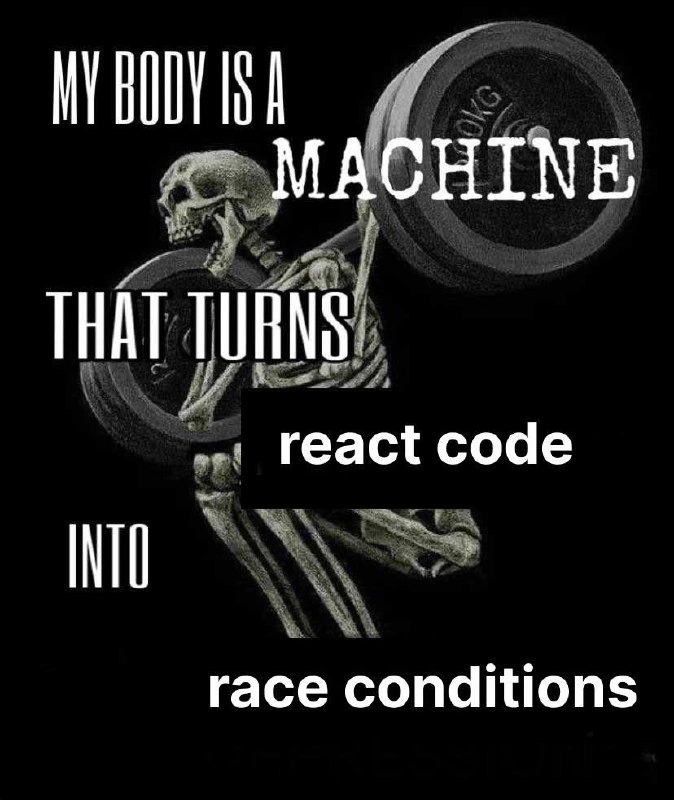
After 15 years of migrating legacy jQuery apps to React, someone finally asked the important question: why not have both paradigms fight for DOM control in the same component? Nothing says 'senior architect' like introducing race conditions between virtual and direct DOM manipulation in your hooks
Ah yes, useJquery - because nothing says 'modern React architecture' quite like wrapping 15 years of DOM manipulation imperative code in a declarative hook. It's the perfect solution for when you want your component lifecycle to fight your virtual DOM reconciliation while your bundle size achieves escape velocity. The PR that 'strengthens that position' probably adds useBackbone and useAngularJS for good measure - gotta have that multi-paradigm consistency in your single-page application
Peak React hooks: a custom hook wrapping three useEffects, an eslint-disable for exhaustive-deps, and a code review calling it a “clean abstraction” - PR approved
Every PR that claims “hooks evolution” ends with // eslint-disable-next-line react-hooks/exhaustive-deps and a 300-line useEverything - congrats, you rebuilt class lifecycles with fewer guarantees and worse stack traces
Hooks evolution pinpointed: useState → useEffect → useJQuery, where deps=['$'] guarantees no stale closures