Urban Dictionary's Painfully Accurate Definition of a Programmer
Why is this Debugging Troubleshooting meme funny?
Level 1: Mad Then Glad
Think of something in everyday life that makes you super frustrated until suddenly it’s fixed, and then you’re super happy. Imagine you’re trying to untangle a big knot in your shoelace. You keep fumbling with it, your fingers hurt, and it’s just not coming loose. You get so mad you want to scream, maybe you even yell at the shoelace out of sheer frustration. That’s the “AAAAAAAHHH!” part – you’re basically shouting because you feel stuck and upset. Now, picture that right after all that yelling, you finally pull the right loop and the knot magically comes apart. The problem is solved! In an instant, you go from being really angry to feeling totally relieved and happy, saying something like “Oh, thank goodness, it’s fixed!” with a big smile.
That’s exactly what this meme is joking about, but with computer programmers. The programmer is like a person trying to fix something complicated (like that knotted shoelace or a difficult puzzle). They get so annoyed that they scream at the computer. Of course, the computer is a machine and can’t hear you, but it shows how upset the programmer feels. Then suddenly, the computer problem gets solved (we don’t see how, but maybe by pressing the right key or finding a tiny mistake in the code). As soon as it works, the programmer instantly calms down and is happy, saying “oh, it works” as if they weren’t just yelling a second ago. It’s a funny emotional flip-flop. We find it humorous because we can all relate to feeling mad, then immediately glad when a tricky problem finally goes away. Just like you might laugh about how upset you were about the shoelace once it’s untangled, programmers laugh at themselves for getting so worked up – but hey, it happens to everyone! The meme simply puts that common feeling into a short, funny definition: programmers get paid to have those “mad then glad” moments with computers every day.
Level 2: Bugs and Screams
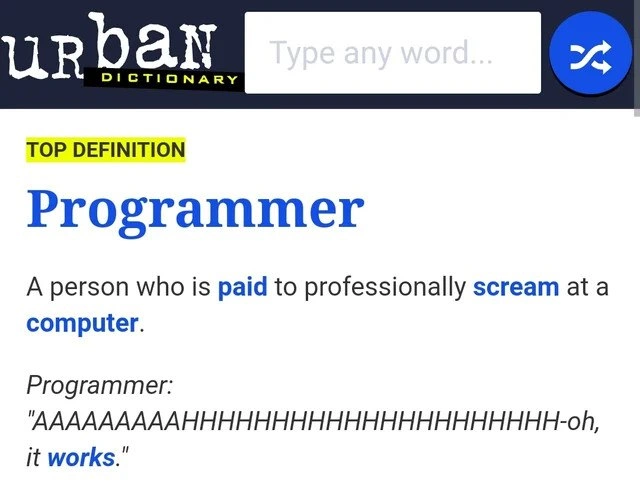
For a new developer or someone early in their coding journey, let’s break down what’s going on in this meme. The image is a screenshot from Urban Dictionary, a popular site where people post informal, often humorous definitions of words or phrases. It’s not an official dictionary; instead, it’s known for capturing slang and cultural jokes. Here, the word being defined is “Programmer.” But unlike a serious textbook definition (“a person who writes computer software”), Urban Dictionary’s top definition jokes that a programmer is "A person who is paid to professionally scream at a computer." Beneath that, there’s an example conversation showing a programmer literally screaming: “AAAAAAAAAAAHHHHHH... - oh, it works.” This is a funny exaggeration of what a programmer’s workday can feel like, especially when debugging code.
Let’s clarify some terms. A bug is a mistake or error in a program that makes it behave in unexpected or wrong ways. Debugging is the process of finding and fixing those bugs. Now, debugging can be tricky. Imagine you wrote some code and it’s not working – maybe the program keeps crashing or giving the wrong output. You try to figure out why. You check your code, you run tests, you print out values to see where it goes wrong. Sometimes the problem is obvious (like a typo or a missing semicolon), but other times it’s really hard to track down. It can feel like the code is misbehaving for no reason, which gets very frustrating. This is the “screaming at the computer” part. Of course, programmers don’t literally scream all day at their screens (at least, not professionally on the record!). But the joke here is that we feel like screaming because the computer only does exactly what we tell it to do – and when we can’t figure out what we told it wrong, it’s infuriating.
The example from the meme, “AAAAAAAAAHHHH...-oh, it works.” perfectly captures a typical DebuggingFrustration moment followed by relief. Often, when you’re debugging, you try many different solutions that don’t work. Each time a fix fails, your frustration mounts. You might not literally yell “AAAAAH” out loud (though trust me, many of us have at least groaned or face-palmed dramatically). The meme exaggerates this into a full-on scream. Finally, after all the struggling, something clicks – maybe you try a solution from a forum like Stack Overflow, or you realize you forgot to save a file or restart the app. Suddenly, the program works correctly. That moment is such a whiplash: you go from pure anger or despair to instant joy and relief. The programmer in the meme stops screaming and says “oh, it works” in a casual tone, as if nothing ever happened. Realistically, a developer might shout “YES!” or do a little victory dance in their chair when the bug is fixed. But the meme’s humor is that the programmer pretends they weren’t just screaming a second ago. It’s like “I wasn’t freaking out… see, everything’s fine now!” 😅
This cycle of frustration_then_relief is a well-known part of the DeveloperExperience_DX. In fact, it’s so common that tech folks joke about it all the time (DeveloperHumor). Here are some common elements of that experience:
- Professional screaming: This isn’t in the job description, but it’s a running joke. We say “professionally” because, well, we get paid to do this job. If a gardener pulls weeds for a living, a programmer “pulls their hair out” over bugs for a living. It’s exaggeration, but it feels apt on tough days.
- Sudden success: Often a bug might get fixed by the last thing you try, sometimes by something simple. For example, you might spend an hour checking your entire codebase, only to find out the server was down or you needed to clear the cache. When the problem finally goes away, it almost feels like the computer was playing a prank. One moment everything is on fire, the next moment all the tests turn green (green usually means “all good” in testing dashboards or monitoring systems).
- Emotional roller-coaster: New developers might be surprised how emotionally engaging coding can be. One minute you’re frustrated or even angry at a bug; you might think “I’ll never solve this.” It’s easy to start feeling down or question your skills (don’t worry, even experienced devs feel this!). Then, when you do solve it, there’s a rush of relief and happiness. You get a big confidence boost and all that stress fades. It’s almost addictive – fixing a hard bug can be the highlight of your day.
The Urban Dictionary entry uses humor to communicate all this. It’s written in a very casual, joking tone. For instance, calling the scream “professional” is ironic. And showing the quote of the programmer screaming and abruptly calming down is like a mini skit that any coder can imagine themselves in. Even the styling of the screenshot – with “TOP DEFINITION” highlighted – makes it feel like an authoritative definition, which adds to the joke (like this is the most accepted truth about programmers). It’s a form of developer self-deprecation: we’re okay laughing at ourselves. By joking that our job is basically yelling at inanimate objects until they work, we’re admitting that, yeah, sometimes it feels that way to us too! But in reality, what we’re doing in those frustrating moments is systematically troubleshooting issues. The screaming (literal or figurative) is just a comedic way to describe the stress we experience internally.
So if you’re a newer coder and find yourself incredibly frustrated when your code isn’t working – take heart! 😄 You’re not alone, and you’re not doing anything wrong. This meme is essentially the programming community saying “Yep, been there, done that.” Debugging is tough for everyone. The trick is learning to take a deep breath (maybe scream into a pillow if you must), then keep calmly investigating. And when you finally see your program run without errors, it feels fantastic – you might even laugh at how upset you just were. As the meme shows, we’ve all ridden this debugging emotional roller-coaster, and we’ve come to find it oddly hilarious in hindsight.
Level 3: Breakpoints and Breakdowns
At the senior engineer level, this meme hits like a stack trace in an empty log file – painfully accurate. The Urban Dictionary definition "A person who is paid to professionally scream at a computer" is a tongue-in-cheek summary of daily life in Debugging_Troubleshooting hell. Seasoned developers recognize this as DeveloperReality: hours of hair-pulling frustration punctuated by the sweet relief of a sudden fix. It’s a comedic exaggeration, sure, but not far from truth. After all, many of us have literally yelled out in the office (or at 3 AM in a silent home) after the 100th failed deploy or yet another NullPointerException. We don't plan to become professional screamers – it just happens when the code defies logic for the nth time.
The humor lands because it captures a common_programmer_stereotype: the emotional roller-coaster of debugging a nasty bug. One moment you’re staring at a cryptic error or a failing test, practically banging your head against the keyboard. You’ve checked everything – or so you think. The bug seems nondeterministic (hello, Heisenbug!): it disappears when you add a print and reappears when you look away. Perhaps it’s a race condition in your multithreaded code, or one of those "works on my machine" nightmares in staging. Frustration builds up to a primal scream — a battle cry of a developer at war with an invisible enemy. This is the "AAAAAAAHHHHHHHHH" in the meme’s example. It’s the moment of DebuggingFrustration when nothing makes sense: logs are lying, the profiler shows nothing, and you start doubting your sanity (and your career choices).
Then, inevitably, comes the whiplash-inducing pivot: "oh, it works." Just like that, the raging coder is pacified. Why is this so funny? Because every veteran dev knows exactly this scenario. Perhaps after screaming, you tried the one stackoverflow solution you’d been avoiding, or restarted the service for the 5th time (the old “turn it off and on again” ritual). Suddenly, all tests go green, the service is healthy, and you’re sitting there in DeveloperSelfDeprecation mode, chuckling at your own overreaction. The meme nails that cathartic moment of sudden_success_bug_fix: one second you’re a furious tech exorcist, the next second you’re a zen master claiming “no big deal, it’s fixed.” The TOP DEFINITION framing on Urban Dictionary is ironic gold: it’s as if our entire job as programmers can be summarized by this feels-too-real joke definition.
Behind the laughter is a hard truth. Debugging can be a grueling process of trial and error, even for senior devs. We use fancy tools – breakpoints in the debugger, profilers, log analyzers – but some bugs reduce us to cavemen with a keyboard, grunting in frustration. It might be a one-character config mistake or an off-by-one error hiding in 10,000 lines of code. Often the fix is embarrassingly simple (did you git pull the latest schema? is it literally a ; missing?). You can almost hear a collective groan across the industry each time a meme like this circulates, because it’s a shared trauma turned into humor. We cope with the DebuggingPain by laughing at it. This Urban Dictionary entry is essentially developer humor therapy: it tells us “you’re not alone – others also fight code until they scream.” In a darkly comic way, it also highlights how DeveloperExperience_DX sometimes means enduring maddening problems that should be solvable in minutes but end up taking days off our life. We jokingly say “I get paid to yell at my computer” because, honestly, that’s how those long debugging sessions feel. The computer is an unyielding, literal-minded beast – no amount of cursing should affect it, yet here we are, professionally screaming as if volume will scare the bug away. And when it finally budges? We act cool like “Oh, it works. I totally wasn't just about to throw my laptop out the window.” 🤦♂️
To put it in code, the DeveloperFrustration cycle looks something like this:
bug_fixed = False
while not bug_fixed:
print("AAAAAH!", file=sys.stderr) # frustrated developer scream to the error console
bug_fixed = attempt_random_fix() # trying another hypothesis or StackOverflow suggestion
print("oh, it works.") # sudden relief when the fix finally succeeds
In real life, attempt_random_fix() might be a series of increasingly desperate changes: tweaking a config, redeploying, clearing caches, adding console.log statements, or commenting out code sections to isolate the issue. Each iteration cranks up the tension. When success finally comes, it’s almost anticlimactic – just an “oh, it works” muttered in stunned disbelief. Veterans have felt that emotional whiplash so many times it’s practically part of the job description. This meme resonates because it wraps that truth in a punchy one-liner. As battle-scarred coders, we laugh, we nod, and maybe we forward it to the new hires with a warning: “Welcome to debugging. Stock up on stress balls and throat lozenges.” It’s funny because it’s true – and every scream is paid for.
Description
A screenshot of the Urban Dictionary website showing the top definition for the word 'Programmer'. The definition reads: 'A person who is paid to professionally scream at a computer.' Below this, an example dialogue is provided: 'Programmer: "AAAAAAAAAAAAAAAAHHHHHHHHHHHHHHHHH-oh, it works."' The image captures the essence of the developer experience, particularly the cycle of intense frustration during debugging followed by the sudden, often inexplicable, relief when the code finally works. It's a humorous and highly relatable take on the emotional rollercoaster that defines the process of finding and fixing bugs, a core activity in software development. The joke resonates with senior engineers who have spent countless hours in this state of desperate screaming, only for the solution to appear abruptly
Comments
9Comment deleted
That 'oh, it works' moment is often followed by 20 minutes of silent terror as you try to figure out what you changed, and then quietly committing the code with the message 'magic'
If we billed clients per decibel emitted during a segfault, debugging would finally become a profit center
After 20 years in the industry, I've realized the real skill progression isn't junior to senior - it's from screaming externally to screaming internally while maintaining a calm demeanor during architecture reviews
This definition perfectly encapsulates the five stages of debugging: denial ('it should work'), anger ('AAAAAAHHHHH'), bargaining ('maybe if I add a semicolon'), depression ('I'm a terrible developer'), and acceptance ('oh, it works'). The real kicker? We're literally paid to experience this cycle multiple times per day, and somehow we keep coming back for more. It's like Stockholm syndrome, but with compilers
Scream-driven development: the acoustic cache invalidation that turns a Heisenbug into a 'transient' Jira resolution
Screaming at the box is just a human-inserted memory barrier that convinces the race condition to pass the demo - for one deploy
That triumphant 'AAAAAHHH, it works' is the rarest production log entry after a merge conflict apocalypse
wow that stickerpack is depressing Comment deleted
I've never been offended this much by something that I agree with so much Comment deleted