When a Week's Worth of Problems Happen Before Hump Day
Why is this MentalHealth meme funny?
Level 1: Feels Like Friday
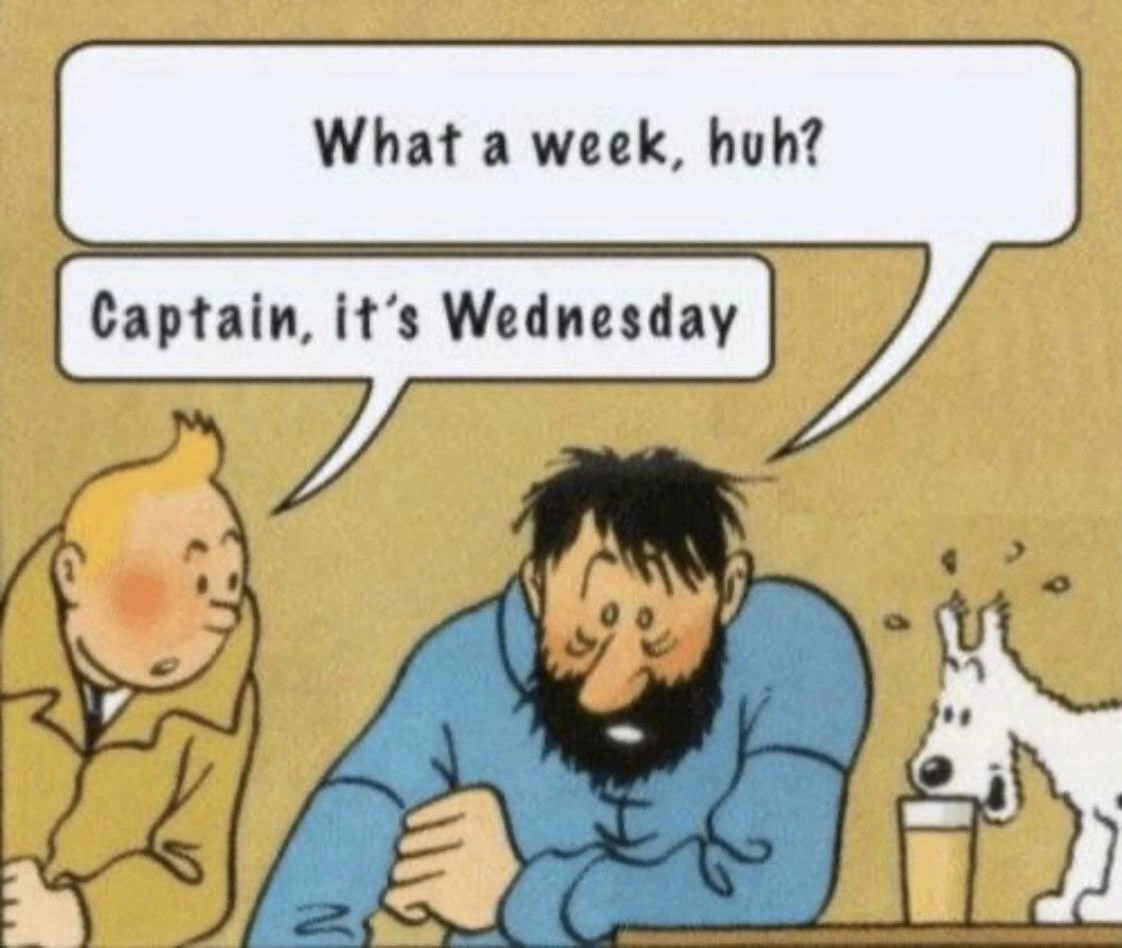
Have you ever had a week that felt so long and tiring that when Wednesday came, you thought it should already be the weekend? That’s what’s happening in this picture. The bearded man (Captain Haddock) is so worn out by the things that happened on Monday and Tuesday that he sighs, “What a week, huh?” even though it’s only Wednesday. His friend (Tintin) is basically saying, “Wait, it’s only Wednesday!” It’s funny because usually people say “What a week” on a Friday after a long week is over. But here, by just the middle of the week, he’s already as tired as if the whole week passed. It’s like when you go to school for a couple of really hard days – maybe lots of homework, a big test, and even running around in gym class – and you feel super tired, thinking “wow, this week has been tough,” but then you realize it’s only Wednesday. You still have Thursday and Friday to go! The joke is in that little shock: feeling end-of-week exhausted when you’re only halfway. It’s a silly way to show just how busy and draining those first few days were. It makes us laugh because we recognize that feeling in ourselves when time seems to drag on after a lot of hard work.
Level 2: Midweek Meltdown
Let’s step back and explain the scenario in simpler terms. Imagine you’re a developer working in a team that follows Agile methodology. In Agile, you work in short cycles called sprints (commonly 1 or 2 weeks long). At the start of a sprint, the team plans a set of tasks or user stories to complete – ideally a workload that fits their team’s proven pace (their sprint velocity). Every day, usually in the morning, the team has a quick check-in meeting called a stand-up (or daily scrum). In a stand-up meeting, each team member briefly shares what they did yesterday, what they plan for today, and if they’re facing any blockers. It’s called a stand-up because originally everyone would literally stand to keep it short and to the point. The stand-up in this meme is happening on Wednesday – the middle of the workweek, often nicknamed “Hump Day” because once you get over Wednesday, you’re over the hump toward the weekend.
Now, by Wednesday of what should be a normal sprint, our developer (embodied by the weary Captain Haddock in the comic) is exhausted – so much so that he says, “What a week, huh?” even though the week isn’t over. Why would someone be that tired by Wednesday? A few likely reasons in developer life:
Production incident: This is when something goes wrong with the live software (the version of your app or service that real users or customers are using). For example, a major bug might crash the website, or a critical feature stops working. When that happens, developers often have to jump in and fix it ASAP – even if it’s late at night. This is sometimes called being on “firefighting” duty or on-call support. In the meme’s context, it sounds like between Monday and Tuesday there was a serious production issue that demanded a lot of hours and energy (possibly even an all-nighter on Monday). Late-night coding and emergency debugging destroy your normal sleep schedule, so by midweek you’re running on very little rest.
Scope creep: This term describes when new tasks or requirements keep getting added after the sprint has started, without proper re-planning. Maybe on Monday your team committed to 10 tasks, but by Tuesday the product manager or a higher-up says “Oh, we also need to include these 5 extra features or bug fixes this week.” That’s scope creep – the scope of work “creeps” beyond what was originally agreed. It’s a big reason people end up overworked. In the meme’s implied story, between Monday and Wednesday, new tasks have been added (maybe a few Jira tickets popped up unexpectedly). Jira is a tool many dev teams use to track work; tasks show up as cards on a board. If we say the “Jira board is overflowing,” it means there are way too many tasks lined up – more than the team can handle comfortably. So our poor developer went from a reasonable to-do list to an overwhelming one in just a couple of days.
Meetings, meetings, meetings: Modern developers often complain about “meeting fatigue” or specifically “Zoom fatigue” when remote. This happens when you spend a huge part of your day in meetings (planning sessions, status updates, brainstorming, you name it) especially on video calls. Meetings can be helpful, but too many back-to-back meetings leave you with no time to actually do the coding work, and they mentally drain you. By midweek, if you’ve had continuous meetings, you might feel burnt out without having checked off much actual coding from your list. In the scenario, the description mentioned “back-to-back Zooms,” which suggests our team has been stuck in virtual meetings for a large chunk of the first half of the week. It’s easy to see why that would make the week feel extra long.
Deadline pressure: Sometimes a week feels long because there’s a lot riding on it – maybe an important deadline or sprint goal by Friday. If management is pressuring the team to deliver something big quickly, developers might be pushing themselves hard from Monday onward. This rush, often called crunch time, is when people work extra hours (nights, weekends) to meet a deadline. It’s common in game development and some software projects, though it’s not a healthy practice long-term. Crunching early in the week will definitely leave you feeling whipped by Wednesday.
Developer burnout: Burnout is a state of chronic stress and exhaustion. Developer burnout specifically refers to when programmers become emotionally drained, cynical, and less effective because of prolonged overwork or tough pressure. If by Wednesday someone exclaims “What a week!” it’s a red flag that they’re moving towards burnout territory. Feeling like you’ve run a marathon when you’re only halfway could mean you’re not getting enough rest or the workload is too high. It’s both a productivity issue and a mental health concern in the tech industry. Many companies now promote work-life balance to combat this – encouraging reasonable work hours, proper breaks, and saying no to extra work when capacity is full. In this meme though, that balance is clearly off-kilter – hence it resonates with folks who have been in environments that ignore those tips.
So putting it all together in plain terms: The meme jokes that by Wednesday morning, a developer feels as tired as if an entire week (or even a whole project release) passed, because the first half of the week was packed with unexpected crises, extra work, and non-stop meetings. Tintin, the young guy in the comic, reminds the Captain (the tired developer avatar) that “it’s Wednesday” – implying there are still a couple of days to go, which is both funny and a little scary. It’s funny because we don’t expect someone to be that worn down so early in the week; it’s scary (in a relatable way) because many of us have felt exactly that.
For a junior developer or someone new to the field, this meme is basically a cautionary tale of bad sprint dynamics. It highlights why things like proper capacity planning (estimating how much work the team can really do), limiting scope creep, and allowing breathing room in a schedule are important. When those practices fail, even a Wednesday can feel like you’ve worked a double shift for three days straight. The comic exaggerates it with humor, but the elements – firefighting a production bug, dealing with added tasks, too many meetings – are all too real. The result? By midweek, you’re sitting at your desk (or in the comic, a bar) completely wiped out, muttering “What a week…” when the week isn’t even over. In developer lingo, you’ve hit the “midweek slump” hard.
This is an oh-so-relatable experience shared across many dev teams, which is why the meme has been tagged as RelatableDeveloperExperience. It’s basically saying: “If you’re feeling this, you’re not alone – we’ve been there too (and it’s okay to laugh at the absurdity of it).” And maybe it’s also a gentle nudge: take care of yourself, because a sprint shouldn’t feel like an entire marathon by day three!
Level 3: Sprint Time Dilation
From a senior engineer’s perspective, this meme hits on the time-bending nature of crunch time in a sprint. By Wednesday morning, it feels like an entire release cycle has passed. The humor comes from that disorienting compression of time when production incidents, scope creep, and endless Zoom meetings pack a week’s worth of stress into just two or three days. Any experienced dev has lived this: it’s only mid-week, but you’re as drained as if it were Friday night after deployment. Agile ideals preach a sustainable pace, yet here we are in mid-sprint already running on fumes.
Let’s break down how the week might have unfolded to create this comic scenario:
Monday: It starts with optimistic sprint planning. By noon, that optimism is shattered by a high-priority production incident – the kind that triggers a Sev-1 pager alert at midnight. Suddenly your fresh start turns into a late-night firefight patching code in prod. So much for easing into the week. You’re debugging bleary-eyed at 2 AM, late-night coding through what was supposed to be your downtime.
Tuesday: You wake up (if you actually slept) to find the Jira board exploding with new tickets. Features and fixes that weren’t planned somehow got added overnight – classic scope creep in action. The sprint’s carefully planned capacity is now a joke; we’ve got more tasks than a team of cyborgs could handle. On top of that, it’s wall-to-wall Zoom meetings all day (design review, “quick” syncs, maybe an emergency post-mortem for Monday’s incident). Each back-to-back video call siphons a bit more soul. By evening, your code editor feels like a stranger – you barely wrote a line of code between meetings. Meeting fatigue has kicked in hard. The day ended with more work and less energy than it started with, a net negative for developer productivity.
Wednesday: Enter the hump day haze. The alarm goes off for the morning stand-up meeting, and you feel like a zombie shuffling to your webcam. Your eyes have the Captain’s half-closed stare as you muster the energy to tell your team what you’re working on. At this point, the whole team shares that hump_day_burnout vibe – everyone looks like they aged a year since Monday. It’s only halfway through the sprint but it feels like the sprint is already in overtime. The burndown chart? Let’s not even look at it… By now it’s obvious the sprint’s capacity_planning_fail – we bit off way more than we could chew, especially with all the “extra” work thrown in. There’s a palpable standup fatigue: nobody even has the strength for the usual chirpy Scrum banter (“Yesterday I worked on X, today I’ll tackle Y…”). Instead, it’s terse updates and knowing sighs. If this were a sports game, Wednesday is when the team hits “the wall.” And indeed, Captain Haddock slumped over a pint is a pretty accurate metaphor for hitting that wall.
Now, why is this funny to those of us in the trenches? It’s that dark, commiserating humor of shared experience. We’ve all heard someone sigh “What a week, huh?” on a Wednesday, or maybe we’ve been that person. It’s amusing in the same way a facepalm is: it hurts, but at least we’re not alone. The meme exaggerates a relatable truth: when you’re juggling deadline pressure, surprise tasks, and constant context-switching, time perception goes haywire. Each day early in the week carries the weight of a normal week’s work. This is essentially midweek_time_dilation – a psychological phenomenon where intense stress and overwork stretch your perception of time. By Wednesday, Monday feels like ages ago, and you can’t believe it’s not Friday yet. The captain in the comic is basically every senior dev who’s seen one thing after another since Monday and is now spiritually 90 years old by Wednesday morning.
On a deeper level, this also pokes at some systemic issues in tech culture. Sprints are supposed to be well-planned, but poor capacity planning and the ever-looming culture of crunch time can turn them into mini death marches. Teams often commit to unrealistic sprint scopes (chasing that sprint_velocity dream), leaving no slack for emergencies. So when the inevitable surprises hit – a server goes down, a VP tosses in a “quick win” feature request – the team has no buffer. Work spills over, people stay late, and by midweek everyone’s running on caffeine and stubbornness. This meme is funny-because-it’s-true: it shines light on the unspoken reality that “agile” sprints sometimes feel anything but agile or sustainable. Developer burnout isn’t just a buzzword here; you can practically see it on Captain Haddock’s face.
The depiction of Captain Haddock at the pub with his pint is a cheeky nod to coping mechanisms, too. Snowy the dog looking alarmed at the glass might as well be your inner voice saying “Uh, it’s a bit early in the week for that, isn’t it?” 😂. There’s a grain of dark humor there: the mid-sprint fatigue is so real that even a hard-nosed sea captain is ready to throw in the towel (or down a drink) by Wednesday. We don’t literally suggest drinking your woes away, of course, but many devs will joke, “Is it beer-o’clock yet?” when the week’s been that long. More healthily, it might mean by Wednesday evening you’re contemplating a strong coffee or an early night – anything to survive the rest of the week.
In essence, the meme lands because it exaggerates a feeling we’ve all had: the week has been such a rollercoaster that calling it “a week” by Wednesday feels justified. Then reality (Tintin) chimes in: “Captain, it’s Wednesday.” That punchline drives home the absurdity – only two or three days have passed! It’s a gentle reminder (with a laugh) of how skewed our work-life balance can get. If you find yourself routinely saying “What a week” on a Wednesday morning, it might be time (after chuckling at this comic) to re-evaluate the workload, push back on some meeting invites, and chase those WorkLifeBalanceTips we’re always bookmarking but never following. Blistering barnacles, we need a break!
Description
A meme using a panel from the classic comic 'The Adventures of Tintin'. The image features Captain Haddock, a bearded sailor, looking utterly exhausted and disheveled at a table. He says, 'What a week, huh?'. Next to him, the youthful character Tintin replies with a dose of reality, 'Captain, it's Wednesday'. To the side, Snowy the dog looks on. This meme is a universally relatable depiction of workplace exhaustion, especially potent in the tech industry. For senior developers, a week can feel incredibly long when it's packed with production incidents, complex debugging sessions, urgent deadlines, or endless meetings. The humor lies in the shared experience of time distortion caused by intense work, where Wednesday feels like the end of a grueling marathon with no finish line in sight

Comments
10Comment deleted
Monday was a Sev1 incident, Tuesday was the emergency patch, and Wednesday is the all-day post-mortem meeting. The week is technically half over, but my soul has already accrued a full sprint's worth of technical debt
When your Prometheus uptime graph shows 99.99%, but your personal uptime drops to 42% by Wednesday, you know the incident budget isn’t the only thing that’s blown
The only accurate time estimation in software development is when your junior dev says 'Captain, it's Wednesday' while you're already planning Friday's hotfix deployment for the features that were supposed to ship Monday
When your sprint started Monday with 'just a few quick fixes' and by Wednesday you've rewritten half the codebase, debugged a race condition that only manifests in production, and somehow became the subject matter expert on a legacy system written before you joined the company. Time is a flat circle, and that circle is your burndown chart going the wrong direction
When Monday's 'simple' monolith refactor accrues more tech debt than a full sprint by hump day
On-call relativity: two Sev1s in 48 hours burn the sprint’s entire error budget, so by Wednesday you’ve hit Friday energy without the deploy freeze
Enterprise Agile tip: when your recurring meetings form a quorum, Wednesday gains eventual Friday consistency - validated by the on-call's SLO burn rate
Where frog? 0-0 Comment deleted
phrog Comment deleted
no one does. Comment deleted