Skip to content
DevMeme
3333 of 7435
A Developer's 'Hello World' Playlist in C
Languages Post #3658, on Sep 8, 2021 in TG

A Developer's 'Hello World' Playlist in C

Why is this Languages meme funny?

Level 1: Musical Secret Code

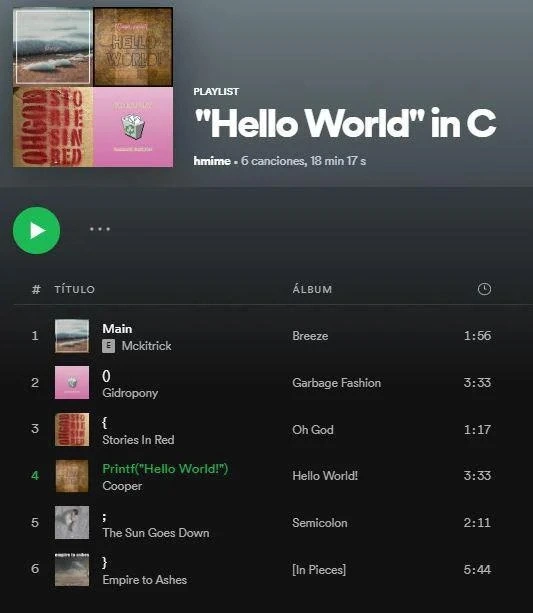
Imagine you have a list of songs where each song’s title is like a word or symbol in a secret message. That’s exactly what’s happening here – someone made a special music playlist that hides a secret code message for computer people! The playlist is called "Hello World" in C, which is a hint. “Hello World” is usually the first thing people learn to make a computer say when they start programming. It’s like the easiest trick to check, “Hey, I can talk to the computer!”

Now, how can a list of songs say “Hello World”? By being very sneaky with the song names:

  • The first song is called “Main” – think of this like the story’s beginning or the big chapter where everything starts. In coding, “main” is the name of the start of the program.
  • The second song is just “0” – a zero. In the secret code, that zero means “everything is okay” at the end of the program. It’s like a thumbs-up from the computer saying, “Finished with no errors!”
  • The third song is named “{” – that’s not a word, it’s a symbol (a curly brace). In code, a curly brace { is like opening a gate to a fenced yard – it shows where the program’s actions begin.
  • The fourth song is Printf("Hello World!") – this one is funny because it looks exactly like code. If you tell a computer printf("Hello World!"), you’re asking it to display the phrase Hello World. So this song title is basically the main action: saying Hello World (kind of like our secret message directly popping up!).
  • The fifth song is called “The Sun Goes Down”, but the tricky part is it comes from an album named “Semicolon”. A semicolon ; is a little punctuation mark (;) that in programming is like a period at the end of a sentence – it tells the computer “that instruction is over, move on to the next.” They snuck the semicolon in via the album name because maybe no song was just named “;”. It’s like hiding a tiny clue in the cover of a book!
  • The last song is “}” – the closing curly brace. That symbol is the partner to the { from earlier. If { opened the gate, } closes it. It shows the end of the program’s actions.

When you read the titles in order, they form a little story that only a computer or a programmer would fully understand: Main 0 { Printf("Hello World!"); }. To a computer, that’s a set of instructions that mean: Start the program, say “Hello World!”, and end the program. In plain language, it’s like the playlist itself is saying hello to us!

It’s kind of like making a poem or a sentence using the titles of songs. People often make acronyms or messages with the first letters of book chapters or the first word of each line in a poem – here it’s whole song names forming a mini computer program. The joke is that only folks who know the coding language C will immediately see the message. To everyone else, the playlist just looks like a bunch of random titles and symbols. But to programmers, it’s as if the playlist is talking in code!

Think of it this way: imagine a friend wrote a secret note using emoji or special symbols that only you and your friends understand. At first glance, others might be confused, but you instantly know what it says and get excited. That’s what’s happening here. The playlist is a normal list of songs on the outside, but on the inside it’s a winky-face secret to those who know the language. The big green Play button even feels like you’re about to “run” or activate that secret message. Of course, if you actually press play, you’ll just hear music – not a computer voice saying Hello World – but it’s the thought that counts! It’s a playful reminder that coding isn’t just work, it can be a fun game. Developers love hiding these surprise messages because it makes us happy when someone else discovers it and laughs.

So, the reason this is funny is because it’s so clever and unexpected. It mixes two very different worlds – music and programming – into one. It’s like if you opened a recipe book and found that the first letters of each recipe spelled out a greeting, you’d be both surprised and delighted. Here, a programmer used song titles like ingredients to cook up a tiny hello. It shows how creative people can be, turning something ordinary (a playlist) into a geeky little treasure hunt. And even if you’re not a coding expert, once it’s explained, you can appreciate the joke: it’s saying “Hello, World!” in the language of music playlists. How cool is that?

Level 2: Track-by-Track Syntax

If you’re a newer developer or just learning about coding, let’s break down why this Spotify playlist is such a geeky gem. The playlist is literally constructing a simple program (specifically, a C language program) using song titles as the pieces. In programming, a “Hello World” program is typically the first thing you write when learning a new language – it just displays the message Hello, World! on the screen. In C, that program needs a certain structure. Here’s how the playlist’s songs map to that structure:

Song Title Represents in C code
Main main – the name of the main function where a C program begins. (Usually you’d see int main() in code.)
0 0 – the number zero, suggesting the return 0; that ends the main function indicating successful execution.
{ { – an opening curly brace, which starts the block of code for the main function.
Printf("Hello World!") printf("Hello World!"); – a call to the printf function that prints "Hello World!" to the console. The quotes and exclamation are exactly how you’d write the string in C code.
The Sun Goes Down (Album: Semicolon) ; – the semicolon character, coming from the album title Semicolon. In C, every statement must end with a semicolon. So this is terminating the printf statement above.
} } – a closing curly brace, which ends the block of code (closes the main function started by the “{”).

Seen together, these pieces form the code:

int main() {
    printf("Hello World!");
    return 0;
}

Let’s explain each part in plain terms:

  • C Programming Language: C is a popular programming language (part of the C-family languages along with C++ and others). It’s been around since the 1970s and is known for its straightforward, low-level approach. When you write a program in C, you have to follow a specific syntax (grammar) so the computer can understand it.

  • main function: In C, the main function is special – it’s where the program starts running. Think of it as the starting point or the front door of the program. When you run a C program, the first thing it does is jump into main and execute whatever’s inside it. So having a track named "Main" immediately signals “this is where the program begins.” In real C code, you’d normally see something like int main(void) or int main(int argc, char *argv[]), but conceptually "Main" here is referencing that crucial function.

  • Curly Braces { }: These braces mark the beginning { and end } of the main function’s code block. Everything between them is what the program actually does when it runs. When you see { in code, it’s like saying "start of a group of steps," and } means "end of that group." In our playlist, track 3 is "{" and track 6 is "}", so they act like bookends around the songs in the middle.

  • printf("Hello World!");: This is the line that actually does something – it prints the text “Hello World!” onto the screen. printf is a standard C function (defined in <stdio.h> library) used for output. The text to print is enclosed in quotes inside parentheses. And notice, in code we put a semicolon ; at the end of the line to finish the instruction. In the playlist, track 4 is literally named Printf("Hello World!") which is awesome because it’s exactly how the code looks (aside from the capital P, but we’ll pretend it’s lowercase 😉). When a new programmer runs their first C program and sees Hello World appear in the console, that’s this line doing its job.

  • Semicolon ;: In C (and many similar languages), every statement (like a command) must end with a semicolon, very much like how sentences end with a period. It’s a tiny but crucial character. The playlist creator found a clever way to include a semicolon – since a song title can’t literally just be ";" (at least none that we know of), they used a track whose album name is Semicolon. The track title “The Sun Goes Down” isn’t code, but the album name provides the missing piece: a semicolon to terminate the printf statement. This detail is super important because if you forget the semicolon in actual code, the compiler (the program that turns your C code into an actual runnable application) will throw an error and refuse to compile. It’s a classic newbie mistake to miss ; at the end of a line, so including it in the joke shows the creator’s thoroughness. Even a junior developer who’s written a bit of C will appreciate seeing that semicolon in there!

  • return 0;: In C’s main function, returning 0 means the program executed successfully. It’s like saying “everything went fine, exit now.” We typically write this as the last line in main. The playlist puts a standalone "0" as track 2, which is a bit out of order from how code would appear (usually return 0; comes at the end, right before the } brace). But the intent is clear: that zero is our return value. In modern C, if you omit return 0; the program will usually assume it for you, but most examples explicitly include it for clarity. So the playlist’s "0" is essentially representing that final step where the program says “I’m all done and everything was okay.” It’s a sly way to include the concept of returning 0 without having a song literally named "return".

Now, what does it mean that the playlist “compiles into a full C Hello World program”? Normally, to compile means to take source code (what programmers write) and run it through a compiler to produce an executable program (something you can run on your computer). Here, of course, we’re not actually running a compiler on the playlist 😅. It’s a figurative way of saying: if you read the playlist like it’s code, it forms a complete, valid program (one that, if typed into a C compiler, would output Hello World). In other words, the joke is that the playlist is code in disguise.

For a new developer or someone just familiar with the basics, this is a fun demonstration of how programming syntax works. Each element – the function name, the braces, the print function, the semicolon, and the return value – has to be in place for the code to be correct. The creator of this playlist essentially did a “Hello World” coding exercise using song titles instead of a text editor. It’s a great example of an inside joke in tech: if you know how code is written, you instantly get what they did there. If you don’t, it just looks like a weirdly curated playlist with some symbols and random words.

Also, notice the big green Play button in the Spotify interface? That’s a funny coincidence because in coding, especially in an IDE (Integrated Development Environment), there’s often a big green play/run button to start your program. So here, pressing play on the playlist feels like “running” the Hello World program! Of course, instead of printing text to a screen, it would start playing the songs – but the parallel is amusing. We have a habit in coding of anthropomorphizing everything into our workflow, and this is a prime example: even our music players start to look like development tools.

Ultimately, this meme is highlighting how creative and geeky developer humor can get. It’s not just a random assortment of songs; it’s been carefully constructed so that the titles serve a dual purpose. For a junior dev, it’s a nudge that says, “hey, remember that thing you learned in your intro to C class? It’s so fundamental that we can spot it anywhere – even hidden in a Spotify playlist!” It’s also a neat recap: you can point at each song and recall why each piece (main, {}, printf, ;, return 0) is needed in your code. Who knew a playlist could double as a pop quiz on C syntax, right? And as you gain more experience, you’ll see these little Easter eggs and jokes pop up often – programming culture is full of them. They reinforce our knowledge and make us laugh at the same time. So next time you see something odd like a playlist named after code, you’ll be in on the joke. It’s the power of music meeting the power of code, and it makes our nerdy hearts sing. 🎵💻

Level 3: Symphony in C

At first glance, this looks like an ordinary Spotify playlist. But to a seasoned developer’s eye, those track titles are blinking like code. In fact, they secretly form a C program. The playlist title '"Hello World" in C' is a big clue: it’s telling us the theme is the classic Hello World program written in the C programming language. And sure enough, reading the song names in order reveals the skeleton of a C program:

  • Main – This hints at the main function, the entry point of every C program. In a real C source file, you’d see something like int main() to kick things off.
  • 0 – A single zero might seem cryptic, but experienced devs recognize it as a return code. In C’s main, writing return 0; signals the program ended successfully. It’s a subtle nod to good old return 0; that every Hello World concludes with. Placing it up front is a bit playful (normally return 0; comes last), but we’ll chalk it up to artistic license.
  • { – An opening curly brace. In C (and many C family languages like C++, C#, and Java), braces define the beginning and end of code blocks. Seeing this “{” on the playlist is like seeing the program’s open scope – we’re entering the function body.
  • Printf("Hello World!") – This is the heart of the program. printf("Hello World!"); is the C code that prints the famous greeting to the console. By naming a track exactly as Printf("Hello World!"), the playlist literally contains the code statement to output Hello World. The mix of lowercase printf and the capital P in the song might break actual C syntax (C is case-sensitive), but we get the joke: it’s close enough to trigger our pattern recognition. It’s a spot-on example of developer humor: we see that string and can almost hear the program cheerfully greeting us.
  • The Sun Goes Down – Hmm, that doesn’t sound like code, does it? But check the album name: Semicolon. In C, ; (semicolon) is absolutely essential – it’s the punctuation that ends statements. Forget a semicolon and your code won’t compile (cue every dev’s facepalm at the compiler error). The playlist creator cleverly snuck in the missing semicolon via an album title. It’s an easter egg inside the Easter egg: only someone fluent in C syntax catches that The Sun Goes Down is contributing a “hidden” semicolon to terminate the printf statement. We’re relieved they didn’t drop the semicolon – missing that tiny track would break the whole program!
  • } – And finally, the closing curly brace. This marks the end of the main function. It’s the playlist’s final track, wrapping up the code block and completing the program structure. The function we started with “{” is now properly closed with “}”. Balance is restored, and our C code is syntactically complete.

By assembling these titles, the playlist spells out something very close to a valid C program:

int main() {
    printf("Hello World!");
    return 0;
}

Yes, they skipped the #include <stdio.h> (which you’d normally need to use printf), but let’s forgive that for the sake of the joke. The core idea shines through: the playlist compiles in our head into a tiny executable that prints “Hello World!”. It’s like encountering source code in the wild, outside of a text editor – a delightful inside joke for programmers. Seasoned developers have written “Hello World” in countless languages and forms, but this might be the first time we’ve seen it done through song titles on Spotify. It’s a testament to the relatable developer experience – even when we’re relaxing with music, we can’t help but see patterns of code!

The humor here relies on recognizing the rigid structure of a C program hiding in an everyday context. If you know C (or any similar curly-brace language), your brain automatically tokenizes those track names into code components. It’s pattern recognition meets prank. The big green Play button on Spotify even resembles the “Run” button in an IDE – press it, and you symbolically “execute” the playlist program. Of course, pressing play won’t literally compile C code, but imagining music that somehow prints “Hello World!” is ridiculously fun. Tech humor often lives in these crossovers: mixing domains (music and programming) to create absurd but satisfying scenarios. In this case, a mundane playlist interface secretly doubles as an IDE interface, and that contrast is pure geeky joy.

This meme speaks to the culture of developers finding code in everything. It’s like code-golfing or creative coding in real life – using non-code tools to write code conceptually. It reminds us of code-poems or those classic jokes where developers hide messages in commit histories or API responses. Here, a Spotify user turned a playlist into a C syntax easter egg. It tickles experienced devs because it shows how deeply ingrained our understanding of syntax is: we can’t even see a curly brace or a printf in the wild without thinking “Hey, that’s code!” And the fact that it’s "Hello World", the grand entrance of programming examples, makes it even more universally recognizable and nostalgic. Every developer remembers their first Hello World, so seeing it pop up in a musical context is both hilarious and heartwarming. It’s a reminder that coding isn’t just a job or a bunch of lectures – it’s a whole way of thinking that can bleed into our hobbies and creative expressions.

In summary, to the seasoned engineer, this playlist is a clever symphony of code and music. It hits all the right notes (pun intended): correct C program structure, an output statement, proper termination, and even a tongue-in-cheek use of Spotify’s UI as a compiler’s Run button. It’s an ode to the programming world’s most famous inside joke – Hello World – orchestrated in a place we’d least expect it. For those of us who have spent late nights debugging missing } or ;, there’s something ridiculously satisfying about seeing those symbols lined up in a Spotify tracklist. This meme nails that “Oh, I see what you did there!” moment that unites devs across languages and generations. Hello World, meet the power of music. 🎶👩‍💻

Description

A clever meme showing a screenshot of a Spotify playlist titled '"Hello World" in C'. The playlist consists of six songs, and their titles, when read in order, form a syntactically correct (though simplified) 'Hello World' program in the C programming language. The song titles are: 1. 'Main', 2. '()', 3. '{', 4. 'Printf("Hello World!")', 5. ';', and 6. '}'. This is a highly creative joke that resonates with programmers, especially those with a background in C or other low-level languages. It merges the universal starting point of any coding journey ('Hello World') with the modern-day digital mixtape, the Spotify playlist. It's a niche, witty piece of content that appreciates the structure and syntax of code as a form of art

Comments

52
Anonymous ★ Top Pick The real test for a senior dev is to make a playlist that correctly includes `<stdio.h>`, handles the return type of main, and passes linting
  1. Anonymous ★ Top Pick

    The real test for a senior dev is to make a playlist that correctly includes `<stdio.h>`, handles the return type of main, and passes linting

  2. Anonymous

    Finally, a C project that ships with perfect dependency management - the only required library is Spotify.h

  3. Anonymous

    After 20 years of explaining to product managers that 'Hello World' isn't a shippable feature, we've finally found a way to monetize it - $9.99/month for Spotify Premium to listen to your first program compile without ads

  4. Anonymous

    When your Spotify Wrapped reveals you've been listening to the same 6-track program on repeat for 20 years - because let's be honest, we all started with `main()`, `printf("Hello World!")`, and a semicolon, and some of us never really left. At least this playlist compiles without warnings, which is more than I can say for most production code I've reviewed this quarter

  5. Anonymous

    Great playlist - just disable shuffle or you’ll invoke C’s favorite feature: undefined behavior

  6. Anonymous

    'Garbage Fashion': C's reminder that without GC, leaks are always on trend in prod

  7. Anonymous

    Cute orchestration, but without the '#include <stdio.h>' track and an 'int main(void)' remix, this compilation fails at link time - Printf goes platinum, return 0 charts, and the rest is undefined behavior

  8. @sashakity 4y

    no include stdio or int?

  9. @sashakity 4y

    or a return value

  10. @cringy_frog 4y

    IIRC the absence of int is not an error in C since it deduces int automatically

    1. @GaggiX 4y

      If I remember correctly it's still a warning on main if you -Wall

  11. @elhadjx 4y

    If you think abt what music is, just beats and u letting ur mind to go with it like a dumb animal

    1. @RiedleroD 4y

      btw most animals don't even like music. There has been some success with cats and dolphins, but nothing comparable to humans.

      1. @elhadjx 4y

        That was not the point

  12. @elhadjx 4y

    Music isn't a thing

  13. @elhadjx 4y

    More like a drug

    1. @RiedleroD 4y

      drugs are things, music is a concept.

      1. @elhadjx 4y

        One purpose

  14. @elhadjx 4y

    It's shame that u need to listen to stupid sounds that control ur mood

    1. @RiedleroD 4y

      nobody "needs" to listen to music, people want to do it - and the music can at most help you achieve the mood you wanted

      1. @elhadjx 4y

        True

  15. @elhadjx 4y

    Even ur moves

  16. @elhadjx 4y

    It's pointless

    1. @RiedleroD 4y

      most of what humans do is pointless in that sense, Mr. edgey

      1. @elhadjx 4y

        Most of humans are retards

        1. @RiedleroD 4y

          true, but I don't see the relation to music

          1. @elhadjx 4y

            Just compare people and you will see

            1. @RiedleroD 4y

              don't want to sound smart, but most good musicians had pretty high intelligence

              1. @elhadjx 4y

                Wasted one

                1. @RiedleroD 4y

                  is it really wasted when with it you boost the morale of other people?

  17. @elhadjx 4y

    But is it right to change ur mood or even need a help to change it

    1. @RiedleroD 4y

      yes

  18. @elhadjx 4y

    Would u want to listen to music to get a good mood after hearing for example that someone of ur family died ?

    1. @RiedleroD 4y

      bit of an extreme example, no? I don't think I'm qualified to answer this question because deaths don't really touch me the same way it does others, and I listen to music all the time

      1. @elhadjx 4y

        Again that is not the point

  19. @elhadjx 4y

    Mood reacts to ur reality

  20. @elhadjx 4y

    If u have a bad mood

  21. @elhadjx 4y

    Change reality

    1. @RiedleroD 4y

      that's not always possible

      1. @elhadjx 4y

        True, but face it if it's not possible

        1. @RiedleroD 4y

          can you just …accept the fact that it's easier to listen to music than to escape depression completely without any mood changer?

        2. @RiedleroD 4y

          and depression is far from the only thing you just can't change at all

        3. @RiedleroD 4y

          people won't magically become happy after accepting that they can't change something - usually quite the opposite.

          1. @elhadjx 4y

            Once the music ends, they'll get back to reality

  22. @elhadjx 4y

    Not the mood it self

  23. @elhadjx 4y

    I was listening to music everyday, it's been more than a year that i didn't listen to any, and since that i didn't get depressed, not like i was when i used to listen to music

    1. @RiedleroD 4y

      your main point is flawed - while I do think the subject of mind-altering substances is a tricky one, music isn't even close to being in the same league. Colors can also change your mood, will you stop seeing in colors to protect your fragile brain? Nonsense. The brain is a everchanging organ, and if you try to protect it from outside stimuli, it's going to get corrupted by the mere absence of stimuli.

  24. @elhadjx 4y

    Anyway dude that was a great chat

  25. @elhadjx 4y

    Have to go

    1. @RiedleroD 4y

      I respect that - though do respond to my other comment when you find the time please

  26. @elhadjx 4y

    Hopefully one day u will know what I'm trying to say

  27. @Stepan_Poznyak 4y

    Why just "main()", not "void main(void)"?

Use J and K for navigation