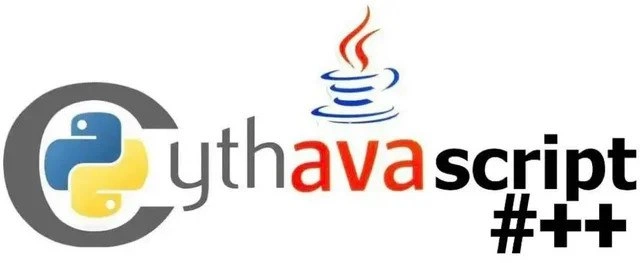
Behold CythavaScript#++: one outrageous logo combining every major language together
Why is this Languages meme funny?
Level 1: One Big Stew
Imagine you have a bunch of different favorite foods – say, ice cream, pizza, sushi, and tacos. They’re all really tasty on their own, but very different from each other, right? Now picture someone taking all those foods and mixing them into one giant dish. 😆 It would be pretty outrageous – a scoop of ice cream melting on a sushi-roll-taco with pizza toppings! The idea is kind of funny because it’s so extreme: you’d never actually cook that way since all the flavors would clash and make a crazy mess.
This meme is doing that with programming languages instead of foods. Programmers sometimes argue over which language is the best (like kids arguing which food is yummiest). This picture jokes, “Hey, let’s just mix all the languages together into one big language soup!” Seeing the logos and names of six different coding languages mushed into one is silly, just like our food combo. It makes people laugh because it’s a ridiculous solution – trying to please everyone by combining everything, and ending up with something impractical and over-the-top. Even if you’re not a coding expert, you can get the humor: it’s like using every color of paint on one canvas hoping to get a masterpiece, but you’d probably end up with a weird blob. In the end, the meme is funny on a basic level because it shows how mixing too many good things can become one wild, crazy concoction. It’s saying, “If choosing one is hard, doing all at once would be hilarious!”
Level 2: Language Mashup 101
Alright, let’s take a step-by-step look at this meme for those newer to programming. It’s basically a big inside joke that mashes up multiple programming languages into one crazy name and logo. The meme’s title “Behold CythavaScript#++” is a made-up word that crams together C, Python, Java, JavaScript, C#, and C++. If you’re just learning to code, you might have heard of some of these languages. They’re all popular in different areas of software development. Seeing them combined like this is kind of like seeing the logos of all your favorite sports teams merged into one jersey — it’s funny because in reality, those teams compete, and these languages “compete” in popularity or preference too.
Let’s decode the visual elements one by one, so you can spot the references:
- The big grey letter C on the far left stands for the C programming language. C is one of the oldest and most influential programming languages (developed in the early 1970s!). Its logo is often just a stylized letter C, sometimes in a grey or blue tone. Here it’s grey. C is known for being low-level (you deal directly with memory and the machine more) and super fast. It’s like the great-grandparent of several other languages in this meme.
- Inside that grey C, you see a blue and yellow snake icon. That’s the unmistakable logo of Python. Python (created in the late 1980s, named after Monty Python the comedy group, fun fact) is a very popular language now, especially for beginners, data science, and scripting. The snake logo is a play on the word “Python” (like a python snake). Python’s design is almost the opposite of C’s: it’s high-level, meaning it handles a lot of the complex stuff for you (like memory management), and it emphasizes readability (Python code looks kind of like pseudocode, and it doesn’t use
{}braces – it uses indentation to group code blocks). In the meme, the letters “Cyth” combine the C and the “yth” (from Python’s name) – so that part spells a mix of C and Python, often read as “Cyth...”. We can already guess they’re building a portmanteau (blended word) starting with those two languages: C + Python = Cython (minus the o). Actually, there’s a real thing called Cython (with an “o”) which is a way to mix C speed with Python code, but that might be coincidence. The key is: C and Python are being fused, which is funny because in real life they have very different uses and even different communities of developers. - Next up, hovering above the middle of the word, is a little red coffee cup with steam. This is the classic logo for Java. Java (created mid-1990s by Sun Microsystems) is a hugely popular language especially in large companies – it’s used for everything from Android apps to big server systems. The coffee cup represents Java because Java is named after a type of coffee. In the meme, right below that cup, you see the letters “ava” in red. So coffee cup + “ava” spells Java. Pretty straightforward! This part of the mashup adds Java to the mix. Notably, Java was designed to be an easier, “write once, run anywhere” language – you compile Java code into a form (bytecode) that can run on any system with a Java Virtual Machine. By including Java, the meme nods at the enterprise world and the idea of cross-platform code.
- Following that, you see the word “script” in black. That’s referencing JavaScript. The word “JavaScript” is literally “Java” + “Script”, but JavaScript is not actually a child of Java; it just took the name to ride Java’s popularity (marketing, sigh!). If you’re new: JavaScript is the language of web browsers (it makes web pages interactive) and nowadays it’s used on servers too (with Node.js). It’s also high-level and dynamically typed like Python, but it has its own quirks (like how it handles web stuff, events, etc.). Here, by including “script” immediately after “ava”, the combined text spells “Javascript”. So even though they are unrelated languages, the meme uses the naming coincidence to blend them seamlessly. This is part of the humor: people often confuse Java and JavaScript because of the name, and here the meme literally merges them as if they were one thing.
- Finally, at the very end in black, you see “#++”. This part is a double joke: it merges C# and C++. C# (pronounced “C sharp”, like the musical note) is a language from Microsoft (early 2000s) that was inspired by Java in many ways. Its logo or shorthand is a C followed by #. C++ (from the 1980s) is an extension of C (hence the ++, which is the increment operator in C, meaning “one more than C”). So writing “#++” hints at both languages. If you split it,
#could stand for C# and++for C++. They even stylized it in the meme as#++with no space, making it look like one continuous suffix. That’s a playful representation because normally you’d never see those together in a real language name. C# and C++ are related by history (both descend from C, and share similar syntax in many cases), but they serve different purposes. C++ is for high-performance applications (like game engines, real-time systems) and gives you a lot of control at the price of complexity. C# is more about productivity on the .NET framework, great for Windows apps and enterprise software, and it’s garbage-collected (meaning it handles memory automatically). By gluing “#” and “++”, the meme effectively says “let’s take the advanced, modern C languages too!” The result is a bit tongue-twisting: “sharp plus plus.” It looks almost like an in-joke itself because C#’s symbol#can be seen as a stylized combination of plus signs (one common joke is that C# is literally C++++, as if adding two more + signs).
So, all together we have CythavaScript#++, which contains:
- C
- Python (hidden in “yth” with the Python logo)
- Java (the coffee cup and “ava”)
- JavaScript (“script”)
- C# (“#”)
- C++ (“++”)
That’s six languages crammed into one! The meme’s subtitle calls it “one outrageous logo combining every major language together.” It really is a language_mashup of many major programming language logos and names, i.e., a language_portmanteau (a blended word). It’s like the programmer’s version of a mega-crossover event.
Now why is this funny to developers? There’s a concept of LanguageWars – basically friendly rivalries where programmers debate which language is best. Some love how easy and readable Python is, some prefer the control and speed of C or C++, others defend Java or C# for large projects because they catch errors at compile-time (thanks to static typing), and web devs champion JavaScript because, well, you can’t avoid it if you’re doing anything in a browser. These debates can be half-serious, half-playful, with a lot of memes and jokes exchanged. It’s common to see posts like “Python vs JavaScript – which should you learn?” or “C# vs Java: Fight!” etc. The truth is all languages have strengths and weaknesses, and often it comes down to using the right tool for the job or personal preference. But the DeveloperHumor here is imagining if someone got tired of all these comparisons and said: “Enough! Let’s just fuse them and get the ‘ultimate’ language so we all stop bickering.” Of course, that “solution” is totally impractical – mixing them all would create a monster that probably no one would truly want to use (because it’d inherit all the complexity and weirdness of each). But that’s exactly why it’s funny: it exaggerates the situation to an absurd extreme.
Another reason this mashup is humorous is because each of these languages has a distinct community and typical domain:
- C/C++ folks might be programming operating systems, embedded devices, or performance-critical software. They’re used to manual memory management and optimizing for speed.
- Python folks might be doing quick scripts, automation, data analysis, AI, etc., and they love how concise and easy Python code is.
- Java developers could be building large-scale enterprise applications, Android apps, or server-side systems where stability and cross-platform ability matter.
- JavaScript developers are creating interactive websites or mobile apps (with frameworks) – they live in the world of browsers and asynchronous calls.
- C# developers might be making Windows applications, games with Unity, or server APIs in the .NET ecosystem.
Each group has its own jokes, idioms, and even stereotypes about how they code. By mixing acronyms/logos, the meme is like smashing together different cultures. It’s the programming equivalent of a crossover episode of multiple TV shows: imagine a single episode where characters from six different series all meet – it’d be chaotic and probably played for laughs. Here, the “characters” are programming languages.
For someone new, it’s also interesting to note how languages influence each other. Over time, languages often borrow features:
- Example: Python added some functional programming features (like list comprehensions and recently even pattern matching, influenced by languages like Haskell).
- C# was influenced by Java’s design initially, and later even added features that came from dynamic languages.
- JavaScript took Java’s name superficially, but now even Java is adding JavaScript-like features (like lambda functions which Java got in Java 8, long after JavaScript had first-class functions).
- C++ and C# share similar syntax for loops, conditionals because of common C heritage, but C#’s memory management is more like Java’s. Meanwhile, modern C++ has been adding high-level abstractions to feel a bit more user-friendly (like the
autokeyword, lambdas, smart pointers) which partly emulate what languages like Java/C# offer out-of-the-box.
So in a way, real languages do evolve by taking the “best” ideas from each other. But they still remain separate entities. The meme pushes that to the limit by saying “what if one language literally had it all at once?” It’s funny because any programmer knows that having it all might actually make things harder, not easier – but it’s the kind of over-the-top joking solution that appears in online forums when people say “why not both?” to an either/or question.
One more subtle layer: The image design itself is a tech joke. The way the logos and text are merged shows some graphic design humor. For instance, placing the Python snakes inside the C is a creative way to visually say “CPython” or “Python in C”. CPython is actually the default implementation of Python written in C. And C# and C++ being jammed together as #++ – that’s something you might laugh at once you’ve learned a bit about each of those languages’ naming conventions and symbols. Even the coffee cup on top of “ava” mimics how Java’s logo often accompanies the word “Java” in official branding. The meme creator knew their stuff and expected the audience to have that baseline knowledge to get the joke.
In summary, if you’re a junior developer or just getting into coding, this meme is a playful introduction to how programmers sometimes think about languages. Each language has its fans and its quirks, and rather than seriously trying to decide one “best” language, we often joke about their differences. DeveloperInJokes like this one use exaggeration: nobody is actually proposing a language called CythavaScript#++ (thank goodness!), but by imagining it, we can humorously highlight how diverse and even incompatible these languages are. It’s a bit like an inside joke: once you’ve written some code in each of these, you appreciate how crazy it sounds to mash them together. And if you haven’t, well, now you know these names and logos and that they are “major languages” used in different arenas. It might even pique your interest to learn why each one is loved (and sometimes hated) by the devs who use it. For now, just know that this meme is all in good fun – a nod to the lively LanguageWars that have been going on in programmer communities for decades, and a creative language_mashup that gives a humorous “solution” to those debates by simply saying: have them all!.
Level 3: Language Wars Ceasefire
Seasoned developers will immediately smirk at this meme, because it satirizes the endless language wars that pervade programming culture. Imagine a conference room of veteran engineers, each fiercely loyal to their favorite programming language. One swears by the speed of C/C++, another extols the simplicity of Python, a third will only code in Java for its enterprise stability, someone from the front-end team chimes in about the ubiquity of JavaScript, and a Microsoft platform guru is humming praise for C#. We’ve all seen these debates devolve into friendly (or not-so-friendly) rivalry – the classic LanguageComparison arguments on forums, Reddit, and over coffee. This meme takes that scenario to a comedic extreme: “Can’t choose the best language? Let’s just use ALL of them at once!” It’s a cheeky ceasefire proposal for the language wars: if every camp’s beloved language becomes part of one monstrous amalgam, maybe we can finally stop arguing... and start collectively laughing at the absurdity.
The image itself is a masterful collage of programming_language_logos and name fragments that any experienced dev will recognize at a glance. Let’s break it down, since recognizing each piece is half the fun:
- The giant grey C on the left represents the venerable C language (often just depicted by the letter C in a bold font as its logo). Inside that C, we see Python’s iconic blue-and-yellow intertwined snake logo. This cleverly forms “Cy...th” which hints at Cython (indeed, Cython is a real thing – a Python variant that compiles to C for speed), but here it’s really merging C with Python to begin spelling "Cyth...". The grey lowercase letters yth that follow continue the word. So the meme artist managed to fuse C and Python into “Cyth”. This pairing is humorous because C and Python are often seen as opposites on the spectrum: one is low-level and manual, the other high-level and automatic. Yet, their fates are intertwined (pun intended, like those snakes): the main Python interpreter is actually called CPython and is implemented in C. Many Python modules (especially for speed) are written in C. So in practice, C and Python often do dance together – but as separate layers, not as one language. Here they’re smooshed into a single lettering as if to say “hey, Pythonistas and old-school C hackers, you’re basically family!” It’s a wink at how these ecosystems rely on each other while also poking fun at the idea of literally merging their syntax.
- Above the next part of the word, a little red steaming coffee cup logo hovers. Every seasoned dev will recognize that as the logo of Java (the steam rising from the cup is like Java’s official mascot icon). Right below it, in red letters, is “ava”. Put together, coffee cup + “ava” = Java. Java had its heyday in enterprise environments, and it’s still incredibly widespread. Its inclusion here is a must, because no “ultimate language” mashup would be complete without the language that promised “Write Once, Run Anywhere.” The Java section sits right in the middle of CythavaScript#++. This feels symbolic, too: Java often tries to be the middle-ground language – safer than C++, faster than Python (in theory), with a bit of everything (OOP, a huge standard library, now functional streams, etc.). So of course, it gets a prominent spot in our Franken-language name. For a senior dev, the sight of that Java coffee cup sharing space with Python snakes and C’s letter might recall the many times Java and Python are compared for backend services, or how Java’s strong typing contrasts with Python’s duck typing. It’s the Enterprise workhorse meeting the scripting ace.
- Continuing, we see the word “script” in bold black. This clearly nods to JavaScript, the language of the web. The way it’s concatenated is clever: it follows directly after “Java”. Many a developer joke has been made about how JavaScript’s name is a historical accident – it’s not actually related to Java; it was originally named LiveScript, then rebranded to ride Java’s popularity wave in the mid-90s. So “Java” + “Script” here unironically sticks together what was only ever stuck together in name. This meme capitalizes on that bit of trivia: by literally taking Java’s logo and the “script” part, it highlights the often confusing naming. Any web developer (or really, any dev who’s answered newbie questions) can attest: “No, JavaScript isn’t the scripting version of Java, despite the name.” Seeing them unified in one word is an inside joke in itself. It’s like the meme saying, “Fine, people think they belong together because of the name? Here you go, one continuous Java-script.” For a senior dev, there’s also humor in JavaScript’s presence because of how ubiquitous it has become. You can’t escape it – it runs in browsers and now on servers (Node.js). It’s dynamic, sometimes unruly (those weird type coercions and
==vs===gotchas), and its paradigm (event-driven, prototype-based) is very different from Java or C. Including it in CythavaScript#++ is like throwing a wild card into an already volatile mix – a bit of chaos to spice up our “perfect” language. - Finally, the tail end:
#++in bold, black. This part is doing double duty, referencing two languages at once. The#(hash or pound sign) is commonly read as “sharp” in musical notation, so C# (C-sharp) is implied. And the++is the famous increment operator that gave C++ its name (C++, as every old-timer knows, was named to indicate it’s “C incremented/improved”). By appending “#++”, the meme manages to wink at both modern object-oriented C# and its ancestor C++. The juxtaposition is comedic because in the real world, C++ and C# occupy fairly different niches despite the similar naming: C++ is a lower-level, compile-to-machine-code language famed (and feared) for its complexity and performance, whereas C# was Microsoft’s answer to Java – a high-level, garbage-collected language primarily for the .NET ecosystem. They share C-syntax heritage but diverged greatly. Seeing#++smushed together is like saying “here, have all the C-based languages in one go.” It’s also a subtle joke on naming: C#’s name can visually be seen as a clever four-plus-signs arrangement (♯ looks like two overlapped plus signs). In fact, there was a tongue-in-cheek idea that C# could be thought of as “C++++” (C plus plus plus plus) since the sharp symbol looks like two pluses vertically and horizontally – meaning it’s one step beyond C++! So#++kind of circles back on that: it’s literally C# + C++. Only a developer would chuckle at the absurdity of reading that out loud: “See sharp plus plus.” It’s a crunchy mouthful of symbols. We recognise each piece, but together it’s borderline gibberish – and that’s exactly the point.
When seasoned programmers look at CythavaScript#++, they can’t help but think of the tech holy wars and debates these languages have sparked over the years:
- Tabs vs Spaces? Forget that – how about Brace vs Indent (C/Java vs Python)? This “language” has both! That’s an immediate chuckle because any team mixing Python and C-style code conventions would be at each other’s throats over formatting. The meme basically says why not do both and laughs at the obvious style clash it’d create.
- Memory Safety vs Control: C++ devs brag about control and performance, Python devs brag about never worrying over pointers – combine them and everyone is uncomfortable! The senior devs remember debugging segmentation faults in C++ and, in different projects, chasing Python memory leaks or Java’s OutOfMemory errors. Each language’s problems could become one giant set of problems here. It’s funny ‘cause it’s true: more features, more headaches.
- “Best tool for the job” vs One Tool to rule them all: Experienced engineers know that each language has strengths. Python excels at rapid prototyping and data science scripts, C++ shines in high-performance games or systems, Java dominates large-scale enterprise apps, JavaScript runs the web interfaces, C# rules the Windows/.NET world. There’s a reason they coexist. The meme jabs at the idea of a silver bullet, a mythical tool that’s perfect for everything. We all know the adage: use the right tool for the right job. So the absurdity of CythavaScript#++ is that it’s trying to be every tool, presumably to do every job. In practice, that would likely mean it’s mediocre or unwieldy at everything! This irony isn’t lost on senior devs who have witnessed management fads of “we’ll rewrite everything in Language X because it’s trendy” go wrong. The meme plays on that by taking the trendiness to the limit—why stop at one trendy language when you could have them all?
- Learning Curve & Code Maintenance: One of the biggest chuckles for a veteran is imagining maintaining a codebase written in this abomination. Each part of the name invokes a different mindset. A single code file might require you to recall whether that
forloop is using C-style indexing, Python’s range iteration, or maybe the.forEachmethod from JavaScript arrays. Picture a poor dev trying to debug such code at 3 AM: “Is this bug because of manual memory allocation (C++) or did the garbage collector not kick in (Java/C#)? Or was this variable dynamically added to an object (JavaScript-style)?” It’s a nightmare scenario that exaggerates real multi-language projects (like a back-end in C++ calling a Python script, or a Java service interacting with a C library – except here it’s all in one file). The very thought of a single codebase containing all language quirks is hilariously terrifying to anyone who’s had to debug complex polyglot systems. It’s like mixing every single gotcha and pitfall from each language into one big “gotcha stew.” Senior devs appreciate this dark humor because they’ve been bitten by plenty of these individual gotchas in isolation – the meme says, “hey, let’s catch ‘em all at once!” - Release and Community Chaos: Another layer of humor is imagining how the community or update cycle of such a language would work. Each of the languages referenced has its own development philosophy and community priorities. C++ evolves slowly through ISO standards, Python has the benevolent dictator (well, now a steering council) approach with PEPs, Java is steered by Oracle and the OpenJDK community with strict backward compatibility, JavaScript (ECMAScript) has yearly releases via TC39 committee, C# is driven by Microsoft and open source contributors. If a senior dev starts thinking about CythavaScript#++, they’ll laugh at the idea of six different committees worth of bikeshedding combined. The joke practically writes itself: “A new feature is proposed – it has to pass the Pythonistas’ readability test, the C++ standards committee’s efficiency scrutiny, the Java folks’ security review, etc. By the time it’s approved, it’s 2050 and the language spec weighs as much as a stack of all seven Harry Potter books.” This is an exaggeration, but it resonates with anyone who’s followed the sometimes slow, contentious evolution of a language. It’s a meta-joke: the process of merging all languages might be even more comically impossible than the technical result.
All these interpretations make the meme a rich vein of DeveloperHumor. It’s an insider banquet of references — each logo and letter is a dish served to those who’ve feasted on that language before. A Java veteran sees their familiar coffee cup sharing a plate with Python’s snakes and either shudders or grins. A C++ hardcore sees #++ and maybe groans remembering how people confuse C++ and C# occasionally (“they both have C, right?!” – a question every C++ dev has heard from non-devs). The front-end JavaScript guru sees “script” attached to Java and feels the decades-old pain of explaining “No, I don’t write Java, I do JavaScript” – now finally in this imaginary world they do both at once!
Ultimately, experienced developers find this meme hilarious because it symbolically ends the language wars by absurd overkill. It’s taking the notion of a “perfect language” to such an extreme that it highlights why the search is futile. We laugh because we’ve been through enough technology fads and debates to know that the “next big language that kills all others” never actually does – we just end up with another tool in the toolbox. CythavaScript#++ is like saying, “Fine, you want one language? Here, have an Uber-language.” It underscores the diversity of our tools while poking at our occasional desire for a one-size-fits-all solution. In a way, it’s almost comforting: it reminds us that no matter how much our favorite languages evolve and borrow ideas from each other, they each remain distinct for good reasons. So, the only place they truly merge is in a joke image on the internet — a truce in a cartoon world, eliciting a chuckle from all sides of the real-world language divide.
Level 4: One Language to Rule Them All
In the realm of programming language design, combining all major languages into one is a fantastical chimera that tickles the imagination of computer scientists. At a theoretical level, any Turing-complete language can compute anything another can (thanks to Church-Turing thesis), so CythavaScript#++ wouldn’t be “more powerful” in a formal sense – but it sure would be mind-bending. Each of these languages embodies distinct paradigms and design trade-offs, so unifying them means reconciling fundamentally different philosophies:
- Type Systems: C# and Java enforce static types (variables have strict types known at compile time), while Python and JavaScript are dynamically typed (types resolved at runtime). A hybrid would juggle both – perhaps something like a gradual type system where variables can be optionally typed. But deep down, Rice’s theorem reminds us that fully analyzing program behavior is undecidable; the more dynamic features you include, the less the compiler can predict. The result? A type system as complex as a PhD thesis, mixing strong guarantees with areas of “we’ll only know at runtime!”.
- Memory and Execution Model: C and C++ give low-level control with manual memory management and pointers, whereas Java/C# run on managed runtimes with garbage collection, and Python/JavaScript execute on interpreters or JITs with automatic memory management. Combining these would be like creating a mutant runtime that supports both manual
malloc/freeand a garbage collector. The operating system kernel and the JVM would have to become roommates. The theoretical memory model might allow both precise pointer arithmetic (for power users) and memory safety nets (for productivity) – but every function call could become a potential culture clash between stack vs. heap, value vs. reference, and garbage-collected vs. RAII paradigms. Designing a consistent memory model that respects all those differences veers into research territory; it’s a bit like solving the Halting Problem for memory leaks (spoiler: you can’t, at least not perfectly). - Syntax and Grammar: Each language’s syntax is defined by a grammar – typically context-free, parsed by compilers or interpreters. Now, merging grammars of C, Python, Java, JavaScript, C#, and C++ into one parser is a theoretical nightmare. You’d have to handle whitespace indentation (Python) and
{curly braces}(C, Java, etc.), perhaps simultaneously. Imagine a language where you could either indent or use braces interchangeably – the grammar ambiguities would make a parser writer cry. Parsing theory teaches us that unrestrained grammar combinations can lead to non-deterministic or ambiguous grammars (requiring backtracking or generalized parsing algorithms). A LALR(1) parser (like many compilers use) might choke on such a soup of rules. You might need to elevate to an even more powerful parser (possibly at the expense of performance) to recognize CythavaScript#++ code. In the worst case, the grammar could become context-sensitive or undecidable to parse efficiently – a theoretical faux pas in language design. - Paradigms and Features: This super-language would be multi-paradigm on steroids: procedural C-style loops, object-oriented Java/C# classes, Python’s introspective dynamic features, JavaScript’s prototypal inheritance and async event loop, plus C++ template metaprogramming and maybe even the kitchen sink. The CAP theorem in distributed systems says you can’t have it all (consistency, availability, partition tolerance) at once; similarly in language design, there’s a limit to how many paradigms you can seamlessly integrate. Every extra paradigm increases complexity nonlinearly – it’s like adding new dimensions to a Rubik’s cube. Languages like C++ are already notorious for combining many paradigms (imperative OOP, generic metaprogramming, some functional style) resulting in near Byzantine complexity. CythavaScript#++ would dial that up to 11. We might end up with a spec that is thousands of pages long (for comparison, the C++ standard already exceeds 1,300 pages). Maintaining internal consistency across that monstrous spec verges on formal verification challenges; it’s akin to proving mathematically that all these language features won’t conflict – a task so complex it would make language theorists break out in hives.
Historically, attempts to create “one language to rule them all” often illustrate why it’s such a hard problem. In the 1960s, PL/I tried to unite the worlds of scientific Fortran and business COBOL into one language, aiming to do everything both could. The result was powerful but hugely complex, and it never became the dominant tool its creators hoped – the complexity was just too high and niche communities preferred their specialized languages. More recently, the JVM and .NET CLR platforms approached language unification from a different angle: instead of merging syntax, they provided a common runtime so different languages (Java, Kotlin, Scala on JVM; C#, F# on .NET) can interoperate at the bytecode level. This highlights a theoretical insight: it might be more feasible to let languages coexist with a unifying platform than to literally combine their syntax and semantics into one. In category theory terms (the abstract mathematics sometimes used to reason about programming semantics), each language is like an object in the category of “Languages,” and converting a program from one to another is like a functor mapping between them. Trying to merge them all into one object might not preserve the morphisms (i.e., the nice transformations and guarantees each language had individually).
In summary, the tongue-in-cheek proposal of CythavaScript#++ is amusing to theorists because it magnifies the fundamental trade-offs in language design. It’s a playful exploration of “what if we ignore all those pesky theoretical and practical limits and throw everything in?” The humor hides a truth: programming languages are products of careful choices and compromises. Attempting to satisfy all contradictory constraints at once would be an outrageous feat, one that likely violates the old engineering adage, “No Silver Bullet.” This mythical uber-language would be less a silver bullet and more a silver chimera – fascinating, unwieldy, and likely to collapse under its own complexity. The fact we can joke about it means we appreciate why it doesn’t exist. CythavaScript#++, as absurd as it is, prompts us to marvel at the rich diversity of language designs and the theoretical boundaries that keep each one unique (and manageable!).
Description
A composite wordmark merges several programming logos into one tongue-in-cheek "ultimate" language. Far left, a dark-grey capital "C" encircles the familiar blue-and-yellow intertwined Python snakes; continuing in light-grey sans-serif, the letters "yth" complete the hidden "C/Python" segment. Centered above the next glyphs sits the red steaming-cup Java icon, whose red letters "ava" follow directly after. The string finishes with bold black "script" (a nod to JavaScript) and a bold hash sign plus two plus signs "#++", simultaneously referencing C# and C++. Read together, the graphic spells “Cythavascript#++”, humorously collapsing C, Python, Java, JavaScript, C# and C++ into a single imagined super-language - poking fun at perpetual language wars and developers’ dreams of the perfect synthesis

Comments
6Comment deleted
CythavaScript#++: because somewhere a committee looked at Python’s GIL, Java’s GC pauses, JavaScript’s type coercion, C++’s undefined behavior, and C#’s MSBuild waits and said, “Ship it - all the foot-guns in one cross-platform runtime.”
Finally, a language with Python's whitespace sensitivity, Java's verbosity, JavaScript's type coercion, C#'s enterprise ceremony, and C++'s memory management - because what every senior architect really wants is five different ways to shoot themselves in the foot simultaneously
Finally, a language that combines Python's whitespace sensitivity, Java's verbosity, JavaScript's type coercion, C's memory management, C#'s enterprise ceremony, and C++'s template errors - because clearly what we needed was a way to get compilation errors in seven different formats simultaneously while our IDE crashes trying to parse the syntax
Introducing CythavaScript#++: GC, RAII, and manual malloc all enabled by default, built with CMake -> Maven -> npm -> pip; finally, vendor-neutral memory leaks
Behold CythavaScript#++ - the result of “use the best language for each task”; our critical path is Python->Java->JS->C#->C++, held together by FFI/JNI/node-gyp, and the only shared runtime is the on-call rotation
Cython for perf? Cythavaavascript for enterprise interop? #+++: When polyglot monorepos birth their own transpiler singularity