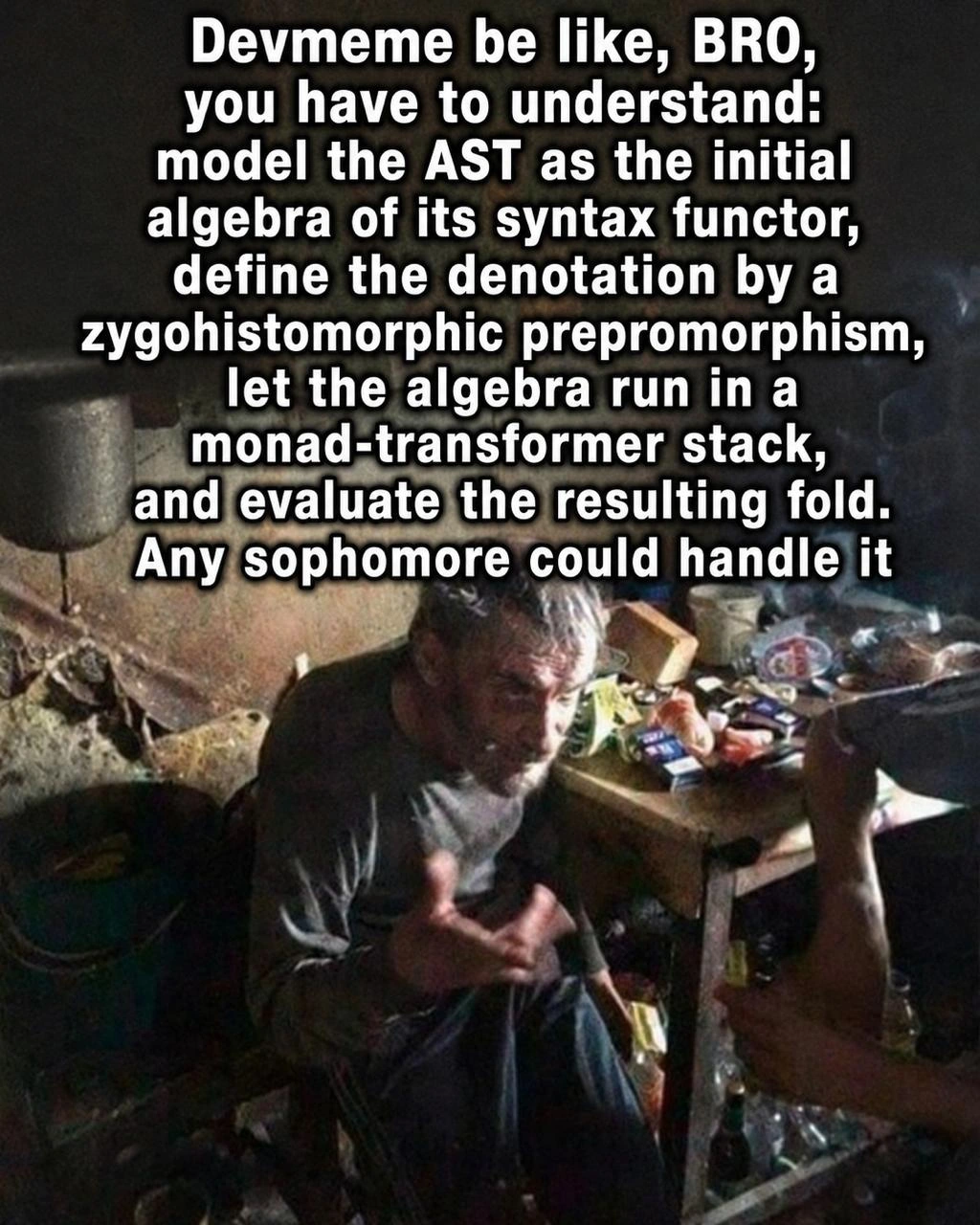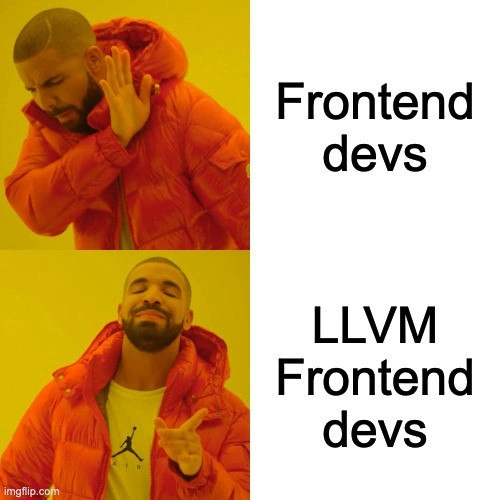
Drake prefers LLVM frontend devs over regular web frontend developers
Why is this Compilers meme funny?
Level 1: Frosting vs Baking
Imagine two people working on a cake. One person’s job is to decorate the cake – they put on the frosting, add sprinkles, and make it look really pretty on the outside. The other person’s job is to bake the cake from scratch – they mix the batter, put it in the oven, and actually create the cake layers. Both are important to getting a yummy cake, but they’re very different tasks. Usually, you might think the decorating part is more fun and easier (because you see the immediate colorful result), and the baking part is harder (measuring ingredients, heat control, actually making the cake structure). Now, in the meme, the character Drake first makes a “no thanks” face at something and then a happy face at something else. The words he’s reacting to are “Frontend devs” and “LLVM Frontend devs.” Think of “frontend devs” like the cake decorators – they make the part of a product that you see and enjoy (like a website’s look). And think of “LLVM frontend devs” like the cake bakers – they work on the hidden, foundational part (like the programs that make other programs work). The funny part is Drake is behaving as if he doesn’t want the easier, more common job (decorating / making things look nice) and instead prefers the very hard, behind-the-scenes job (baking the cake / building the deep technology). It’s humorous because it flips expectations – most people would gravitate to the simpler task, but here Drake is portrayed as a connoisseur who only respects the really tough stuff. In simple terms, the meme is joking that making the inside workings (like baking the cake or writing a compiler) is cooler than making the outside look nice (like frosting a cake or designing a webpage). It’s a playful way to show admiration for the “invisible” hard work that we don’t usually see, and it makes people who understand both roles smile at how the comparison is made.
Level 2: From Buttons to Bytecode
Let’s break down the terms and the joke in simpler technical terms. Frontend developers (in the common sense) are the programmers who build the parts of software that users directly see and interact with. For example, a web frontend dev will create the layout of a website, style it with colors and fonts, and write code to handle when you click buttons or scroll through a page. This involves languages like HTML (for structure of the page), CSS (for styling and layout), and JavaScript (for interactive behavior). These developers worry about things like making the site look good on different screen sizes, responding quickly to user input, and ensuring the interface is user-friendly. If you’ve used a modern web app or a mobile app, frontend devs were the people who crafted that smooth menu animation or that neat form you filled out. Essentially, they build the “front face” of applications – the part that faces the user.
Now, LLVM frontend developers are something quite different. Here frontend is referring to the front part of a compiler. A compiler is a program that translates code from one form to another, typically from the code that a developer writes (high-level language like C++, Swift, or Rust) into the low-level instructions that a computer’s hardware can execute (machine code or an intermediate bytecode). Compilers are often split into two major parts: a frontend and a backend. The frontend of a compiler handles understanding the source code. It reads in the text of a program, checks for errors (for example, syntax errors or type errors), and then converts that code into an intermediate format. In the context of LLVM, this intermediate format is usually the LLVM IR (Intermediate Representation), which is sort of a generic low-level code that isn’t specific to any one machine type. The backend of the compiler will later take that IR and turn it into actual machine-specific code (like x86 assembly for your PC, or ARM instructions for a phone).
So an LLVM frontend dev is someone who writes or maintains the part of a compiler that deals with the source language and produces the LLVM IR. For instance, imagine you’re adding a new feature to a programming language (say a new loop syntax or a special kind of number type) – an LLVM frontend developer would figure out how to recognize that new syntax in the source code (that’s parsing) and how to represent it in the IR so that the back-end can handle it. They work with concepts like parsers (to read code structure), ASTs (Abstract Syntax Trees, which are like a structural map of the code), and code generation for IR. They might use tools and libraries from the LLVMCompilerInfrastructure to do this heavy lifting.
Now, here’s why the meme is funny: normally when someone says “frontend dev,” we think of the first kind (the web or app GUI developer). It’s a very common job and crucial for making all the interfaces we use daily. But the meme is joking that Drake (the character in the meme) doesn’t “approve” of that kind of frontend dev – instead, he approves of “LLVM frontend devs,” which is this much rarer, more specialized kind of developer. It’s a play on words. The humor comes from the juxtaposition: both are called “frontend devs,” but their day-to-day work is totally different. One is arranging buttons on a webpage; the other is implementing programming language features in a compiler.
To put it plainly, it’s comparing someone who builds front end user interfaces to someone who builds the front end of compilers. The meme assumes the viewer knows that these are two very different domains. If you do, the exaggeration that Drake prefers the obscure one (compiler frontends) over the common one (web frontends) makes you grin – it’s a bit like an inside joke among programmers. It suggests that compiler work is “cooler” or more hardcore. Of course, that’s subjective and said in jest. In reality, both roles require skill, just different kinds. One might be debugging why a <div> isn’t centered on the screen, the other might be debugging why the compiler’s parser isn’t recognizing a new syntax correctly. Both can be frustrating and rewarding! But the FrontendHumor in this meme exaggerates the difference for comic effect. If you’ve ever heard developers joking about “real programmers” versus “JavaScript developers,” this meme is tapping into that same stereotype in a light-hearted way.
For some additional clarity, let’s compare the two types of “frontend” side by side:
| Web UI Frontend Developer 🌐 | Compiler/LLVM Frontend Developer ⚙️ |
|---|---|
| Builds the user interface of a website or app – what the user sees and clicks. | Builds the language interface of a compiler – how source code is understood by the computer. |
| Works with HTML, CSS, JavaScript, and frameworks like React or Angular. | Works with C/C++ (to write the compiler), language grammars, and LLVM libraries. |
| Focuses on design, layout, and user experience. E.g., making buttons, menus, and forms look and feel good. | Focuses on syntax, semantics, and code generation. E.g., writing a parser for a new language feature and producing correct IR. |
| Tools might include a browser dev tools, design software, and lots of testing on different browsers/devices. | Tools include compiler compilers (like parser generators), debuggers for low-level code, and lots of terminal work. |
| Example task: Making a responsive navigation bar that works on mobile and desktop. | Example task: Implementing support for a new keyword in a language by modifying the compiler’s source code. |
In the meme’s two panels, Drake is essentially saying: “No, not that kind of frontend dev” to the first column, and “Yes, that’s the cool frontend dev” to the second column. It’s a tongue-in-cheek way to poke fun at how broad the term frontend can be. If you’re new to these concepts, don’t worry – the main takeaway is just that the same word is being used for two very different jobs, and that contrast is the joke. People who get it will nod and laugh because they’ve perhaps thought about this difference before (or maybe they are one of those two types of devs!). It’s a little bit of community humor among programmers.
Level 3: Front-End Feud
From a senior developer’s perspective, this meme is a playful jab at the contrast between two very different kinds of “frontend” work. In the top panel, Drake is rejecting frontend devs, by which we mean the usual FrontendDevelopment role – the folks who build user interfaces for websites and applications. In the bottom, he’s enthusiastic about LLVM frontend devs, meaning engineers who write the front-end of compilers (like the part of a C++ or Rust compiler that handles parsing and code generation into an IR). Why is this funny? It plays on a bit of developer culture and mild elitism: there’s a stereotype in programming that building compilers (and working close to the metal) is hardcore, while building web UIs with HTML/CSS is, unfairly, seen as “less technical.” So here we have Drake – a meme symbol for approval – essentially validating that bias in a tongue-in-cheek way. Experienced developers recognize this DeveloperHumor instantly: it’s the age-old frontend vs. “real” programming debate, distilled into two panels.
In practice, both web front-end and compiler front-end work are challenging but in different ways. Seasoned devs know that making a complex web app isn’t trivial – you wrestle with browser quirks, asynchronous user events, performance tuning, and a constantly evolving ecosystem of frameworks. However, they also know that writing a compiler is a deep dive into computer science theory, requiring knowledge of things like parsing algorithms, type systems, and low-level machine behavior. The meme leans into the notion that the compiler work is more “elite.” It’s the kind of joke a compiler guru might share to gently flex their niche skills, or that a team might laugh about when joking around: “Oh, you fix CSS bugs? Well, Bob over there writes LLVM passes in his sleep.” 😏
The Drake format itself is a well-known template in memes (often used in meme_comparison contexts): one frame to disapprove of something, another to approve of something else. By plugging in “Frontend devs” vs “LLVM Frontend devs,” the meme delivers its punchline through subtext. As experienced programmers, we see Drake’s dismissive hand implying “just regular frontend? Nah” and his pointing finger saying “now that’s a frontend dev!” The humor works because of the double meaning of frontend. If you’re in the know, you immediately think, “Haha, not all frontends are created equal.” It resonates especially with those familiar with Compilers or who remember their college compiler class (and perhaps the iconic Dragon Book, used to slay the dragon of parsing). It’s a little nod of respect to the compiler folks wrapped in the format of a relatable meme.
We’ve also likely encountered this front-end feud in real life. In companies, the UI engineers and systems programmers inhabit different worlds (and tech stacks). Imagine a senior C++ engineer teasing their colleague who works in JavaScript about “real programming” – it’s usually in jest. Conversely, any frontend web dev might joke that the systems dev couldn’t make a decent-looking webpage if their life depended on it. This meme definitely takes the side of the low-level compiler crowd for comic effect. It’s not meant to be taken too seriously; even the most battle-scarred backend dev knows aligning a complex CSS grid can be its own kind of nightmare. But the shared understanding is: writing a compiler frontend (like generating LLVM IR for a new language feature) is an esoteric skill few have, whereas just saying you’re a frontend developer typically implies working on user interfaces – a much more common, almost ubiquitous developer role in the age of web apps.
So when an experienced coder sees “LLVM Frontend devs” getting the Drake thumbs-up, they chuckle at the implied one-upmanship. It’s reflecting an inside joke among developers about what’s considered hardcore. This is classic tech humor where the punchline is “my tough problem is tougher than your tough problem.” And truth be told, there’s some genuine awe mixed into the joke – a senior developer knows that under the hood of every high-level programming language (the stuff everyday devs use) there are these brilliant compiler mechanisms. Seeing Drake prefer the compiler guru is an acknowledgement of that complexity. In summary, the meme humorously contrasts the two worlds of front-end: the flashy world of UI development and the nerdy underworld of compilers. It gets a knowing grin from those of us who appreciate both sides, even as we laugh at the idea that Drake can tell the difference. After all, as the saying goes among devs, “Not all frontends are equal – some deal with div tags, others deal with DAGs.” 😄
Level 4: Source-to-IR Alchemy
At the deepest technical level, this meme riffs on compiler architecture and the dual meaning of frontend. In compiler design, a frontend is the stage that transforms high-level source code into a lower-level Intermediate Representation (IR). For example, an LLVM compiler’s front-end will perform lexical analysis (turning raw text into tokens), parsing (building an Abstract Syntax Tree out of those tokens according to the language’s grammar), semantic analysis (enforcing rules like type checking), and finally IR generation. The mention of LLVM (the LLVM Compiler Infrastructure project) is key here. LLVM is a modular compilation framework: you can write a front-end for any programming language to output LLVM’s universal IR, and then LLVM’s back-end will optimize it and produce machine code for various architectures. An LLVM frontend developer is someone who works on these first phases of a compiler. They might be implementing a new programming language or adding features to an existing one by writing code that translates source language constructs into LLVM IR. For instance, a developer working on Clang (LLVM’s C/C++ front-end) needs to handle C++20’s new syntax in the parser and map it to correct IR. This involves deep knowledge of CompilerDesign: formal grammars (often written in something like EBNF or using parser generators), AST data structures, and possibly even the mathematical properties of LLVM’s IR (which is in Static Single Assignment form, a property that simplifies optimization algorithms). In short, being an LLVM front-end dev requires comfort with theory and low-level details – from understanding how recursion and loops are represented in IR to dealing with memory addresses and CPU registers eventually. The humor here comes from that heavy-duty Compilers knowledge being contrasted with what “frontend” usually means in a more everyday context (web interfaces). It’s a bit of insider TechHumor: the term frontend in computing actually predates web development – it originally described the front half of compilers and other systems – but today it’s largely associated with websites and apps. By implicitly elevating LLVM IR wizards over web UI builders, the meme taps into the mystique of low-level programming. It’s like saying, “Sure, making a slick webpage is cool, but have you tried implementing a whole programming language?” The joke lands because of this almost absurd comparison: generating optimized machine code via LLVM feels like black magic (hence “Source-to-IR alchemy”), so Drake gives it the nod of respect in the second panel.
Description
Two-panel Drake meme on a yellow background. In the top panel, Drake (face pixelated) raises his left hand in rejection while facing away from the right-hand text that reads "Frontend devs" in large black letters on a white background. In the bottom panel, Drake (still pixelated) smiles and points approvingly toward the right-hand text that reads "LLVM Frontend devs" in the same black font. The joke hinges on the dual meaning of “frontend”: typical web UI engineers versus compiler front-end authors who generate LLVM IR, poking fun at how the latter are implicitly deemed more hard-core. The meme resonates with developers familiar with compiler architecture and the LLVM toolchain while riffing on everyday web-frontend stereotypes
Comments
6Comment deleted
Two kinds of frontend engineers: one debates Tailwind vs CSS-in-JS, the other debates whether their SSA still dominates after inlining - same title, radically different stack traces
The only frontend where "undefined behavior" is a feature, not a bug report from QA
The real frontend developers are the ones who parse your code before it even thinks about rendering a button. While web frontend devs argue about React vs Vue, LLVM frontend devs are casually implementing entire programming languages over coffee, turning source code into IR like it's just another Tuesday. They don't deal with CSS specificity wars - they deal with type systems, symbol tables, and making sure your pointer arithmetic doesn't summon undefined behavior demons
I’ll take the frontend where DOM means the dominator tree, repaints are instruction scheduling, and hydration is just register allocation
Reject pixel-pushers; approve the frontend that turns template metaprogramming nightmares into optimized IR
Say “frontend” and two teams show up: one debates CSS-in-JS, the other IR and undefined behavior - both blame the backend, only one can actually crash it