Skip to content
DevMeme
953 of 7435
TypeScript Confronts Its JavaScript Origin
Languages Post #1076, on Feb 29, 2020 in TG

TypeScript Confronts Its JavaScript Origin

Why is this Languages meme funny?

Level 1: Same Person, Better Helmet

This is like someone putting on a serious costume and telling their younger sibling, “You are messy,” only for the sibling to answer, “I am literally you.” TypeScript looks stricter and more grown up, but underneath it still comes from JavaScript, so the joke is that it cannot fully escape the thing it is making fun of.

Level 2: Static Mask, Dynamic Bones

JavaScript is the language that runs natively in web browsers and commonly runs on servers through Node.js. It is dynamically typed, which means values carry types at runtime and variables can hold different kinds of values over time. That flexibility is useful, but it can also let simple mistakes hide until the code actually executes.

TypeScript is a superset of JavaScript. Developers write TypeScript, a compiler checks the types, and then the result becomes JavaScript. That is why the TS character can act superior: it provides tools JavaScript does not require by default, especially for bigger applications where many people change the same code.

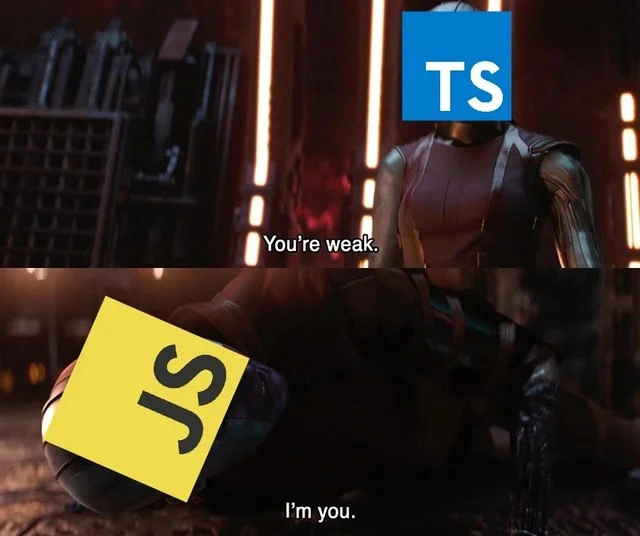
The meme’s visual elements map neatly onto that relationship. The standing armored figure with the blue TS logo represents TypeScript’s confidence: safer APIs, better editor autocomplete, cleaner refactoring. The fallen figure with the yellow JS logo represents JavaScript’s reputation for loose typing and odd behavior. But the fallen figure says, “I’m you,” because TypeScript is built directly on JavaScript rather than replacing it.

Level 3: Typed Family Drama

You’re weak.

I’m you.

The meme uses the Darth Vader-style confrontation to stage TypeScript as the intimidating successor and JavaScript as the wounded origin story. The TS logo says “You’re weak,” but the JS logo’s reply is the important part: TypeScript can judge JavaScript’s looseness all it wants, yet it still compiles to JavaScript and runs on JavaScript engines. That is the delicious little family secret behind every language-war victory lap.

For senior developers, the humor is not “TypeScript bad” or “JavaScript bad.” It is the tension between static typing and inherited runtime reality. TypeScript catches many mistakes before code runs: misspelled properties, impossible unions, wrong function arguments, forgotten null cases if the project is configured seriously. But after compilation, the browser or Node.js is still executing JavaScript. The runtime still has prototypes, coercion, undefined, weird historical compatibility behavior, and every library boundary where types may be incomplete, stale, or just aspirational documentation wearing a badge.

That is why the line “I’m you” stings. TypeScript improves the development experience and raises the floor for code quality, especially in large frontend systems, but it does not erase JavaScript’s semantics. It puts guardrails around the road; it does not rebuild the mountain. The painful real-world version appears when a codebase has any everywhere, generated API types that do not match production responses, or a third-party package whose declarations say “trust me” with the confidence of a deploy on Friday afternoon.

The deeper industry joke is that teams often adopt TypeScript hoping for discipline, then configure it to avoid discomfort. strict mode gets postponed, as unknown as becomes a ritual, and suddenly the “strongly typed” codebase is JavaScript wearing a blazer. TypeScript is powerful, but it is not magic. It rewards teams that treat types as design constraints, and it politely looks away when teams use them as decorative comments.

Description

A two-panel Darth Vader-style meme shows a dark armored figure with a blue "TS" TypeScript logo over the head saying "You're weak." In the lower panel, a fallen figure with a yellow "JS" JavaScript logo replies "I'm you." The humor comes from TypeScript criticizing JavaScript despite being built on JavaScript's runtime semantics, adding static type tooling while still inheriting much of the ecosystem's behavior and baggage.

Comments

1
Anonymous ★ Top Pick TypeScript did not kill JavaScript's ghosts; it just made them pass CI before haunting production.
  1. Anonymous ★ Top Pick

    TypeScript did not kill JavaScript's ghosts; it just made them pass CI before haunting production.

Use J and K for navigation