The Pandemic as the Ultimate Cursed Jira Ticket
Why is this ProjectManagement meme funny?
Level 1: The Elephant on the To-Do List
Imagine you have a really big chore written on your family’s to-do board, like “Clean the entire house top to bottom.” It’s super important – the house is getting messier each day. But the task is so huge and scary that every time someone walks by the list, they pretend they didn’t see it. Maybe Mom wrote “URGENT” next to it with a red marker, but still nobody starts doing it. A couple of smaller easy things under it got done (like someone picked up a few toys in the living room – at least we admitted the house is messy). But the big parts – like warning everyone to stop making messes and actually deep-cleaning every room – those are still not done. Now it’s months later, the chore has been there since last year, and the house is in even worse shape (even the family piggy bank broke because of the mess!). Everyone knows it needs to be done, but it’s such a huge problem that everyone is afraid to even try. The joke in the meme is just like this: it’s funny in a scary way because the pandemic was a giant problem that sat around with people hesitant to tackle it decisively, kind of like a big chore nobody wants to start. It makes us chuckle and cringe because we’ve all seen situations where something really important doesn’t get done simply because it’s so daunting that everyone hopes someone else will handle it.
Level 2: Backlog 101 – Big Task, No Takers
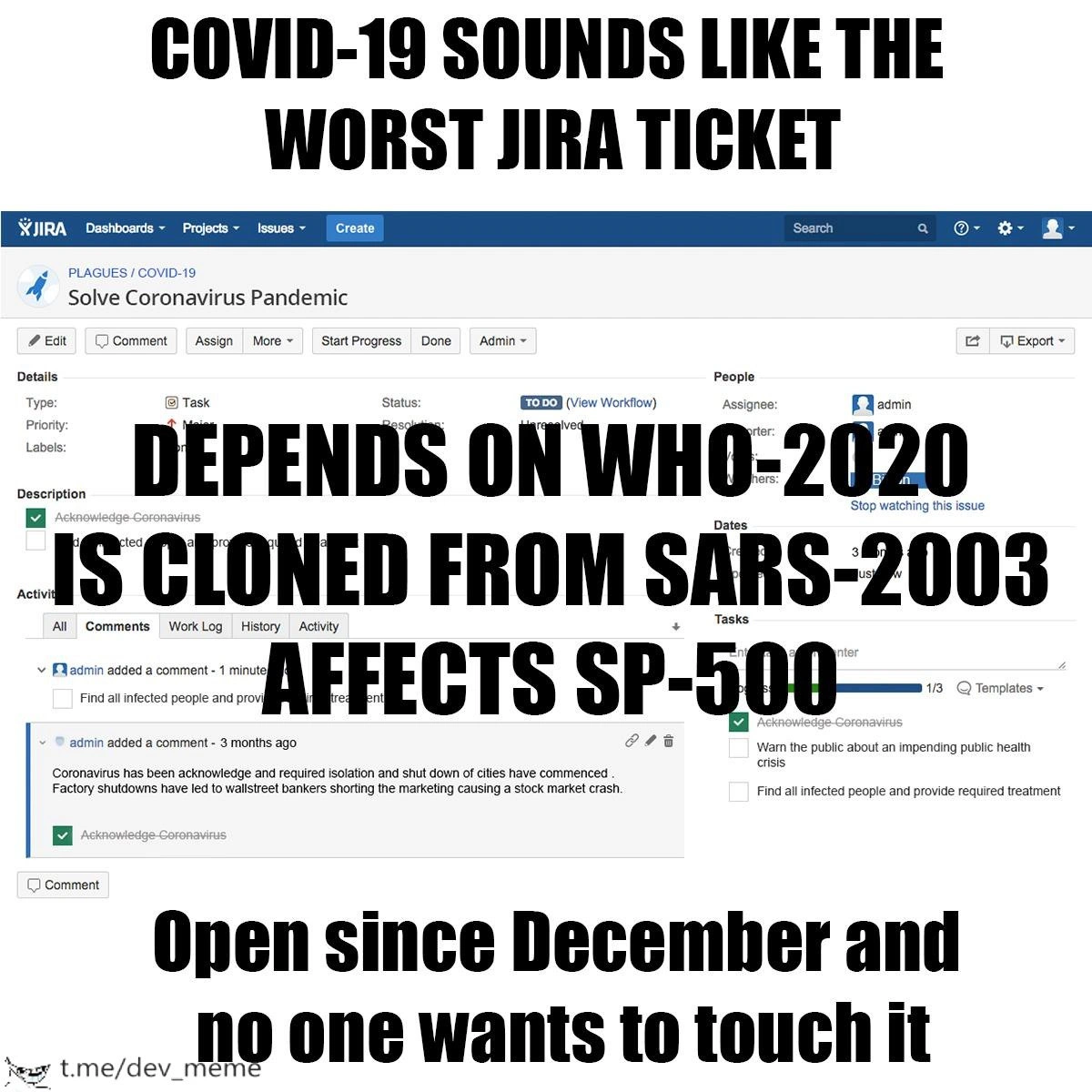
Let’s break down the joke in simpler terms. Jira is a popular tool software teams use to track work. Think of Jira as a big digital TODO list where each task or issue is a “ticket” that someone can be assigned to work on. In an Agile workflow, teams regularly review this list (a process called backlog grooming or triage) to prioritize what to do next. High-priority issues are supposed to be tackled quickly. However, in reality, some tickets just sit there for a long time – especially if they’re complicated or unpleasant. This meme imagines the COVID-19 pandemic as one of those nagging high-priority tickets that’s been open forever because nobody wants to deal with it.
In the meme’s screenshot, the title of the Jira issue is “Solve Coronavirus Pandemic.” That immediately sets the tone – it’s a hilariously oversimplified description of an enormous real-world problem. The issue type is “Task,” as if curing a pandemic is just a normal work item. The priority is set to “Highest,” meaning it’s super important (no surprise, since millions of lives are at stake!). The status is TO DO, which means it hasn’t been started yet. And the assignee is “admin,” which is basically a placeholder user (often “admin” is the default account or someone who manages the system). If a ticket is assigned to admin rather than a specific person, it’s basically unassigned in spirit – nobody has taken ownership. So the most important task in the world is sitting unworked, assigned to nobody. That’s the first layer of humor: a Highest-priority item that’s been idle for months – a scenario all too familiar in poorly managed projects.
The big black text at the top says, “COVID-19 SOUNDS LIKE THE WORST JIRA TICKET.” This means developers see the pandemic as the ultimate bad ticket: huge scope, urgent priority, global impact, and still unresolved. It’s worst-case scenario for a backlog item. Usually, a “worst” Jira ticket might be one that’s extremely hard to fix or causes a lot of pain; here it’s literally a life-or-death issue. The text is in all caps, exaggerating how glaring this ticket is.
The middle text block, “DEPENDS ON WHO 2020 / IS CLONED FROM SARS-2003 / AFFECTS SP-500,” uses Jira jargon:
“Depends on WHO-2020” implies this issue has a dependency link to another issue (like “we can’t complete this until that is done”).
WHO-2020appears to reference the World Health Organization in the year 2020, meaning probably a task or decision that WHO must do. It’s as if the team logged a separate ticket for “WHO response 2020” and our COVID ticket is blocked by it. In plainer words, the team is waiting on the WHO before they act. This is poking fun at real life, where everyone was waiting for the WHO to declare a pandemic or give guidelines.“Cloned from SARS-2003” suggests this Jira issue was created by cloning an older issue from 2003 about SARS (another coronavirus outbreak). In Jira, cloning is copying an issue including its details. By saying COVID-19 is cloned from SARS-2003, the meme highlights the similarity between the 2003 SARS epidemic and the 2019-2020 COVID outbreak – almost as if we copied the old problem into a new one instead of truly solving it back then. It underscores how history repeats itself in a funny tech way.
“Affects SP-500” uses the Jira idea of an “Affects” field (usually used to note which software version or component is impacted by a bug) but here
SP-500clearly alludes to the S&P 500, a stock market index tracking 500 large companies in the US. So it’s saying this issue affects the stock market. This is a humorous way to acknowledge the pandemic’s economic impact. In a normal bug ticket, “Affects: Production” might mean it affects the live site; here the entire economy is “production” and it’s on fire.
Finally, the bottom caption reads, “Open since December and no one wants to touch it.” This is pretty straightforward: it means the issue was created back in December (2019, presumably, since that’s when COVID-19 started appearing) and it’s still open now (in 2020) because no one wants to take responsibility. In a dev team, when a ticket is nasty or intimidating (like rewriting a huge piece of code or fixing a deeply rooted bug), team members might avoid picking it up. People might say “I don’t want to touch that one” because they know it’s going to be troublesome, time-consuming, or risky. Here, “no one wants to touch it” is ironically underlining that no one in the world had solved the pandemic for months; it was a growing crisis that, at that time, felt like it wasn’t being aggressively addressed. It’s dark humor because obviously many people wanted to solve it, but the progress was slow and hesitant – much like a stalled project.
The sub-tasks listed are mini-steps under that main Jira issue. Teams break big tasks into sub-tasks to tackle them piece by piece:
- “Acknowledge Coronavirus” – This sub-task is checked off as done. Essentially, they’re saying “Step 1: admit there’s a problem” was completed. In real life, by February 2020 most countries had acknowledged COVID-19 as a real issue (after some initial downplaying). So at least the awareness part happened.
- “Warn the public about an impending public health crisis” – This one is not checked, meaning it’s still pending. This part of the plan was arguably fumbled in many places (warnings were delayed or unclear). The meme highlights that the public warning/alert stage was effectively not done in time. In Jira terms, the team hasn’t finished that task, which is bad because you’d normally warn people early in a crisis.
- “Find all infected people and provide required treatment” – Also not done, and it sounds almost impossible. That’s like the ultimate goal: test and treat everyone who has it. By that date, testing was very limited, and there was no established treatment for all. In a project sense, that sub-task is so huge and open-ended (find all infected? treat everyone?) that no wonder it’s unfinished. In agile practice, you’d normally break that down or mark it as an epic itself, but the joke is that it’s just sitting there as a single line item – daunting and untouched.
The comment from admin (the one who is supposedly in charge of the issue) basically narrates what had happened so far. It reads: “Coronavirus has been acknowledged and required isolation and shut down of cities have commenced. Factory shutdowns have led to Wall Street bankers shorting the market causing a stock market crash.” This is written in a dry, status-update style, which is funny because it’s describing very dramatic real events in the bland tone of a project update. It’s similar to a developer writing an update on a bug like, “We rolled out patch v1, which fixed the login issue but led to high CPU usage on the server, so now users can’t load pages.” Here the admin is saying: we acknowledged the virus and started quarantines (isolation, city shutdowns), but that caused factories to stop, which caused investors to panic (shorting the market), and thus the stock market crashed. It’s effectively documenting a side effect of the attempted fix. Developers find this amusing because it mirrors what happens with complex bugs: you try a fix and it triggers another bug elsewhere. The pandemic response fixed one problem (slowing the virus spread) but created another (economic downturn). In Jira, people often leave comments to track these twists and turns while solving an issue.
So, taken together, the meme is a multifaceted joke:
- It’s Agile humor because it uses the context of Agile project management (tickets, backlogs, sprints not explicitly shown but implied).
- It highlights project management failings: critical item not executed despite being top priority.
- It touches on corporate culture and bureaucracy: depending on committees (WHO), worrying about the stock market while the main task isn’t done, and assigning big problems to “admin” (meaning no real owner, possibly hinting at governments or higher-ups passing the buck).
For a junior developer or someone new to this: think of a time you had a group assignment and one huge task was so daunting that everyone avoided it – that’s what “no one wants to touch it” means here. In software teams, if something is beyond one person’s skill or outside everyone’s comfort zone, it can sit idle while smaller, easier tasks get done first. Unfortunately, with something like COVID-19, there are no smaller tasks that will solve it – you have to tackle the big scary ones. That contrast – treating a massive crisis with the same tools and attitudes as a small bug fix – is what makes the meme funny and a bit painfully real. Developers laugh because we’ve seen issues handled exactly this poorly (if on a smaller scale), and non-developers can relate too, because it feels like 2020’s real “project” management was indeed chaotic.
Overall, the meme uses the JiraTickets metaphor to convey frustration and irony about how the pandemic was handled, all in a format that tech folks immediately recognize. If you’ve ever used Jira or worked in Agile teams, you’ll get the layered references. It’s basically saying: “This pandemic would be just another backlog item in our sprint board – and we’d probably bungle it just like this.” It’s a bit of a cynical laugh at ourselves and our institutions, wrapped in project management parody.
Level 3: Pandemic Backlog Blues
At first glance, this meme looks like a standard JIRA issue screen, but it's actually turning the COVID-19 pandemic into a software project ticket. It’s dripping with dark Agile humor and corporate culture satire. Imagine opening your organization’s JIRA board and finding a task labeled “Solve Coronavirus Pandemic” — that’s the joke. In this fictional ProjectManagement nightmare (project code PLAGUES/COVID-19), the entire global crisis is just another Jira ticket in the backlog. And of course, it’s been rotting in TO DO status since December with Highest priority, yet no one wants to touch it. Sound familiar? This is poking fun at those AgilePainPoints where the most critical tasks linger undone because they’re too overwhelming or politically charged.
The overlay text riffs on JIRA lingo to connect real pandemic details with issue-tracker speak:
“DEPENDS ON WHO-2020” – In JIRA, one issue can depend on another. Here it implies the plan is blocked waiting on
WHO-2020(a nod to the World Health Organization 2020 response). It’s a cheeky way to say “we can’t start until WHO does something.” Seasoned devs recognize this as a classic excuse: blocked by an external dependency. In the real pandemic, many governments waited on WHO’s declarations, just like a team waiting for an upstream task to finish. It’s a sly reference to bureaucratic dependency.“Cloned from SARS-2003” – JIRA lets you clone issues. The meme suggests COVID-19 is a clone of the 2003 SARS outbreak. Technically, SARS-CoV-2 (the virus causing COVID-19) is related to SARS-CoV-1 from 2003, so scientifically it’s like a copy with tweaks. In project terms, someone probably hit “Clone issue” on the old SARS ticket (
SARS-2003) to create this one. It’s darkly funny because it implies we’ve seen this bug before (the SARS epidemic), but apparently we resolved that one and forgot the lessons, so now the clone issue is back with a vengeance. Tech history often repeats — just like old bugs reappear when code is copied, old epidemics come back in new forms.“Affects SP-500” – In issue trackers, “Affects Version/Component” denotes what systems are impacted. Here
SP-500looks like a system code, but it’s actually the S&P 500 stock index. The meme jabs at the fact that the pandemic tanked the stock market (in early 2020 the S&P 500 fell sharply). So they listed the economy itself as an affected system. It’s like saying this bug affects everything from health to finance. CorporateCulture tie-in: executives always worry about the stock market, so of course the ticket notes that the S&P 500 is impacted!
The core humor is that this worst_ticket_ever is treated with the same process as a software bug, exposing how inadequate that is. It’s labeled a simple “Task” with one assignee (the poor admin user – basically “someone else”). In reality, solving a pandemic isn’t a one-person job, but how often do we see a colossal task unfairly dumped on a single engineer or team? The BacklogGrooming failure here is relatable: the issue’s been open since December (early reports of COVID-19 surfaced in December 2019) and by February nobody has moved it. In Agile terms, this should have been an Epic (a big project broken into stories) or even a multi-team program. Instead, it’s languishing as a single to-do item. This lampoons those impossible JiraTickets that everyone avoids because they’re career-endingly huge or hopelessly vague.
Look at the sub-tasks on the right in the meme:
- “Acknowledge Coronavirus” – Checked off. They at least admitted the problem exists (perhaps a dig at initial responses that were slow just to acknowledge the threat). In dev terms, this is that trivial first step a team does – like writing a wiki page or email about the bug – low effort, minimal progress. It’s the easiest sub-task, so of course someone did it and promptly stopped there.
- “Warn the public about an impending public health crisis” – Unfinished. This clearly should have been done early, but it’s sitting unchecked. This parallels how some authorities delayed public warnings. In project terms, the team procrastinated on the hard but urgent step.
- “Find all infected people and provide required treatment” – Unfinished. The biggest, hardest part is left untouched, which is sadly true: by Feb 2020 there was no widespread testing or treatment for everyone. This sub-task is gargantuan, almost absurd – it’s like a user story with no hope of being completed in one sprint (or by one team, or one admin!).
The single comment by admin is pure gallows humor. It reads like a progress update from a harried project manager: they’ve started isolations and city lockdowns, but that led to factory shutdowns, which led bankers to short the market, causing a crash. In other words: we tried a partial fix and broke something else. Any senior engineer knows this story: you deploy a quick fix for a big bug, and it causes a cascade of other failures (side effects, regressions, new bugs). Here the “fix” for the virus (lockdowns) triggered an economic bug (market crash). Depends on who 2020 is cloned from sars-2003 affects sp-500 – the whole chain of cause and effect is encapsulated in that comment. It’s a grim parody of how complex problems have interconnected outcomes, which an ordinary Jira ticket can’t really capture. The tone is cynical: “we did X like you asked, now Y blew up. Great, now the ticket is even harder.”
This meme hits home for developers because it frames a global disaster in terms of familiar workplace frustrations:
- Long-lived tickets that nobody wants to own (especially those opened by “somebody upstairs” and left to rot).
- The absurdity of treating an epic crisis as a neatly trackable Agile project. (Stakeholders asking “Why isn’t it done yet? It’s priority Highest!” sounds like those product managers who think anything can be solved if it’s just labeled important.)
- Deadline pressure vs reality: By February 2020, the real pandemic felt like a ticking time bomb, akin to a ticket past its due date with escalating urgency. Devs joke that “Open since December” with no progress is a management failure – here that failure has global consequences.
- The meme underscores how corporate bureaucracy might handle a plague: committees (dependencies on WHO), documentation (acknowledge it), but slow action on the real fix (finding & treating everyone). It’s laughing so we don’t cry; we recognize the pattern of inefficient process in the face of dire issues.
In summary, this darkly funny image uses our everyday project-management language to highlight a colossal ProjectManagementHumor fail. It resonates because we’ve all seen critical issues mishandled in bureaucratic ways. COVID-19 as a lingering Jira ticket is a perfect storm of AgilePainPoints: huge scope, unclear ownership, external blockers, and catastrophic impact – the kind of ticket that gives every veteran engineer PTSD. It’s the Worst. Ticket. Ever.
| Jira Field | Real-World Referent |
|---|---|
| Project: PLAGUES/COVID-19 | A tongue-in-cheek project for global pandemics (as if “Plagues” is an official program with COVID-19 as one task) |
| Issue Type: Task | Treated as a normal task, though it’s truly an Epic (massive project) masquerading as a single to-do |
Status: TO DO |
Still not started; the pandemic problem is known but no active mitigation at this point |
| Priority: Highest | It’s marked critical (P0), yet somehow it’s still sitting open – highlighting the disconnect between priority and action |
| Assignee: admin | Assigned to “admin” (likely a default user or sysadmin). Essentially, nobody specific is working on it. It’s like leadership saying “someone will handle it” but no owner is truly assigned |
Depends on: WHO-2020 |
Depends on World Health Organization’s 2020 actions. In JIRA, this would be a blocking issue. In reality, it means the team can’t proceed until WHO declares info or takes lead. A built-in excuse for inaction |
Cloned from: SARS-2003 |
The COVID-19 issue is a copy of the SARS 2003 outbreak issue. A witty way to remind us this scenario isn’t new; we had a similar “ticket” in 2003 (SARS), and now it’s duplicated with COVID-19 |
Affects: SP-500 |
Affects the S&P 500 stock market index. Instead of a software version or component, the impacted system is the global economy. A funny exaggeration but also true – the pandemic crashed markets |
| Sub-task: Acknowledge Coronavirus (✔️ done) | Admit the problem exists. This trivial step is done, akin to creating a Confluence page or initial report. Necessary but barely progress |
| Sub-task: Warn the public (❌ open) | Alert everyone about the crisis. Still open, meaning the warning either came late or is incomplete – reflecting criticism that public warning was delayed |
| Sub-task: Find and treat all infected (❌ open) | The herculean task of identifying and curing every case. It remains undone (as of early 2020, indeed impossible at that scale). In software, this is that gigantic sub-task no one even knows how to approach, so it stays undone |
This table shows how the meme cleverly maps JIRA fields to real-world pandemic elements. Each mapping is a punchline for those who know both worlds. The entire image is essentially a deadline pressure joke and an Agile parody rolled into one. It laughs at how corporations might try to manage even an act of nature with a ticket, and in doing so, it hits a nerve: sometimes our processes are comically insufficient for real-life problems.
Description
A multi-layered meme that presents the COVID-19 pandemic as a Jira ticket. The top text reads 'COVID-19 SOUNDS LIKE THE WORST JIRA TICKET'. Below is a screenshot of a Jira issue for the 'PLAGUES' project, with the ticket titled 'Solve Coronavirus Pandemic'. The ticket details are overlaid with humorous, bold text phrases: 'DEPENDS ON WHO-2020', referencing a dependency on the World Health Organization; 'IS CLONED FROM SARS-2003', mimicking the 'clone issue' feature in Jira; 'AFFECTS SP-500', indicating its impact on the stock market; and 'Open since December and no one wants to touch it', capturing the universal developer experience of a daunting, unwanted task. The Jira ticket itself shows details like 'Status: TO DO', 'Assignee: admin', and a comment from three months prior about the stock market crash. The humor stems from applying the mundane, bureaucratic framework of project management to a catastrophic global event, a satirical take that deeply resonates with any tech professional who has dealt with overwhelming and poorly defined tasks
Comments
5Comment deleted
That ticket has been in the backlog since December, has dependencies on every team, and the acceptance criteria is 'world peace'. No wonder no one's picked it up during sprint planning
The ‘Solve Coronavirus’ ticket started as a 3-pointer, mutated into an R₀-sized epic, and now nobody wants to drag it to In Progress because the global side-effects aren’t idempotent
Cloned from SARS-2003 with WHO-2020 deps? That's legacy tech debt even our most battle-hardened seniors won't touch without a full refactor epic
Classic enterprise agility: a Task titled "Solve Coronavirus Pandemic" with dependencies on WHO-2020, cloned from SARS-2003, affecting the S&P 500 - an epic so big the only workflow used is "Stop watching."
Peak Jira: “Solve Coronavirus Pandemic” - cloned from SARS‑2003, depends on WHO, affects S&P‑500, reproducible only in production, and the assignee is “admin” because nobody wants ownership