The Dunning-Kruger Curve of a Programming Career
Why is this Career HR meme funny?
Level 1: Master Chef, Burnt Toast
Imagine a person who went to a famous cooking school and learned to make the fanciest dishes – five-tier wedding cakes, gourmet sauces, and even those cool smoky molecular gastronomy recipes. They feel like a master chef when they finish school. But on the first day at a real restaurant job, the first thing they do is burn a piece of simple toast. 🍞🔥 It’s ironic and funny: despite all that high-level training, a basic task goes wrong!
This meme is making a similar simple comparison with programming. In school, our developer learned all the super-fancy “recipes” of coding – even Artificial Intelligence, which is like the fanciest recipe you can imagine. They felt like an expert ready to change the world. But when they started the actual job (the real kitchen), they stumbled on something really basic: a tiny bug in the code called a NullReferenceException (that’s like the burnt toast of programming mistakes). The joke is that all the advanced knowledge didn’t prevent a beginner mistake. It’s a bit like knowing how to build a rocket ship but forgetting how to ride a bicycle. 😂
So the funny part is the big contrast: very advanced skills on one side, and a simple error on the other. It reminds us that learning in theory is great, but doing things in real life can be a whole different challenge. The new programmer’s confidence went up, up, up… and then whoops, came tumbling down – just like our chef who has to laugh at himself while scraping off the burnt toast. The humor comes from that relatable “oops” moment when even a smart person can mess up something basic. It’s a friendly reminder to stay humble and be ready to learn from practical mistakes, no matter how smart you thought you were.
Level 2: Buzzwords vs Bugs
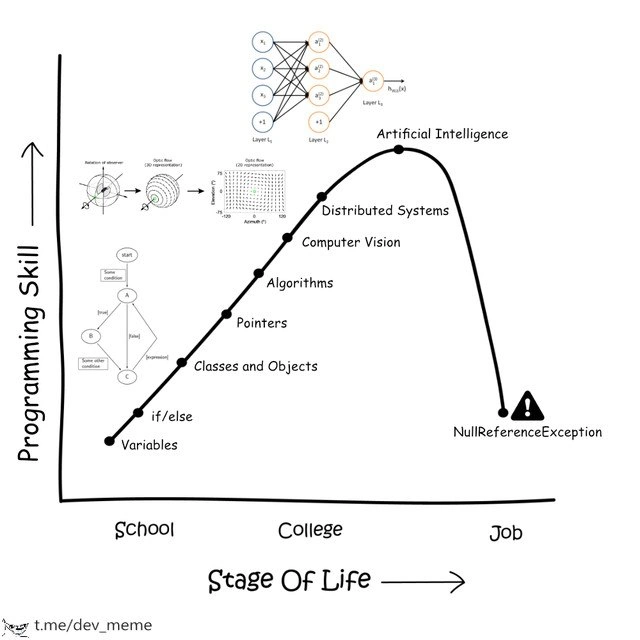
Let’s break down the journey shown in this meme. On the left we have “Programming Skill” going up, and along the bottom we have life stages: School, College, then Job. The cartoon plot shows a young programmer’s learning journey. In School, you start with the basics of coding:
- Variables – these are like boxes to store data (numbers, text, etc.). For example,
int score = 10;uses a variable namedscoreto hold the number 10. - if/else – the fundamental conditional statements that let programs make decisions. Think of
ifas asking a question (“Is this true?”) andelseas “If not, do something different.” e.g.,if (score > 100) { /* win game */ } else { /* keep playing */ }. - Classes and Objects – the building blocks of object-oriented programming. A class is a blueprint (say,
Car), and an object is an instance of that blueprint (your specificCarobject like myCar). In school, you learn to organize code by grouping related variables and functions into classes to model things. - Pointers – a more advanced concept usually encountered in low-level programming (like C or C++ classes). A pointer doesn’t hold a traditional value, but rather a memory address of another value. Think of it as a reference or an arrow pointing to where data lives in memory. For example, you might have a pointer to an integer. If that pointer doesn’t point anywhere valid (like it’s set to
NULL), then trying to use it is like following directions to a location that doesn’t exist – you’ll get lost (and so will your program, resulting in a crash). Pointers are powerful but can be tricky; they’re often the first time students see how a simple mistake can cause a program to blow up.
During College, the curriculum ramps up the complexity. You tackle:
- Algorithms – these are step-by-step solutions to problems. You learn classic algorithms (sorting a list, finding the shortest path in a graph, etc.) and analyze their efficiency (how fast or slow they are, often described with Big O notation like $O(n)$ or $O(n^2)$). This gives you foundation in problem-solving and efficiency.
- Computer Vision – a field of AI/ML (Artificial Intelligence / Machine Learning) where you teach computers to interpret and understand images or videos. You might have done a project where you use a convolutional neural network (CNN) to recognize handwritten digits or identify objects in pictures. It’s exciting and feels very “high-tech” because you’re making the computer do something seemingly intelligent (like seeing).
- Distributed Systems – this is all about how to make programs run on multiple computers (or servers) at once, communicating over a network. In a distributed systems class, you learn how big web services or databases work under the hood: how they handle multiple requests, keep data in sync across servers, and stay fault-tolerant (so if one machine fails, the system as a whole still works). You encounter terms like consistency, replication, maybe even the famous CAP theorem (which says a distributed system can’t guarantee Consistency, Availability, and Partition tolerance all at the same time – there’s always a trade-off).
- Artificial Intelligence – the peak of the academic mountain in this chart. AI is a broad field, but in college it often means learning about neural networks and machine learning algorithms. You get to play with things like a neural network diagram (like the one drawn in the meme) which has layers of “neurons” connected with weights. You learn how to train these networks with data (using methods like gradient descent). AI feels like the future; it’s powerful and complex, so reaching that point in your studies makes you feel like an expert programmer ready to create the next smart application.
So by the end of college, our budding developer has checked off a lot of buzzwords that make them sound super qualified. LearningCurve in the meme is steep – they’ve gone from “Hello World” to building an AI in a few years. Their “Programming Skill” (or at least their knowledge) appears to skyrocket.
Now comes the Job stage – the first gig as a professional developer. Here, the meme delivers the punchline: all that advanced knowledge, and on day one you’re confronted with a bug like NullReferenceException. Let’s clarify what that means. A NullReferenceException is an error typically seen in languages like C# (in Java it’s called NullPointerException) that basically says, “Hey, your code is trying to use something that isn’t there (null)!” It usually happens when you have a reference to an object that hasn’t been set. For example:
string message = null;
Console.WriteLine(message.Length);
In this C# snippet, we set message to null (meaning it points to nothing), and then we try to get its Length. The program will throw a NullReferenceException at that second line, because message isn’t an actual string object – it’s empty. You can’t ask “what’s the length?” of nothing, just like you can’t open a book that doesn’t exist. This is a very common bug in real programs! It often surprises new developers because it’s not a complex math error or a fancy AI issue – it’s a simple logical oversight.
The meme humorously suggests that when this new graduate starts their job, their programming skill “level” drops right down to that error. In truth, their knowledge isn’t lost, but it feels like starting over because working on production code introduces challenges they haven’t faced before. For instance, in college projects, maybe you never had to deal with someone else’s code or handle data that isn’t perfectly formatted. At work, suddenly you have to write code that checks “is this object null before I use it?” everywhere, because if you don’t, the application might crash and real users or customers are affected. It’s a huge shift in mindset: from solving contained homework problems to building robust, error-proof software.
So why does the curve plummet at NullReferenceException? It’s showing the gap between academic learning and practical skills needed in the real world. All those big topics like AI and distributed computing are great, but if you don’t know how to debug and fix everyday bugs in software, you’re in for a rough time initially. In a way, the meme is a lighthearted warning: “Don’t get cocky, kid. Real-world coding will challenge you in unexpected ways!” Every experienced dev remembers that first real-world vs academia reality check. It might be a trivial bug (like a null reference) that teaches you more about careful coding than any advanced algorithm did. It’s a normal part of the learning curve when transitioning from college to a professional developer role.
In summary, the meme lists impressive academic concepts one after another – Variables, if/else, Classes, Pointers, Algorithms, Computer Vision, Distributed Systems, Artificial Intelligence – to show how high the student’s confidence or perceived skill climbs. Then it jokes that in the real world job, the developer’s biggest challenge isn’t some sci-fi AI problem, but a basic runtime error: a NullReferenceException. It’s a funny way to say: “No matter what fancy things you learned, the basics can still trip you up!” And anyone tagging this with DeveloperHumor or AIHumor is poking fun at themselves too – we’ve all been there, thinking we’re hot stuff and then feeling totally lost by a simple bug. Don’t worry, it gets better with experience! You learn to combine those academic smarts with practical debugging skills, and then that curve starts climbing upward for real.
Level 3: AI Hype vs Null Reality
This meme nails a feeling every seasoned developer recognizes: the great reality check that hits when academic confidence meets real-world code. In school you conquer mountains of knowledge – from simple CS fundamentals to cutting-edge AI/ML topics – and you start to feel on top of the world (or at least on top of your class). By graduation, you’ve implemented fancy projects: perhaps a mini AI that recognizes handwritten digits, a toy distributed system that handles network messages, or optimized algorithms that impressed your professors. Your “Programming Skill” (or more accurately, your confidence level) is at an all-time high. The chart shows it climbing steadily through School and College, passing milestones like Variables, if/else logic, Classes and Objects (object-oriented programming), tricky pointers in C/C++, classic algorithms, then high-level domains like Computer Vision and Distributed Systems. At the very peak sits Artificial Intelligence – the crown jewel of modern computer science hype. By the time you’ve done AI, you feel like a wizard who’s cracked the code of the universe. It’s that “I can build the next big thing” optimism. Developer humor often teases this phase as riding high on the learning curve. It’s almost a rite of passage to be a little overconfident right after mastering tough concepts in school.
Then comes the first Job, and CRASH! – that soaring curve plunges straight down to ground reality. The meme labels that crash site NullReferenceException, marked with a warning triangle as if to say “Hazard ahead: Welcome to production debugging”. In practice, a NullReferenceException (or its Java twin, NullPointerException) is one of the most common bugs in software. It happens when your code tries to use an object that hasn’t been initialized — essentially nothing is there, and you’re treating it as something. In a classroom, you might have seen this once in a rushed assignment; in a real codebase, it’s a frequent facepalm. The joke here is that after conquering the lofty heights of AI, our new developer is utterly humbled by a basic null pointer bug. It’s the classic Real World vs. Academia smackdown.
Why is this funny (and a bit painful)? Because it’s too real. Every senior developer can recount watching a bright newcomer struggle with something “simple” like debugging a null reference, despite their impressive academic creds. It’s not that the newcomer isn’t smart — it's that real-world programming has messy edges that academic problems often gloss over. In college, your project’s scope is controlled; test cases are curated; you rarely deal with a ten-year-old legacy codebase where half the objects might be null in edge cases. Once you’re in a professional codebase, you discover that glamorous work (like training ML models or architecting distributed services) often takes a backseat to unglamorous tasks: reading other people’s code, writing unit tests, adding null checks, fixing off-by-one errors, and figuring out why on earth the deployment server throws exceptions that never showed up on your machine. This gap in expectations – academic vs. industry realities – hits hard. The meme sarcastically visualizes the developer confidence arc: you thought you were a genius, but now you’re a newbie all over again, faced with bugs that couldn’t care less about your GPA.
Notice the elements chosen: AI and Distributed Systems are buzzwords that have every student thinking they’ll revolutionize tech. But ask working developers what they wrestle with daily, and you’ll hear things like “Ugh, chasing a null reference crash” or “tracking down a memory leak” far more often than “implementing a novel machine learning algorithm.” The NullReferenceException here isn’t just a specific error – it’s a symbol for all those trivial-sounding but soul-crushing bugs (the ones that have you combing through logs at 3 AM). It’s an exclamation point (hence the ! icon in the image) on the lesson that book knowledge alone doesn’t make you a production-ready programmer.
Experienced devs chuckle at this because we’ve lived it. It reminds us of the Dunning-Kruger effect in action: in early learning stages, a little knowledge can inflate confidence hugely (climbing that steep curve), but real experience teaches humility (the sudden drop). The meme’s curve humorously resembles “Mount Stupid” (high confidence with limited experience) and the “Valley of Despair” (when you realize how much you don’t know). That precipitous drop into NullReferenceException-land? That’s the Valley of Debugging Despair. 😅 And guess what? Climbing out of that valley is where you truly grow as a developer.
The inclusion of NullReferenceException specifically is a tongue-in-cheek jab, likely familiar to anyone who’s worked with C# or Java. It’s practically a running joke: “It compiled fine, but then boom – NullReferenceException in production!” Entire comic strips and posts in the DeveloperHumor corner of the internet are dedicated to this exact moment. We laugh (perhaps a bit bitterly) because after all the high-minded academic stuff, so much of real development comes down to handling mundane errors and edge cases. The meme also subtly points out how academic curricula emphasize breadth and depth of concepts (from simple basics to AI within a few years), but industry learning is often about depth in practicality: debugging, maintenance, using frameworks, dealing with team legacy code, understanding customers’ vague requirements – none of which had a textbook checkpoint on that curve.
So the humor works on two levels: AI humor (poking at the hype that every problem magically needs AI) and plain developer humor (the absurdity that after all that hype you’re defeated by a null value). The phrase “crashing into NullReferenceException on the job” in the title says it all – it’s a crash figuratively and sometimes literally (program crashes). It’s a humbling initiation into the real world of software bugs. Seasoned devs laugh knowingly, juniors laugh nervously (knowing it could be them), and everyone learns not to underestimate those “simple” bugs ever again.
Level 4: Neural Networks vs Null Pointers
At the pinnacle of academia, our intrepid developer was grappling with the math of artificial intelligence and the intricacies of distributed systems. In college, they learned how a multi-layer neural network functions: layers of neurons taking weighted sums of inputs, applying activation functions (ReLU, sigmoid, etc.), and backpropagating errors with calculus-based optimizations. They studied convolution kernels sliding over images for computer vision, mastered shortest path and sorting algorithms with $O(n \log n)$ efficiency, even toyed with consensus algorithms for distributed nodes (think Paxos or Raft in a simulated cluster). These are heavy theoretical concepts — the kind that come with academic trophies and fancy project demos. In theory-land, everything is elegant: a neural network can approximate any computable function (the universal approximation theorem), and a well-designed distributed system can tolerate byzantine faults and network partitions (per the CAP theorem, you trade off consistency vs. availability under partitioning but you handle failures gracefully).
Yet, towering above all that theory is a little gremlin that theory classes scarcely prepare you for: the humble NullReferenceException. This error isn’t discussed in glossy research papers, but it’s the billion-dollar mistake Sir Tony Hoare warned us about – the legacy of allowing a “null” value in pointers/reference types. Academically, a pointer is just a variable holding a memory address. You learn to manipulate pointers to implement data structures or manual memory management. But one pointing to nothing (a null pointer) is a ticking time-bomb in code. Dereferencing it (accessing the object it’s supposed to reference) breaks the illusion: your program tries to find an object that isn’t there, often leading to a crash or exception. Formally, it's an invalid memory access – the runtime stops with a segfault or a thrown exception because you attempted to use an object that literally doesn’t exist in memory. No amount of linear algebra or distributed consensus theory can save you if you forgot to check for null.
In advanced type theory, some languages eliminate nulls entirely with option types (e.g. Haskell’s Maybe, Rust’s Option<T>). But in mainstream OO languages (like C# or Java), null is a phantom menace always lurking. It’s ironic: we can design a network of $n$ nodes to agree on a value in the presence of $f$ failures, but one forgotten null check in any one of those nodes’ code will bring the whole distributed system down just the same! We teach machines to learn patterns from data, but we still have to teach ourselves to handle a missing object reference. The meme’s curve peaks at Artificial Intelligence – symbolized by that neat neural network diagram – representing the theoretical zenith of the developer’s knowledge. But then the curve nosedives into the stark reality of a NullReferenceException. It’s a collision between lofty theory and low-level runtime error. In academic exercises, all inputs are neatly provided and systems are idealized; in reality, a single null can violate all your assumptions and send your fancy algorithm screeching to a halt. The academic vs industry disconnect could not be clearer: you might understand gradient descent or distributed transaction protocols, but the computer will still gleefully throw a NullReferenceException if you try to call .Length on a non-existent object. The laws of physics and computer science fundamentals always win: a null pointer dereference is a fatal error no matter how many AI papers you’ve read. This deep irony – that complex theory doesn’t exempt you from basic bugs – is exactly what the meme humorously captures.
Description
A graph illustrating the trajectory of a programmer's life and skills. The x-axis represents the 'Stage Of Life' (School, College, Job), and the y-axis represents 'Programming Skill'. The curve starts in 'School' with basic concepts like 'Variables' and 'if/else', showing a steady increase through 'College' with 'Classes and Objects', 'Pointers', 'Algorithms', 'Computer Vision', 'Distributed Systems', and peaking at 'Artificial Intelligence'. Along this upward slope, small diagrams illustrate the concepts, such as a simple flowchart for 'if/else' and a neural network diagram for 'AI'. After peaking, the curve plummets dramatically in the 'Job' stage, ending at a single point marked with a warning icon and the text 'NullReferenceException'. This meme humorously depicts the Dunning-Kruger effect in software development: the accumulation of complex theoretical knowledge in academia, followed by the harsh reality that even the most advanced skills are often defeated by simple, common errors in a professional setting. It's a cynical but relatable take on how production environments humble even the most educated engineers
Comments
7Comment deleted
You spend a decade learning about algorithmic complexity and distributed consensus, only to have your entire application brought down by a variable that someone forgot to initialize. Welcome to the show
I went from proving Paxos safety in grad school to discovering the real-world consensus algorithm: everyone agreeing that the NullReferenceException isn’t their microservice
Twenty years of experience taught me that the real distributed system is the null checks we scattered along the way
After years of mastering neural networks, distributed consensus algorithms, and computer vision pipelines, the seasoned engineer's most valuable skill becomes the ability to add '?.?' before every property access - because production taught them that theoretical knowledge peaks in college, but NullReferenceExceptions are forever
We promised AI; we shipped a distributed NullReferenceException - strongly consistent, highly available at 3 a.m., and guaranteed to partition your weekend
You can ship transformers and Raft, but the only thing achieving consensus in prod is every service agreeing to throw NullReferenceException - because null‑safety got pushed to “Phase 2.”
Skills peak at AI like Gartner's hype cycle, only to trough in prod's eternal NullRef - the real distributed fault