Skip to content
DevMeme
4064 of 7435
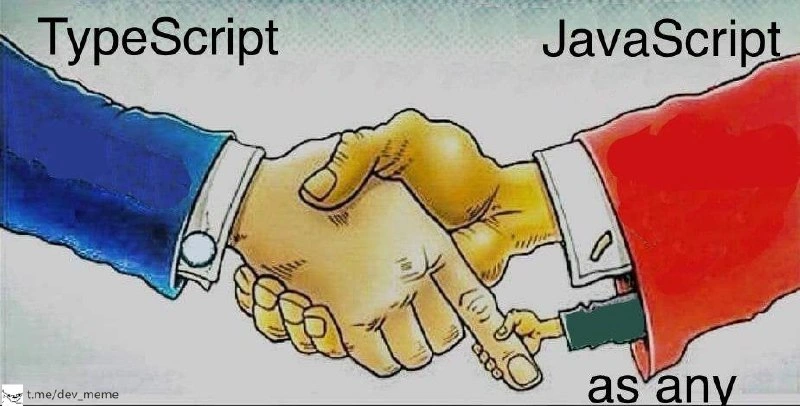
When TypeScript shakes hands with JavaScript, but `as any` is hiding a pistol
Languages Post #4432, on Jun 9, 2022 in TG

When TypeScript shakes hands with JavaScript, but `as any` is hiding a pistol

Why is this Languages meme funny?

Level 1: Betrayed by a Friend

Imagine you have a friend who promises to play by the rules, and you both shake hands on it. For example, say you agree to share candies only if you both ask permission – a fair deal to avoid any fights. But unbeknownst to you, your friend has their fingers crossed behind their back or a sneaky plan up their sleeve. As soon as you turn around, they grab a handful of candies without asking. That’s a bit like what’s happening in this meme.

Here, TypeScript and JavaScript are portrayed as two buddies shaking hands, meaning they’re supposed to cooperate to keep things safe and orderly. TypeScript is like the responsible friend saying, “Okay, we’ll follow the rules so no one gets hurt (no bugs in the code).” But JavaScript has a secret trick (as any) hidden, kind of like a concealed water gun or a joy-buzzer for a prank. The moment TypeScript isn’t looking, that trick can be used to break the rules. In essence, JavaScript (with as any) can do something unexpected that TypeScript wouldn’t normally allow, similar to your friend breaking the candy-sharing rule as soon as you trust them.

The reason this is funny is the betrayal of trust in a playful way. We expect the handshake to mean “all good, we agree,” but the hidden pistol (as any) shows one side not really honoring the deal. It’s a cartoonish way to say: “You thought we had a deal, but I found a loophole!” Even if you don’t know programming, you can relate to a situation where someone finds a sneaky way to bypass the rules. In programming, that sneaky trick is as any – it lets you do anything you want (like JavaScript usually does), even though you promised to play safe with TypeScript. So the meme is basically an inside joke among developers: we created a system to prevent mistakes, yet we laugh knowing that with one little cheat, we can throw the rules out the window. It’s like a friend who agrees to follow the house rules in a game but wink-wink has a plan to cheat – it makes us laugh because it’s a cheeky and relatable kind of naughty.

Level 2: Cheating the Compiler

Let’s break down what’s happening in the meme in more straightforward terms. The image shows TypeScript (the arm in the blue suit) and JavaScript (the arm in the red suit) shaking hands. In an ideal world, this handshake means “let’s work together to make better programs.” TypeScript is essentially JavaScript’s helpful friend, adding rules (static types) to catch mistakes early and improve TypeSafety. But look closely: from the JavaScript sleeve, a pistol is sneaking out, labeled "as any". That pistol represents a trick or loophole within TypeScript: using as any to override the type system. In other words, JavaScript (dynamic, no rules) is secretly undermining TypeScript’s rules during their friendly handshake.

So what is **as any** exactly? In TypeScript, you can use the keyword any as a type, and as ... is a syntax for type assertion (you might think of it like a type cast). Writing something **as any** tells the TypeScript compiler to treat something as if it could be any type at all. It’s basically you saying: “Hey compiler, I know what I’m doing, don’t type-check this.” This is why we call it a type_system_bypass or an escape hatch — it lets you cheat the compiler’s rules. Normally, TypeScript is statically typed which means it would stop you if you try to, say, treat a number like a string. But any disables that check for that value. It’s the one size-fits-all type that says “I can be whatever, and I’ll make everything compile.”

Consider an example to illustrate the danger:

// Using 'as any' to silence the compiler and bypass type safety
let value = 42 as any;           // value is now of type 'any', hiding its true type (number)
let str: string = value;         // TypeScript allows this because value is 'any' (pretending to be a string)
console.log(str.toUpperCase());  // Compiles fine, but at runtime, str is 42 (number), so this will crash!

In this snippet:

  • We start with a number 42. Normally, you couldn’t assign a number directly to a string variable without an error.
  • 42 as any tells TypeScript, “treat 42 as an any type.” The compiler obliges and forgets that value was a number.
  • Then we do let str: string = value. The compiler says, “well, if you insist that value can be anything, sure, I’ll trust you that it’s a string.” No compile error, even though at runtime str is actually not a string at all.
  • Finally str.toUpperCase() is meant for strings. If str were truly a string, no problem. But here str is actually holding the number 42. When the JavaScript engine tries to run toUpperCase() on the number, it will throw a runtime error (since numbers don’t have that method). TypeScript’s compile-time check has been completely bypassed, so the error shows up when the program runs, possibly far from where the cast happened.

This example shows how using as any is like removing the safety goggles that TypeScript gives you. JavaScript by itself is dynamically typed, meaning these sorts of errors (calling a string method on a number, for instance) aren’t caught until the code is actually running. One goal of TypeScript is to catch such errors during development (static analysis). But if a developer liberally uses any, they’re basically opting out of those checks – the code becomes as error-prone as plain JavaScript. It’s as if you had a spellchecker but told it to ignore certain words entirely; you might end up with obvious typos in those ignored words.

Now, why would anyone do this if it undermines code quality? There are a few reasons:

  • Gradual adoption and legacy code: When converting a large JavaScript codebase to TypeScript, you might not know all the correct types upfront. Using any temporarily can get things to compile until you can tighten the types later. It’s a bit of a hack, but it helps get the job done incrementally.
  • Complex types or hacks: Sometimes a library or operation is too complex for the compiler to understand, or TypeScript’s type system can’t easily express a particular concept. A developer might use any to hush the compiler for that line, essentially saying “trust me, I know this is okay.” (Though a better solution might be to refine the types or use TypeScript’s unknown type or generics, but those can be advanced.)
  • Laziness or deadline pressure: Let’s be honest, if you’re in a rush and the compiler is throwing an error that’s hard to fix, using as any is the quickest fix. It’s the “I’ll fix this properly later” button. It turns the red squiggly error line to green. The code runs. All seems well... until that shortcut causes a bug down the line.

The meme’s humor comes from visualizing this scenario: TypeScript (with its strict rules) and JavaScript (with its no-rules freedom) shake hands as if they’ve agreed to play nice — but JavaScript hides a "secret weapon". That secret weapon is as any, which lets JavaScript do whatever it wants under the table. It implies that JavaScript can betray the agreement by sneaking in a dynamically-typed behavior right where TypeScript thought everything was safe and sound. This is a classic handshake betrayal image: two parties appear to cooperate, but one has fingers crossed or a hidden gun. In tech terms, “as any” is that hidden agenda that can shoot down the benefits of the type system.

For a junior developer or someone new to TypeScript, the takeaway is: as any should be used with caution. It might feel like a quick fix to make the compiler happy, but it’s equivalent to disabling a smoke alarm because you got tired of it beeping — sure, it’s quiet now, but you’ve lost the protection. TypeScript provides static typing to catch errors early; any turns those checks off for a given piece of code. So you typically use it only as a last resort or during a transition, and even then, it’s good to comment why and ensure it doesn’t spread like wildfire. After all, if you use any everywhere, you’re basically writing JavaScript without the safety net, negating the whole point of using TypeScript in the first place.

In summary, the meme is funny to developers because it exaggerates a truth: you have this great tool (TypeScript) to improve reliability, but if you intentionally circumvent it (as any), you’re back to square one — it’s like wearing a helmet but not strapping it on. The Languages we choose have features meant to improve CodeQuality, but our own actions (like abusing a loophole) can undermine those features. This inside joke captures that irony in one picture. 😉

Level 3: Escape Hatch to Chaos

From a senior developer’s perspective, this meme elicits a knowing groan and chuckle. It perfectly captures a common developer humor scenario: using a tool meant to enforce discipline, yet having a cheat code to bypass that discipline at will. Here TypeScript represents the promise of robust, error-free code (blue-sleeved arm offering a handshake of cooperation to JavaScript), and as any is the sly escape hatch that lets you slip back into the anything-goes world of JavaScript. It’s a bit of MemeCulture commentary on our own bad habits: when the compiler gets too strict, many of us have cheekily whispered “just cast it to any and move on.”

Why is that handshake so tense? Because experienced devs know that as any is hiding a pistol behind the friendly handshake. It’s the classic "I’ve got your back... bang!" situation. TypeScript was introduced into a project to boost code quality (catch bugs earlier, make refactoring safer, etc.), essentially a truce between the dynamic chaos of JavaScript and the order of static types. But with one little keyword, that truce can be broken. as any is like signing a peace treaty and then crossing your fingers behind your back or hiding a dagger in your coat. The meme uses the handshake_betrayal_meme format to visualize that betrayal: we pretend to commit to type safety, all the while knowing we have a sneaky way to ignore it.

Every seasoned TypeScript developer has seen or written code where someone got tired of wrestling with the compiler and just said: “Alright, this is not working, I’ll just cast it to any.” It’s often accompanied by a comment like // TODO: fix this properly (which may never happen). We joke that any is the JavaScript gremlin living inside TypeScript, ready to wreak havoc. It’s JavaScript’s dynamic nature asserting itself with a sly grin: “Types? Sure, do whatever you want – I can turn them off whenever.” This is a big part of the static vs dynamic LanguageWars in programming culture. Fans of dynamic typing might even tease, “If you’re just going to use any, why use TypeScript at all?” – and that’s exactly the point the meme drives home humorously.

Real-world scenario: imagine a large codebase where most of the code is nicely typed. Then there’s that one module – maybe interfacing with an older JavaScript library or just written by someone in a rush – where you see variables typed as **any** or functions returning any all over the place. That module becomes a black hole of type uncertainty. You can’t trust anything coming out of it, because the compiler didn’t check it. If later a bug surfaces (like a function expecting a number gets a string instead), tracking it down leads you to the culprit: an as any cast that silently bypassed the type system and let the wrong type slip through. It’s the equivalent of finding out the guard who was supposed to check IDs at the door just waved everyone in. 🙈

The humor is also in the LanguageQuirks: JavaScript famously lets you do almost anything (for better or worse). TypeScript is the strict parent saying “don’t mix those types!” But any is JavaScript sneaking out past curfew. It’s a quirky coexistence. We’ve created this wonderful static analysis tool that can make development more predictable, and yet we all carry around this little secret weapon for when the tool inconveniences us. It’s hard not to laugh at ourselves for that.

In developer meme culture, calling out this kind of hypocrisy is common. It’s funny because it’s true: the very feature meant to save us (types) can be disarmed from the inside. The meme essentially says TypeScript trusts JavaScript... but JavaScript brought a gun to the handshake. And anyone who’s been burned by a rogue any or a // @ts-ignore comment in a code review will appreciate that dark irony. We know TypeScript is powerful, but we also know that with one slip (or one lazy cast) we’re back to debugging weird runtime errors at 3 AM as if we never had types at all. In short, this meme is a nod to the experienced dev’s motto: “With great type power comes great responsibility” – and a reminder that if you abuse that power (any), you might just shoot your code in the foot. 🔫🤦‍♂️

Level 4: Achilles' Heel of Types

At the most theoretical level, this meme highlights a fundamental compromise in programming language design: the tension between static typing and dynamic flexibility. TypeScript introduces a rigorous type system on top of JavaScript’s free-form nature, essentially bringing order to chaos. In type theory terms, TypeScript strives for a degree of type safety (catching type errors at compile time) by creating a formal contract for your code. However, the existence of any is the deliberate weak link — the Achilles' heel of TypeScript's type system.

In a sound type system (one that guarantees no type errors at runtime if the code compiles), a catch-all escape like any wouldn’t exist or would be heavily restricted. TypeScript, however, is a gradually typed language — a pragmatic blend of static and dynamic typing. It needs to interoperate with plain JavaScript, so it offers an escape hatch. The **any** type is effectively the top type (or universal supertype) in TypeScript’s type lattice. This means any value can be treated as type any, and an any can masquerade as any other type. It’s a bit like a universal adapter socket that fits any plug: convenient, but it bypasses the specific safety mechanisms of correctly shaped adapters.

Why would the TypeScript designers allow a type_system_bypass at all? The answer lies in practicality: JavaScript’s ecosystem is huge, with countless libraries and dynamic patterns. Enforcing absolutely strict typing (a fully strongly-typed regime) in every scenario would make TypeScript unusable in many real-world cases. In formal terms, they sacrificed soundness in certain corners of the system to maintain usability. There’s even academic literature on gradual typing that describes how languages blend static and dynamic worlds — often inserting runtime checks at boundaries. TypeScript’s approach is more laissez-faire: as any doesn’t add runtime checks; it just tells the compiler “don’t worry about it.” It trusts you... perhaps more than it should. This trust is the unsound alliance between TypeScript and JavaScript: most of the time the type system is strict, but occasionally you can lie to it, and it will believe you.

The "handshake with a pistol" imagery can be viewed through a theoretical lens as well. The handshake itself signifies a contract (TypeScript’s type system contract) between your code and reality: if you write by the rules, certain bugs won’t happen. But the pistol labeled as any is like a Trojan horse or an unsoundness injection in that contract. It’s saying there’s a backdoor to break the rules. In logical terms, any is a ⊤ (top) type that cancels assumptions; once a value is of type any, the compiler’s reasoning about it is null and void. This is analogous to having a proof system where you’re allowed to assert an axiom like “0 = 1” at will — the entire proof guarantees collapse after that.

So, at this deep level, the meme is pointing out a kind of type-theoretic irony: to make JavaScript and TypeScript shake hands, TypeScript had to allow a bit of JavaScript’s wild nature inside its walls. The result is a type system that is incredibly useful and catches many errors, but can be subverted from within. It’s unsound by design. The pistol under the sleeve is the embodiment of that necessary evil. In academic discussions, one might say TypeScript’s type system is not fully sound precisely because of features like any (and a few others, like type assertions and ! non-null assertions). But rather than a mistake, this is a conscious design choice, balancing code quality and developer ergonomics. The humor (and horror) for programming language enthusiasts is knowing that even in a language created to bring types to a weakly-typed_vs_strongly-typed fight, there’s a loophole that lets you sneak back into dynamic typing whenever you want. It’s like building a mighty fortress of correctness, yet leaving a secret tunnel open for old habits to creep in. And as any PL theorist will tell you, once you allow an escape to unsoundness, all formal bets are off — or in practical terms, here be dragons. 🐉

Description

Cartoon-style drawing of two suited arms meeting in a firm handshake. The left blue sleeve is labeled "TypeScript"; the right red sleeve is labeled "JavaScript." From the red sleeve, a concealed pistol is pointed at the blue arm’s wrist, and the muzzle is captioned "as any." Visually, it references the classic "secret weapon during handshake" meme template. Technically, the joke points out that developers can sidestep TypeScript’s static type safety by casting to `as any`, reverting code behaviour to dynamic JavaScript and undermining code quality and reliability

Comments

8
Anonymous ★ Top Pick Enterprise TypeScript: six sprints enabling strictNullChecks, one frantic global-replace to `as any`, CI turns green, and type safety quietly bleeds out
  1. Anonymous ★ Top Pick

    Enterprise TypeScript: six sprints enabling strictNullChecks, one frantic global-replace to `as any`, CI turns green, and type safety quietly bleeds out

  2. Anonymous

    After 15 years of arguing about type safety in production, we've learned that 'as any' is just technical debt with a Harvard degree - it looks sophisticated in code reviews but still crashes at 3 AM just like the old days

  3. Anonymous

    The 'as any' type assertion: TypeScript's official way of saying 'I know this looks unsafe, but trust me bro' - the architectural equivalent of commenting out your integration tests before a Friday deployment. It's the duct tape that holds together your migration from that 200k-line legacy JavaScript monolith, and the reason your runtime errors now come with a side of existential dread about whether you've just negated three months of gradual typing work

  4. Anonymous

    TypeScript and JavaScript shake hands; “as any” is the hidden blade - compiler quiet, on‑call louder

  5. Anonymous

    “as any” is TypeScript’s sudo - great for unblocking JS interop, catastrophic when it silently voids type guarantees across the module graph

  6. Anonymous

    TypeScript's strict contracts meet JavaScript's 'as any': the type union no architect can refactor away

  7. @Araalith 4y

    Sometimes it is the only option.

  8. @ZgGPuo8dZef58K6hxxGVj3Z2 4y

    Lets test

Use J and K for navigation