Text-to-Image API invents mutant baboons for a dog basketball prompt
Why is this AI ML meme funny?
Level 1: A Funny Mistake
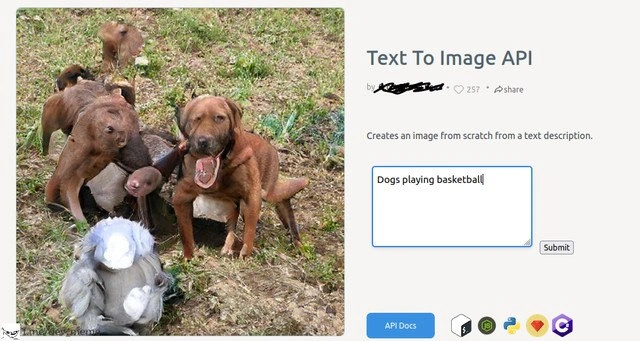
Imagine you ask a friend, “Hey, can you draw me a picture of some dogs playing basketball?” You’re probably expecting a cute drawing: maybe a couple of dogs wagging their tails on a basketball court, one dog bouncing a ball or trying to shoot it into the hoop. Sounds fun, right? Now imagine instead your friend misunderstands in the craziest way. They give you a drawing, and when you look at it, you go, “Huh?!”. In the picture, the “dogs” have monkey faces and look kinda scary, there’s no basketball hoop at all, and the whole scene is on a patchy grass field instead of a court. Maybe there’s something that’s sort of a ball, but it looks more like a gray stuffed toy. The picture is just completely wrong and odd. You’d probably laugh because it’s so far from what you asked – like, it’s not even close! It’s as if the friend heard you, but then drew the wrong thing in a really silly way.
That’s basically what happened here, except the “friend” is a computer program (an AI that makes images). The person asked for one thing (dogs playing basketball) and the computer gave back something else that was totally weird (mixed-up animals that look part-dog, part-baboon, and no real basketball game happening). It’s a big mix-up. We find it funny because it’s such a goofy mistake. It’s like if you told a robot to make you a peanut butter and jelly sandwich, and it took out pickles and ice cream instead – the result would be wrong and gross, but you’d chuckle at how off-base the poor robot was. In this case, the AI was supposed to make a fun doggy sports image, and it ended up making an image that belongs in a monster movie by accident. The surprise and silliness of that error is the heart of the joke. We’re laughing because even smart computers can mess up in ridiculous ways, and it’s kind of cute (and a little creepy) when they do.
Level 2: Text In, Baboons Out
Let’s break down what’s happening in this meme in simpler terms. We have a Text-to-Image API, which means there’s a service where you can send a written description (text in) and get a picture that tries to match that description (image out). In this case, someone typed the prompt "Dogs playing basketball" into the API’s demo interface. That’s a straightforward request: you’d imagine seeing a fun picture of some dogs on a basketball court, maybe with jerseys on, chasing a ball or going for a slam dunk. Essentially, the user gave a clear instruction in English, and they expected the AI to fulfill it literally.
Now, what did the AI actually do? It returned an image, but the content is all wrong – it’s almost like the output is from a parallel universe. Instead of a lively sports scene, the picture shows what looks like four grotesque animals that are a mix between dogs and baboons standing on some patchy grass. In front, there’s a strange gray plush-looking creature. There’s no real basketball or court to be seen. It’s as if the AI scrambled the instruction. The result is a prompt mismatch: the text said dogs and basketball, but the image has mutant baboon-dogs and no obvious basketball game. The phrase "mutant baboons" in the title is a funny way of describing those messed-up animals – they do resemble baboons (a type of monkey) but something’s very off about them, like they’ve been genetically mixed with dogs.
Why would an AI make such a bizarre mistake? Here’s where understanding generative AI (specifically image-generating models) helps. These models learn by looking at lots of example images and their descriptions. A diffusion-based image model (which is one popular type among generative models) learns to create new images by gradually improving random noise until it sees something that matches the prompt. Think of it like molding clay: it starts from a shapeless lump and tries to sculpt it into something meaningful based on what it “knows” from training. But if it never saw a particular combination, it has to guess. The AI likely knows what dogs look like from many photos, and it knows what a basketball looks like, and perhaps what playing generally entails. However, if it hasn’t seen dogs actually playing basketball (which is a pretty peculiar thing outside of maybe a movie or two), it might mash up separate ideas. It might have seen pictures of dogs playing (with toys, running outside) and pictures of primates or other animals doing tricks. Somewhere in its “brain”, the concept of animals + playing + object could have been associated with monkeys, since monkeys are often depicted playing with things (or perhaps it found some halfway point between dog features and human-like playing posture, which ended up looking like a baboon).
So the poor AI did something, but it wasn’t the something the user wanted. It’s kind of like a rookie chef mixing the wrong ingredients for a recipe because they sound vaguely similar. The model essentially produced a glitchy output – a mistake where the image features got blended incorrectly. The technical term for this is often just a “generative failure” or glitch. The dogs and baboons got merged in a freakish way because the AI isn’t explicitly told “hey, keep each animal looking like itself and put a ball in the scene.” It just tries to fulfill the prompt as a whole, and sometimes it does so in a literal but misguided fashion.
Let’s talk about the interface we see in the meme. On the right side, we have what looks like a developer portal or demo page for this Text To Image API. It has a text area where the prompt "Dogs playing basketball" is entered, and a Submit button to generate the image. There are icons for "API Docs" and SDKs, indicating you could use this API in your own programs (the docs would explain how to call it, and SDKs are software kits to help integrate it). This setup suggests that the creators of this model are encouraging developers to try it out and potentially include it in their applications or websites. However, showing off a failure case like this is unintentionally humorous. It’s like an advertisement gone wrong: “Look at the amazing images our AI creates!” – and then the example image is a nightmare blend of animals. For a developer or anyone testing, it immediately shows that AI-generated content is not always reliable.
Some important terms and concepts from the tags and context, explained in plain language:
GenerativeModels (Generative AI): This refers to AI systems that generate new content. In our case, it generates images from text. They try to create outputs (like pictures, text, music) that look like something a human might have made. They learn from lots of existing data. The Text-to-Image model here learned from many images and captions, so it tries to imagine a new image for any caption you give.
AIGeneratedContent & AIHumor: AI-generated content means anything produced by an AI (like this image). AI humor is a category of jokes or memes that come from the funny mistakes AI makes. This meme is a prime example because the AI’s error is so outlandish that it becomes laughable. People find it funny when a super-smart system does something dumb, like mixing up dogs with baboons.
AIHypeVsReality: There’s a lot of excitement (hype) around AI, especially with things like text-to-image. But the reality doesn’t always match the hype. This tag is about comparing what people hope AI can do (or claim it can do) versus what it actually does sometimes. Here, hype would be “you can get amazing art of anything you describe!” Reality is this weird mutant image that nobody asked for.
AILimitations: This refers to the things AI still can’t do well. As we see, generating a complex scene with multiple dogs and an action (playing basketball) revealed limitations of the AI. It struggles with understanding the scene the way we intended. It can’t reason that dogs should hold or chase the basketball, or that they need a court. It just tries its best based on patterns. The result shows the limitations clearly – it doesn’t really understand the request, it’s just guessing based on what it’s seen before.
text_to_image & image_generation_fail: Text to image is exactly what this tool does – converting a text prompt into an image. An image generation fail is what we got: a failure case where the generated image is wrong or ridiculous. People often share these fails to laugh at them and to discuss where the AI went wrong.
prompt_mismatch: A prompt is the input description you give (here, "Dogs playing basketball"). Mismatch means the output doesn’t match the input. This happens when the AI interprets the prompt in an unexpected way or can’t fulfill it correctly. In our case, there’s a huge mismatch – the output has dogs and some notion of “playing,” perhaps, but no real basketball game, and extra baboon features that were never requested!
baboon_mutation & uncanny_animals: These describe the content of the image humorously. Baboon mutation suggests the dogs mutated into baboon-like creatures. Uncanny animals refers to how the animals look uncanny, meaning strange and unsettling. They’re close to real-looking, but clearly not right (like a dog head that’s the wrong shape, or a face that’s distorted). The term "uncanny valley" is often used when something looks almost human (or animal) but has slight oddities that make it creepy. Here, the animals are in that weird zone where they resemble normal creatures but are off enough to be creepy/funny.
diffusion_model_glitch: The model used is likely a diffusion model. A glitch in this context means an error in output – not a software crash, but a messed-up result. Diffusion models work by refining noise into an image as mentioned. A glitchy result means somewhere in that refinement process, things went astray. The tag emphasizes that this distortion is a known kind of hiccup for diffusion-based generators.
developer_portal_ui & APIDevelopmentAndWebServices: The interface shown is a developer portal UI (User Interface). It’s the front-end where developers or users can interact with the API. It’s common for AI services to have a web demo like this. API stands for Application Programming Interface – basically a way for different software to communicate. Here, the Text-to-Image API would allow your program to send in a text and get back an image. Web services like this often come with documentation (how to use it) and SDKs (pre-written code libraries to easily connect with the API). The presence of this in the meme highlights that this AI isn’t just an internal lab toy; it’s offered as a service for others to use. But as a dev, if you tried to build an app on top of it, you’d quickly discover you need to handle these * “unexpected features” *. You might need to implement checks, like verifying if the output actually contains the right objects (dogs, a basketball, etc.), or have a fallback if it’s way off.
In simpler terms, think of the AI like an art student who’s seen lots of pictures but sometimes gets confused. You gave it an assignment: draw dogs playing basketball. It kind of panicked and drew something, but what it drew shows it didn’t quite understand the task. It drew dogs that look half like monkeys, and they’re just standing around. Maybe it remembered “dogs” and started drawing that, then remembered “playing” and thought of some playful monkeys, and then “basketball” and tried to add a ball but ended up with a gray blob. The end result is a weird collage of ideas from the prompt, rather than a coherent scene.
For a junior developer or someone new to AI, the takeaway from this meme is: AI can be impressive, but it’s not foolproof. Just because you have an API that sounds like it can do something (turn text into image), doesn’t mean it will always do it correctly. Sometimes the results can be laughably wrong. Part of working with these technologies is learning their quirks and limitations. And honestly, part of the fun (and frustration) is seeing these kinds of crazy errors. They remind us that as “smart” as these systems are, they don’t think like humans – they’re basically pattern machines, and weird outputs like mutant baboons are a side effect of that. This meme became a bit of an inside joke in the developer community about the state of AI in 2022: amazing capabilities, but plenty of WTF moments along the way.
Level 3: Not Quite Air Bud
Seasoned developers and AI enthusiasts chuckle at this because it perfectly encapsulates AI hype vs. reality. The prompt was innocently straightforward – "Dogs playing basketball" – conjuring a mental image of something like a canine version of an athlete (perhaps even evoking the classic kids’ movie Air Bud, where a dog actually joins a basketball team). The expectation: maybe a cute golden retriever dunking a basketball on a court, or a group of dogs with jerseys frolicking with a ball. The reality: four abominations from a pet cemetery playing at… well, it’s not clear what they’re playing at, but it’s definitely not basketball! It’s as if the AI heard the request and produced a scene from an alternate universe where evolution took a bizarre turn. This stark mismatch is comedic gold for anyone who’s been following AI-generated content. We’re laughing with a wince: sure, the AI did something, but it definitely didn’t do what was asked.
The humor here also stems from the context of a polished developer portal UI showcasing the model. On the right, everything looks so tidy and professional: "Text To Image API" – it sounds like the latest slick service ready to be plugged into your app. There’s a fancy text box with the prompt, a Submit button, and even links to API docs and SDKs, implying this tech is production-ready. The interface proudly says "Creates an image from scratch from a text description," inviting users to test this magical capability. But on the left… the first impression is “What on earth am I looking at?!” The output image is the kind of nightmare fuel that would make any developer demoing this hang their head and laugh-cry. This contrast between a shiny API promise and a facepalm of an outcome is a scenario many seasoned devs know too well. It’s a classic expectation vs. output gag, and it highlights the developer challenge of working with cutting-edge AI models: they’re powerful and impressive in theory, but sometimes they serve up wild surprises.
Why did this happen? Any developer with experience in GenerativeModels or machine learning will recognize a few likely culprits:
Compositional Chaos: Generating multiple animals doing an action is hard. The model tried to compose "dogs" + "playing" + "basketball" and ended up lumping things together. Instead of distinct dogs each holding or dribbling a ball, it produced dog-shaped creatures with oddly baboon-like features and no real basketball in sight. It’s as if the AI couldn’t decide whether to draw a dog or a baboon, so it averaged them out into a mutant. Multi-object scenes often confuse these models, especially back in 2022 – the AI doesn’t truly know how to make the dog hold the ball or aim for a hoop, so you get a prompt mismatch where parts of the prompt (dogs, ball) all appear, but not in the right relationship.
Training Data Troubles: Senior folks know that these models are only as good as their training data. It’s possible the model saw lots of images of dogs on grass and monkeys doing tricks, but maybe zero images of dogs playing basketball. So when asked to extrapolate, it reached into what it knew: dogs (okay, four-legged pets on grass), playing (perhaps it found references of primates playing, since monkeys and apes are often photographed using objects or in funny poses), and basketball (orange balls, maybe some humans, but here it really fumbled that part). The output looks like it defaulted to an outdoor setting (patchy grass field) because, in the model’s learned experience, animals are often outdoors. The grey plush-like blob could be a distorted attempt at a basketball or maybe another creature entirely – a sign that the model wasn’t confident about the ball, so it produced a vague ball-shaped oddity. This kind of diffusion_model_glitch was common: when unsure, the AI merges features or leaves surreal artifacts.
The Uncanny Valley of Pets: Those faces… shudder. Experienced devs have seen this in AI image outputs before: the uncanny animals phenomenon, where generated creatures look almost real but have distorted faces or limbs. The humor has a bit of horror in it – these dog-baboon hybrids are unsettling! It’s funny because it’s so wrong, but also a little creepy to look at. That mix of emotions (laughing at how badly it failed, while also being weirded out) is a hallmark of AI humor in the generative art community. It reminds us of early days in CGI and automation where things nearly looked human or natural, but not quite, triggering that this is off feeling. Here we have it with animals, and it’s both hilarious and disconcerting. Seasoned AI devs will recall countless generative fails shared on Twitter and Reddit – this meme fits right in with those.
Hype Meets Reality Check: In 2022, generative AI was blasting off in hype. Every week, some new demo or paper promised near-magical abilities (and indeed, models were improving fast). But those of us integrating AI into products or APIs knew there were serious AILimitations. This meme is basically a poster child for AIHypeVsReality. The hype: “Ask for any scene and the AI will draw it for you!” The reality: “Well, it might – or it might give you mutant baboons and you’ll have to explain that to your users.” 😅 It’s a gentle ribbing of the optimistic marketing around AI. The image generation API technically did its job (it returned an image for the text) but qualitatively, it failed hard. The humor is in that disconnect. Every senior dev has dealt with a technology that promises the world in demos, but when you actually use it, you uncover all these edge cases and ridiculous outputs. It’s a mix of “I can’t believe it did that” and “Actually, I totally can believe it did that”.
Now, consider the position of a developer exposing this model via an API. You have to think about user expectations. Someone might genuinely use this API expecting an illustration for "dogs playing basketball" and get this horror show. That’s a quick way to get bug reports (or support tickets asking “um, why are there monkeys?”). It highlights the need for things like result filtering or at least a disclaimer. Perhaps the dev in the meme left this example precisely to set expectations that the model can be hit-or-miss. In any case, the meme is a humorous cautionary tale: with AI services, always expect the unexpected. It resonates with developers who have been burned by surprising outputs. It’s essentially saying, “We built this cool AI feature, but… hehe, sometimes it does monkey business on the job.” And indeed, seeing baboons instead of basketball-playing dogs is about as monkey-business as it gets.
From an API development standpoint, it’s also poking fun at how we sometimes rush to wrap a bleeding-edge model in a clean API. The UI suggests “Plug this into your app today!”, but the underlying model might still be more of a research experiment than a dependable service. Veteran engineers recognize this pattern: pressure to integrate the shiny new AI, followed by the realization that it might spit out weird results. They might recall late-night deploys where a seemingly minor detail went awry – not unlike an AI suddenly deciding a dog should have a baboon’s head. In sum, “Text-to-Image API invents mutant baboons for a dog basketball prompt” is one of those absurd headlines that makes developers laugh, nod, and maybe cringe a little in sympathy. It captures the absurdist reality of working with generative AI: you expect Air Bud, but sometimes you get Planet of the Apes. And as long as it’s not your production system on the line, you can afford to laugh at the madness.
Level 4: Latent Space Zoology
At the cutting edge of AI image generation, models operate in a high-dimensional latent space where concepts like "dog", "basketball", and "playing" are just points or directions. In a diffusion model (a common type of generative model in 2022), the process begins with pure noise and gradually alters that noise to form a coherent image guided by the prompt. The prompt "Dogs playing basketball" gets encoded into a numerical embedding (often by a text encoder like CLIP, which aligns images and text in a joint space). The diffusion model then iteratively tries to produce an image whose features match that embedding. However, these models don’t truly understand discrete objects or activities – they only know statistical correlations from their training data. If the training set rarely showed actual dogs shooting hoops (which, let’s face it, is not a common real-life scene), the model will grasp at anything remotely related: dogs, yes; basketballs, yes; perhaps any animal playing something. The request traverses an uncanny part of latent space that lies somewhere between "dog catching a ball" and "primate playing sports," and the model hallucinates a hybrid. We get chimeric canines with baboon-like features, as the network tries to reconcile all elements of the prompt at once.
This is a classic case of generative compositionality failure: the AI knows what dogs look like, and it knows about basketballs, but combining them into a coherent "dog-playing-basketball" scene is a complex spatial and semantic puzzle. Early diffusion-based image models lacked an explicit understanding of object relationships, so they often just fuse concepts together. The grotesque dog-baboon mutants are essentially an emergent property of the model’s optimization: they satisfy bits of the prompt (some dog-like fur here, a vaguely spherical object there that might be a ball) without ever nailing the whole scene correctly. In technical terms, the diffusion process got stuck in a strange local minimum of the model’s loss function, one that was "good enough" for the AI’s own criteria but obviously absurd to humans. It’s as if the AI’s imagination took the prompt and wandered off into a surreal jungle of its training data. The diffusion algorithm, lacking any common-sense constraints, happily blended features like a mad painter mixing clashing animal parts on canvas. The end result is a mini neural horror show: faces and bodies distorted by the model’s attempt to interpolate between "dog" and "baboon" features, and a setting (patchy grass) that was probably a default from many animal photos in the training set. In the realm of latent space zoology, such mutant creations are the bizarre specimens that reveal how these algorithms think in abstractions rather than concrete concepts.
Under the hood, what likely happened is that the model’s text-conditioning guided it toward any imagery that CLIP might label as "dogs playing basketball." Since CLIP (or a similar mechanism) scores an image by how well it matches the prompt, it might have given a decent score to an image with animal-like shapes (dog-ish, monkey-ish creatures count as animals) and some hint of play or a round object (perhaps that strange plush-gray blob was the model’s attempt at a basketball). To the AI, that mutant image might objectively register as containing "dogs" (furry quadrupeds – close enough) and "basketball" (something round-ish present) because the AI’s notion of these things is fuzzy. This exposes a limitation of the generative model: it lacks a robust world model to sanity-check the composition. There’s no separate logic saying "the subject must be clearly a dog, and the object clearly a basketball, and they must interact in a sensible way." Instead, everything is mushed together in one big vector of parameters. The consequence? Diffusion confusion – the model is essentially confused about which features belong to which entity, leading to the glitchy image we see. Researchers in machine learning often discuss this as the challenge of controlling latent representations: without finer control, multi-part prompts can invoke weird superpositions of concepts (here, dog+baboon).
It’s worth noting that this meme captured a transitional moment in AI development. Around 2022, text-to-image generators were improving rapidly but still often produced uncanny or outright wrong results for complex prompts. The mutant baboon-dogs are a perfect example of a diffusion model glitch. They highlight that despite the impressive capability of generative models to create imagery from nothing, these models can misfire in spectacular ways when faced with unusual combinations. Fundamentally, the math and training data behind these AIs impose constraints: without explicit training on "dogs playing basketball" or a similar scenario, the model’s best guess might be some average of separate concepts – a statistical chimera. In summary, the meme’s horrifying yet hilarious image is the direct outcome of how these algorithms generate content: by assembling patterns they’ve seen before, sometimes creating creepy composites when reality didn’t supply the needed example. It’s a reminder that AI image generation, for all its hype, is still bound by the limits of its training distribution and the abstract, and sometimes alien, logic of its neural network’s latent space.
Description
Screenshot of a developer portal demoing a "Text To Image API." The page is split: on the left a generated picture shows four grotesquely blended animals - baboons and dogs merged together with distorted faces - standing on patchy grass while a plush-like gray creature sits in the foreground. On the right, the interface displays the heading "Text To Image API," author information, the caption "Creates an image from scratch from a text description," and a blue-bordered textarea containing the prompt text: "Dogs playing basketball." A gray "Submit" button sits below the prompt, along with icons linking to API documentation and SDKs. The absurd mismatch between the requested scene and the output pokes fun at generative-AI failure cases, highlighting the limitations of diffusion-based image models and the developer challenge of exposing such models through an API
Comments
9Comment deleted
Text-to-image in prod: we serialize DogsPlayingBasketballDTO, the model deserializes BaboonMutantCluster - exactly what happens when your whole contract is a free-form string and hope
This is what happens when your image generation model was trained on 'dogs sitting for treats' dataset but never actually saw a single NBA game - now every prompt becomes an excuse for the model to show off its extensive knowledge of 'good boys waiting patiently' instead of whatever you actually asked for
When your text-to-image API has perfect uptime, flawless documentation, and enterprise-grade security - but the model was trained exclusively on literal interpretations of idioms. Sure, the dogs are technically 'playing' and there's probably a basketball somewhere in the training set, just not in the same embedding space. At least it's deterministic: garbage prompt in, confused canines out
We added a seed for reproducibility; now our e2e suite deterministically verifies that “dogs playing basketball” returns primate - dog chimeras - turns out versioning a probability distribution is still a breaking change
Prompt parsed perfectly until the latent space clustered 'basketball' with 'dogpile' - embedding drift hits again
Prompt: "dogs playing basketball." Output: latent space kennel orbiting a sphere; CLIP score 0.89, so product says it’s ready; apparently we replaced acceptance criteria with cosine similarity
Is it bad if i can understand why this is generated like this even tho I haven’t ever trained AI and I am not planning to except for text recognition? Comment deleted
Looks like dog porn! Comment deleted
but it was the first one, the next were +- cats Comment deleted