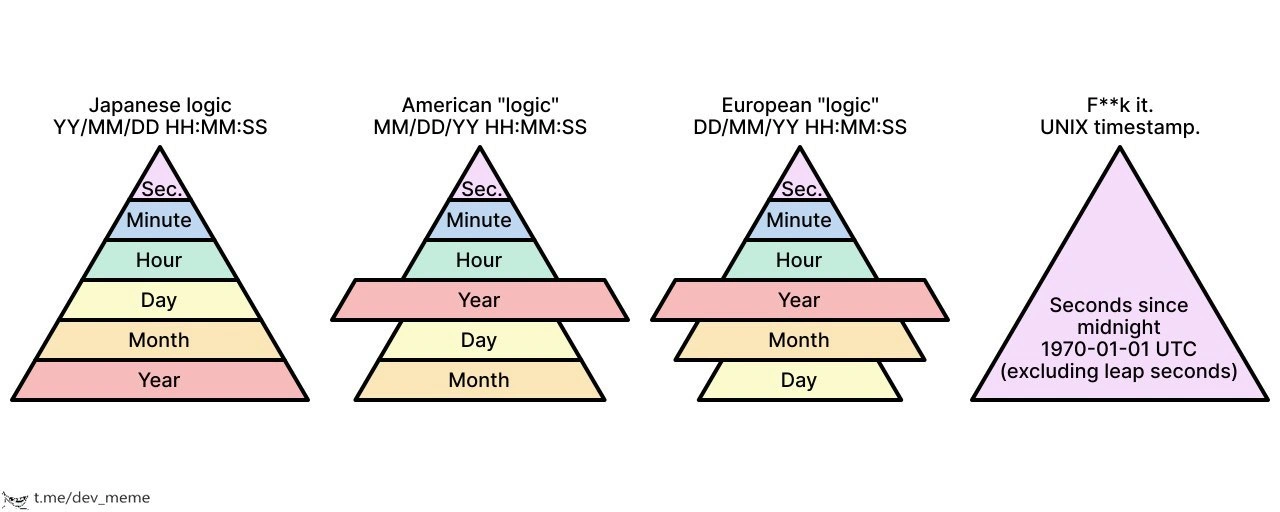
From structured YY/MM/DD logic to ‘just use epoch seconds’ timestamp pyramid meme
Why is this DataFormats meme funny?
Level 1: Stacking Time Blocks
Imagine you have a bunch of stacking blocks or Lego pieces of different sizes, and each size represents a part of time. The biggest block is a Year, the medium block is a Month, and a smaller block is a Day. Then even tinier pieces are Hours, Minutes, and the tiniest of all are Seconds. Now, one person builds a tower by stacking the blocks from largest at the bottom to smallest on top – Year at the bottom, then Month above it, then Day, and so on. This tower looks nice and sorted by size, right? It’s stable and makes sense: big foundation, then medium, then small. That’s like writing a date as Year-Month-Day (and then the time) in order – it’s clear and everything is in its place.
But now imagine another person stacks the blocks in a weird order. One friend puts a medium block at the bottom, a small block in the middle, and then the big block near the top. The tower looks lopsided or out of order – like something is off. This is what happens when you write the month first, then day, then year (which is how dates are often written in the U.S.). It’s as if the Year (the big block) isn’t at the bottom where it logically should be, so the whole order feels confusing. Another friend does a different odd thing: they start with the small block at the bottom and end with the big block on top. That tower is upside-down in terms of size ordering – which is like writing day first, then month, then year (common in some other countries). These different ways of stacking might be okay once you know what they are, but if you looked at your friends’ towers without being told the method, you’d be pretty confused! Each of their towers has the same pieces, but arranged differently, so you can’t immediately tell by looking which one is taller in terms of actual total size. In the same way, if someone just shows you a date like “06/08/22” and you don’t know the convention, you can’t be sure what it means – is the 06 the month or the day? It’s like seeing a weirdly stacked tower and not knowing which piece is which.
Now, the last part of the meme (the last pyramid) says, essentially, “Forget all these fancy stacks, let’s do this the simple way.” Instead of stacking different blocks at all, imagine using a single measuring stick or a counter. It’s like you say: “Rather than remembering the year, month, and day separately, I’m just going to count every second that passes from a fixed starting point and use that one big number as my time.” That’s what the Unix timestamp is – picture a world clock that started at zero and just keeps ticking up seconds: 1, 2, 3, … into the millions and billions. If you want to know which of two events came first, you just see which counter number is smaller. It’s a bit like having a race and using a stopwatch time: you don’t care about the date on the clock, just the total seconds elapsed. In real life, saying “it’s been 1,654,646,400 seconds since the start of 1970” doesn’t roll off the tongue, but to a computer that’s a super clear way to say “June 8, 2022”. No matter who you are or where you live, a bigger number of seconds means later in time, period.
So why is this funny? Well, because dealing with date formats can be a running joke (it often causes mix-ups), the meme shows a frustrated solution: when you can’t agree on how to stack the blocks, just use one giant block (or number) that everyone can agree on. It’s like if kids were arguing about whether to put the red block or blue block first, and an adult just says, “Enough! Let’s use this one big weight to track time instead.” It’s humorous because it’s true – programmers often hit a point where all the year/month/day confusion makes them say, “I’m done with this, let’s just count seconds”. The pyramid on the right with one big block is simple and impossible to mix up, which is exactly the relief a tired developer wants. In everyday terms, it’s like instead of saying “8th of June, 2022” or “June 8, 2022” and worrying who might read it wrong, you hand everyone a stopwatch that reads a huge number of seconds – not intuitive for a person, but undeniably clear. The joke is that sometimes the easiest way to avoid confusion is to abandon the nice pretty formats and go with something so bluntly straightforward (seconds ticking from a fixed date) that there’s no room for misinterpretation. It highlights a silly truth: when humans make things confusing, we can always ask the computer to use a plain count as the final say. The result might not be human-friendly, but it sure is consistent – and that consistency can feel like a lifesaver when you’ve been burned by one too many mixups with dates!
Level 2: Date Format Tower
If you’re newer to coding or just starting to work with dates, this meme is illustrating the different ways people write dates and how confusing that can be for computers. The picture uses a pyramid tower made of time units to show four different date formats. In each pyramid, the base is the biggest chunk of time and the top is the smallest. Let’s break them down:
Japanese format (YY/MM/DD HH:MM:SS) – This one is ordered from large to small. The year is the biggest time unit (think of a year as a huge span of time), so it’s the wide bottom layer. Above that is the month, then the day, and so on up to seconds at the tip. It’s like stacking blocks from largest (Year) at the bottom to smallest (Second) on top. This is actually very logical for both humans and computers: if you list Year, Month, Day in that order, it’s easy to sort and easy to understand magnitude-wise. For example, 2022/06/08 14:35:00 clearly comes after 2021/12/31 23:59:59 because 2022 is a bigger year number than 2021, and everything is lined up in descending importance. This Year-Month-Day style is also known as the ISO 8601 format, a common international date_formatting standard (many programmers love it because of its clarity). In Japan (and many other places like China and ISO-standard contexts), they actually write dates this way, from year down to day, which is why the meme labels it “Japanese logic.” It just means it’s logically ordered by time magnitude.
American format (MM/DD/YY HH:MM:SS) – In the USA, the common way to write a date is Month/Day/Year. So, June 8, 2022 would typically be written as 06/08/2022 (MM=06, DD=08, YY=2022). The meme’s second pyramid shows this as a wobbly tower. Why wobbly? Because here the order of blocks is a bit odd: Month (a medium-sized time unit) is at the bottom, Day (a smaller unit) is in the middle, and Year (the largest unit) is oddly placed above them. The pyramid graphic even depicts the Year layer sticking out of the side, as if it was taken from the bottom and shoved in the middle — visually emphasizing that the natural order has been disrupted. For a computer or anyone thinking in logical sequences, this American date order is confusing. It’s like if you were organizing books by size and you started with a medium book, then a small book, and put the big book on top of them — the sequence isn't by size anymore. For real-world consequences, consider a simple example: the dates 01/02/2022 vs 12/03/2021. In Month/Day/Year format, "01/02/2022" means January 2, 2022, and "12/03/2021" means December 3, 2021. If you sort these as text strings without understanding the format, you’d compare "01" to "12" (the first two characters, representing the month). Since "01" comes before "12", a naive sort would think January 2022 comes before December 2021 – which is obviously wrong in actual time. The American format breaks that nice sorting-by-character property, so developers have to write extra code to handle it (parsing the parts out and comparing year to year, month to month, etc., instead of just comparing the whole string).
European format (DD/MM/YY HH:MM:SS) – Many countries (often in Europe, hence the label) write the day first, then month, then year. So the same date June 8, 2022 would be 08/06/2022 (DD=08, MM=06, YY=2022). This is shown in the third pyramid. Here the Day (smallest of the three date parts) is at the bottom, Month in the middle, Year on top. This is a little-endian style ordering (small-to-large). It’s actually the exact reverse of the Japanese/ISO order. If you sort date strings in this format lexicographically (alphabetically), you’ll also get nonsense results unless the dates all happen to be in the same month and same year. For instance, "08/06/2022" (08 June 2022) and "09/01/2021" (09 January 2021) as strings would compare the first two digits (08 vs 09) and think the one starting with 08 is earlier, even though 2022 is later than 2021. So just like the American format, the European date order isn’t inherently sortable as a string either. The key point is: regional_date_formats like these require us to know the context. If a program only sees “08/06/2022”, it won’t immediately know if that means 8th June (European) or August 6th (American). Developers solve this by explicitly specifying formats (like
"DD/MM/YYYY"or"MM/DD/YYYY") when parsing or displaying dates, or by using locale settings that tell the program which convention to follow. If you’ve ever used a library like Moment.js or Java’s DateTimeFormatter, you might have seen those format strings – that’s why they’re needed! They unambiguously map the order so the computer doesn’t have to guess.
By now you can see why dealing with dates is a common headache. Enter the last pyramid: “Fk it. UNIX timestamp.”** This part is about a totally different approach. Instead of writing out Year, Month, Day, etc., a Unix timestamp is just one large number – specifically, the number of seconds that have passed since a fixed start time (midnight Jan 1, 1970, in the UTC time zone). For example, 2022-06-08 00:00:00 UTC as a Unix timestamp is about 1654646400. That’s a single integer representing that exact moment in time. It doesn’t look anything like a date to us, but computers find it much easier to handle. Why? Because if you have two timestamps, say 1654646400 and 1640995200, it’s immediately clear that 1654646400 is a later time (since it’s a bigger number). There’s no month/day/year to shuffle around. Sorting a list of such timestamps will correctly sort by date and time, because it’s literally sorting by an ever-increasing counter. Developers often use Unix timestamps internally for this reason – it’s a simple, universal yardstick for time. In many programming languages, getting the current time gives you something like this. (For instance, in JavaScript, calling Date.now() returns the number of milliseconds since 1970-01-01 UTC – essentially the Unix timestamp in millisecond form.) It’s a way to avoid any confusion about format: a timestamp is just time in seconds (or milliseconds) under the hood. When you need to display it to a user, you can then convert that one number into whatever date format you want (American, European, ISO, you name it). But in storage or comparison, you keep it as a pure number to stay out of trouble.
The meme’s final message is basically a joke that many developers have lived: after struggling with mismatched date formats (“Was that 5/6 or 6/5? Is the 07 the day or the month?”), we often throw our hands up and say “Just give me the Unix timestamp!”. It’s like saying, "Forget all these different regional ways of writing dates – let’s use a single agreed-upon epoch_time reference that everyone’s computer can understand." The note about “excluding leap seconds” is a minor technical footnote (in reality, standard Unix time doesn’t count those occasional extra seconds, so it stays nice and consistent; leap seconds are rare adjustments to clocks that most software simply glosses over). You don’t usually need to worry about that unless you’re programming extremely precise systems (and even then, there are strategies to handle the leap second). The big takeaway is: using a raw timestamp is the simplest common ground. No matter if you’re in New York, London, or Tokyo, 1654646400 seconds since epoch means the same point in time, without any ambiguity. It’s the one pyramid with no funky shape – just a solid block – because it doesn’t have separately labeled parts to mix up.
In simpler terms, think of the first three pyramids as different ways to format a date for humans, and notice how only the first one is nicely ordered. The last pyramid is how computers often prefer to handle dates internally: one uniform measure. This meme is a lighthearted illustration of a real-world developer pain point – formatting dates – and how a lot of us just rely on a straightforward Unix timestamp when things get too complicated. It humorously captures that moment when a programmer, tired of juggling Day/Month/Year orders and making mistakes, decides to use the brute-force one-size-fits-all solution. After all, when every other method fails, counting seconds never does! (At least not until we hit something like the year 2038 problem on old machines – but that’s a story for another time.) The underlying lesson aligns with basic computer science: consistent data representation matters. If everyone used a single standard (like ISO dates or epoch seconds), life would be easier – but humans have their habits, so developers will keep writing code to translate between these mini “Tower of Babel” date formats.
Level 3: Temporal Endianness
At first glance, this meme is a masterclass in mocking data formats and cultural inconsistencies with time. The four pyramids visualize the hierarchy of a date-time structure, and any seasoned engineer will recognize the underlying CS fundamentals at play. The leftmost pyramid (labeled “Japanese logic YY/MM/DD HH:MM:SS”) stacks time units in perfectly descending magnitude: Year at the base (the largest unit of time here), then Month, Day, Hour, Minute, and finally Seconds at the tiny top. This is essentially a big-endian representation of a timestamp – the most significant parts (years) come first, just like the high-order bytes in a big-endian number. It’s no coincidence that this format (Year-Month-Day) is also the basis of the international standard ISO 8601. In ISO (and in many databases), a date like 2022-06-08 14:35:00 follows that logical order, meaning string comparisons or sorts will also sort by time. In other words, the “Japanese logic” pyramid isn’t just aesthetically pleasing – it reflects a format that is inherently sortable and unambiguous (especially when using four-digit years). It’s the ideal that every programmer quietly loves: chronological order directly in the string format.
Now look at the next two pyramids. The meme pointedly calls them American "logic" and European "logic" – quotes very much intended as sarcasm. In the American date order (MM/DD/YY HH:MM:SS), the stacking goes Month, Day, Year for the date portion. If you think of that as a hierarchy, the Year (biggest unit) is awkwardly sandwiched in the middle of the sequence, like a huge block pulled out of the base of a tower and randomly shoved higher up. In computer architecture terms, the American format is infamously middle-endian – neither strictly big-endian nor little-endian, just a confusing mixture. The European format (DD/MM/YY HH:MM:SS) isn’t off the hook either: it’s a little-endian style for the date – Day (small unit) first, then Month, then Year last. That at least has a consistent small-to-large progression for date, but it’s still reversed from the big-to-small logic of the first pyramid. For a developer, these mixed-up orders are frankly chaos. They break the neat hierarchy and can wreak havoc in software if not handled properly. Imagine sorting dates as plain text: "2022-06-08" vs "06/08/2022" vs "08/06/2022". A lexicographical sort of "YYYY-MM-DD" format works as expected (2021 comes before 2022, June comes before August, etc.). But if you sort "MM/DD/YYYY" strings, you might get April 5, 2022 (04/05/2022) coming out ahead of December 1, 2021 (12/01/2021), simply because "04" is lexicographically less than "12". Chronologically that’s nonsense – and exactly the kind of bug you get when data is formatted in a non-hierarchical way. It’s a classic developer pain point: dates formatted for local human habits but fed into systems that naively compare them. One stray "Month/Day/Year" in a sea of "Year-Month-Day" entries, and your program’s sort or comparison logic goes off the rails.
Any programmer who’s debugged a date issue knows the dread. Without clear context, 02/03/04 is an enigma: is that Feb 3, 2004? March 4, 2002? 02 Mar 2004? (And if you think two-digit years are ancient history, pray you never inherit an old codebase.) These ambiguous formats are the stuff of nightmare deployments. It’s why libraries like Moment.js (for JavaScript) or Python’s datetime parsing exist – to handle the wild west of date strings so you don’t have to. They let you specify, for example, that "04/05/06" should be read as "YY/MM/DD" or "DD/MM/YY" or whatever the regional convention is. Absent that, you’re left guessing…and usually guessing wrong. The meme calling the American and European formats “logic” in scare quotes is exactly how devs feel – whose logic is this, really? Certainly not the kind that makes a programmer’s life easy. It pokes fun at the arbitrariness of regional date formats that break the natural datetime hierarchy of Year > Month > Day. It’s a gentle jab: “Why, America, would you put the year in the middle? Why, Europe, do you start with the day?” – questions any global software team has hashed out at least once in the great developer date format wars.
The final pyramid is the punchline we’ve all been waiting for: “F**k it. UNIX timestamp.” The image shows a single big triangle filled with the text “Seconds since midnight 1970-01-01 UTC (excluding leap seconds).” This is the developer’s ultimate trump card in the date format debacle. When every other format causes confusion, we turn to the Unix timestamp – an integer count of seconds (or milliseconds) elapsed since a standard epoch. No months, no days, no human-friendly frills, just a raw number that inexorably increases. Why 1970-01-01? That’s the Unix epoch, essentially time zero for Unix-like systems, chosen by the early Unix creators. By using this single number, all those messy ordering issues evaporate: epoch time is region-agnostic and trivially comparable. A larger timestamp means a later point in time, period. If someone says a file’s timestamp is 1654646400, you might not know what date that is offhand (it happens to be around June 8, 2022), but you can be sure that a timestamp of 1654646400 is later than 1609459200 (which is around Jan 1, 2021). Computers love this simplicity – comparing two integers is straightforward, and sorting a list of timestamps will always sort the events in true chronological order. The meme implies a collective developer sigh: “screw all this confusing ordering, let’s reduce time to one flat number.” It’s a very relatable humor moment for anyone who has thrown up their hands after wrestling with date strings. We’ve seen things – mis-scheduled cron jobs, mismatched log entries, internationalization bugs – and many of us have indeed muttered “Just use epoch seconds, I beg you.”
Of course, the meme’s tiny text “excluding leap seconds” is a nod to the nerdy reality that even Unix time has its quirks. In practice, POSIX/Unix timestamps ignore leap seconds (those occasional 61st seconds added to adjust Earth’s rotation), effectively pretending they don’t exist to keep the timeline smooth. It’s a minor detail unless you’re a systems programmer or an astronomer, but it shows the meme creator’s depth: they’re aware that our “simple” solution isn’t 100% aligned with astronomical time. And yet, compared to the mayhem of multiple date formats, leap seconds are a footnote. The Unix timestamp remains the sanity-saving common denominator. Many systems and databases store dates in this format under the hood, precisely to avoid format confusion. It’s also the reason you see timestamps like 1640995200 in APIs – one side produces epoch seconds, the other side knows exactly how to interpret it, with no cultural translation needed. The downside? Humans can’t read it at a glance, but that’s a small price for consistent date_formatting. As the saying goes, “Computers are good at counting, humans are good at misreading those counts.” So we let computers count time for us.
In the end, this meme hits on a core truth in software development: time is hard. We have so many ways to represent a simple moment that sometimes the only refuge is to strip it down to basics. It’s poking fun at how a fundamentally logical thing (the progression of time) gets represented illogically due to historical and regional habits – and how developers often cope by choosing an entirely different representation that’s reliably consistent. It’s a tongue-in-cheek reminder that when faced with a tangle of conventions (YY/MM/DD vs MM/DD/YY vs DD/MM/YY… and let’s not even start on time zones, because TimeZonesAreHard), the most pragmatic solution is often to go one level more abstract and use a format that only computers find friendly. The pyramid of time collapses into a single block – problem (mostly) solved. Any senior developer reading this meme is likely smirking and nodding, recalling the exact moment they decided to store dates as Unix timestamps to avoid an on-call fiasco. It’s funny ’cause it’s true: when human “logic” fails, let the silicon logic take over.
Description
The meme shows four pastel-colored pyramids comparing date-time ordering schemes. 1) At left, a perfect pyramid labeled “Japanese logic YY/MM/DD HH:MM:SS” stacks layers from bottom to top: Year, Month, Day, Hour, Minute, Sec. 2) The next pyramid, captioned “American "logic" MM/DD/YY HH:MM:SS,” has the Year layer awkwardly pulled out of the middle, breaking the hierarchy. 3) The third, “European "logic" DD/MM/YY HH:MM:SS,” similarly yanks Day and Month out of sequence. 4) The final pyramid simply reads “F**k it. UNIX timestamp.” and is filled with the single text block “Seconds since midnight 1970-01-01 UTC (excluding leap seconds).” The visual joke highlights how regional date formats disrupt natural magnitude ordering, while developers often retreat to the monotonically increasing Unix epoch for sanity and sortability
Comments
32Comment deleted
After the fifth bikeshed on whether 03/04/05 is March or April, we just cast every timestamp to BIGINT and agreed to revisit the spec at 03:14:07 UTC on 19-Jan-2038
After 20 years of dealing with timezone bugs, date parsing edge cases, and explaining why '01/02/03' means three different dates to different teams, you realize UNIX timestamps aren't just elegant - they're self-care. Sure, you'll still get bitten by leap seconds, but at least you won't have to debug why your European CI pipeline thinks your American deployment happened last month
After decades of international date format bikeshedding and countless production bugs from MM/DD vs DD/MM ambiguity, the industry collectively realized that arguing over human-readable formats is a waste of time - just store everything as Unix timestamps and let the presentation layer deal with the localization nightmare. Because nothing says 'I've seen things' quite like choosing epoch seconds over yet another regex to parse '02/03/04'
I've never seen an outage caused by epoch seconds, but I've triaged three incidents caused by '07/08/09' - pick ISO 8601 or epoch and stop playing date roulette
Date formats prove CAP theorem irrefutably: never consistent across American and European services - unless Unix timestamps rule
We argued Y/M/D vs M/D/Y vs D/M/Y for a sprint and shipped UNIX timestamps - leap seconds excluded, humans confused, and time still the worst distributed system; see you in 2038
"Reiwa 4" moment Comment deleted
I use japanese dates appearantly Comment deleted
You don’t use the austrian style? Comment deleted
no, it's less logical Comment deleted
the whaaat Comment deleted
I'm austrian, we usually use what they call European style Comment deleted
Now I feel like I want a map with color codes where what is used Comment deleted
https://en.wikipedia.org/wiki/Date_format_by_country Comment deleted
How tf did you send it within 2 secondds Comment deleted
google "date format map" first link Comment deleted
damn hungary Comment deleted
Yeah😂😂😂💀 Comment deleted
iso 8601> am i joke to you Comment deleted
Thank god in Hungary we use the “Japanese” style Comment deleted
who in europe write their dates as DDMMYYYY HHMMSS, i thought it was HHMMSS DDMMYYYY Comment deleted
depends on what you're writing the date for ig Comment deleted
Everyone who wants to find the files in a directory ordered by date YY-MM-DD Comment deleted
1999 moment Comment deleted
2 is still more than 1, even when comparing strings Comment deleted
YY vs YYYY Comment deleted
Ah, you're right. Comment deleted
99 vs 1999 Comment deleted
I've done some black magic with bash and date utility, no need to convert Comment deleted
SQL style ftw Comment deleted
Ancinent (1970) prophecy tells that in 2038 will happen timelapse Comment deleted
I always use YYYY-MM-DD, much more convenient Comment deleted