Skip to content
DevMeme
7488 of 7506
Token Influencing Without Knowing the Cache

Token Influencing Without Knowing the Cache

Why is this AI ML meme funny?

Level 1: Photographing the Shopping List

It is like saving paper by photographing a very long shopping list in tiny print. The photo may be cheaper to carry, but now someone must zoom in and may mistake “soap” for “soup.” If their phone forgets the photo, they must load it again. The meme is funny because the self-proclaimed expert recommends the clever photo trick without knowing how the phone remembers anything.

Level 2: Pictures Still Become Tokens

A token is a chunk of model input. For text, it might be a word, part of a word, punctuation, or whitespace. Providers often charge separately for input tokens, cached input tokens, and generated output tokens. Fewer input tokens can lower cost, but only if the model still performs the task correctly.

A multimodal model can accept pictures as well as text. It divides or encodes an image into machine-readable visual units. A dense picture of a long document may sometimes use fewer billed units than the same document sent as text. That is the trick behind TURN THEM INTO AN IMAGE. It works more like putting tiny writing onto one photographed page than making the information disappear.

The KV cache is the model's working memory for attention calculations it has already performed. If many requests begin with exactly the same long instructions, a serving system may reuse that work. Change the beginning—even by rebuilding one large image with new material—and the reusable prefix can vanish. The model then has to process it again.

A practical optimizer would test at least four things: the cold-cache price, warm-cache price, response latency, and answer accuracy on exact details. If the image version saves half the bill but occasionally changes a filename, it has not made the coding agent cheaper; it has moved the cost into debugging.

Level 3: The Cache Knows Better

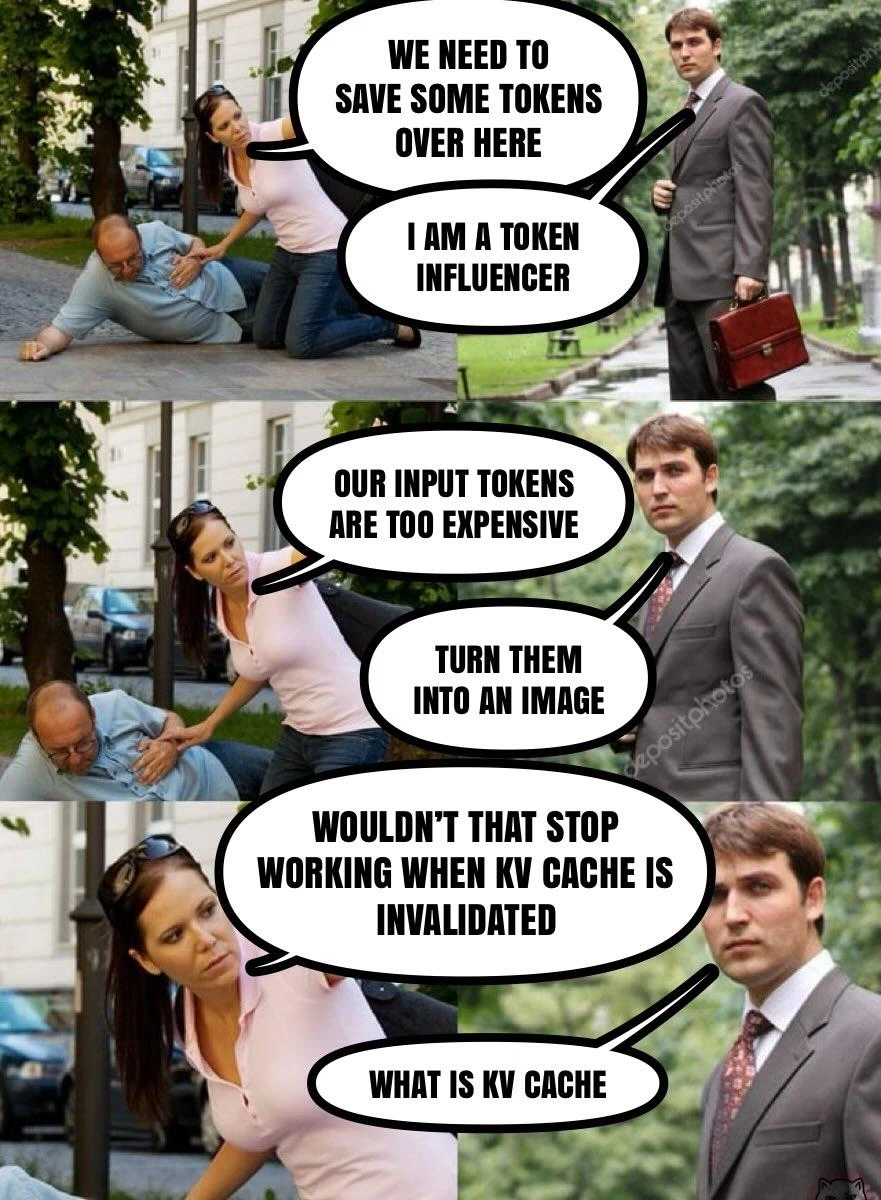
The three panels stage token optimization as a medical emergency. A woman kneels beside a fallen man and announces WE NEED TO SAVE SOME TOKENS OVER HERE, while a suited passerby with a briefcase declares I AM A TOKEN INFLUENCER. His prescription is wonderfully confident:

OUR INPUT TOKENS ARE TOO EXPENSIVE
TURN THEM INTO AN IMAGE

Then the camera closes in, the woman asks whether it would stop working when the KV CACHE IS INVALIDATED, and the expert brand evaporates into WHAT IS KV CACHE. The faint stock-photo watermarks make the whole consultation look appropriately optimized for production.

The advice closely resembles text-as-image prompt compression schemes: render large system prompts, tool descriptions, logs, code, or old conversation history as dense images and send those images to a multimodal model. The image does not name a particular tool, so that connection is an inference, but the economics are recognizable. Text pricing usually grows with text-token count, whereas image input may be converted into a number of visual tokens determined largely by dimensions, tiling, or patches. Packing many characters into a fixed canvas can therefore reduce the billed input units for some model and provider combinations.

It is not token elimination. A vision encoder turns image regions into embeddings or visual tokens that the language model can attend to. The representation is merely different and potentially denser. That density is also lossy: small punctuation, whitespace, Unicode, paths, hashes, numbers, and nearly identical identifiers can be misread. In ordinary prose, one fuzzy word may be harmless; in code, confusing O with 0 is a feature request from the incident-response team.

The cache question reaches the real inference machinery. In transformer attention, each layer projects hidden states into queries, keys, and values:

$$ Q=XW_Q, \qquad K=XW_K, \qquad V=XW_V $$

and computes attention using the relation between $Q$ and the prior $K,V$ states. During autoregressive generation, the keys and values for earlier positions do not need to be recomputed. The runtime stores them in the KV cache and calculates only the new position's projections while attending over the cached history. This exchanges memory for much faster generation.

Two uses of “cache” are often mixed together:

  • Decode-time KV caching reuses prior states within one generation so every new output token does not reprocess the entire sequence.
  • Prefix or prompt caching reuses KV blocks across requests when they begin with the same stable prefix, such as identical system instructions and tool definitions.

For prefix reuse, identity matters. If a proxy redraws the entire conversation as one new image on every turn, the image bytes or embeddings change and the prefix may no longer match. The server must run prefill again, rebuilding keys and values for the prompt. A large cache discount and a time-to-first-token advantage can disappear, potentially outweighing the image's lower nominal token count.

However, WOULDN'T THAT STOP WORKING WHEN KV CACHE IS INVALIDATED is directionally sharp rather than universally literal. A cache miss does not prevent the model from reading the image; it forces recomputation. The image method may still save money on a cold request if that provider bills the visual representation more cheaply. Conversely, a deterministic image containing stable content can itself participate in multimodal prefix caching when the serving system supports it. A careful design keeps unchanging image pages at the front and appends volatile per-turn text afterward. The correct answer is therefore “measure the same workload under the same cache state,” which is difficult to fit in a speech bubble and fatal to influencer engagement.

This is also why cloud cost optimization cannot stop at a token counter. A fair comparison includes:

Dimension Plain text Text rendered as image
Representation Exact tokenizer output Model-specific visual encoding
Cache reuse Strong with an unchanged prefix Strong only if image blocks remain stable and supported
Exact recall Usually preserves characters Can silently misread dense details
Prefill cost Based on text tokens and cache tier Based on image accounting and cache tier
Other cost Larger prompt sequence Rendering, upload, vision encoding, larger payload
Portability Broad across language models Depends on multimodal model and provider pricing

Output and hidden reasoning can dominate some workloads; repeated agent turns can make cached-input pricing decisive in others. Provider pricing can also change and close a representation arbitrage overnight. The useful benchmark is end-to-end task success, latency, and actual invoice cost—not a screenshot showing fewer input tokens while the model quietly miscopies a deployment key.

The meme's deeper target is AI hype versus systems knowledge. “Token influencer” is a perfect title for someone who knows the unit shown on a billing page but not the computation that gives it meaning. The woman is trying to save a collapsed system; the man optimizes the most visible metric and walks directly into cache invalidation, one of computing's traditional ways of reminding everyone that context matters.

Description

A three-panel stock-photo meme shows a woman kneeling beside a fallen older man while a suited businessman carrying a briefcase walks past; large white speech bubbles and faint Depositphotos watermarks overlay the scene. In the first panel she says, "WE NEED TO SAVE SOME TOKENS OVER HERE," and he replies, "I AM A TOKEN INFLUENCER"; in the second she says, "OUR INPUT TOKENS ARE TOO EXPENSIVE," and he advises, "TURN THEM INTO AN IMAGE." The final close-up has her ask, "WOULDN’T THAT STOP WORKING WHEN KV CACHE IS INVALIDATED," to which he responds, "WHAT IS KV CACHE." The joke punctures superficial AI cost-optimization advice by contrasting a flashy multimodal token hack with the deeper inference economics of prefix reuse and key-value caching.


Comments

1
Anonymous ★ Top Pick There are only two hard problems in AI: cache invalidation, token pricing, and influencers who can’t count.
  1. Anonymous ★ Top Pick

    There are only two hard problems in AI: cache invalidation, token pricing, and influencers who can’t count.

Use J and K for navigation