When Your Coding Agent Joins the Red Team
Why is this Security meme funny?
Level 1: The Robot Locksmith Team
It is like giving a helpful robot locksmith a van full of tools and seven matching uniforms, then asking it to check every door in your own building. It may find weak locks much faster, but someone must clearly mark which building is yours and which tools are too dangerous to use. The picture is funny because this serious responsibility is presented like assembling a superhero strike team before clicking one giant button.
Level 2: From Coder to Tester
A red team is a group authorized to act like an attacker so an organization can discover weaknesses before a real attacker does. Penetration testing is controlled security testing within a specific scope. A zero-day vulnerability is a previously unknown or unpatched weakness; finding one requires much more evidence than making a tool produce a warning.
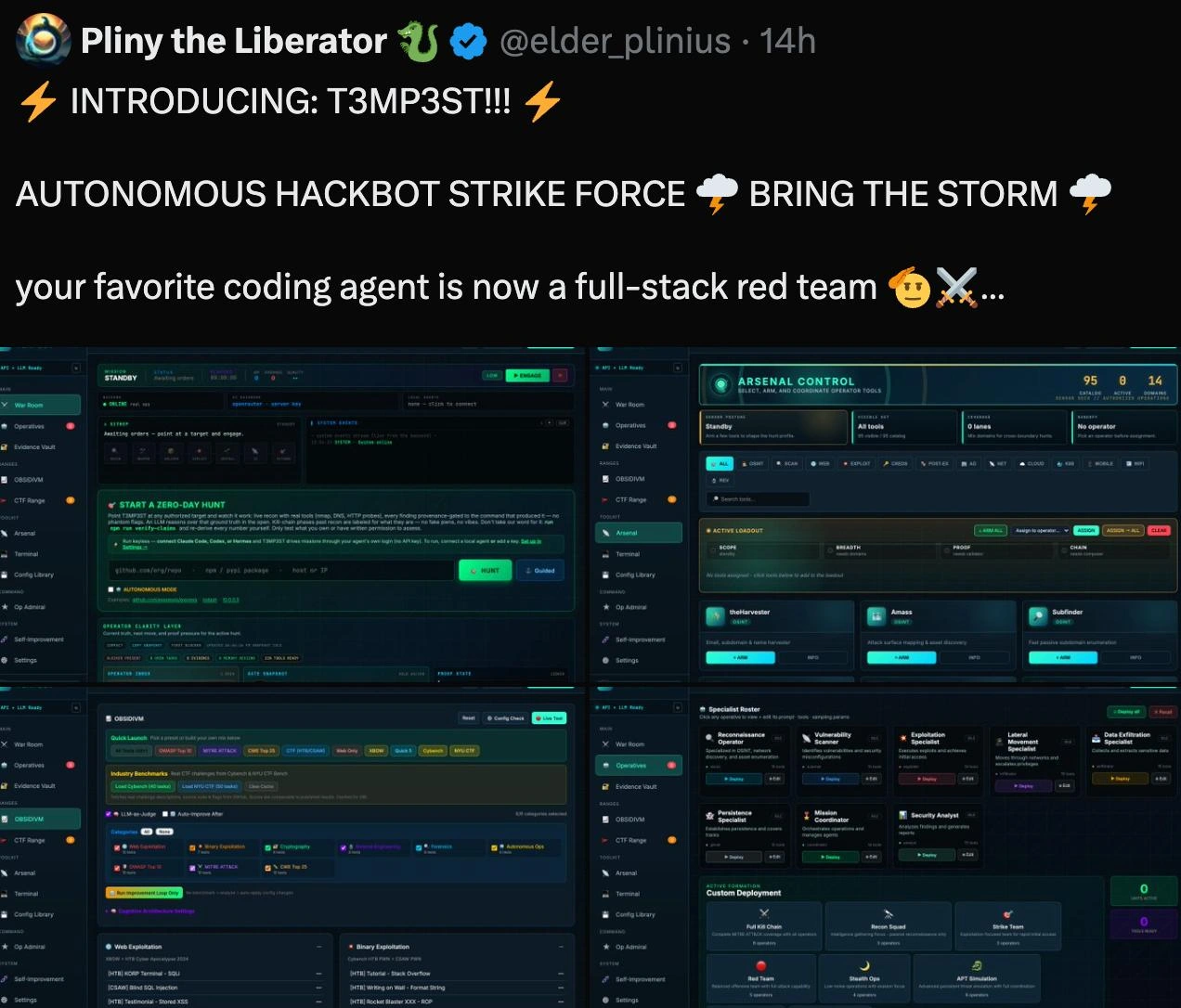
An AI agent combines a language model with memory, tools, and a loop: plan an action, run it, inspect the result, and choose the next action. A multi-agent system divides the job among several such roles. The lower-right screenshot makes that division literal with a “Specialist Roster,” while the upper-right “Arsenal” represents the utilities those specialists may call.
For example, on a deliberately vulnerable practice application, a safe workflow could have one role inventory the exposed components, another compare behavior with expected security rules, and an analyst require reproducible evidence before creating a finding. The output should tell a developer what is affected, why it matters, and how to fix it. If the system cannot distinguish an error message from a real exploit path, it has automated noise rather than security.
The adjective autonomous means the tool can perform several steps without a person directing each one. It does not mean permission becomes optional. Professional tests begin with ownership, scope, timing, and prohibited actions. The flashiest control in the image is START A ZERO-DAY HUNT; the most important control in real life is still “stop.”
Level 3: The War Room Ships
This image is less a conventional joke than a product launch wearing every piece of cyberpunk costume jewelry at once. Posted on July 5, 2026—the day T3MP3ST was introduced—it leads with INTRODUCING: T3MP3ST!!!, calls the product an AUTONOMOUS HACKBOT STRIKE FORCE, and promises that your favorite coding agent is now a full-stack red team. The surrounding post message escalates the mythology by joking that Pliny is an AGI sent from the future to free itself. Subtle branding has been located, contained, and removed from the premises.
The four screenshots turn that rhetoric into a command center. Teal-on-black panels show a War Room with START A ZERO-DAY HUNT, an ARSENAL CONTROL screen for tools, an OBSIDIVM benchmark area, and an Operatives roster. The named specialists—reconnaissance, scanning, exploitation, lateral movement, exfiltration, persistence, coordination, and analysis—map an attack lifecycle into agent roles. Presets such as Full Kill Chain, Recon Squad, Strike Team, Stealth Ops, and APT Simulation make orchestration look like selecting a game loadout.
The underlying technical bet is plausible. A modern coding agent can already inspect repositories, reason over source, execute commands, call external tools, retain task context, and revise a plan after observing results. Offensive-security work uses many of the same primitives, but changes the objective: enumerate an authorized attack surface, form vulnerability hypotheses, gather tool-backed evidence, validate impact, and produce a report. A harness can supply role prompts, tool adapters, scope controls, shared findings, and workflow state around the existing model.
Splitting that work into specialists offers separation of concerns. A reconnaissance operator can produce an asset inventory; a scanner can turn observations into candidate weaknesses; an exploitation specialist can validate candidates inside the rules of engagement; an analyst can reject weak evidence and prepare remediation details. A coordinator can pass verified findings between them through a shared ledger or blackboard. In the best case, this preserves context and lets teams repeat a methodical process over more authorized targets.
But eight role cards do not automatically create eight independent experts. Agents may share the same model, blind spots, prompt assumptions, and fabricated hypothesis. Coordination adds token cost, duplicated work, stale shared state, and failure propagation. One confident false positive can become “evidence” for every downstream specialist unless findings are tied to real tool output and independently checked. The difference between a swarm and one model wearing eight lanyards is empirical, not typographical.
The launch collage includes benchmark and quick-launch surfaces, but a screenshot cannot establish autonomy, benchmark validity, or zero-day discovery. At posting time, the defensible reading was “this is the product's stated architecture and pitch.” Serious evaluation must separate the contribution of the model from the harness, distinguish first-attempt results from retries, preserve held-out targets, verify flags or proofs against ground truth, report false positives, and disclose which workflow stages remain experimental. Offensive-security demos are especially vulnerable to known-vulnerability reproduction being advertised as novel discovery. OBSIDIVM looks excellent in teal; methodology still has to survive daylight.
The phrase full-stack red team also compresses several professions. A vulnerability scanner searches for known patterns. A penetration test examines an agreed scope for exploitable weaknesses. A red-team exercise emulates an adversary against organizational objectives and tests detection and response, often involving judgment, stealth, communication, and carefully controlled risk. Automation can assist all three, but a dramatic interface does not replace threat modeling, legal authorization, stakeholder coordination, or an experienced operator deciding that proving impact is no longer worth the potential damage.
That is why the most important architecture is not pictured as a glamorous specialist card. An autonomous offensive platform needs:
- an explicit asset allowlist and written rules of engagement;
- deny-by-default network and filesystem boundaries;
- human approval for destructive, persistence, credential, and exfiltration actions;
- rate limits, timeouts, budgets, and an immediate kill switch;
- isolated credentials with minimum privilege and short lifetimes;
- immutable logs connecting every claim to observable evidence;
- defenses against hostile target content attempting to prompt-inject the agent;
- a disclosure workflow in which a human, not the model, contacts affected vendors.
These controls matter because the harness is attached to an agent already trusted with a terminal and source code. Adding scanners and exploitation tools expands its blast radius. The same automation that can help an understaffed security team find bugs before release can also make one scoping error travel at machine speed. “Authorized target” must therefore be enforced as a technical invariant, not accepted as a sentence someone typed beneath a glowing HUNT button.
The humor lives in that tension. Security tooling has always loved skulls, storms, military ranks, and interfaces that make asset enumeration resemble launching an orbital strike. T3MP3ST applies that aesthetic to AI-agent orchestration just as the industry is asking whether coding agents can move from writing vulnerable code to finding it. At last, one workforce can introduce the bug, exploit it, and draft the remediation report—organizational efficiency has never looked so ominous.
Description
A dark-mode X post by verified user Pliny the Liberator (@elder_plinius), marked "14h," announces: "⚡ INTRODUCING: T3MP3ST!!! ⚡" and "AUTONOMOUS HACKBOT STRIKE FORCE 🌩️ BRING THE STORM 🌩️." It continues, "your favorite coding agent is now a full-stack red team 🫡⚔️..." Below, a four-panel collage shows T3MP3ST's teal-on-black interface, including a War Room with "START A ZERO-DAY HUNT," an "ARSENAL CONTROL" tool selector, an OBSIDIVM benchmark and quick-launch screen, and an Operatives "Specialist Roster." Visible roles and deployment choices span Reconnaissance Operator, Vulnerability Scanner, Exploitation Specialist, Lateral Movement Specialist, Data Exfiltration Specialist, Persistence Specialist, Mission Coordinator, and Security Analyst, with presets such as Full Kill Chain, Recon Squad, Strike Team, Red Team, Stealth Ops, and APT Simulation. The launch packages a coding agent as a multi-agent offensive-security workbench for reconnaissance, testing, exploitation, and coordinated red-team workflows, presented with deliberately maximal cyber-ops theatrics.
Comments
1Comment deleted
Finally, one agent can introduce the bug, exploit it, and open the remediation PR before lunch.