Skip to content
DevMeme
411 of 7435
A Junior Developer's Baptism by Legacy Code
Juniors Post #478, on Jul 16, 2019 in TG

A Junior Developer's Baptism by Legacy Code

Why is this Juniors meme funny?

Level 1: Muddy Welcome

Imagine you just joined a group, and on your very first day they ask you to do the grossest chore that nobody else wants to do. Let’s say there’s a big puddle of muddy, yucky water in the backyard, and it’s full of old toys and junk. All the older kids or the ones in charge stand around smiling while they tell you, the new kid, “Go ahead, jump in and clean it up!” You want to make a good impression, so you wade in, but pretty soon you’re knee-deep in muck, pulling out slimy things, and it’s all over you. It feels unfair and overwhelming, right? They’re basically making you do the hardest, nastiest job as a way to “welcome” you.

That’s what’s going on in this picture and caption. The new person (junior developer) is being given the messiest task in a computer program (the “legacy code” is like that muddy puddle – old and dirty). The experienced person knows it’s a tough, unpleasant job – just like cleaning that mud pit – but they let the new person do it anyway, almost like an initiation prank. It’s funny in a teasing way because the new person probably has no idea how messy it’s going to get, and the experienced folks do. They’re basically saying, “Welcome to the team, now prove yourself by handling this big mess we’ve been avoiding!” It’s the tech equivalent of an older sibling tricking the younger one into doing a yucky chore.

So, the meme is comparing fixing old, messy code to getting dunked in mud as your first experience. It’s a joke about a rough start that a lot of people in programming can relate to – a funny way to say “sometimes being new means you get the dirty jobs.” Even if you haven’t written code, you can understand the feeling: being new somewhere and immediately getting a task that’s a total mess. It’s like being forced to take a mud bath when you thought you were just going to a pool party. It might make you laugh a bit, because you can picture how absurd and uncomfortable that is. In the end, the “muddy baptism” is an exaggeration to make us smile about a situation that’s usually frustrating in real life. It’s saying: being the new guy can be tough, and sometimes you literally get all the muck dumped on you!

Level 2: Sink-or-Swim Onboarding

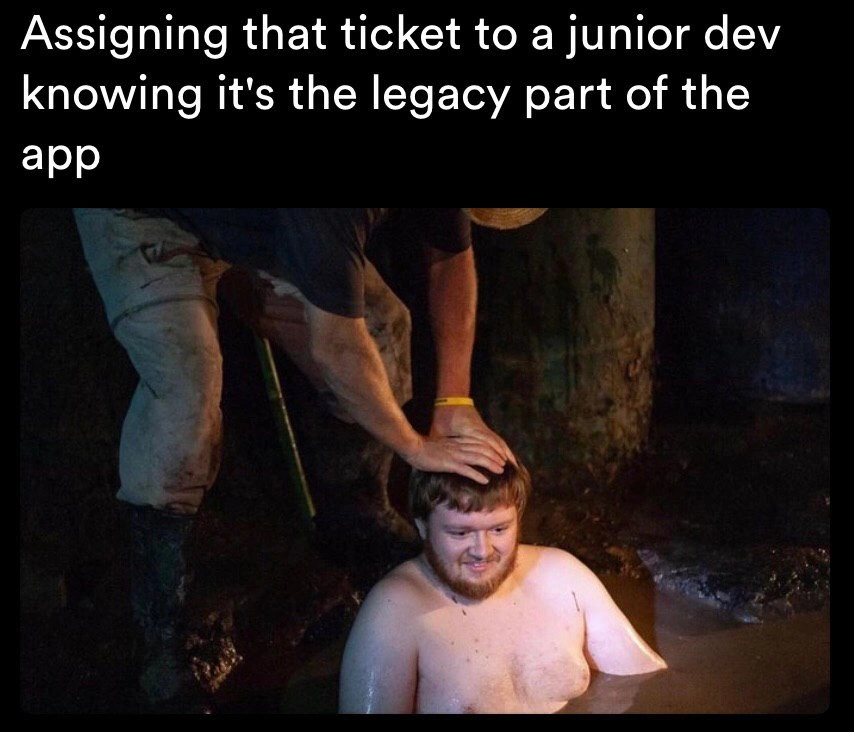
Let’s break this down for a less-experienced developer or someone newer to these concepts. The meme shows a senior person (standing, wearing mud-covered wading pants) performing what looks like a muddy baptism on a younger person who’s kneeled in filthy water. The text says: “Assigning that ticket to a junior dev knowing it’s the legacy part of the app.” In plain terms, a “ticket” here means a task or bug report tracked in the team’s system (like Jira, Trello, or GitHub issues). So, a manager or senior developer is giving a junior developer a task. But it’s not just any task – it’s one in the legacy part of the application.

Now, legacy part of the app refers to an old section of the software. Legacy code generally means code that was written a long time ago (relative to the fast pace of tech) and is still in use, even though it might be outdated or of lower quality by today’s standards. Think of it as an old, creaky part of a house: it still stands and people live in it, but the floorboards are rotting and no one’s sure how the plumbing works anymore. In software, legacy code might have been written using old frameworks or practices that are no longer common. It might not follow the current team’s coding standards. Importantly, it often lacks proper documentation (explanatory text or guides) and might not have been thoroughly tested. In other words, it’s fragile and hard to work with.

So why is giving a junior developer a legacy task seen as funny (and a bit cruel)? Imagine being new on a job and being asked to fix something in a part of the codebase that even the experienced folks are afraid to touch. The junior developer likely has little context – they weren’t around when that legacy code was written. They probably don’t know the older technology or weird quirks of that module. It’s a bit like asking someone who just learned to drive to go maneuver an old, broken-down truck on a rocky mountain road with no map. It’s overwhelming and quite possibly dangerous (to the codebase, anyway).

The meme compares this situation to a baptism, but not a nice clean one – a mud baptism. Baptism by fire is a phrase that means being thrown into a difficult situation to learn quickly. Here, baptism by mud emphasizes how dirty and messy the experience is. The junior dev is being “initiated” or welcomed to the team by being dunked into the messiest situation possible: the legacy code. It’s an extreme form of an onboarding challenge. (Onboarding is the process of integrating a new employee into a team, usually involving training and first tasks.)

This is sometimes called a “sink or swim” approach. The phrase sink or swim comes from the idea of throwing someone into deep water with no support: they will either figure out how to swim (survive) or they’ll sink (fail). In a work context, sink-or-swim onboarding means giving newcomers very challenging tasks right away to see if they can handle them. Here, the “deep water” is the confusing legacy code. They either manage to fix the issue (swim) or get overwhelmed by it (sink). It’s a tough-love training method – not everyone agrees with it, but it does happen.

Let’s clarify some terms that show up in discussions of legacy systems:

  • Technical Debt: This is a metaphor in software. When developers take shortcuts or write quick-and-dirty code to solve a problem fast (often to meet a deadline), it’s like taking on debt. In the future, that code will cost extra time to fix or improve – you “pay back” that debt with interest. The legacy part of the app likely has a lot of technical debt, meaning it’s full of things that should have been refactored or cleaned up long ago but weren’t. Now it’s harder to change anything without causing problems, just like debt making future work harder.
  • Spaghetti Code: This is a slang term for code that is tangled and complex, with a messy structure. It’s like a bowl of spaghetti noodles – hard to follow one strand from start to finish. Spaghetti code often has lots of interdependent pieces, goto statements or overly complicated loops, and it doesn’t follow a clear modular design. The meme’s reference to the “legacy part” of the app suggests it might be full of spaghetti code, where the junior will struggle to make sense of it.
  • Legacy System/App: A software system that is still in use but was developed in the past. It often runs on older technology or has old design patterns. Many businesses have legacy systems (for example, a bank might still run a COBOL program from the 1970s for core banking operations!). In this meme’s case, the legacy part of this app might not be quite that old, but it’s old enough that current developers treat it warily. They might even joke about it being “from another era.”
  • Management/PM: The meme hints that sometimes project managers (PMs) or team leads assign these tasks. Maybe your boss or lead says, “Alright, we have a bug in the old payment module, let’s give it to our new junior dev.” The humor (and frustration) here is that management might not realize (or might willfully ignore) how hard that task really is. From their perspective, a bug is a bug – why not have the junior handle it? But the team’s senior developers know that module is a minefield.

For a junior developer reading this, you might wonder, “Why would they do this to a newcomer?” In reality, good teams try not to! Ideally, a new developer gets gradually introduced to a system, maybe fixing smaller issues in safer parts of the code first, and they get mentoring. However, in some teams – especially if they’re under-staffed or swamped with work – the reality is exactly as the meme describes: the hardest, ugliest tasks fall to whoever is lowest in the pecking order. It can also happen accidentally: perhaps the importance or difficulty of the legacy code task was underestimated, and they gave it to the junior without realizing it would be like solving a muddy puzzle.

The meme is funny to developers because it exaggerates this scenario as a form of initiation. It’s depicting a kind of twisted welcome ritual: “Welcome to the team, now endure this suffering that we’ve all been through.” The muddy water in the photo stands for the messy code. The person pressing down is the one assigning the task, essentially saying “go on, get in there!” with a pat on the head. And the junior dev (the person being dunked) has an awkward smile, probably thinking “oh no…” but going along with it, because they’re new and want to make a good impression.

Let’s also talk emotionally: if you’re a new developer and this happens, you might feel overwhelmed and maybe even a bit set up. The task might be way over your head initially. You might struggle to even get the legacy part of the app running on your machine. (Legacy software can have very specific setup steps or require old versions of libraries that are a pain to install.) You’ll likely spend a lot of time reading code that doesn’t make sense, trying to find clues (like comments or commit history) about how things work. It can be frustrating, like groping in the dark. Many developers recall their first year on the job having at least one assignment where they felt utterly lost in a sea of someone else’s code. That’s why the meme is also tagged as DeveloperPainPoints and RelatableHumor – it’s relating a common pain in a humorous way.

One common scenario: the junior dev might ask, “Is there any documentation for this part?” and the answer will be a laugh or “No, just what’s in the code.” If they ask, “Who wrote this originally?” they might hear, “Oh, some developer who left 5 years ago,” meaning no one currently around fully understands it. This is the poor knowledge transfer mentioned: the knowledge about that legacy code wasn’t passed on, so now it’s like a mystery. The junior has to become a detective. They might use tools like git blame to see the last edits (only to find very old dates and unfamiliar names). They might try to run the app and get errors because environment variables or config files are missing (typical in legacy setups). This trial and error process is how they slowly learn – hence management calling it a “learning opportunity.”

The “mud baptism” metaphor also implies that it’s a messy learning experience. You’re going to come out of it with a lot of lessons learned, but you’ll probably be exhausted and a bit dirty from the ordeal. Yet, after surviving it, a junior developer might actually gain a ton of knowledge about the system’s inner workings (and maybe some battle scars 🥴). In some teams, overcoming such a challenge earns you respect – you proved you can handle the tough stuff. That’s the “initiation” aspect: now you’re one of us. Of course, it’s also a warning: this is what we deal with here, be prepared!

So, in simpler summary of this level: The meme is saying that giving a new developer a task in the old, messy part of your application is like dunking them in mud as a baptism. It’s a humorous way to talk about how senior developers or managers sometimes make juniors deal with the worst code, intentionally or not. And it points out the tech debt and legacy code issues that cause that part of the app to be so dreaded in the first place. It’s both a joke and a little cautionary tale about how not to treat your new team members (unless you enjoy the twisted tradition of “I suffered through it, so the next person should too”). If you’re a junior dev, don’t worry – not every team does this, and even if you do get thrown into the mud, you will learn a lot from digging your way out. Just maybe keep a towel (or a senior mentor) handy!

Level 3: Baptism by Tech Debt

At the highest level of technical humor, this meme captures a darkly comic truth in software development. The image of a literal mud baptism perfectly symbolizes what it's like assigning a LegacyCode ticket to an unsuspecting junior developer. In the meme, a senior (or perhaps a project manager in muddy waders) presses down on a junior’s head, dunking them into a pit of muck. Translated to coding terms: a seasoned engineer or PM is effectively submerging a newbie into the murkiest depths of a legacy system. This scenario is a rite-of-passage on some teams – a baptism by TechnicalDebt. The humor here is biting: everyone who’s been around legacy systems knows that giving a junior the “honor” of fixing the crusty old part of the app is like initiating them with a trial by sludge. DeveloperHumor often points out uncomfortable truths. In this case, the truth is that maintaining LegacySoftware can be a grimy ordeal, and who better to hand it to than the fresh hire who doesn’t yet know what lies beneath the surface?

From a senior developer’s perspective, this combination of elements is funny because it’s painfully relatable. The senior in the picture has a knowing stance – one hand firm on the junior’s head – just as a tech lead might have a knowing smirk when assigning a dreaded legacy bug fix. Why is it dreaded? Legacy parts of an application are typically the undocumented sections of code written eons (in tech years) ago, full of quick fixes and fragile logic. Picture a module last touched in 2010, written in an outdated framework, with no tests and cryptic comments (if any). Every experienced dev on the team is aware that messing with it could unleash a cascade of new bugs. This is the “brittle module” everyone whispers about. But when something finally needs to be done — a bug to fix, a feature to bolt on — nobody volunteers. Managers eye the new hire with a grin. It’s a sink-or-swim onboarding strategy: “Welcome aboard! Time to earn your stripes in the undocumented_spaghetti_zone of our codebase.” The meme nails this ironic situation: the poor junior is about to get baptized in mud, i.e., dunked into dirty legacy code, while the senior essentially says “Good luck, kid.”

This practice is an open secret in many organizations. Offloading risky, high-unknown tasks onto the least experienced developer is an anti-pattern, yet it persists. Why? Partly because no one else wants to take a dip in that mud if they can avoid it. TechnicalDebt has a way of scaring off folks who've been burned before. The legacy part of the app might have been patched together under a tight deadline years ago. It’s now a fragile Jenga tower of quick fixes. The original authors have long since moved on (or repressed the memory). There’s likely zero documentation explaining how it truly works. Touch one piece and the whole stack might teeter. This is the domain of LegacySystems maintenance – a domain often handed to newcomers under the euphemism of a “learning opportunity.” The humor is in how transparently unfair this is, yet how common. Seasoned devs swap war stories about “my first task was updating a 15-year-old report generator written in Visual Basic with no docs; I basically swam in mud for a month.” This meme resonates because it exaggerates that scenario to an initiation ritual: you haven’t truly become part of the team until you’ve slogged through the dirty legacy code and emerged (if you’re lucky) on the other side.

Let’s unpack some of the technical pain points being satirized: “legacy part of the app” implies code running on old frameworks, possibly with deprecated functions or ancient dependencies. It’s the code that nobody has refactored because “it still sort of works” and “we’ll rewrite it next year” (famous last words in software teams). Over time, this code accumulates TechnicalDebt interest: small hacks layer into big kludges. Changing one line could unexpectedly break functionality in a completely different part of the system, because the design is a tangled web. That’s why working on it is risky. The senior assigning the ticket knows all this. The junior does not — yet. The image’s energy (“I know this will be rough for you, but it has to be done”) captures that imbalance of knowledge. We have a classic SeniorVsJuniorDevelopers dynamic: the senior has survived previous battles with the legacy monster and now stands safely on the bank (in waders!), while the junior is literally neck-deep in the problem. It’s hazing, tech edition.

In real-world scenarios, this could play out like: a new developer joins, eager to prove themselves. The team immediately hands them Issue #257 – an elusive bug in the oldest module. Perhaps it’s the accounting module that none of the current team wrote, but it’s throwing incorrect totals at year-end. “It should be a quick fix,” the manager says. The junior soon discovers a labyrinth of functions calling functions, global variables that mysteriously toggle behavior, and maybe a comment from 2008: // FIXME: this is a temporary hack. Sound familiar? The code might even be in a language or framework the junior has never seen – imagine expecting modern React or Node.js, and getting a dusty jQuery soup or a Perl script. It’s a baptism by fire… or rather by mud, since it’s murky and gross. The grossness is both literal (mud water in the image) and figurative (the ugly state of the legacy code).

To make matters worse, legacy code often lacks modern safeguards. Perhaps there’s no version control history that makes sense (the git blame might point to an author named “admin” on the initial commit – super helpful), or no one wrote unit tests back then, so the junior has no safety net. Any change is a guess-and-check game in production. That looming risk adds to the comedic tension: everyone on the sidelines (the senior devs) know that one wrong move could break the app at 3 AM. In fact, the CynicalVeteran in me is thinking: “Go ahead, assign the junior that legacy ticket. I’ll be sipping coffee at 3 AM when it pages the on-call – which this week happens to be… the junior.” DeveloperPainPoints indeed! The meme exaggerates it as a ritual, but a lot of teams have this very real pattern where the newest developer becomes the de facto maintainer of the nastiest code. If they survive, congrats – they’re part of the club (and possibly now stuck as the expert on that part, a mixed blessing).

We also see an element of ManagementHumor here. Project managers might not fully grasp how bad the legacy mess is. They just see an open ticket and a free engineer. They might assign it thinking, “John is new and looking for tasks, let’s have him handle this old bug.” Little do they know they’ve initiated John into the Order of the Muddy Codebase. The senior engineers exchange glances but say nothing – perhaps out of dark amusement or relief that they aren’t the ones diving in. In some cases, a senior actually is the one assigning the task, either out of tradition (“I did my time in the swamp, now it’s your turn”) or because they want to avoid it themselves. It’s a form of tech hazing. The meme’s photo looks like a grim ceremony, and that’s exactly how these assignments feel: hereby we anoint you as our Legacy Module Maintainer; may God have mercy on your soul. The senior pressing down on the junior’s head parallels the power imbalance – the junior has little choice but to accept the task, trusting their seniors, much like an initiate trusts the priest performing a baptism (except this priest is half-smirking and the water’s filthy).

To illustrate how these conversations often go, consider the euphemistic language used versus reality:

When they say... It really means...
“It should be a quick fix.” It’s never quick; the code is a minefield.
“We need your help on this old module.” Everyone else refused to touch it.
“Good chance to learn the system.” Trial by fire (or rather, by mud).
“Let me know if you have questions.” There are no docs, so you’ll have plenty of questions.

The humor lands because every experienced dev reads those lines and nods knowingly (perhaps with a chuckle or a wince). This is RelatableHumor in the tech world: we laugh so we don’t cry. The phrase “mud baptism” itself is just a colorful twist on the old saying “baptism by fire.” In a baptism by fire, you’re thrown into a difficult situation without preparation. Here, it’s the same idea but emphasizing how dirty and unpleasant the legacy code situation is. Muddy water gets all over you; likewise, legacy code’s problems tend to stick to you. After wrestling with it, a junior dev might come out feeling mentally and emotionally covered in muck — perhaps having introduced a few new bugs (mud splashes) along the way. And just like a real mud bath, it’s an experience you won’t forget, even if you’d rather not repeat it!

On a more systemic note, this meme highlights the issue of TechnicalDebt and poor knowledge transfer. Why do such messy legacy parts even exist? Often, it’s due to shortcuts taken long ago – maybe to meet a deadline or because of outdated practices. Those shortcuts accumulate into debt that someone eventually has to pay off. But instead of a structured pay-off plan (like dedicated refactoring or proper documentation efforts), companies often let that debt linger until things get critical. Then a junior dev is tasked with a “simple fix” which is anything but simple. The poor newcomer ends up doing software archaeology, digging through layers of sedimented code history. They might unearth functions no one called in years, or configuration files with comments in languages they don’t speak. It’s truly like exploring a swampy ruin. Meanwhile, the organization hasn’t invested in proper onboarding for this code, so the junior is alone with their flashlight (or IDE) in the dark. The shared trauma among developers comes from exactly these scenes – hence the meme’s popularity.

In summary (for the senior-level understanding): this meme is a satirical nod to the practice of throwing a junior developer head-first into a legacy system rife with technical debt. It’s funny in a grim way because it’s true to life. The mud baptism imagery exaggerates the sink-or-swim onboarding many of us have experienced, where solving a legacy ticket feels like being swamped by mud. Every element – the senior pressing down (management assigning the task), the murky water (spaghetti code and debt), the kneeling junior (the new dev with no context) – aligns with a real DeveloperPainPoint. Those of us who have trudged through legacy sludge find this both hilarious and horrifying. We laugh at the meme, perhaps while recalling our own baptism moment (and maybe plotting gentle revenge by eventually passing the mud bucket to the next new hire 😈).

// Example of what a junior might find in that legacy code:
int processData(Item* item) {
    if(globalFlag && item != NULL) {
        runLegacyProcess(item);   // globalFlag comes from who knows where, no docs
        status = 1;
    } else {
        goto cleanup;            // using goto for flow control - spaghetti alert!
    }
    // ... many more lines of convoluted logic ...
cleanup:
    return status;  // status is a global or static variable, possibly modified elsewhere
}
// This snippet illustrates the kind of cryptic, fragile code ("spaghetti code") 
// that lurks in legacy systems, complete with mysterious globals and gotos.

Above: A tongue-in-cheek pseudo-code snippet showing the sort of spaghetti code a junior might encounter. Global flags, mysterious side effects, even a goto statement (considered harmful in modern practice) – it’s all the hallmarks of a legacy undocumented_spaghetti_zone. One can imagine our junior dev scanning this in horror, much like being submerged in mud without a clear view. The code is as murky as the water in that pit: you’re not quite sure what’s underneath, but you have a sinking feeling it’s not good. This is the kind of code where a one-line change could inadvertently send execution into a completely different path (goto cleanup jumping around), much like stepping into a hidden sinkhole in a swamp.

Ultimately, the meme’s punchline lands because it’s a shared insider joke: Management_PMs and seniors might call it “assigning a ticket,” but the dev community jokes it’s more like a mud baptism. It’s an initiation ritual that every programmer fears but many inevitably experience. You can almost hear the senior figure in this image intoning solemnly, "By the power vested in me by the product deadline, I hereby anoint you maintainer of Module X. May you return with fewer bugs… or at least alive." And the junior, like the poor soul half-submerged, wears a strained smile, thinking “What have I gotten myself into?”. In classic developer humor fashion, we’re laughing at this scenario because if we didn’t, we might just cry.

Description

A meme consisting of a caption and a reaction image. The caption at the top reads, 'Assigning that ticket to a junior dev knowing it's the legacy part of the app'. Below is a dimly lit photograph depicting a man, shirtless with a beard and reddish-brown hair, submerged up to his chest in murky, dark water. He has a resigned, slightly pained smile on his face. Another person, wearing waders, is standing over him and placing a hand on his head in a gesture resembling a baptism or an initiation. The meme serves as a powerful metaphor for a common rite of passage in software development: a senior developer assigning a junior developer a task in the most dreaded part of the codebase. The 'legacy' system, like the muddy water, is opaque, difficult to navigate, and full of hidden problems. This act is often seen as a trial by fire, a way for new developers to prove their mettle by tackling the unglamorous but necessary work of maintaining old, poorly documented, and technically indebted code
Comments

7
Anonymous ★ Top Pick It’s not hazing, it’s 'accelerated domain knowledge transfer.' The junior emerges with a deep understanding of the system's darkest secrets, or they don't emerge at all
  1. Anonymous ★ Top Pick

    It’s not hazing, it’s 'accelerated domain knowledge transfer.' The junior emerges with a deep understanding of the system's darkest secrets, or they don't emerge at all

  2. Anonymous

    Every time I hand a junior a ticket in the legacy module, I feel like a priest of Tech Debt: “In the name of the monolith, the unmockable service, and the holy comment from 2006 - go forth and grep.”

  3. Anonymous

    Nothing builds character quite like discovering the original developer named every variable after Lord of the Rings characters and the only documentation is a README that says "TODO: add documentation" from 2009

  4. Anonymous

    Ah yes, the time-honored tradition of 'knowledge transfer' where senior engineers delegate the legacy monolith tickets to juniors under the guise of 'learning opportunities.' Nothing says 'welcome to the team' quite like being submerged in a 15-year-old codebase with no documentation, where the original authors have long since left the company, the business logic exists only in production behavior, and the last commit message reads 'fixed stuff.' It's not hazing if we call it mentorship, right? The junior emerges either battle-hardened and wise beyond their years, or updating their LinkedIn profile

  5. Anonymous

    Our onboarding ritual: assign a junior a Jira for the legacy module where the ORM is a stored procedure, the tests are nightly cronjobs, and git blame resolves to ‘retired’

  6. Anonymous

    When the ticket says 'easy win' but links to the 1998 monolith - may the gods of git blame have mercy

  7. Anonymous

    Baptism by monolith: give the junior a “quick win” in the legacy module - SVN checkout, EJB2, XML over JMS - and if they come up for air, congrats, they’re now the bus factor

Use J and K for navigation