Nobody Expects the Syntax Error
Why is this Bugs meme funny?
Level 1: Unexpected Surprise
Imagine you’re playing a game where you have to follow a very specific set of rules. Suddenly, you do something completely out of order – like making a move when it’s not your turn. The game master would stop you and say, “Whoa, I wasn’t expecting that move now!” In this meme, the computer is like that strict game master for coding. The programmer did something against the rules in the code (used a special shortcut in a spot where it wasn’t allowed), and the computer essentially said, “Uh oh, I didn’t expect that there.”
Now think about a silly surprise in a story. There’s a famous comedy skit where a group called the Spanish Inquisition always shows up when nobody expects them, which is exactly what makes it funny. They jump in out of nowhere and shout, “Nobody expects the Spanish Inquisition!” meaning it’s a total surprise every time. In our coding story, the computer’s error message basically said it found “SpanishInquisition” when it didn’t expect it – just like the joke. So it’s as if the code pulled a prank and even the computer went, “Wow, I didn’t see that coming!” The humor comes from the computer unintentionally quoting the punchline of that famous sketch. In simple terms: the programmer’s little mistake caused a big surprise, and everyone’s laughing because the way the computer reacted sounds just like the classic joke about unexpected Spanish Inquisition popping up.
Level 2: Go Syntax Gotcha
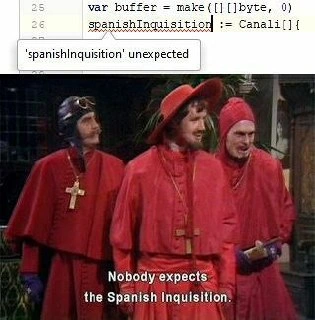
Let’s break down what’s happening in this meme in simpler terms. We have a Go program (Go is a programming language often called Golang) with the following code snippet:
var buffer = make([][]byte, 0)
spanishInquisition := Canali[]{}
On the first line, var buffer = make([][]byte, 0) is creating a variable named buffer. It calls Go’s built-in make function to create an empty slice of byte-slices (think of it like an empty 2D array of bytes). Using var buffer = ... at the top level is totally fine – it’s a proper variable declaration in Go.
The second line is where the trouble starts: spanishInquisition := Canali[]{}. Here, someone is trying to declare a new variable named spanishInquisition using the := shorthand assignment operator. In Go, := is a convenient way to declare and initialize a variable in one line without explicitly writing the type, but there’s a catch: this shorthand only works inside a function. (At the package or global scope, you have to use a normal declaration like var spanishInquisition = ... instead, or put that line inside a function.) In the meme, they tried to use := at the outermost level of the code file. When the Go compiler sees spanishInquisition := ... outside of any function, it gets confused because it’s not expecting an assignment statement there. Go’s syntax rules say that at the top level you should only have declarations (like var definitions, const constants, type definitions, and function declarations), not arbitrary statements.
As a result, the compiler throws an error before the program can even run. The error message 'spanishInquisition' unexpected basically means “I ran into the name spanishInquisition in a place I didn’t expect it.” The compiler was probably expecting to see a keyword like var or func at that point, but instead it found an identifier and a :=, which didn’t make sense there. In compiler terminology, “unexpected token” is like saying “this piece of code doesn’t belong here according to the language’s grammar.”
Now, here’s why the meme is funny. Monty Python is a famous British comedy group, and one of their most well-known sketches features characters called the Spanish Inquisition bursting into a scene unexpectedly. In that sketch, people are caught off guard and the Inquisitors shout, “Nobody expects the Spanish Inquisition!” It’s a comedic way of saying “surprise!” This phrase became a popular joke to reference whenever something surprising happens.
In our case, the computer’s error literally said the SpanishInquisition was unexpected. It’s as if the compiler itself set up the Monty Python punchline. The meme shows the actual Monty Python Inquisitors in their bright red robes in the bottom panel with the subtitle “Nobody expects the Spanish Inquisition,” to drive the joke home. Essentially, the code had a surprise in it (breaking a rule), and the compiler’s response unintentionally sounded like that classic comedy line.
For a newcomer, the key lessons here are:
- Know your language rules – Little syntax rules can matter. (Go, for example, won’t let you use
:=at the top level; you must use a propervardeclaration or move that code inside a function.) - Developers love pop culture references – Programmers often mix coding with classic jokes and memes (like Monty Python) to make learning from mistakes a bit more fun.
So the meme is combining a programming mistake with a famous comedy punchline. The Go compiler complained about an unexpected token, and that token just happened to be named in a way that completes the joke, “Nobody expects the Spanish Inquisition!” It’s a lighthearted reminder that even errors can be entertaining in the world of developer humor.
Level 3: Shorthand Surprise
From a seasoned developer’s perspective, this meme hits on multiple levels. First, there’s the Go language quirk itself: any Go veteran knows that the := operator (the shorthand assignment) is off-limits at the package scope. It’s meant for quick variable declarations inside functions. Try to use := at the top level of a Go file and the compiler will immediately complain – it's a rookie mistake that many of us made exactly once. The error you get in that scenario is phrased as a sudden syntax failure, often something like “unexpected X, expecting Y.” Here, the “X” happened to be the identifier spanishInquisition. So the compiler basically said it found “spanishInquisition” where it didn’t expect an identifier. The moment a Go-savvy dev sees that error snippet, they recognize the cause: someone tried to do a shorthand define outside a function, and the parser choked on it. It’s a subtle language quirk that can feel like a gotcha when you first encounter it.
Now layer on the Monty Python reference – that’s where the real developer humor kicks in. Monty Python’s famous sketch has the line “Nobody expects the Spanish Inquisition!” which is a beloved punchline in geek culture. Seeing the compiler literally say 'spanishInquisition' unexpected is like the computer unintentionally setting up the same joke. The Monty Python Inquisitor characters famously proclaim, “Our chief weapon is surprise!” – and sure enough, the compiler’s chief weapon here was also surprise, catching the developer off guard with a syntax error. The meme’s bottom panel shows those red-robed cardinals bursting in with the caption “Nobody expects the Spanish Inquisition,” directly tying into the compiler’s message above. It’s the perfect inside joke: you have to know Go and know Monty Python to fully appreciate why this is hilarious. When those of us in the developer community see that error and the matching subtitle, we immediately hear the Monty Python joke in our heads. It’s a classic case of meme culture intersecting with real-world programming woes. The compiler served up the straight line, and the meme delivers the punchline.
There’s also a bit of shared developer pain being acknowledged here. Compile-time errors can be frustrating (“Why won’t this code build?!”), especially when they boil down to a pesky rule like “no shorthand assignments outside functions.” By framing the error message in terms of Monty Python, the meme turns that frustration into laughter. It’s as if the compiler itself had a sense of humor, even though we know it’s really just following strict rules. For experienced devs, the juxtaposition is brilliant: a dry compiler error transformed into a Monty Python gag. This is coding humor gold — we laugh because we remember encountering similar “unexpected token” errors, and also because the absurdity of a 16th-century inquisitor troupe appearing in modern code is just too perfect. It’s the kind of joke you’ll excitedly share in the team chat, and then spend 5 minutes explaining to any junior devs who haven’t heard of Monty Python or that particular Go rule yet!
Level 4: Grammar Inquisition
At the most granular level, this meme highlights a quirk of the Go compiler’s parsing process. In compiled languages like Go, source code is processed by a lexical analyzer (lexer) and then a parser that enforce a formally defined grammar (often specified in a form like EBNF). The Go language grammar dictates what can appear at the top level of a source file versus inside function bodies. According to the Go specification, a short variable declaration (using the := operator) may only appear within a function body – never at package scope. When the compiler encountered the line go spanishInquisition := Canali[]{} at the top level, it violated these grammar rules. (For the Go compiler, using := outside a function is essentially a cardinal sin in the syntax, so it immediately halts and raises an error.) The parser was in the context of reading a top-level declaration and saw an identifier (spanishInquisition) followed by := where only a keyword-led declaration (like var, const, type, or func) was legal. This mismatch triggered a syntax error because the token sequence didn’t fit any production rule the parser could follow.
Compiler error messages for parse errors are often phrased as “unexpected token, expecting something else.” In this case, the error 'spanishInquisition' unexpected means the identifier spanishInquisition appeared at a point the grammar didn't allow – essentially, the parser found an unexpected token and had no valid way to incorporate it into the syntax tree. The message is generated automatically by the parsing logic: the compiler isn’t intentionally making a Monty Python joke, it’s simply reporting that “spanishInquisition” (the exact unexpected token it read) wasn’t expected by the grammatical rules. It’s an accident of naming that results in a comedic phrasing.
This reveals a bit about how compilers work internally. The parser moves through tokens according to rules akin to “TopLevelDecl = ConstDecl | TypeDecl | VarDecl | FuncDecl.” When it hit an identifier with a := at the top level, there was no valid path in the parse table / recursive descent logic for that construct, causing an error state. It’s a classic compile-time grammar violation, caught long before the code could ever run. Ironically, because the chosen variable name was spanishInquisition, the automatically generated error text overlaps with a famous comedic line. The strict language specification acted here like an unyielding inquisitor: it expects certain patterns and will not proceed when something deviates. The Go compiler’s arsenal (to paraphrase Monty Python) includes strict grammar enforcement, surprise errors, and an almost fanatical devotion to the spec. The outcome – 'spanishInquisition' unexpected – reads like a tongue-in-cheek comment on the situation. Even though the compiler is dead serious about enforcing rules, the result is unintentionally humorous. In other words, due to these formal syntax constraints, nobody (not even the compiler) expects the Spanish Inquisition in a Go program’s global scope.
Description
A two-panel meme that cleverly combines a programming error with a classic cultural reference. The top panel displays a snippet of code, likely Go, from within a code editor. A variable is being declared with the name `spanishInquisition`, but an error message popup points directly to this variable, stating that it is 'unexpected'. The bottom panel features the iconic image of three characters in red robes from a Monty Python sketch, with the caption, 'Nobody expects the Spanish Inquisition.' The humor is a direct and literal pun: the code editor itself did not expect the 'spanishInquisition' variable, perfectly mirroring the famous catchphrase. This resonates deeply with developers who appreciate both the nuances of compiler errors and the shared cultural shorthand of nerd humor
Comments
7Comment deleted
The Go compiler's chief weapons are surprise, ruthless efficiency, and a fanatical devotion to the spec... I'll come in again
CI crashed with ‘spanishInquisition unexpected’; apparently Go treats := at package scope the same way architects treat surprise microservice proposals - nobody expects them, and they’re instantly rejected
After 15 years of writing Go, I've learned there are three chief weapons of production outages: panic, nil pointer dereference, goroutine leaks... and fanatical devotion to defer recover() blocks that silently swallow the actual error
When your linter throws 'spanishInquisition' unexpected, you know someone on the team has been reading too much legacy code and watching too much Monty Python. The real crime here isn't the syntax error - it's that they're trying to make a byte slice with JavaScript syntax in what appears to be a Go-flavored fever dream. At least the error message is honest: nobody expects mixing language paradigms like this
Go’s LL(1) parser throws “unexpected identifier ‘spanishInquisition’”; deterministic grammars expect semicolons - nobody expects inquisitions
Go devs know: nobody expects the Spanish Inquisition, but every first compile summons 'unexpected' anyway
LL(1) parsers: Nobody expects the Spanish Inquisition - because the grammar’s FIRST set certainly didn’t