Senior Engineer, Junior Human Being
Why is this Career HR meme funny?
Level 1: Good Coder, Bad Friend
Imagine a kid in school who always gets an A+ in math but also makes fun of anyone who struggles. He’s super good at math, but he’s not very nice to his classmates. Or think of a friend who builds the tallest LEGO tower on the playground, then laughs at everyone else’s smaller towers and knocks them down. He might be really talented at building, but he’s also being a bully. This meme is saying the same kind of thing: a person can be a top-notch programmer (the best at coding) but still act mean or immature. In simple words, being really good at computers doesn’t automatically make someone a good person – you have to be good to people too.
Level 2: Code vs. Communication
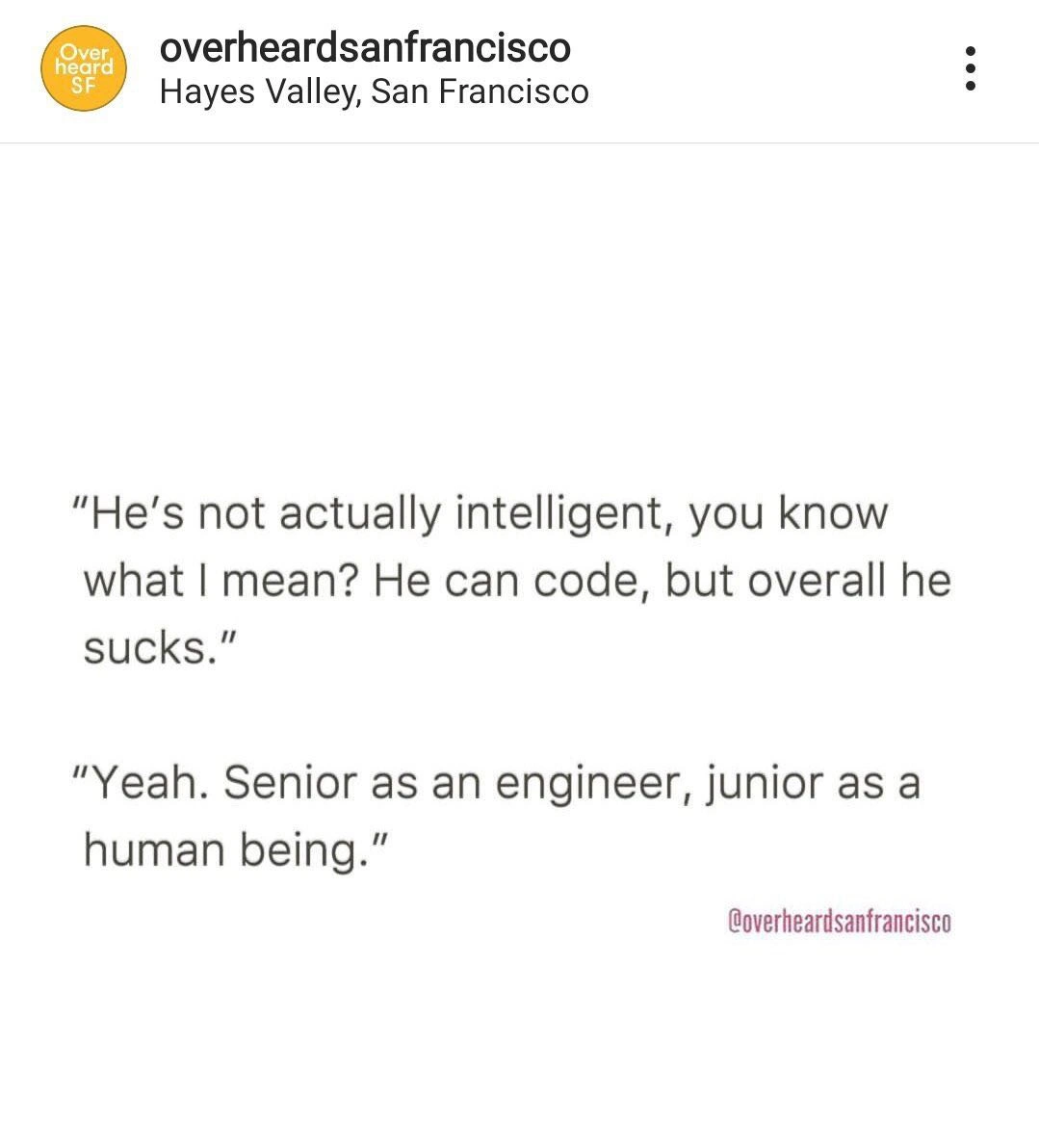
This meme is basically an overheard conversation highlighting the gap between technical skill and social skill. It shows two people talking:
Person A: “He’s not actually intelligent, you know what I mean? He can code, but overall he sucks.”
Person B: “Yeah. Senior as an engineer, junior as a human being.”
In simple terms, Person B is joking that the guy might be a senior developer (very skilled at coding) but he’s like a junior trainee when it comes to being a decent person. It’s a funny way to say he’s great with computers and terrible with people. The phrase uses job levels we know from tech – junior vs. senior – and applies them to human qualities. That contrast is what makes tech folks smirk and nod: we’ve seen people who are geniuses in Python or Java but still need remedial classes in basic respect.
Let’s break down some terms. A senior engineer is someone with a lot of experience in software development – they can design complex systems, write efficient code, and often lead projects. They’re usually expected to help guide others on the team too. Soft skills, on the other hand, are things like communication, empathy, teamwork, and patience. These skills aren’t about typing code; they’re about how you work with other humans. In a healthy team, even the smartest engineer needs soft skills to share knowledge, review others’ code kindly, and keep the project running smoothly.
Now, saying someone is “junior as a human” implies this whiz-kid coder hasn’t grown up when it comes to how he treats others. The first person basically says, “Sure, he can code, but he’s not actually intelligent in other ways that matter.” They likely mean he lacks emotional intelligence or just basic maturity. Being "intelligent" isn’t only about solving algorithms or math problems – it can also mean understanding people and making good decisions in everyday life. So the joke here is that this guy’s IQ (logic and tech smarts) might be sky-high, but his EQ (empathy and people skills) is scraping the floor.
Why is this funny in a developer context? Because it plays on a well-known stereotype in tech: the programmer who writes flawless code but acts arrogant or clueless socially. For example, imagine a senior dev who always finds the bug in seconds, but when a teammate asks for help, he rolls his eyes and says something rude like, “I can’t believe you didn’t know that.” Or during a code review he comments, “This code is garbage, were you even trying?” without any constructive feedback. Even if he’s technically right, that kind of attitude is hurtful and unprofessional. It makes other developers feel stupid or discouraged. That’s the communication gap here – he can “speak” in complex code, but he can’t communicate kindly in plain English.
In the tech industry, many companies now emphasize the importance of these soft skills as part of their corporate culture. They’ve learned that if someone can code well but can’t work in a team or treats others badly, it drags everyone down. There’s even a saying, “You can’t npm install good communication,” meaning you can’t just download a fix for a bad attitude like you’d install a software library. As developers move from junior roles to senior ones, they’re expected to improve not just their coding, but also how they mentor others, handle disagreements, and contribute to a positive team vibe.
Think of it like a video game: this guy maxed out his “coding” skill tree, but put zero points into his “teamwork” and “kindness” stats. So he’s level 99 in Java or C++, but still level 1 at basic human courtesy. The meme is poking fun at that imbalance. It’s basically a warning wrapped in a joke: being a great programmer doesn’t give you a free pass to be a jerk. The truly respected senior developers are the ones who write good code and help others succeed. So if you want to level up in the developer world, don’t just grind experience in programming – make sure you’re leveling up your people skills too.
Level 3: Brilliant Jerk Syndrome
Cue the eye-roll from seasoned developers. We’ve all encountered that colleague: a senior engineer who can refactor the entire codebase overnight but can’t refactor a single conversation without snark. This meme hits on a classic developer stereotype scenario: the brilliant jerk who aces the technical side and flunks the human side. It’s developer humor with bite because it’s painfully relatable – in some tech teams, technical intelligence rockets ahead while emotional intelligence lags in the Stone Age.
This quote pairing nails the communication gap perfectly: “He can code, but overall he sucks.” followed by “Yeah. Senior as an engineer, junior as a human being.” In tech lingo, they’re leveling up job titles to rank someone’s humanity, and it feels scathingly apt. We toss around titles like junior developer and senior developer all day, so hearing someone labeled as a “junior human being” cracks us up (and makes us wince) because it's a truth bomb about misaligned priorities. When pure coding prowess outruns soft skills, you get a brilliant coder who’s still operating at an entry-level of empathy.
Think of the contrast in terms any dev can appreciate:
- Implements complex algorithms but can’t implement basic courtesy.
- Optimizes code for speed but creates slow-burning resentment on the team.
- Knows every design pattern but has no pattern for basic decency.
- Thrives on logic but short-circuits during emotional discussions.
Being a senior engineer is supposed to imply leadership: mentoring juniors, communicating architecture decisions, reviewing code with patience. In a healthy corporate culture, a true senior elevates the whole team, not just the codebase. That’s why this meme stings – it calls out the guy who earned his title through raw programming talent but never leveled up his soft skills (the human side of the job). He’s got the Git commit history of a pro and the emotional maturity of an intern on day one.
Industry veterans even have a nickname for this type: the 10x engineer who’s −10x on teamwork. Sure, he might solve a gnarly production bug before breakfast, but then he’ll derail the 9am stand-up by belittling a colleague’s question. Tech folklore is full of these coding wizards who drag their team down – hence the famous “No Asshole Rule.” It’s management’s way of saying that one toxic “rockstar” isn’t worth ten solid developers who collaborate. Netflix, for example, flat-out rejects brilliant jerks despite their code prowess, knowing that teamwork > heroics in the long run.
That this snarky gem was actually overheard in Hayes Valley – startup central in San Francisco – adds an extra layer of truth. In the heart of the SF tech scene, even casual cafe chatter acknowledges the gap between code brilliance and basic decency. It’s a nod to the fact that our developer culture sometimes inadvertently rewards hardcore technical skills over empathy. And anyone who’s been on call at 3 AM with an “indispensable” engineer who refuses to help unless it’s his code knows exactly why this is a problem (been there, debugged that).
Ultimately, the humor here is a bit of catharsis for the rest of us. We laugh because we’ve all met the “senior engineer, junior human” and survived the fallout. It’s a reminder that writing beautiful code is great, but not if you make everyone around you miserable. You can patch a memory leak, but you can’t just apt-get install empathy. Some bugs aren’t in the code – they’re in the humanware, and those are the hardest to fix.
Description
A screenshot of a text-based post from the Instagram account 'overheardsanfrancisco', with the location tagged as 'Hayes Valley, San Francisco'. The post contains a two-line dialogue. The first line reads: '"He's not actually intelligent, you know what I mean? He can code, but overall he sucks."'. The second line is the reply: '"Yeah. Senior as an engineer, junior as a human being."'. The text is black on a plain white background. This meme captures a prevalent critique within the tech industry, particularly in hubs like San Francisco. It highlights the critical distinction between technical proficiency (being a 'senior engineer') and emotional maturity or soft skills (being a 'junior human being'). For experienced developers, this is a painfully familiar archetype: the 'brilliant jerk' who is technically skilled but whose arrogance, poor communication, and lack of empathy make them a net negative on a team, ultimately hindering collaboration and productivity
Comments
7Comment deleted
He can refactor a legacy monolith into a perfect microservices architecture, but ask for his input during a code review and he'll refactor your entire sense of self-worth
He can squeeze Kafka to sub-10 ms p99, but his empathy layer is still a single-threaded monolith that crashes on every edge case
The guy who can refactor a monolith into microservices but can't refactor his personality out of being a monolith
Ah yes, the classic 10x engineer who's a 0.1x human being. You can have all the algorithmic complexity mastery in the world, but if your emotional intelligence runs in O(1) while your condescension scales at O(n²), you're just optimizing for a toxic work environment. Turns out 'works well with others' isn't just HR fluff - it's the difference between being a senior engineer and being senior at clearing rooms
Aces distributed systems design, but his emotional API endpoints all return 404
Ships blue-green deploys flawlessly, but in conversations still prefers hard cutovers - SLOs for uptime, none for empathy
He designs elegant distributed systems, but treats people like stateless services - no retries, just dropped packets